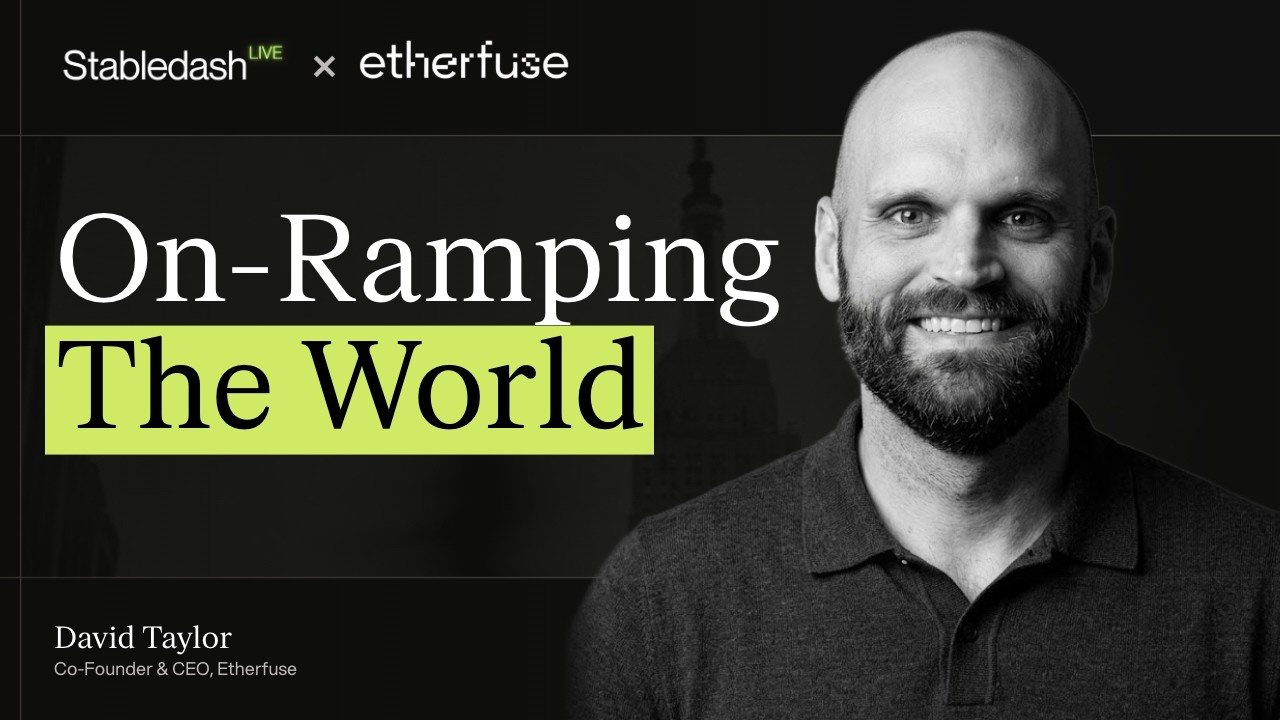
Zach Fowler of Stable Dash interviews David Taylor of Etherfuse at a stablecoin conference in Mexico City, discussing the company's work issuing local, non-USD yield-bearing stablecoins ("stable bonds") backed by on-chain sovereign debt. Taylor describes Etherfuse's five-year history starting in Mexico, its recent launch in Kazakhstan (completed in about three months versus a two-and-a-half-year process in Mexico), and its four-stage market entry playbook, noting the company operates in multiple countries and is fully AML/sanctions compliant. He explains use cases such as cross-border payments near Russia and China, recommends short-term Gilt-style debt products as collateral, and states Etherfuse enables free bank-to-on-chain conversions to eliminate FX costs. Taylor claims the company is now receiving inbound interest from governments and institutions, is working with roughly seven governments, expects to onboard around 40 new countries by year-end, and is closing a new funding round.
Transcript
31 turns, about 4000 words. Straight from the recording, so it reads like speech.

Zach Fowler
host0:00
Hey. We're back. This is Zach from Stable Dash. I'm sitting here with Dave from Etherfuse. Stable Dash live is sponsored by Agora, built for global institutions, moving money at the speed of the Internet. You can learn more at agora.finance. I mean, really, you're probably the first person that comes to mind, candidly, when I think of local stablecoin, non USD stablecoins. We talked about it, I think, 70% of the time yesterday, so excited to dive in today. And you're far from a first time guest.
I think this is good stable minded. Yep. Have you been on stable dash life twice? I think so. Yeah. It's my side. Yeah. You're you're climbing the ladder of most interviewed guests, which is great because you are kind of in a league of your own when it comes to what you you what you do with stable bonds. So we'll we'll get there. I wanna start with I mean, what's it like to be back in Mexico City? You kinda mentioned this is kinda like coming home. You've been here for five years.
David Taylor
guest0:52
You get to see this market mature. Like, how what's the biggest difference you've seen in the last five years? And Yeah. So this thesis that everyone's talking about now, we had five years ago, and Mexico was the first place we came. So we have multiple subsidiaries all over the world, and Mexico is the first. So or the first country that we launched and operated out of. So we've been here the longest. You know, the biggest presence of our team is here.
It's really awesome to come here to see it's like a a way to measure your growth each year. Yeah. And, you know, last year, this conference was like, wow. We kinda made it, you know, and not really made it, but, like, at least for somebody. You know? Yeah. And this year, you know, it's It's like it's like EtherFuse. Oh, I know you guys. Yes. Yes. And it's really nice, you know, because, part part of a startup is just
Zach Fowler
host1:41
trying to get your toe in the room, and then you're in the room, and then make money in the room. And, you know, and so I think the greatest thing is to see, you know, all the hard work we've been doing is paying dividends each year Yeah. And and measuring that against the year before. So It's funny you mentioned that, like, kind of feeling of, like, little bit, you start feeling like you made it. We have an adviser who's with us. We're kinda doing a team off-site, he's like, yeah.
Was at an event last night, I said I'm a stable ash, and people actually said this here. Yeah. I know who you are because, you know, we're barely two years into this, and we were here last year. And, again, it was the first time going around the circuit. LATAM's kind of been, like, your core core market. You obviously went to went to market with, the Mexican peso stablecoin. You've mentioned you I think you have five or six live, but you just went live with another one recently, you're telling me? Yeah.
So we just launched Kazakhstan.
David Taylor
guest2:30
And Kazakhstan was, I think, in a final evolution of our playbook that helped us figure out how to launch countries. So and end to end. So we, are now fully regulated. We issue Kazakhstani debt on chain, and we are, like, in the middle of building the ramps there as well. But what's interesting with Kazakhstan is we were able to take a lot of our learnings on how we engage with regulators and what we say and how we articulate our products so that we can ensure that everything we need to be able to do, we can do.
It also is very quick. Like, Mexico, when we started five years ago, it was a two and a half year process. You know? And so this is, like, our fourth country that we've been regulated in. We've entered other ways too, but Carlos was, like, three months
Zach Fowler
host3:22
Three months. End to end. So Like, first first discovery call. And so did they come in with was this a coal introduction? You met them at a conference, or was this a they came to you. They kind of had an idea of what they wanted to do, but they didn't know how to do it?
David Taylor
guest3:38
Yeah. So and and this might be some interesting to talk about too is, like, in the last, like, six to three months even, we are getting so much inbound from literal governments and institutions. And I think what we've done well is articulate a problem we're trying to solve, and it's a problem that they wanna solve too. And so, with Kazakhstan, we actually had them come out to us and say, Hey, we want you to help us issue our debt on chain. And so we felt a lot of confidence, You know?
I mean, it's just like anything you wonder who's wasting your time or not. You know? And so we felt a lot of confidence like, hey. We can do this, but the process can't be exhaustive. It can't be years. It has to be days. And they gave us they gave us a lot of confidence, but also they were buying Mexican debt from us just to experience the process. So we saw them KYB
Zach Fowler
host4:30
and KYC. So we're like, people are saying prompted that, or was that like, hey, we recommend you like, this is your zero to one.
David Taylor
guest4:38
Basically they saw what we were doing and said, we want you to do this here. And they made accounts and they bought assets to see what it looks like and feel. And so I felt that they were very serious. That you that must have felt like,
Zach Fowler
host4:51
we're doing something right.
David Taylor
guest4:52
It felt really good. I think what was interesting about this is we we met with everybody in the room there that has kind of like a a decision point, making this happen. Kazakhstan, and you might see this in other areas, there actually are two governments and two constitutions. Interesting. And you might see this in other areas too. It's a pattern where, like, a new government wants radical change. And so instead of changing the old system and uprooting things, they create a new one.
And so in it could be complex in the fact that we'd have to get regulated in both to do an exhaustive, approach, but it went very quick even to the point where we were meeting with the ministry of finance to recommend a debt type that works good on with on chain debt. So just as an example, you know, our assets get rated, and a lot of times people wanna know what's it collateralized by. Well, that becomes very simple if the debt product is very simple, if it's short term, if it's highly liquid.
And one of the things we recommend is is creating a debt product like Gilts, where it's a series with an I s like an ISIN that's that's fixed, and they just create a a new tap to it. So we can go to people and say, this is the type of debt we buy, and it will always stay the same. And so, I don't know if this is be clearly making sense, but the different debt issuances aren't changing. So I can clearly communicate to you, this is the product that is collateralizing it.
You can read a a prospectus on it, and, you know, in six months, that's not gonna change. Well, that's what I was gonna ask. Did you see the work that, Jason Animas and Blockworks were doing with the token alliance program?
Zach Fowler
host6:39
Well, so they're really going out there and obviously more on the on the token side of things, but saying, hey. How how do we give investors, you know, and the market clear standards for tokens and disclosures? Yeah. Is is there the equivalent of that right now for issuing sovereign debt on chain, or is it more like we think this is the best route right now and we're modeling this after existing, you know, existing tried and true models?
David Taylor
guest7:03
Yeah. I think our recommendations probably follow that pattern of saying the blockchain is a new interface for your debt, and it works differently than the traditional space. So how can we mold what what's worked in certain places and approve them for the blockchain? An example, just to make this kind of clear, is most bond issuances, they end and so you have to explicitly say, I wanna sell this and I wanna reinvest it or you pay someone to do that for you, like a a funds, you know, to roll it over.
Or you have an app like treasury direct where you click do this for me. Well, our protocol just does that inherently where it's inverse. Your decision to divest is the the action behavior, not your decision to reinvest. So I don't know if this is is making the most sense, but it inverts the, like, the activity that needs to happen. And so to create a bond product that supports that better is a short term product that doesn't change serial or series. So it it kinda matches the new interface. Yeah.
And and so we we kind of approach now we're working with, like, seven governments right now for new so Wow. Next next quarter, we'll have a few. We approach them to kinda articulate this, and none of this is new. Like, Gilts, I think, is probably our best model, the British, short term debt product of something that is a great collateral for a stablecoin. So we just articulate those points.
Zach Fowler
host8:37
Let's let's go back to I think the biggest question most people are gonna hear when they hear this is, why Kazakhstan? You know, we hear Mexican peso. We hear BRL a lot. We hear the euro. I don't think and, you I think we've seen a few, like what's the company? They're doing, like, rupees, I think, backed by gold. Again, so getting more activity in this region, what's, like, what's the use case for Kazakhstan?
David Taylor
guest9:01
Well, I'd say the mission statement for EtherFuse is to on ramp the rest of the world. So we don't really focus or think about Europe or the West too much. We focus about the underrepresented areas. So and I and not even like a a moral statement. It's just we see opportunity there. Yeah. And we have a protocol and a playbook that we can go and apply and on rapid. So Kazakhstan, why Kazakhstan? Well, one, they came to us and convinced us it would be quick and that they were interested.
I mean, the the second use case is they're very everyone there is is intuitively understands the need for stablecoins because proximity to Russia and proximity to China. So Russia is sanctioned, so they have family in Russia that they can't get money from. You know? They have. Yeah. And and so they understand, hey.
I need some way to talk with people who I know that I can't, you know, and true to so not that we support sending money from Russia or or whatever, but they understand the need to have some mechanism that is, independently sovereign and supported. And so stablecoins are, like, second nature to them. The other would be, you know, China is kinda a a wall fence for a lot of people, but there's a strong relationship and a strong gateway to China through Kazakhstan.
So there's a a two exchanges there, Case and AIX, and both have, partnership exchanges in China. So you can move money between China and Kazakhstan pretty easily Wow. Which is hard to do anywhere else. Yeah. I just gave away a lot of my secrets, but
Zach Fowler
host10:49
I was gonna say, yeah. You let us know if we need to change any of that.
David Taylor
guest10:54
Or the we we obviously we are I'll just stress. We're fully AML compliant. We follow all sanctions laws, but I bring that up to just put in your mind that we don't have problems with making payments or talking to relatives, but they do. So they understand the need for a more personally owned decentralized mechanism of interacting with finance.
Zach Fowler
host11:17
And so walk me through now okay. The stablecoin exists. What's next? Is the is there because I think you've we've seen, like, the Marshall Islands. There's, you know, the the government using the I think they have a I'm going blank. It's USDM 1, but I'm going blank on the company. And, you know, they're using that stablecoin for, you know, I think, payments with their universal income. Is is this are we thinking along those lines with how they're thinking using this?
Is this going into the consumer apps in in exchanges and more in the importer, exporter use cases? Is it still early right now, and the first step is just getting the currency on chain? Yeah. So
David Taylor
guest11:53
we are an infrastructure. Well, fundamentally, we offer FX and yield Yeah. Like, at its basin. But we wrap that up in an SDK for you to build products on top of them. So we don't necessarily build a stable coin. It is, but it's a yield bearing stable coin. We call it a stable bond. And we we believe that on top of this product, you can build anything in finance. And so we expose that to the institutions, neobanks, to startups in that country. And so what's next for us?
So once we issue the asset, we build the rails between it. So in all of our countries, the end goal, and and in half of them, we're live today. You can go from any bank account in that country to an on chain asset of equivalent value for free. Wow. So right now we are issuing from Kazakhstan, and now we are working with our partnership bank there, Halik Bank, to,
Zach Fowler
host12:46
to map a bank account to a self custody wallet in a compliant way, enable the community there to go from a bank account to, an asset for free. And then we'll on ramp the banks and and startups and things like that. What's the belief behind doing that for free? Because I think you could you could easily charge, you know, whatever, couple cent forex fee on it. And that's a big problem that I think a lot of consumers have in the market right now when they're going and swapping between that. Like, what's why free?
David Taylor
guest13:16
I just think it's the wrong place to make money. So we make money. We are now, in the middle of a lot of things. We're in the middle of your debt products. We are cheaper than a broker to get debt because we collectively bargain now for those assets. We are in the middle of your FX products. We now have an asset for lending and things like that. So we try to make money where it makes sense and not where we can. And so I think to make it free for us is to inspire growth and to become the infrastructure layer.
I think if we charged, we'd leave a lot of room for other people to to make it free. But also, think from a fundamental point of view, we see if people folks in these countries are going to start to rely on the blockchain as a primary financial infrastructure to go and buy a soda, that has to be free with except the cost of a soda. So, you know, credit cards are taken off right now. But if I use my I'll make them a fake name because I love all these people. Yeah. I'll use my Stablecoin card. Stablecoin card.
And he knows. And it's collateralized by USDC, and I'm in Mexico. That cost me the cost of the soda, but plus probably a 100 bitch on FX. And so we want those stable coin card issuers to use us because now we eliminate that FX cost and we make it more useful for everyday Mexican to use. So Have you talked to Stefan from Altitude?
Zach Fowler
host14:38
Yes. They should. Stefan is He had a call last last week when he was on stream. He's to say, call to non USD stablecoin builders. I was like, alright. I hope you and Dave are talking because because we've talked about this a few times now. And I'm for me, it's it's a very glaring, like, why if I if you see all the time on Twitter, hey. FX FX rates, FX rates, we're tired of these. Why aren't companies moving a little bit faster to to find that? Yeah. Probably because they make money on it.
So there's I'll put pressure on Steppen. They will use us. They're
David Taylor
guest15:10
going to use us. We're already talking. K. It's time to commit. It's good. Yep. Now we're close friends. Yeah. And we talked back at Sabocon too in in Amsterdam. I believe they will eventually use us for Mexico and Brazil at least. And, I mean, we're we're the intuitive. We unlock them quite a bit. I think they'll see that. And, you know, we're we're already talking to you now. They're great people. So I'm being kind of obnoxious here, but No. I mean,
Zach Fowler
host15:39
there's I think there's a place for this this in media and, like, building in public where I I like the call to actions. I actually encourage guests to do it more because it's like, hey. At the end of the day, you never know who's gonna see that that one moment. Or, again, we talked to we got two we've had over 200 guests. Like, at some point, when we ask you, what do you need? Who who are you looking to actually connect with? Like, we could probably help facilitate that. We hope at least we hope so. Yeah.
I guess kind of last question before we wrap. I'm going back to you mentioned in Kazakhstan, working with fill fintechs. Has your what's your kind of, like, go to market motion in kind of this virtual world when you're starting to get plugged into these developer communities in emerging markets? I was talking with Guillermo from Eldorado, and he mentioned, hey. In Bolivia, we're we're opening a brick and mortar for our business banking, you know, product.
David Taylor
guest16:29
I think we have four stages of entering a market. The first is as a foreign entity where we issue an asset Right. From a foreign country that's custodied in that country. Then we develop some revenues there, and then we enter on a partner's rails. So someone who has you know, most countries are real time payment systems now, so they have people who offer those through useful APIs. We do that, and we start to if if our rails start to work, then we start to build them ourselves, and then we become regulated.
So individually. So that means we open up a subsidiary there. So we have subsidiaries in a lot of countries. It does get quite complicated. So we wait, we, we go in through it through steps to ensure that we're seeing some response first. Now that's been a five year kind of outlook. Yeah. The last three months, we've had four or five countries reach out to us. And so it's, it's like speedrunning this process.
And it's, it's kind of taken our playbook and thrown it in the air where we're like, dang, maybe we go straight to regulated first. And then, And then the man will come like that. Yeah. We'll we'll figure it out. Cause if we, I mean, it took us three years to get a no action letter from Mexico, and it took us I have a bunch of stuff I could tell you about, but in one of the biggest countries in the world, it took us a week. You know? And you'll by the time this comes out, it'll probably be public. But Yeah.
Zach Fowler
host17:53
We'll talk about it then. Yeah. I was gonna say, well, you'll be on in the future, so we can save it. And and we're the only
David Taylor
guest17:59
company in that country that has this denomination articulated from a regulator. So, I think we've built a lot of trust. I think people see how we behave with other countries. We respect their culture. We respect their sovereignty. We respect their need to have control of it. And so I think the inbound that we're starting to see is, like, a dividend from the work we put in. And so that was our playbook before. Yeah. I think these next six months to the end of the year, we'll probably onboard 40 new countries
Zach Fowler
host18:33
because we've built that kind of reputation. Wow. I think that's a good place to wrap because I'm just thinking next time, like, can we go boots on the ground in one of these countries, like, with developers? That's kinda how we're thinking. Like, how can we make this show Again, we've been kind of siloed into geos. How do we kinda break out? And I think it'd be very interesting.
David Taylor
guest18:53
So we are I was just talking to a cofounder. We're likely closing a new round here pretty soon, and I wanna do something with you guys because I go in these places and I'm like, this is such an insane life experience. Like Yeah. I was in the Malmati. I mean, I'm kinda embarrassed to say this, but when I was there, I was like, I had never thought about this place four months ago. Yeah. You know what I mean?
And now it's, like, 90% of your your brain capacity between, you know, the work and We had a country, and this is embarrassing if you're very American, reach out to us and said, we're from this place. We want you to come here. And I was like, where? You know? And so that would be a cool place to bring you guys along because every country has a different characteristics of how they could apply stable coins Yeah. And why it's useful for them. And that's how we think about it, you know?
And so I would love to do some stuff that you guys probably help tell that story better than we That's
Zach Fowler
host19:46
where we we've talked. I mean, again, we get the chance to maybe get together in person three, four times a year, and it's okay. Hey. We like what we're doing. We like the interviews. How do we branch out from that? Can we get can we go talk to your customers? How much do they actually wanna talk? That's the side of the space right now that's almost not getting covered at all.
Like, even the MoneyGram and Western unions of the world, they're starting to come out, but it kinda took a while for them to get talking about them. So, obviously, follow that through to the government of Kazakhstan or or whoever's building with these stablecoins. But even the side of there's a lot of stories to tell here that are more than just product. Yeah. So I'm excited to talk more about that. So more to come.
I'm sure we'll have you on the next few quarters as as you go live and who knows how many more nations. But we'll be back shortly with more interviews from a stablecoin conference in Mexico City powered by Bitso Business. Dave, thanks again. Seven.
David Taylor
guest20:36
Seven.
Zach Fowler
host20:37
Call to action. You'll see a clip.