Stablecoin Conference · · 31 min
1Money Is Building One Vertically Integrated Stack for Stablecoin Payments
Brian Shroder
Transcript
45 turns, about 6500 words. Straight from the recording, so it reads like speech.
S0
0:00
Here we go. Alright. We're back for another amazing conversation. We are live here in Mexico City. We're with the one money team. I'm very excited about this. We've been, trying to get you guys on on a pod for a minute, and it's great that we got a chance to do it in person. It's always a little bit more fun when you get to sit down and place Yeah. Your So, Brian, Matt, thank you for the time and for tuning in here live. We're here in Mexico City powered by bits of business.
We're at the conference in partnership with Agora. StableDash live is sponsored by Agora, built for global institutions moving money at the speed of the Internet. You can learn more at agora.finance. And I'm really excited to just dive into what you're building. I know you guys have had such an incredible background. How do you typically start the intros with how you stumbled into this problem? When we first talked, I was extremely impressed with the go to market background and what you guys were doing before this.
Maybe maybe we start there. Yeah. So, you know, I came to crypto actually from fintech.
Brian Shroder
guest1:01
So, prior to, starting One Money with Matthew, I was CEO of Binance US for many years, overseeing, like, the second largest centralized exchange in The United States. But I came from Ant Financial, which is one of the largest fintechs in the world. And so I was leading Ant, helping grow payment companies all around the world. If you Google the world's first blockchain remittance corridor, that was our team. And so that was eight years ago. It was the first blockchain between Hong Kong and The Philippines.
And so I felt like there was still a lot of unfinished business, especially since it's been eight years since we launched it, and we still haven't perfected it yet. And so a part of OneMoney was,
Matt Shroder
guest1:35
focused on that. Yeah. And I also come from, web free and also traditional tech. So prior to this, I was the head of expansion and operations for Binance Global. And then before that, spent six years at Uber leading its central operations team. And so, you know, this is a space that we were passionate about. And although we have similar backgrounds and similar names in the companies that we worked for, we never actually worked together. Yeah.
And so, you know, it's always fun to start something with your with your brother. And so this is, this is our intent to to build something amazing together that we've always wanted to Yeah. So cool. What's it like building with,
S0
2:09
we actually had Wallopay on. Tom and his brother are cofounders. It's what's that like building this? What does it feel like building it with family? I I mean, I think it's great. We haven't ruined Thanksgiving yet, so that's that's a win for us. Mom hasn't mediated at all or anything along those lines. Did you guys know you wanted to do this eventually? Like, growing up and kinda being in careers for a while, like, you knew that this was coming?
Brian Shroder
guest2:32
I mean, I think we have, like, quite complimentary skill sets. So Matthew is, like, amazing at operations and execution. I focus a lot more on, product and business development, and so it's a little bit of yin and yang. And so, to do it with somebody that obviously you grew up with and trust, you know, we're not gonna have any founder disputes because then we would get in big trouble with mom. Yeah. So I think it's a forcing function.
Matt Shroder
guest2:55
Yeah. And we also come from the industry. Right? We both were at Uber for a period of time. He was at Binance US. That was Binance Global. He was in and financial. And so and, actually, also our own career progressions kind of, like, led us to this particular area that we're very passionate about. So I think that's also contributed to that. But, you know, unlike a a cofounder that you're meeting for the very first time, the trust is already there. Yeah. I can't get rid of him. Right?
Like, he he will continue to be in my life, and I think there's this element of, you know, he's one of the smartest people that I've ever met in my life, and so that's just, you know, the element of,
S0
3:29
you know, family plus a significant influence of trust. Yeah. Yeah. Yeah. So bring us bring us into what you're building. And specifically, like, when you were considering starting the business together, what were you really thinking about from first principles to go build? I feel like you with your background, with the resources to to capital, like, you guys probably thought through a handful of different things.
Like, why what why did you land on the one money, approach go to market wise and and maybe bring a sense of what that looks like right now. Yeah. So, you know, as we think about today's financial system, right, how money is moved is
Brian Shroder
guest4:09
the infrastructure that was built in the seventies. Right? So we're still using seventies infrastructure to move money globally, which is wild. Finance is one of the last, I think, frontiers that hasn't been completely disrupted by technology. And so our thesis is going forward, all of the legacy systems will effectively be migrated to Web three. So it will be money will be moved through a stablecoin or tokenized products and then blockchains. So that was the original thesis.
The entire TAM in terms of what's available is the entire, like, m two, m three money supply. So all of that will be migrated on chain in our belief. And so as we thought about One Money, what we wanted to do is we wanted to, match that ambitious vision of how the world will change with an ambitious product. And so what we are doing at One Money is we're trying to create really the first vertically integrated stack for money movement.
So our goal is to kind of be almost like the operating system for money movement across three different sectors, including orchestration, blockchain, and issuance. And so, One Money actually has three different products in those categories. So we have an orchestration business that is now live called 1money.com. We have an issuance business. We announced a partnership with mZero. OneMoney has kind of the same licenses as Circle in The United States, we can issue a white label stablecoin.
So if Coca Cola wanted to create the Coca Cola dollar, we can do that. And then the final piece, where we spend a lot of our intellectual capital is actually on, OneMoneyNetwork, which is our purpose built blockchain. So this is something that we've been working on for over two and a half years now. We filed about eight patents on this core technology, and the goal is to differentiate us from, like, a general purpose blockchain, optimizing for the stablecoin and RWA use case.
S0
5:50
Why do you think it's, the approach of doing all of these things kind of at one time together, what advantages does that give you compared to maybe some of the companies in the room who maybe just pick one of those things. Yeah.
Brian Shroder
guest6:06
Why take that approach? What was the the thinking there? Yeah. I think that there was a couple different efforts. So one is, like, the economics. Right? So Great.
S0
6:16
Announcement going on. We'll we'll awkwardly try to buy some time. Five, four. I don't think the noise cancellation is that good. Okay. There we go. So why all why all at one time? Yeah. So I think it's, you know, partially around,
Brian Shroder
guest6:36
economics and then partially around kind of, like, a go to market strategy. So on the economics piece, right, if you are, an orchestrator today, a lot of your cost structure is going to pay banks. It's going to pay blockchain fees. So you're actually a renter. Right? You're renting fiat space. You're renting blockchain space.
Our vision was if you're able to put this into a one vertically integrated stack, you can actually effectively guarantee that you will have not only the cheapest, but also the fastest because you're doing everything internally. Right?
The second piece is is that as larger corporations start to think about integrating, like, broader web three technology into their infrastructure, Today, if they wanted to, you know, use a a OneMoney product, they would have to go to, Agora or to, Paxos to do, like, their issuance, and then they would have to go have a conversation with Solana around how they're gonna move the blockchain. And then they would have to go have a conversation with, like, Bridge or BB and K in order to do orchestration.
So that's three different businesses that they have to coordinate. The, like, integration pieces are not smooth. So having kind of one fully integrated product allows you to just talk to one person, and and then that way we can customize a solution across all three of those verticals for you. When when you say purpose built, what does what does that mean? What what what is the purpose that you're building it for, do you think? Yeah.
So we we build this in order to be the fastest, the cheapest, and the most compliant for the, stablecoin and RWE's use case. So, some of our patents speak to kind of the core infrastructure. So one of the unique things about the OneMoney network is is that we don't have a a tokenized, guess, token. So you don't need a second asset in order to use the one money network. You don't have to go like, CFOs around the world don't have to go buy a speculative asset in order to power the blockchain.
So instead, how it works is you can pay fees in whatever asset you're, transferring or sending. If you're sending a Mexican peso stablecoin, the gas fee is collected in that Mexican peso. If you're sending a Canadian dollar stablecoin, the gas fee is connected into that, Canadian dollar. So we've built a what we call a pricing engine inside our layer one that is entirely configurable. And so it means that you never have to hold two assets in order to send a stablecoin. Right?
Where where else in your life do you have to pay with two currencies for the same transaction? It's actually quite weird. And then the last piece that is a part of kind of our our innovation is is that we are one of the first blockchains that can actually be entirely deployed as a SaaS model. So what that means is instead of paying, a per transaction gas fee, you can pay per month or per year. And then once you pay that fee, you get unlimited transactions on the network.
So you could literally do, you know, millions and millions of transactions, and it's still that one flat fixed fee. The idea for us is that we wanted to bring the marginal cost of sending a stablecoin down to zero. Because when you bring the marginal cost of sending a stablecoin down to zero, it actually creates new use cases that were previously too cost prohibitive to attempt. Yeah. So specifically things like around, high frequency micro transactions, and things like streaming yield.
Matt Shroder
guest9:35
Circle. Or or it's just AI payments. Right? So, basically, giving your agent the ability to transact as much as it wants without actually incurring additional costs if you're under a SaaS model. And so that's also an interesting use case that we've been, you know, very excited about.
S0
9:51
Another loud announcement. I wanted to ask about the specific, like, thought process behind the software model specifically and how that might compare or contrast to it seems like that's I I have we've never met a company building in this space who's taken that approach. It's actually very interesting to build you know, a payments business typically is, like, very focused on taking slices of volume and, like, building business models around that.
Speak a little bit more about how this this specifically is different than maybe the other approaches we're seeing with, yeah, other layer ones or systems like this. It seems really unique.
Matt Shroder
guest10:35
Yeah. So I you're you're you're referring to like the SaaS type model? Yeah. Oh, okay. Yeah. So, I mean, I mean, today, if you think about, kind of the general purpose blockchains, a lot of them are running on smart contract systems. There's a lot of expense related to those validators, but more importantly, you're powering those blockchains through speculative assets. Right?
And so if I'm an issuer who's issuing on a general purpose blockchain, I need to ensure that not only my customers have the stablecoin that they want to transact, but that they also need to have that other asset as well. And even when I send that, I'm paying in the, the speculative asset, but I still have a finality time that has to wait for, you know, maybe a few blocks to occur, and so it still takes minute settlements because it's running on top of smart contract systems.
If you are operating or you're building a layer one from scratch that's just designed to do payments and only one thing truly effective, which is just moving money, what you actually design in a layer one looks very different than how a general purpose blockchain is designed today. They're much more focused on supporting smart contracts, various use cases, bringing developers onto the platform. We just take a very different approach.
We fundamentally believe that the underlying technology of stablecoin and sort of the money movement on a purpose built payments layer one is where the industry has in in directly now is heading. And so we fundamentally believe that we can find our our niche and and a product market fit with a a blockchain that's, you know, intended just to do one thing incredibly well and be the best at that one thing, which is payments and money movement.
Brian Shroder
guest12:10
I also add that, you know, as corporations incorporate WebBreathe technology into their own platforms, price predictability really matters to them. Right? Now it's more in this experimental phase. But as you go to scale, like, you care about costs. Yeah. So in a world where, you know, BlackRock Builder is primarily, I think, distributed on Ethereum, Today, they're doing this on a daily basis. If you look back twelve months ago, BlackRock was paying $13.50 per user per day Wow. To distribute their yield.
So if you're building a larger product for a larger distribution, especially to consumers, you're not gonna be able to send somebody, you know, 7¢ in interest for today and then incur $13.50 in ETH gas fees. Right? And especially, like, for ETH, if you look through the last, like, 36 months, ETH gas fees has spiked all the way up to, like, $50 per transaction. Right? It's wild. So you can't really build a a sustainable or scalable product on that sort of cost structure. Yeah.
So that's why we took the first principle approach to designing it. It reminds me the the first principle nature of what you're building reminds me a lot of how the m zero team thinks about the world, and it's it's cool to hear that you you're working with them strategically to bring these stablecoins to life.
S0
13:23
Are there any other, like, aligned first principles companies or partners like mZero that are helping you guys stand up these three systems effectively that deserve to be called out at this point? Or is that, like, kind of one of the core the core pieces?
Matt Shroder
guest13:39
Well, I mean, maybe I can speak to the principles, but, like, one of our core values as a company is don't be a greedy financial institution. And so the way that we approach that in every single product is is how do we pass more of the value along? So if you just look at our orchestration platform, we're very different from other platforms in this space, specifically around our pricing structure. Yep.
So if I'm you know, the average, consideration for a business to maybe engage with the orchestration platform is I reach out to the orchestration platform. I have to speak to a sales representative. That sales representative then asks me how much volume I wanna move and on what rails. They then come back with a price, then I have to go through KYB if we directionally agree. We take a very different approach.
So we just publish our pricing online, and anyone can start a KYB application on our website, and and you can just onboard to to OneMoney's orchestration platform that way. And so we try to be For free. For free. Mhmm. And so, and the other thing that's so different about our pricing structure is when you ask businesses, you know, what is the pain point in the industry around how you price these types of, products and services, you know, I think the industry tends to kind of lean into this. Alright.
We're gonna have, you know, annual or, you know, two year contracts in which you have monthly minimum spending limits and all of these things. We actually take a very different approach where we price ourselves more like a like a banking model. Meaning, we don't actually charge for anything unless you're actually utilizing our service. And so what's so interesting about it is a lot of our customers actually come to us maybe early on as a redundancy, and they quickly realize that we're doing it faster and cheaper.
Mhmm. And then they start migrating their flows and things like that. And when a contract runs out, they, you know, prefer us at at the end of the day. And I think we've been able to grow a really, an interesting, segment of the population who, you know, initially in this region want to use, like, redundancy for U. S. Dollar virtual accounts, or maybe they want more liquidity providers as it relates to USC to USDC or USDT.
And then we've been able to kind of meet their expectation there, and then the relationship grows and grows and grows. And, eventually, we hope that it will touch all of our products, then kind of really deliver the value that we think a full stack experience should deliver when it comes to stablecoins. Yeah. Is there anything to call out given, you know, we're in Mexico City for this conference? Anything like thematically or regionally that you guys are seeing
S0
15:52
from your vantage point in in the stack that's like extremely relevant or valuable to companies in this part of the world or just emerging markets generally that you're seeing? You know, I think that, emerging markets are,
Brian Shroder
guest16:06
just faster innovators of technology because sometimes they can jump, right, like legacy systems. And so what we're seeing is places like Mexico and Brazil, there's much faster adoption of, like, stablecoin blockchain infrastructure into, like, even large corporations all the way down to small and medium sized businesses. And so there is a faster adoption curve, in these emerging markets than, say, like, a US.
A part of that was our thesis is that there was, like, a a hurdle in terms of having to sign, like, a twelve month contract, having to commit to, like, $4,000 a month Yeah. Without even doing your first transaction. And so we kind of took it upon ourselves in order to,
S0
16:43
create a platform for maybe the corporations or small and medium sized businesses that are stablecoin curious. Right? It's like going I'm I'm just giving your background. It's like, imagine if Uber like, when you downloaded the app or wanted to ride, they're like, okay. How many rides are you going on this year? Like, let's let's put you into, like, a very,
Brian Shroder
guest16:57
monthly committed models for this. Like, ridiculous. Like Sign up for a year, Uber. You're gonna pay us a thousand dollars a month. Even if you don't take a single ride, we're still gonna charge you. And, also, if you try and cancel your contract, we will sue you. That's not that's that's why we're so different. Right? We we are currently personally feeling this pain right now with a data provider that we don't use anymore, we don't need anymore, and, yeah, we're stuck paying this contract. It's ridiculous.
This doesn't it's not how you do it. I meant about, like, there's also,
Matt Shroder
guest17:24
sort of this reputation of traditional financial institutions of being the greedy financial institution. Yeah. Really trying to pinch the pennies. And and and for this industry to grow, you have to lower the barriers. And we fundamentally believe I think we all, this conference, believe that this these new types of money movement rails will ultimately become the default, but why are we kind of getting in the way of ourselves? And so I just think that we've taken a very different approach.
And it's not just our orchestration platform. Right? Like, we just talked about our layer one. Every single one of our products differentiates some way in the industry. But long term, we believe that, fundamentally, you can come in in any one of those products and have the ability to say, oh, wow. This is generating a lot of value for me as a business or as an individual.
Now maybe I wanna actually lean more into the, you know, stablecoin issuance side if I'm, you know, a business who's using orchestration and maybe capture more of the economic activity that I normally am losing to third parties. And that's where I think long term we really differentiate. Yeah. Yeah. We
Brian Shroder
guest18:21
we focus on trying to be like the Switzerland of stablecoins. Right? So we're happy to work with everyone because our focus is just at building the infrastructure on which, like, other people can build their own products. And so although we're vertically integrated, you don't have to use the whole stack. So if you only wanna use orchestration, great. Right? We support a variety of different blockchains. We support dozens of different stablecoins. If you wanna only use the blockchain, also great. Right?
We can support you in that capacity. Or if you only wanna issue a stablecoin, we can do that as well. How do you,
S0
18:49
how do you make that like, what what have you seen? So something I'm I'm noticing is, like, because of the maybe the infancy of the market right now and what everyone is trying to build is is such a big deal. There's such a, everyone is kind of coop coop the coopetition is so felt right now in the infrastructure stack.
How how do you you know, frankly, just from my perspective, it seems like you guys can just dunk on so many of these companies in the room because of how you've approached the problem, and you probably will because of that. But how do you, like, also play nice with them? So I think that coopetition is the best way to think about it. The the
Brian Shroder
guest19:35
truth is is that this is actually the model in fintech. Right? So PSPs for decades have been working with each other. Some PSPs cover, let's say, the Africa the Africa corridor, and then they don't cover Asia, so they partner with another PSP. And so they actually change volumes. And so as our industry evolves, like, this same sort of model that exists in fintech is is is, starting to behaviorally be incorporated into our, our partnership models. Yeah. And so a lot of these companies here, we actually power. Right?
So, they use parts of our infrastructure throughout kind of the the broader ecosystem. You might be using OneMoney and not even know about it. Yeah. And we're okay with that. Right? Because we wanna be the infrastructure underlying money movement. Yeah. We wanna be the plumbing for sure. I also think that we've just also taken a very different approach historically,
Matt Shroder
guest20:21
especially in places like The US. So we have money transmission licenses here in The United States. A bit about that. Yeah. We we I mean, we, started this process more than, I guess, more than two years ago. Yeah. And so when we when we incorporated, the first thing we did was start on our money transmission wise process.
S0
20:37
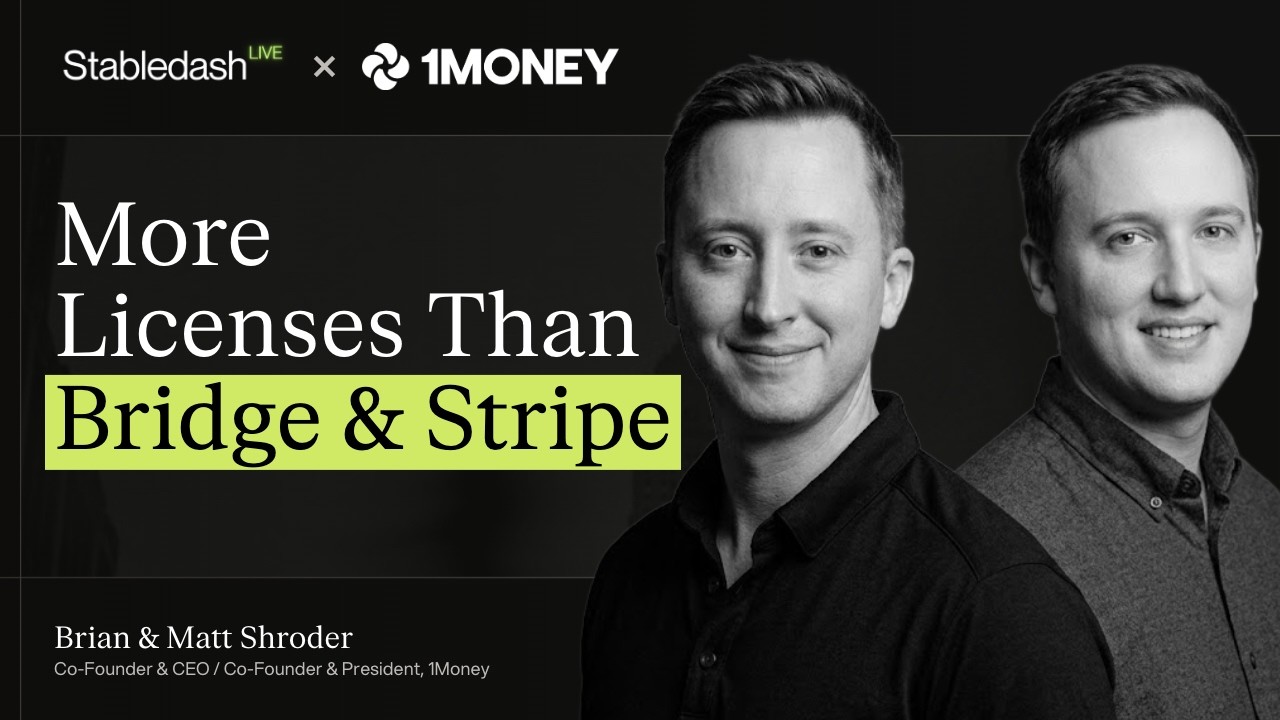
And so That was our first impression of you guys. We were like, who is this team? Levi's, like, more licenses than what what was the one liner? I think that was my first impression of you guys. Licenses than, Bridge Stripe Bridge and BB and K. Despite the fact that we're, like, three or four years younger than them, we've actually surpassed them in terms of regulatory footprint in United States. You've never gone on a podcast where, like, who is this team? Like, what what is going on?
So speak, yeah, speak about that strategy. Why why was that so important to you guys to do so early? The US. Right? We also have many other jurisdictions like the other notable one that we have that we've been very public about is our Bermuda BMA class f license, which is also, like, the same license that, you know, Circle and Coinbase use to operate a lot of their international entities and and operations.
Matt Shroder
guest21:17
And so we just have always taken the approach that, like, licensing and compliance is a huge part of our, our long term competitive advantage. Mhmm. And especially in a world where stablecoins are, you know, very hot in the emerging markets, we have become, in many ways, like, a a really good partner for a lot of these emerging market, like, financial institutions to have access and have broader ways to engage with US companies or, U US rail systems. Right?
And so, especially in this context of this conference, right, a lot of folks, do use OneMoney as sort of the infrastructure plumbing for US based rails and fiat and stablecoin activity. And so we're very lucky to kind of build that differentiation because these things are massive investment, and they take a lot of time.
And I think a lot of, companies don't necessarily have the time or maybe the resources to invest, and we've just been very lucky to recruit a very seasoned, leadership team who have done this many, many times before. I think this is Brian's fourth company with money transmission licenses. And so this is a process that we know well and a regulatory group that we know well as, too.
You know, long term, I don't see a world where you can operate in this space and not have sort of direct access to, you know, fiat rails or have these close relationships. And so this is always something that we're investing in. Yeah. And and I would also say that, in terms of, like, public facing, we just are very different,
Brian Shroder
guest22:37
in many ways from other, like, web three companies because a lot of Web three companies, they're focused on hyping, right, because they have a token event. And so they're building towards this token event. That's usually how, like, the founders and the employees cash out. It's usually how the investors cash out. Our, you know, core principle around the OneMoney network is you don't need a token in order to use a blockchain. And so we don't have a token.
Our focus is actually on building an infrastructure that people use at scale. And so we didn't have to engage in, like, the hype cycle because it's not a part of how we, like, monetize the the company or the business. Or measure success. Or measure success. Absolutely. Yeah. It is interesting, like, you know, as a participant of the of the yeah. You're like,
S0
23:18
you know, I I have some Canton coin. Like, I I think Canton's a very interesting project and and company, and what they're doing is so interesting. But, like, you know, it's I'm like, what is the relationship there? Like, between the asset and the success of that that organization. It's just yeah. It does it doesn't really seem clear or Yeah. Very integral to the business. So that makes that makes a lot of sense why you're thinking about that. But but, also, it's not, like, super,
Brian Shroder
guest23:42
scalable. Right? So, like, the ARC network the ARC network, Circle's network. Right? In order to, power that, you have to pay gas fees and USDC. Right? My guess is Tether will probably never issue Yeah. On the ARC network because then you would be sending USDT and having to pay fees in USDC. So, like, structurally, that is the only accepted gas token Correct. In ARC? Yeah. Yeah. Yeah.
And so if you're a Mexican peso stablecoin, right, and you wanna, choose a blockchain where your Mexican peso is moving around, do you wanna go with Arc? Because every transaction you have, you are requiring your users to also hold a competitor product or, at the very least, USDC.
Matt Shroder
guest24:21
So we built it differently. Right? So you only need to have one asset in order to use the blockchain, and it's whatever asset you're bringing to it. So, differently, we we we built the arc for every stablecoin. Exactly. Yeah. So any stablecoin can have their own Hemis network now, and that's long term where we think we really differentiate. Yeah.
And not to mention what you're able to do when you have these stablecoins that are minted on your network because now you can utilize sort of the the true value of, like, the atomic swap and having an on chain FX transaction with this zero counterparty risk. That's an amazing world. I hope we get there soon. Yeah. You're actually, like, building what
S0
24:53
Internet for money requires. Maybe, like, last question. I know we gotta wrap here in a minute. What is the most underestimated part of the business for each of you? Like, when you think about when you kind of are, like, you know, having the late night calls or syncing on the weekends or just, like, don't know, eating you're eating glass and growing, and you're like, what are what are these things that you lean on that you're like
Brian Shroder
guest25:19
For me, personally, it's the actual, like, full integration of the stack, which we haven't even shown the world yet. Yeah. So I think that once the pieces start to come together,
Matt Shroder
guest25:29
having all three of those components in one product, I think, is gonna be, game changing. Yeah. I I I don't wanna cop out and say the same, but, like, that is what we built this for. Right? It it it is for all of these business units to work together in one cohesive product. And and it's a big vision. Everyone says it's a bold vision, but, like, we can't wait to actually demonstrate how all three of them do because it is a magical experience.
And if you look at each one of them in sort of silo, you can see why the others are just so complementary. So for let's use the issuance as an example. Right? Historically, issuers would issue their stablecoin in their local market, and then they would go around and try to basically beg exchanges for listing. We both come from the exchange side. Side. I always begged a lot. Yeah. I'm gonna know what that's. Yeah. Exactly.
And so, you know, you had to do all the hard work of issuing, and you had to, you know, make sure that your smart contract was ready, you had your audits, etcetera. But then had to pay fees. But then you must have to go pay fees in order to exchange for this list. And then Yeah. And then you also are picking the networks, and you have to engage with the networks. And so imagine a world where now, you know, you can issue on, with one money. You're already listed from day one. Mhmm. Mhmm.
And and you already have a network that will be supporting the other networks that you have. And so you can start to just get a a glimpse of what the magic is that will be. Yeah. And that's what we're that's what we're really excited about. And you get, fiat on and off ramps globally,
Brian Shroder
guest26:50
both, you know, US dollar as well as domestic solutions right out of the box. So it's it's just a very different model. Yeah. It seems like in the next one to three years, the micro payments
S0
27:00
agent focused commerce use cases are one where we are really excited to, like, cover what's happening in that space. And I feel like we have really not experienced the possibilities of that because these systems haven't worked effectively. They have, like, been so piecemeal. But now it's like we have all of these Agencik tools paired with, like, and maybe we can speak on this quickly. I know it sounds like that might be top of mind for you guys. Like, what are you seeing?
And now that these three areas can work seamlessly together,
Brian Shroder
guest27:32
what are you seeing or what are you excited about with some of these new applications or new primitives for for this conversation? It goes back to the first principle approach. Right? So a a few of our the patents that we filed were actually speak to Genetic and AI payments. And so when you take a step back, you you don't want to have your, AI agent have to go into a marketplace to buy gas fees in order to make it work. Right?
You don't wanna have to have an AI agent make sure that each of the wallets that it's engaging with has just enough gas in order to actually operationalize the transactions. And so, like, this is what we built this for is is being able to, you know, operate in a gasless environment without having to worry about fees, without having to worry about what secondary asset you need in order to even make the thing work. Yeah. Are these patents
S0
28:16
private or public? Like, was there a way we can see them, or is it private right now? So we we haven't,
Brian Shroder
guest28:22
announced kind of each of these patents. I think that the goal for us is as again, going back to how we're very different, we only really like to announce products when they are perfect, live, and working. So I I I always grew up with, like, as Makes sense. Not many people get that. Exactly. Exactly. So I always admired, you know, growing up like Steve Jobs. Right? Where it's like, let me demonstrate this amazing technology. And, oh, by the way, you can go buy it on our website in an hour. Right?
Did you see the David Protein
S0
28:49
launch with the the Steve Jobs mock up? No. Shout out. Go the Dave the have you heard of David Protein? The bars the, like, gold protein bars? So they came out with, like the whole thing is, like, protein to caloric ratio, and it's, like, the best protein dense food on planet Earth. It's Tia Tia is sponsored or is an investor in it. Peter Otti. Okay. Yeah. Yeah. But the guy who started RXBAR is, like, behind it, and they came out with COD. It's, like, their new product line is COD, like, tinned COD.
And they did, like, a whole mock up on like, he came out on stage in, like, the black turtleneck and did did, like, a a tech feeling release. Like, the the the the gold cod was, like, rotating. It looked like an iPhone. It's beautiful. So well done. Anyway, it was it was perfect. It was a perfect product launch. It was ready. Yeah, guys. This was fun. I'm one, I'm excited to just get to know you guys more, follow the journey.
What is the there's a lot of, like, stuff that is awaiting, like, building toward perfection, but, like, what can we practically expect from the team, like, into the end of the year with, yep. How are you approaching kind of getting the world to know more about you? Like, what can we expect? So right now, you can go to 1money.com,
Brian Shroder
guest30:03
the number 1money.com, and you can apply for an orchestration account for free. Right? We don't charge an application fee. We don't have minimum monthly commitments. We don't have minimum monthly fees. So you can experiment with stablecoins on and off ramps. Right now, it's, you know, cheaper to buy USDT through us than, like, Coinbase or Binance or OKX. And so you can check it out.
Matt Shroder
guest30:26
And then in the next, upcoming months, we should have announcements around kind of the, stablecoin and the, the blockchain side. So stay tuned. In addition to some other partnerships that we're gonna announce. Mhmm. Yeah. Cool. But we're really we're really excited. I think this is last two years have really been building the infrastructure for this moment around all three of these pieces kind of coming together.
And I think in the next, call it sixty days, you'll start to see some of that that cohesion, and that's what we've been working towards for the last two years. So I think this is the year, the orchestration business is off to a a massive start. Like, we're really excited about the volumes that we're seeing just in the first four months. But, you know, we're really also excited about getting these other units off the ground and and and altogether.
S0
31:04
It's incredible. Yeah. Matt, Brian, thank you guys. Thank you much. And when in the next sixty days when these announcements come out, we do the show virtually Tuesday, Thursday. So love to have you back. It'll be fun. Cool. Thank you so much for having us next year. Yeah. I'm I'm long overdue, but we made it worth it. Alright. That was our chat with Matt and Brian from one money. We're live here in Mexico City. We're gonna take a quick break, and we'll keep it going after this.


