Stablecoin Conference · · 33 min
Inside Brazil's New Crypto Licensing and Compliance Rules
Caio Barbosa
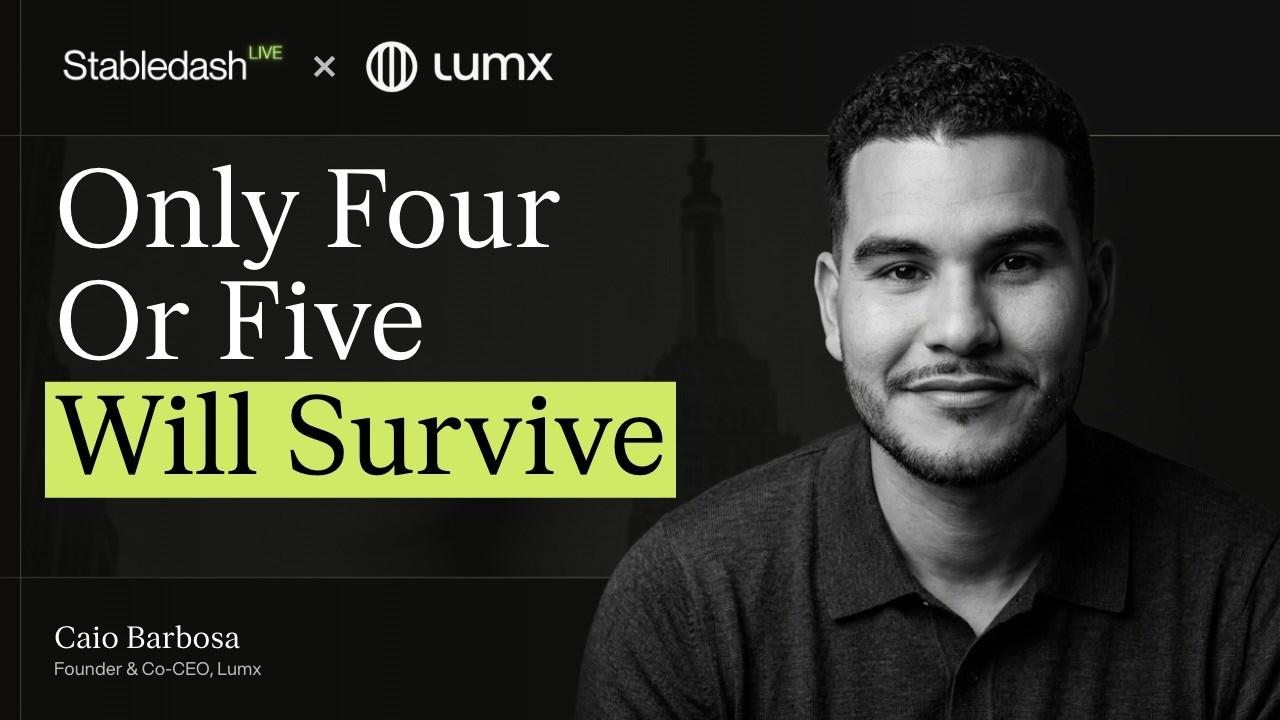
In this StableDash Live episode recorded at the Bitso Business Conference in Mexico City, the host interviews Kyle (Caio Barbosa), founder and CEO of Lumix, a Brazil-based stablecoin API for cross-border payments. They discuss Lumix's three use cases (B2B import/export payments, corporate treasury management, and neobank accounts), its partnership with and investment from Brazilian bank BTG Pactual, and an embedded-finance example with logistics SaaS customer LogComX. A major focus is Brazil's stablecoin regulation, including the central bank's three resolutions, licensing categories (intermediary, custodian, exchange) with capital requirements from roughly $2 million to $3.5 million, the October 29 application deadline, the IOF FX tax increase from 0.38% to 3.5%, and expected market consolidation where banks and a few well-capitalized players are positioned to survive. Kyle also mentions Lumix's $3.4 million seed round in October 2025 plus an unannounced extension, and notes players like Conduit have left Brazil due to regulatory barriers.
Transcript
45 turns, about 6100 words. Straight from the recording, so it reads like speech.
S0
0:00
Crazy that it's almost a year ago since we were in this booth, at Stablecoin conference number one. But if you're just tuning in, this is StableDash live. We're we're streaming live here from the Bitso Business Conference in Mexico City. We're here again with Kyle from Lumix. StableDash live is sponsored by Agora, built for global institutions moving money at the speed of the Internet. You can learn more at agora.finance. Man, it's good to it's good to be with you.
Why don't we start with, for those who are just meeting you, your your quick intro? And then I'd love to just dive into, yeah, what you're what you're seeing right now on the product side, and it sounds like there's some, like, regulation focus top of minds. I think what I'd you know, first off, if you're watching this live, stop watching it live and go back to the master class that you gave last year on Pix.
I think that, like, that was such a amazing understanding of, like, the Brazilian payment infrastructure and the landscape there. So go leave, go watch that, and then come back.
Caio Barbosa
guest0:57
But, yeah, man, give us give us the intro, and we'll love to hear what's top of mind. Yeah. Of course. Well, first of all, happy to be here again. It seems like a decade ago. Too many things that does. This year. Right? Crazy. That's crazy. But, yeah, for the for those who don't know me, I'm Kyle, founder and CEO at Lumix. Lumix is a stablecoin API for cross border payments based in Brazil, Rio, to be specific.
Today, we basically have an API that enable businesses to collect, do payouts worldwide, and also enable named accounts because that it was for their users. So we serve three main use cases up to this point. Right? The first one is b two b payments, so mostly imports, exports, supply payments out of LatAm to the world. The second one is treasury, so we serve corporate, businesses that use our infrastructure to move money between their international accounts, right, in a more streamlined way.
And finally, we also support, nil bank use cases that are giving global accounts or local currency accounts for global users to spend worldwide. Right? And one cool thing about us, which makes us very different, especially in Brazil, is that we are the only stablecoin player who has a bank, in the cap table. Right? So we have one of the largest banks in Latin America in our cap table.
It's called BTG Pacto, which basically gives us a very strategic alignment and a very unique position in Brazil, especially now that we are being regulated. Right? So, yeah, I think that's it. What advantage does that give you having BTG on on the cap table? Like, what what has that accelerated or unlocked for the business so far? Being honest, I think, like, two main things. Right? The first one is that, BTG now, when it comes to Brazil, is our main liquidity provider.
So we connect them, so we connect through them to get access to, stable kind of liquidity. So instead of using, I don't know, OTC desk or exchanges, we get this directly from the source. Right? Because, of course, those guys then use the bank. We are directly with the bank. So definitely helps when it comes to, liquidity and debt and, of course, pricing. Right? So we can be very competitive in Brazil specifically. And on a more, like, broader aspect, of course, this definitely helps on the branding side. Right?
Because credibility credibility. Equity. Exactly. Sure. Because when you look at our customer base, like, 90% of them are, let's call it, mainstream businesses. Right? Web two companies, fintechs, and platforms that don't necessarily understand what we are talking about here. Yeah. So what they want is someone they can trust. Right? And if the bank of the size of BTG had trust us, why won't they? Right? So this definitely helps on the sales side. So Yeah. How did you originally,
S0
3:32
get them to trust you? Like, how did that relationship
Caio Barbosa
guest3:35
come to be? And and, yeah, it seems like a huge unlock for the business. Yeah. It was funny because, you know, for those who don't know me, now I'm talking about stablecoins. Right? But, Lumix actually started out in 2022 as a tokenization platform. So we used to tokenize literally everything, like Yeah. Tickets, carbon credits, real estate, like, everything. And back in 2022, in Brazil was kind of this movement of CBDCs and it's a nice economy, right, from the central bank.
So all the regulated players are trying to figure it out how will we use blockchain to tokenize whatever. Right? And BTG was one of those players, so they were looking for, a blockchain infrastructure provider that could help them, at some of the initiatives. Right? And we kind of became this player, at first mostly on as their partners slash infrastructure providers. Yep. And this has actually evolved to them being you know, wanting to invest in the company. Yeah. Okay. So you have,
S0
4:30
you know, you've evolved obviously from that, like, tokenizing a lot of different things to tokenizing money and a lot of the infrastructure that has to be around tokenized money to be you have utility to work to serve businesses. You said those three areas. I wanna go back to that. Go back to those three, like, key use cases, and I'd love to, like, break down
Caio Barbosa
guest4:53
break down each of them. And and I'd love to, like, maybe if you have top of mind examples or real, like, pain points that each of those three areas are solving, that would be great. So what what were those three again that you said? So B2B payments. Right? And what in B2B payments, I mean, on our perspective, in our use cases, sorry, most imports and exports and supplier payments. Like that. Right?
The second one is, treasury management, so corporate businesses using our infrastructure to move money into their own accounts, like, globally. And is that a front end that you've created, or is that embedded within, like, other systems? So, our core is the API, raw. Right? But we also have a front end. Be honest. It's not that friendly for non tech So most of the most of the companies in bucket two are using the API? Is that? Okay. Yeah.
We're now actually improving our dashboard to make it even better, but up to this point, it's mostly API driven. Right? And is that meaning that, like, Linux is embedding that API into
S0
5:50
other fintechs platforms or, like, maybe for let's let's go back to one and two and, like, any examples would be great. So, like, go back to the b to b use case. Like, what's the business right now that's using this? What does that look like? Yeah. Give us, as as just clear clearly as possible,
Caio Barbosa
guest6:07
maybe the before the before and after of working with Lumix. Yeah. Like, one very cool use case that I like a lot, we have a customer that's called LogComX. Right? And t r d r is that they are the largest SaaS for imports and exports in Brazil. So before entering this new financial wave, they used to serve, lots of ex importers and exporters, for supply supply for the whole supply chain management. Right? So those businesses use this software.
S0
6:36
I think we talked about this before. They use this software to run their business in a nonfinancial way, just like like data and and Yeah. Systems. The the shipments Yeah. In your So it's logistics platform sort of. And so they so you guys keep going. You've embedded within there, I believe. Right? Exactly. So recently, on q one of this year, they officially launched the the product, which is basically a global account
Caio Barbosa
guest6:59
for those importers and exporters. Like, they serve mostly importers. Right? So Brazilian businesses that are imported from Chinese, for example, exporters. So the main use case on their side is now that these importers have had now a global account that can use to pay out to their, offshore exporters. Right? So, usually, flow funds is they do a non ramp, like, from BRL to a stablecoin to a dollar to a stablecoin. Right?
And then through this custodial wallet that we serve them, they can then pay out to a USD named accounts that were created for them too to the Chinese exporter, for example, like, Hong Kong or China itself. Right? So this is their main use case. But it goes both ways. Right? For the exporters, it's the opposite. Right? So now they have a dollar account so they can collect payments offshore and bring them, home. Right? Yeah. It seems for me, it seems like a really, really powerful position to put,
S0
7:52
to to equip the software layer with financial tools because I feel like so many companies like so like like the ones that we're talking about have existing distribution and existing commercial relationships that are really sticky and they're really embedded, I'd imagine the importer or exporter that's using this software is, like, pretty reliant on it and very, like, connected to it. And before working with Lumix, was this company doing financial related?
Like, were they offering financial services within the system in other ways, or was this the first time they've introduced? First. So it's like now, you know, talk a little bit about what tokenized money in these types of tools. I mean, that is a huge unlock for for companies because you're essentially able to turn software businesses into financial services companies. How how has how have you seen that maybe specifically with this use case drive new revenue? Like, what's the impact of that for for this company?
Yeah. It's huge. Right? Because it's, embedded finance at its finest. Right?
Caio Barbosa
guest8:55
Because now we haven't seen of course, like, embedded finance is not new. But now with stablecoins and this new infrastructure, definitely enables businesses to launch global products very fast. Right? So for them, for example, like I mentioned to you, their business model were pretty much like a SaaS business. Right? Subscription, some usage basis fees, and all those things.
But as you can imagine, especially in Brazil, when you look at the whole, like, FX volume that all the players do in Brazil, if I'm not wrong, around 60 to 70% of the whole FX volume Brazil is related to imports and exports. And these guys, before doing anything with financial services, they already serve one third of the whole Brazil volume. Right? And they didn't capture anything of it. So as you can imagine, the, you know, addressable market for them is huge. Like I mentioned, the customers are already there.
Right? They already use the platform for everything. Why not also move money, with the with the platform? Right? So the growth have been has been great on their side. Of course, it's not all good, right, because there's still some education. Because as you can imagine, these important exporters, they are used to using their traditional bank accounts that they have for fifteen years. They know the people there. They kind of not know what is Stablecoin, and these guys are really trying to push. Okay.
You are you're actually using stablecoin. They're not trying to hide it. You know? Oh, really? So That's it. Why do you think they took that that position? Because in the Brazilian market, the bubble really popped. So people actually know what is a stablecoin. Right? Of course, not as us because they don't live twenty four seven like we do. But, what I'm trying to say is businesses are actively looking to have access to a stablecoin. They want to hold balances in stablecoin. Right?
There's a desire and a demand for that. Exactly. What do you mean when the bubble popped? What do you mean by that? I mean, that it's not only Us crypto slash saber coin bros that talk about this. Like, literally, you can have a very traditional business right now, especially because of the taxes in Brazil that affects taxes, the IOF situation.
S0
10:57
Can you can you dive into that a little bit? What do you mean by that? Yeah. The because, like, in Brazil, there's an FX tax which is IOF.
Caio Barbosa
guest11:04
Right? Which is basically every time that you do a FX transaction in Brazil, depending on the nature of the transaction, you need to pay a tax, right, which is called IOF. And, usually, the the the IOF has been going down and down because there there was, like, a huge government strategy for the IOF to actually be zero by, 2030, if I'm not wrong. Right? The problem was last year, because of the no government and all those things, it went the opposite. So IOF was, from 038% to 3.5%. So almost Wow. 10 x. Right?
That's huge. So, basically, the main issue, as you can imagine, is everything got market expensive. And the TRDR right now is most of those businesses that were were doing traditional FX, they're starting to do this using stablecoins. Right? Basically, because with stablecoins in Brazil right now, of course, depending on how it is structured and how you design it, you can basically operate without the IOF in this aspect. Right? Mhmm. But mostly
S0
12:04
So stablecoins as a as a core techno technology primitive has allowed businesses or users to avoid that that tax.
Caio Barbosa
guest12:16
Yeah. I I I don't like the word avoid because this might seem like a best thing. Sure. But, actually, like, what this enabled is since now stablecoins as as virtual assets are now kind of perceived as money Yeah. Businesses started to accept to receive payments in Right? So it's not that rare for you to find, for example, a business in Brazil that is paying someone else in Hong Kong using stablecoins. So the the the the receiver is actually getting receiving the payment in stablecoin directly. Right?
Of course, especially after the regulation came in Brazil, it's not it's not like, black and white. Right? Because, of course, Stablecoin is kind of, kind of are replacing FX in Brazil. So if you need to pay taxes on FX, like, you cannot just use stablecoin and avoid the taxes. Right? So now the market is regulated, so every all the players are adapting
S0
13:11
and making sure that, you know, we are a 100% compliance with with what's inquired from the central bank, their IRS in Brazil. K. I know we said we were gonna go to, like, do one, two, three, but I know I've I've derailed this so bad. Of course. But just since we're on the topic, like, what what do what do we need to know about the reg the state of regulation in Brazil? It seems like there's been a very, like yeah. Like, misunderstood up and down. Like, what what are you seeing right now?
Like, what what what does the world need to know about that? Like, what's actually happening? Is it good? Is it bad? Seems seems a little bit unclear right now. Yeah. So for context, so Brazil has kind of not regulation, but, like, a direction
Caio Barbosa
guest13:52
in virtual assets since 2022 to 2020 sorry. '21 to 2022, which was kind of like a general regulation for the virtual assets industry, but nothing actually, nothing was actually defined. But the main thing that this regulation did was to put the central bank as their regulator. Right? So the central bank was the the only one who will be responsible to regulate virtual assets in Brazil. And last year, in in November, finally, the regulation came.
So the way Brazil did it, it was, like, the central bank published three resolutions, Resolution five one nine five two zero five two one. Right? These are the resolutions. Not gonna remember that. But No worries. Good job. And the issue is, like, there each resolution kind of defining a a few things. Right? So for example, resolution five zero five zero one nine, define what is advanced. Right? What is considered advanced in Brazil? Which categories can you be in? Right?
So in Brazil, now we have three categories, essentially. So it can be intermediary, a custodial, or an exchange, which is which is like a combination of intermediary and custodial. Right? And depending on the category of the license that you want to apply, of course, we can offer specific numb list of services or products. And, of course, it it is more expensive depending on the type of of license that you want to get.
So for example, the first license, which is intermediary, the capital minimum for you to actually apply and only exist is $2,000,000.
S0
15:23
$2,000,000 to just get that bill just exist.
Caio Barbosa
guest15:26
Just exist. Exactly. Okay. Insane. And it can go up to $3,500,000
S0
15:33
depending on the type of license that you want to apply. And does that even does that that doesn't even necessarily guarantee acceptance. That's just the application. It's like an application fee? You need to applicate.
Caio Barbosa
guest15:43
You need to apply. Sorry. But it's not like a a fee that you pay for someone else. Right? What about the other ones? Are they also expensive, the other two? Yeah. So it's starting out at at 2,000,002 million dollars, which is 10,000,000 reais. Right? K. And it can go up to 80,000,000 reais. Right? So around $3,500,000. Just for the first one? Just for the intermediary? No. Just for the for the license. So intermediary is the $2,000,000. Right? Custodian, around 2.5.
S0
16:12
Another 2.5. So now we're at 5,000,000. No. No. No. It's
Caio Barbosa
guest16:15
you you choose
S0
16:16
one. You have to choose one. Yeah. So you can't you can't be multiple? Yeah. Because if you are intermediary,
Caio Barbosa
guest16:21
you can do one, two, three things. Right? Mhmm. For a custodian, it can be this and this. Okay. And for an exchange, you can be you can do everything. Right? I see. I see.
S0
16:31
So What are and what is Lumix right now categorized as? We
Caio Barbosa
guest16:37
have because, like, enough to to give you, like, a better context on that. So to define what you are, the it depends what you did up to February 2 because this was kind of the deadline for you to be considered a operational VaaS to for you to leverage the quantified period. Right? So in our case, up to February 2, we were actually doing everything. Right?
So because we offer the payments, so intermediary, we offer the custodial wallets, and we offer other services that are considered to being an exchange, right, in this case. So, yeah, we'll be considered an exchange for this for this purpose. So you you went through the process of applying. Did you go through that? Or This is a funny story. Three weeks ago, I don't know when you were watching this episode, but we are June 15 Yeah. 2026. Mid June. Yeah.
But, the issue is we have a a event from the central bank, like, two weeks ago, and they literally told everyone that, oh, no one has applied yet.
S0
17:38
So basically No one has applied? No. No one has paid the fee? No. But good. Yeah. Because because it's just so expensive? Or what do you why do you think? To be honest, the problem is not only the money. It's more about the requirements.
Caio Barbosa
guest17:51
Okay. Because Brazil, like, put the bar very, very high. It's just, like, extremely
S0
17:55
taxing to go through. It's like a it's like an awful RFP sort of. Like, just will just drag you for for The the main issue is, like, the compliance requirements,
Caio Barbosa
guest18:07
which, of course, you might think that, okay, this is kind of obvious, but the way they put it and and the timeline that, everyone needs to adapt, put the bar very high, which, to be honest, for us is good because we were already very prepared. Again, we have a bank and a cap table, so we gotta be more compliant even if we we don't want it to. Right? So we're very well prepared on that aspect. But the reality is the market is being cleaned up. It's being cleaned up.
So, basically, like, when you take a look at the whole market, a few players will survive. Others are literally selling
S0
18:39
right now. What do you mean others? So others who would be in a position to apply for this are instead choosing to become acquired? Or Exactly. Exactly. Stacking operations, trying to merge, or doing stuff like that. Where have we seen are there examples of, like, recent acquisitions or recent companies that are good examples of that happening? I know I feel like we are in, like, an interesting period of consolidation Yeah. Throughout the stack.
Are there any companies that come to mind there in this part of the world that have been recently acquired or, like, looking to get acquired? Maybe that's probably confidential, but are there any public examples of this? Not yet. Not yet. A few a few of them. But you're kinda you like
Caio Barbosa
guest19:18
Sure. Because, like, in Brazil, what is happening right now is two main things. Right? The first one is startups like us, like other players in the ecosystem that aren't they already know they won't be able to check all the boxes. Yeah. Right? So they will pretty much die or use someone else or even sell the company. So these guys are trying to sell right now. To who? Doing partnerships with us or other players that we will apply for the license.
We most likely get the license so it can continue to be, operational, but they won't get the license themselves. Right? Okay. But Brazil also had a very specific situation because, basically, if you are, like, a pure VAST, you are capped. So essentially, this means that if you are VAST, you you have a limit of 100 k per transaction. Right? But if you are an FX broker, which is a regulated type of entity in Brazil, you can go from, 100 k to 500 k. Right?
And if you, for example, have a big customer that wants to process $5,000,000 per transaction, you need to go to a bank. Right? Because banks doesn't have any limits. So as you can imagine, what is happening right now is some of those FX brokers that also won't check other boxes because they also need to be regulated as fast are trying to sell the license. Right? And are banks the ones who are in the position to purchase these companies typically, or who who is buying?
They don't need it because banks don't have any limits. They can operate without any limits, and they are pursuing the vast classes themselves. Right? So the ones who are trying to buy these FX brokers are companies like us, for example. Right? Not saying that we are doing this right now. But But you also are not not saying you're not Thinking about it. The the thing is, like, you can pretty much operate in in higher limits. Right? Mhmm.
And you are buying a a really rosolithic entity, which, of course, comes with its own challenges. What what is it like just, like, you know, there's such an interesting
S0
21:11
the role that the government plays in creating these dynamics is so obvious. Like, the the cost of application, the requirements of these things.
Like, in Brazil, it seems like with the PIK system and all these other things, the central bank, the government seems like a very, very integrated and involved, for better or worse, party in the in this conversation compared to other countries that have, like, taken a very hands off approach and, like, kinda, you know, go and build and do what you want, and then, you know, we'll we'll come out with with regulation later.
But it feels more freeing for builders to, like, not have those constraints or not have those barriers. Like, what has it been like for you on being being an entrepreneur and builder in that part of the world? How have you navigated how have you navigated that? It seems like a very, you know, for a company like yours in the part of the world that you're in, a very, very important piece to success is how you navigate these things. How how how have you done that?
Caio Barbosa
guest22:15
Yeah. So the funny part is, I no no joke. I've been spending, like, in the last three months, I've been spending at least, like, 70% of my time only talking about regulation, talking to lawyers, designing flow of funds, or adjusting flow of funds to making sure that everything is compliant, updating our our policies, dealing with auditors that are because we need to be audited right now for for specific things, to actually be able to apply. So the reality is, like, eventually, you need to slow down on product.
Right? You cannot launch new features and launch, you know, new new currencies and everything and still adjust everything to apply for the license, especially due to the bar being very, very high in Brazil. So the reality is we chose our path. Right? Like I mentioned, we we we see the license as one of the main definition of success for Lumix, especially because from my perspective, of course, I totally believe in in our team, in our product.
We think, you know, that we have a very unique position in the region, but the reality is the space is very crowded. Right? So we have a lot of players kind of trying to do the same thing. Global players trying to enter the LatAm region. They will pretty much look to use us or other players in the ecosystem or even try to acquire one of them or even try to enter themselves.
But the reality is we see this license, in in the time that this came as one of the main, definitions of success and one of the the the moats that we can have, on our strategy. So this is why we decided to, purposely slow down in a few aspects. So for example, like, of course, we continue selling. We continue trying to grow, right, because this is is part of the business.
But we we chose a path of maybe giving up a little bit of revenue or a little bit of, you know, new features and product development right now for this to pay off in the midterm. Right? Sure. Because, again, what we have been seeing in the space is that a lot of players are doing stuff, you know, in a not a good way that may be getting a lot of money right now. But being honest, I don't think they will survive after this wave of the central bank approvals came. You know?
So this is why, you know, it is it is a decision that we do. Yeah. Yeah. It kinda reminds me of the BitLicense in The US and just, like, in the late teens, like,
S0
24:35
how powerful it was to have one of those. There's, like, you know, maybe a dozen plus companies who did. So it sounds like you you see getting this applying, going through that process, then eventually getting this license as a a key strategic moat for the business, but it's like, it's gonna take some time. How how long do you expect this process to take?
Caio Barbosa
guest24:57
Yeah. So here's the thing. There's a deadline of October 29 that you can apply. Right? So if you don't apply by October 29, you're out. So you either need to close your business or you need to use someone else. And and two weeks ago, the government said that no one has applied yet is what you said. Oh my gosh. Okay. Based on our conversations with the market, pretty much everyone will apply at the same time. Okay. It's kinda it's kinda like a is is it public information who applies, is it private? So no one knows.
No one knows. Okay. Yeah. We know this because, literally, the central bank says, oh, okay. Even. But if they didn't say anything, we we will know. But the funny part is when it's with with the place in the ecosystem, they will say the same thing. Right? So everyone is adapting, making sure that we are a 100% prepared to make sure that when we apply, everything is good. So let's say we apply today. Right? The approval process, is divided into phases. Phase one, which is what we are adapting right now, and phase two.
What is the difference between phase one and phase two? For example, there are a few requirements that are only required on phase two, travel rule, for example. Right? So travel rule is not required in Brazil, but only for phase two, which is only 2027. Not right now. We could, of course, you know, implement travel rule now, and we are actually doing this. But we we won't need if we don't want it to. Right? Because it's not regulate not required on phase one. So, let's say we we applied today.
The central bank doesn't have any, like, timelines to approve, so they can take one day or one year. But when they approve you on phase one, you have sixty days to be a 100% compliance with phase two. Wow. Ralph? So this is the the funny part. Right? So you kinda have to be ready in the for all of the phases right away. Yeah. Yeah. Okay. Get all of your dominoes ready to go. Exactly. So it's Yeah. Testing. Yeah. That's why I apply right now, but what if the central bank approves too fast? Right?
But what if they took too long? What I'm I'm the last one that applies, or I'm the first one. Right? So everyone's kind of trying to figure it out the best time to apply. So you you foresee
S0
27:03
some some consolidation to continue to happen within a lot of the players who are are in this conversation in Brazil who, you know, wanna join forces, maybe avoid having to go through all this. Do you see ultimately that consolidation as a good thing, or is that, like, a loss for the industry?
Caio Barbosa
guest27:22
Yeah. Of course. No. I'm biased. Right? Because, of course, for us, again, we are very prepared. We we have capital. We are we have a good team. So, of course You just raised. Right? What was the last raise? Yes. We raised a 3.4 seed round, $3,400,000, back in October last year. Okay. So October '25. '25. Yeah. And we got yeah. And, we didn't made it public, but we also did an extension rounds on of this year. Okay. But we didn't made it public yet. We brought some new investors that we will soon announce. Cool.
But but yeah. So so for us, of course, it's good because if the market concentrates, this means more business for us, less less competition and everything else. But from a personal perspective, like, of course, it's kind of bad. Right? Because you you are literally killing a lot of businesses in the industry. A lot of players are leaving Brazil, literally. For example, Conduit. Right? Conduit is one of those those global players that, actively try to, you know, enter Brazil.
They're hiring there, and they kind of left Brazil. Right? Due to these barriers. Yeah. Exactly. And we have a lot of, like, global exchanges that are leaving the country or not applying for the license, maybe using someone else. Right? So what what is happening right now is, like, only a few players will actually survive, not only because they they they will check all the boxes, but for various reasons, this global global player, for a lot of them, doesn't necessarily make sense to apply for the license. Right?
Because you can spend this money somewhere in in something else. Right? Yeah. So what is happening right now is this. So for local players like us, pretty much, like, only, like, four or five will survive. Right? So the market will be very concentrated. At the same time, we have seen a lot of, you know, conversations about consolidation when it comes to M and As, mergers and acquisitions. And even these global players are trying to buy local players in Brazil. Right?
For example, the FX brokers that I mentioned to you Yeah. That can go up to 500 k. Right? Those limits. So having seen some conversations on that. But So interesting. But but the the reality is, like, the the the biggest winners of this of this whole thing are the banks. Right? Because they are they don't have any limits. They can now provide services to everyone. If we want to process, like, real volume, you would need to use a bank, right, be it good or not. So, again, they are the biggest winners on this battle.
S0
29:53
But, yeah, here's the thing. Are you happy about that?
Caio Barbosa
guest29:57
Again, I'm biased. Right? Because I have a bank with me.
S0
30:01
But you know? Yeah. It's hard. Yeah. It's hard. Yeah. Well, thank you for continuing to, like, bring depth of knowledge here. I feel like this is, a masterclass for anyone who's thinking about the regular the regulatory state in Brazil.
And I feel like all across Latin America, Asia, Europe, like, what's so complex about the reality of the moment we're in is, like, all of these different teams in this room right now are all trying to do I mean, every every country has its own requirements, and it's, like, a very, very complicated like, we spent this entire conversation really unpacking Brazil, but that's, like, you know, one of so many different markets that are super important with businesses and use cases and different, you know, banking dynamics.
And, yeah, it's it's it's interesting. I one, I admire the focus and, like, niching down and really trying to win that market and focusing there. Because what we've seen is a lot of companies who you've mentioned some of them who take more of that, like, broad approach and try to, like, enter markets and do a ton of things. And it it actually gets really hard to create a sense of depth and a sense of, like, understanding for a market. And so shout out to you guys.
I think you've done a really good job of, like, the team, and everyone here that we meet is just, like, incredible people. And you've the cap table seems incredibly intentional. So keep us posted with, like, the the process of the application and all of that stuff. But, yeah, good luck. As an American, I'm like, there there's like I don't know if I'm, like, a fan of the the barriers to entry here. I think it it feels a little, like, unfortunate.
But like you said, selfishly, think you guys are positioned extremely well to to win that race. So it'll be fun to keep following along. Maybe we'll be here next year in the booth again. Yeah. What what final thoughts for the for the StableDash
Caio Barbosa
guest31:55
the StableDash community? Yeah. No. First of all, thank you for, for the conversation. Again, always a pleasure. Right? Let's hope next year we are, you know, we already have a license. Yeah. Dollars 2,500,000,
S0
32:07
less wealthy. It sounds like A big check that has to be written. But, it sounds like you guys have some maybe funding news and stuff like that. So Yeah. That all makes sense. But Kyle, thanks for the time. Yeah. And it's always fun. I I really enjoyed talking to you. You bring a really good spirit to these conversations. Thanks, man. Good. We'll take a quick break. This is stable dash live presented by Agora. We're here in Mexico City. We'll be right back. Appreciate you tuning in. See you soon. Yep.