Stablecoin Conference · · 30 min
Building the Internet for Money: Inside Lightspark's Grid
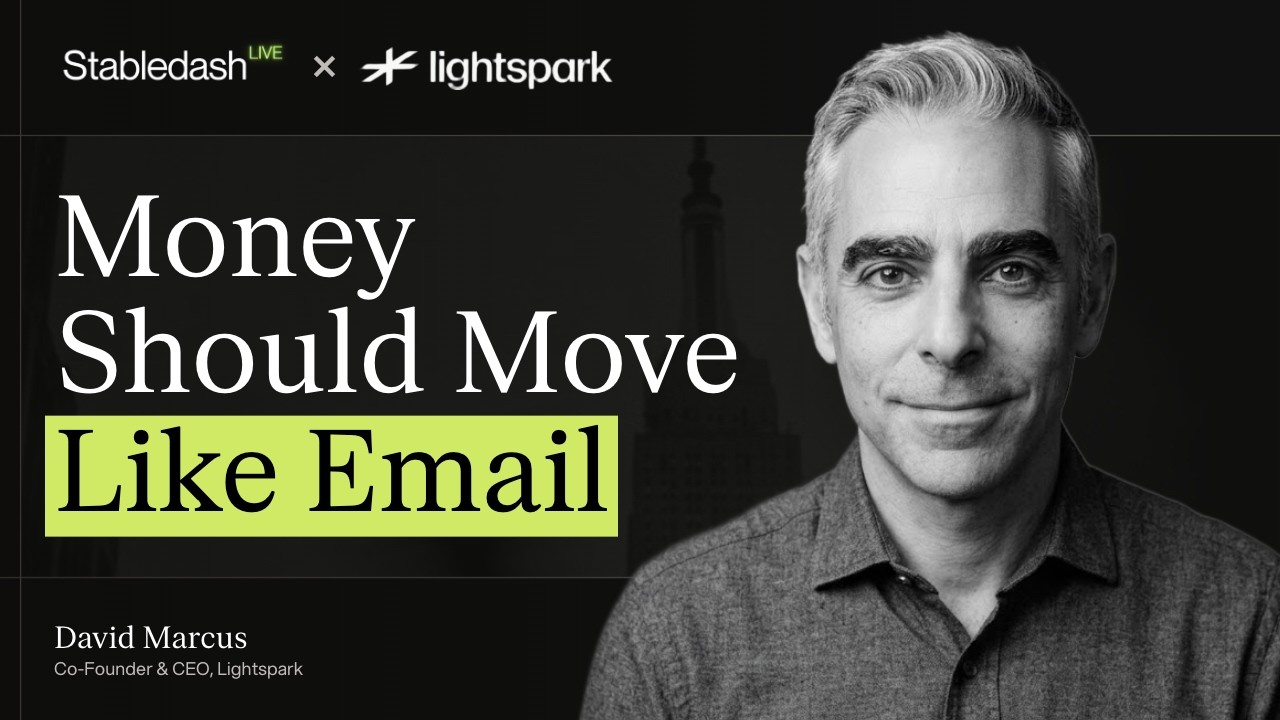
David Marcus
David Marcus, CEO of Lightspark, discusses the evolution of his global money movement platform in an interview at Mexico City's Bitcoin conference. He explains how Lightspark progressed from an initial focus on Bitcoin and the Lightning Network to a broader orchestration platform called Grid that connects 65+ countries and dozens of blockchains. Marcus describes the company's pivot from Ooma (Universal Money Address) to Grid, retaining only the compliance and FX components while dropping the addressing requirement to achieve faster adoption. He details Lightspark's three main products: Grid (real-time money movement), Grid Global Accounts (branded multicurrency accounts with Visa cards), and Spark (Bitcoin Layer 2). Marcus emphasizes the company's commitment to building an open, decentralized network for global money movement rather than a closed platform, recently acquired European payments firm Striga, and is expanding into challenging markets like China. He also highlights the opportunity for platforms like neobanks and marketplaces to own customer financial relationships through Grid Global Accounts, capturing economics previously lost to traditional banking partners.
Transcript
33 turns, about 5400 words. Straight from the recording, so it reads like speech.
S0
0:00
Okay. I am so excited for this one. We are back for another amazing conversation with David Marcus, CEO of Lightspark. We are here in Mexico City in the Bitso business booth as what we're going to name it powered by Agora. Shout out to that team for helping us get on base with this. Stable dash live is sponsored by Agora built for global institutions, moving money at the speed of the internet. You can learn more at agora.finance. It's gonna be fun. Yeah. Thanks for listening. Give us your quick intro on Lightspark.
Have you met someone who doesn't know you on the show floor? How are you introing yourself?
David Marcus
guest0:38
So Lightspark is a global money movement platform, and we have three different things we do. So the first one is Lightspark Grid that enables, large platforms, banks, the likes to move money in real time to 65 countries, dozens of blockchains and stablecoin assets, all orchestrated, all real time.
Then we have great global accounts, which we announced six weeks ago that enables, like, all of the the large platforms that actually do a lot of payouts to now have a branded dollar or a multicurrency account with a Visa card that allows that balance to be spent at a 175,000,000 merchants plus access to grid. So, like, balance can move to a local or global payment network in 65 plus markets.
And then lastly, we have Spark, which is our Bitcoin l two that helps us move both stablecoin and Bitcoin in real time for the purpose of the platform. And our clients are banks and, you know, very large, like, gig economy, creator platforms, or, large multinationals that are looking to move treasury around in real time. Yeah.
S0
1:51
So the first question I have for you, I've I've been following Lightspark. I've been fanboying over Lightspark for many years. We you know, I I consider Lightspark to be when I first heard about it, the the way that one of my close friends, Xander, who's also very just deep in the Bitcoin space and I am as well, he framed a bit Lightspark as I think I was in a moment in my career even where I was like, okay.
I wanna go work for a company, and I want this to be a company that's, like, really crushing it with the intersection of Bitcoin and institutional. Mike Xander, you know this space better than anyone who's doing that best. He's like, you heard of this team, LightSpark? And since then, I've been following you guys, and I just it's been really interesting to see some of the things that have held true the whole time, but also some of the evolution of even how you've have framed what is top of mind right now.
How for for those who maybe have followed Lightspark, maybe that's a question people like me are asking is, like, how what are some of these key pieces of learning or evolution that you've that you've experienced as you've built the business and and Right. Bring us into a little bit of that. It seems like it kind of started really deep in, like, maybe some, like, Bitcoin focused things that have become more open handed. I'm curious if that's how you feel about it. Yeah. Yeah. So I mean, look.
I I actually haven't, like, explained that arc
David Marcus
guest3:18
Yeah. Before, so it's a good opportunity to do this. But but, look, I mean, the the whole reason we started LightSpark is that, like, a bunch of us tried the Libra thing at Facebook, and it didn't it didn't work exactly the way that we had intended to because wrong place, wrong time, etcetera. I mean, we we we don't have to go there again. Many many great podcasts. Many like, we've talked about it a lot.
But, like, the the the the the base thing is my chronic frustration with the fact that we don't have an Internet for money. That money doesn't move on the Internet like any other piece of content. And so when we came out of the Libra journey bruised by the experience we had, we're like, okay. We're never going to actually let ourselves be killed so easily. And as such, we need to build on top of the most decentralized, the most neutral platform that ever existed for money, which is Bitcoin.
And so we started there and started really working on making Lightning better, making it more enterprise grade, then really reached the limits of what we could do with Lightning. And so we had to build our own l two, and we also wanted to support stablecoins on top of Bitcoin. So we So b one was Ooma. Ooma was, like, that moment. Yes.
So Ooma like, so the interesting thing with Ooma is, like, you know, maybe let's do this, like, from the endpoints of where we want to take this and, like, how we go there and, like Sure. Detours. So, like, the endpoint of all of this is there's an Internet for money, and you can move any currency, any stablecoin in real time twenty four seven the same way you send a text message or send an email, whether you're a person or whether you're a business and it works and it's cheap and it's available to everyone.
And you have, like, an email address, you'll have a money address, and that was, like, the the purpose of Ooma. And so that's kind of the end game. And so we started with Ooma, which had, like, three properties, and Ooma stands for universal money address. It's a an open source standard for global money movement, and it has three components. One is a human readable address. Two is compliance.
So you can actually exchange, like, you know, AML, like, you know, sanction checks and all these things, like, before the transaction actually is initiated. And three is an FX quoting system that enables, like, the sender to have a locked quote for a period of time in local currency of the money you wanna send. And what we realized is, like, if you wanna do this, like, you know, everyone has to adopt the same address. Right? And it's so hard to actually do a thing where everyone adopts the same thing.
It's like a cold start network problem. So for now, we've kind of put aside a little bit, like, the addressing piece, but we kept the two most important parts, which are the compliance bit
S0
6:11
and the FX quote bit. It was sort of like, given your background, it's like you have to use PayPal to send PayPal to someone else is kind of the idea versus, like Yeah. I mean this constraint general idea is, like, you know, if everyone has an address and everyone adopts a standard which happens to be open source for money addresses,
David Marcus
guest6:30
it'll be great. Right? Yes. No more routing and checking, I bands. Like, you have one universal standard. It'd be great. The problem is, like, you first need to get everyone on the same network Mhmm. Before you are able to do that. And if it becomes a hindrance, then, you know, just drop the part that's actually causing the most friction, which is, like, changing the behavior and the habits of people and businesses and the way that they send money. Okay.
And so we kept the two parts, which are, like, not the address, the compliance bit and the FX bit, and we packaged all of that on Grid. And so now if you're using Grid, which is our global money movement orchestration platform, now if you're using Grid, you can actually get a log quote to send any local currency in any of the 65, soon to be 70 countries that we support on the network where we have deep integrations to local payment systems. This is all built on open standards.
We don't, like, you know, have any ambitions to own the network and make our clients tenants on our network. We want it to be as open as possible. That's why, like, most of this is open sourced and and and available to to build on by everyone. Yeah. And and now it's, like, taking off like crazy because, like, we we still have, like, you know, poor settlements that's enabled by Bitcoin on Spark and Lightning, but we also support dozens of other chains and stablecoins.
And we think of these as other types of payment networks in the same way that we integrate into, you know, here in Mexico into the SPAY payment system or PIX in Brazil or CEPI in Europe. And so we support all the chains, all the domestic payment networks. We can orchestrate the payment from a to b in a really easy way. We have, I think, the best developer facing platform that enables you to build with AI agents really easily and get going really quickly.
And so we've we've basically accumulated over the last four years a number of capabilities that I think are really unique in the market now. Yeah. So going into the the three pieces turning into two, what were like, that seems like a really, really
S0
8:39
I can only imagine, like, the internal, like, debates and conversations around this. Like, what were the key trade offs or things that you were thinking about? Because it seems like I know that the team has been very bold and, like, very convicted in some ways around this, like, corporate chain stuff and, like, the danger of that and the things that you've seen there and the downsides of doing that wrong. Tell like, what were those types of considerations?
Because it seems like with this new this new going down from three to two in this way, it is way more accessible and plays well with others, which is great in some ways. It sounds like that's it's being adopted. What were those trade offs that you were thinking through? No. I mean, look. I think we still want to
David Marcus
guest9:25
ultimately build on an open network that we don't control and we don't own, and we think that's really, really important for the world. Like, if we basically take our current payment infrastructure and banking infrastructure and just do a search and replace all, with the current names and have new names instead of the current banks that control everything, it would be kind of a sad outcome for the world. And, you know, the Internet is not that. Right? The Internet is not CompuServe or AOL, like, with another name.
It's like a brand new different open network and infrastructure. And I wouldn't be spending my time doing this if I wasn't building an open network. I feel like, you know, great. You can build a very successful company, sell it for a couple of single digit billion dollars maybe, and it's like, some people are happy with that.
I'm at the point of my life and my career where that's, like, really not that exciting to me, and I really want to build something that, you know, lasts longer than this generation and is, like, actually an open network that people use to move money around the world in an open, non controlled network that looks and behaves like the Internet. And and, you know, we're just going to do whatever it takes to actually get there. And and and for that to happen is you still have to give people what they want.
And if they want to actually send, you know, USDC on Polygon or USDT on Tron, like, fine. Like, you know, use our platform, do it, and, you know, gradually over time, you can use it for many other things that are, you know, helping you move money in a more in a more seamless way. Yeah. It's interesting because I think most people in this room
S0
11:04
probably can't say that in terms of their motives for working on what they're working on or building what they're building. I think having a single a single digit billion, like I think a lot of people who who do build are are doing so for motives in that way. Yeah. I'm wondering, like, how has your relationship to work changed because of that? Or maybe how what motivates you or how you measure success? And when when did that change, would you say? I mean, look, I feel like,
David Marcus
guest11:33
you know, first of all, there are two things. Like, you see a lot of payments companies in general or stable point companies. Like, they get to the point where it gets really hard. And and, you know, it's hard when you start, but, like, it gets really, really hard as you move more volume and you interface with more jurisdictions, and you have to deal with more regulators, and you have to deal with more bank partners, and you have to deal with all of these things.
And then you start to see, like, what it is to operate the the large scale payment system, and then you're like, woah. Like, you know, to get to the next level to get to the next level is going to be, like, a massive lift. And most people are just like, you know, if they have a good payout because they're right place, right time, they're going to take it. And I feel like, you know, I've done this, and so I know I I I know the drill. I've done this in my life.
But I I I'm at the point in my career where I'm, like, actually not motivated by that anymore. I'm actually motivated in something that we can build that's truly differentiated, that's going to be a great business, of course. But that's actually, like, a a business that gives the the tools to many types of different businesses and banks and consumers and developers to actually go build the next generation global money movement applications that are going to be used by billions of people.
That that that gets me excited. You know? Yeah. Okay. So let's let's
S0
12:58
Grid. Grid is the hero of the moment for Light Spark, it seems like. How did that product kind of come to be, and how has it evolved lately? It seems like there's been some really key unlocks with that product. Yeah. Bring us into just how Yeah. How Grid formed and what you're seeing built with it maybe today versus the future. And I just packed, like, eight questions in there. So That's okay. Pick whichever one is That's okay. No. Look. I mean, for me, like so Grid is kind of, like, the the natural evolution
David Marcus
guest13:30
of our product iterations. So, like, we we talked about Ooma. Like, in a world where every last bank and wallet adopted Ooma, the addressing standard plus everything else, then we wouldn't have to build, like, all of the connectivity into the domestic payment systems. Right? Because, like, everyone is on the same network. It's a new rail. It's, like, it's real time. It's super efficient. Everyone's happy. Like, it's great consumer experience. It's fantastic for everyone. Sadly, the world doesn't work that way.
And so at some point, you know, I was like, okay. Like, we're going to, again, have to do the nitty gritty work of integrating with all of the domestic payment systems around the world and get licenses everywhere and, you know, buy companies and do all of these things to actually get to that last mile, which is going to take us ten years and okay. Fine. Let's go do it. And so we started that journey, and now we are live in 65 countries.
So meaning, if you open an account now on Lightspark, like, you know, grid.lightspark.com, you open it right now, and we set you up. Same day, you'll be able to send real time money in local currencies to 65 countries in real time with locked quotes that, you know, enables you to send exactly what the recipient wants to receive in their local currency.
S0
14:45
This this random question because we had breakfast this morning with a server who's sending money. Our team was having a breakfast server sending money to Venezuela. Is that in the network right now? Not not right now because Venezuela is still a sanctioned country. Well, that's probably So experiencing issues. As soon as it's
David Marcus
guest15:03
sanctions are lifted or eased, like, we will be able to send money to Venezuela. So is is
S0
15:09
is Grid more more better understood as a, like, mainly developer focused products versus something that, like, the server at breakfast can go and, like, get that done? Or would you Yeah. That person's like They would use basically
David Marcus
guest15:22
the the the the apps that our customers They use Grid. So Okay. Like, we have, like, hundreds of wallets, neobanks that have built on Grid that are using Grid as the backbone for money movement. So Grid is not only fiat, though. So we can also take deposits in USDC and enable customers to make a deposit in USDC and then do Swift, like, if that's what they wanna do. Or you want to deposit in USDC and do a payment in rupees in India, we can do that.
Or you want to do a a a deposit in euros and pay someone with USDT in some other countries, you can do that. Or USDC or any other stable point, you can do that. So any type of permutations across dozens of chains and, you know, 65 countries domestic payment networks, we can do. And you can do payouts, you can do pay ins, you can do virtual accounts.
So you can do virtual named accounts, which is really super helpful for neobanks that want to launch in new jurisdictions and give their customers virtual I bands and others. And so we can do that as well. So it's a it's, in my opinion, the most powerful global money movement platform available to build on today, and that's just on the grid side. And where it goes from now, it's basically every single payment system that exists in the world that's real time, we will get to.
So, you know, we'll we'll have an announcement this week, but or, you know, I can say it right here. Why not? Do it. But so, like, you know, this week, we're announcing that we're adding China to the list of supporting countries, for instance, which is really hard to do if you wanna support b two c case like b two c or c two c flows in Yuan, but also b two b flows into China that requires Yeah.
S0
17:18
The utility. This is huge. Yeah. Just in terms of, like, what that is by itself, it's it's very that's pretty uncommon. You don't hear that a lot. Know. It's hard. It's very hard. So let's let's, like, let's double click on this one because it's, you know, first time talking about this. But two, it seems like this is a kind of a view into the future of how you're thinking about the business and, like, what you're gonna be doing. So why why is this exciting for you?
And practically speaking, like, what did you and team have to go do to make this happen? I'm curious what that was like. So, I mean, just generally speaking,
David Marcus
guest17:50
I mean, there are countries that are easy, and there are countries that are really difficult. And for countries that are really, really difficult, you have to just adopt to like, adapt to the the the rules and the norms of, you know, what is expected from the banking and regular regulatory, like, bodies in those countries and and hide all of that complexity away from our clients because they don't care. They just want to send money like they send an email, and they just want it to arise. It's attention sometimes.
And so all of the sausage making is, like, our problem. It's not our client's problem, and that's where the the value comes from. But the but the general sense is if we can actually connect every domestic payment network that today is not interoperable with one another in real time, Like, the only interoperable layer is correspondent banking with Swift. Right? And that's not real time. It's t plus three, five, whatever. It depends.
And and so if if you're able to start connecting all of those last domestic payment systems with one another with a real time super efficient low cost rail, you start becoming the settlement backbone and network for all of the payments if you're the path of least friction. I I like to say that that money is like water. It'll always, you know, go through the path of least resistance.
And and I think we're close to that point of, like, having the most connectivity into the most payment systems with the most efficient rail with the best developer tools. And and, ultimately, that enables us to start being at the center of more and more volume for more and more platforms and and and take all of the modalities that they want for pay ins and payouts. Yeah.
S0
19:37
What what have you learned as a just an executive operating at a global scale to get something like this done? Like, what what strategies or things have you picked up in your toolkit to actually be able to push through these kind of, like, global launches and global partnerships like this? Yeah. I think, you know, I have a a friend of mine,
David Marcus
guest20:04
Simon Sinek, who wrote that book, the Infinite Game. Right? And so you have to take the Infinite Game approach to payments. There's no winning. Like, you know, it's only one one foot in front of another, one country after another, one redundancy path for each of the country after another. And the the engine room is messy, and it's complicated, and it takes time, and it takes a lot of commitment. And it never ends. And it never ends, and that's okay. Yeah.
And, like, you compound the value of what you build over very long periods of time. And it's like payments businesses are, like, are slingshots. Right? It's like it it feels like really, really, really, really hard. You pull, pull, pull, pull, but then you get to a point where you have enough capabilities that it feels like the the energy gets gets, you know, moved to the other side.
So and I feel like we're in in that position at the company right now, which feels really, really great after four years of, like, hard work of Pulling back that slingshot. Pulling back that slingshot. When when did that slingshot release for you? Or, like, when was that kind of moment?
I I mean, I do feel like, you know, right now, the the transition from we're connecting banks on Ooma to enable them to communicate with one another, move money in real time, to know we're actually going to have, like, an open orchestration and global money movement platform, plus great global accounts that we just launched six weeks ago now has everyone's attention because everyone, you know, wants to basically keep the economics of all the payouts that, like, all of those large platforms. Right?
It's a very different
S0
21:46
in some ways, like, I'm I'm going back to your really marquee partnership with Coinbase. I think in the when and I was trying to understand, like, who's doing what, and Coinbase at that time was, like, the licensed counterparty for that infra. Like, they were my understanding is they're they were using all of that, and that's that's what made them a really great fit for that tech. It sounds like now you guys really wanna play that role of being in the kind of licensed, trusted
David Marcus
guest22:12
position? We have to because, like so last year, we acquired Strigo Okay. Which is now Lightspark Payments Europe.
S0
22:20
That is that. That was nice. On your big your big conference, you did that. You announced Yeah. Yeah. Exactly. And
David Marcus
guest22:27
and so, like, that's going to be our EMI CASB entity in Europe as soon as we get this license converted, which is going to be probably soon. And that gives us, like, direct SEPA network participation. In The US, we have our own licenses. And then everywhere else around the world, we actually have, like, redundant routes into every payment network. Because, like, as you build more connectivity into, like, aggregators, you realize that what they say and what they can deliver is, like, actually quite different.
And so you have to build redundancy. You have to build
S0
23:07
your first party connectivity wherever you can, and that just takes time. Yeah. What's so so you're going now into this position where you really wanna be serving, like, the front end applications, people who have relationships with users, neobanks, and and platforms like this. What are you seeing? We we a big theme for us is gonna be covering a lot of this.
But what are you what are you seeing as, like, key winning strategies of the maybe existing partners or companies that are building with Grid or just other applications or or things that you've seen in your career. Like, there's so much there's so much opportunity with the tools that exist to go build, like, niche go to market applications. What are you seeing as, like, the the reasons why the ones that win do?
David Marcus
guest23:53
I mean, look. I think so let me just re I I I think the thing to watch, in my opinion, in the next nine months or so is really this transition from I'm just using Stablecoins as a Stablecoin sandwich or to replace a payout in Stablecoin and someone else's Stablecoin in a in a wallet. Two, I'm going to own the infrastructure as a big platform. So let's say you're a creator platform, a gig economy platform, a marketplace Yeah. And you're paying out all of that money.
And right now, when you pay out all of that money, it goes to banks that serve your customers that you've created, like, this whole like, you are the economic nexus of all of these people and these small companies and sellers and all of these. Right? I like that word. Nexus. I like that word. And they have and they have, like, banking needs, and, basically, you're relinquishing all of the economic value of deposits, of local and global payments Yeah. Of interchange on card transactions.
So we're becoming Visa principal members, and we're we announced that we're going to enable issuance of stablecoin backed cards in a 100 plus countries. So with Grid Global Account, now you can own that relationship all the way to the end, and those accounts are super powerful multicurrency accounts where you can move your balance in real time to your local bank account if you need to $24.07 on Sunday at 2AM. You want Mexican peso, you can do that. Yeah. You have a Visa card. You can spend it.
You want to send money not to Venezuela but to Argentina, you can do that. And and you want to send USDT on Tron, you can do that. Right? And so now, like, you as a platform, you start to have, like, a branded account where you earn money on yield on deposits, on interchange on cards, on local and global transactions, and you keep the data in house.
So when it comes time for you to want to underwrite credit, for instance, for all of the marketplace players on your marketplace, you can do that because you're the best positioned player to do that. You have the best data. You're not leaking that data to the bank that's going to actually start lending money on your behalf. And and that's a huge opportunity. And since we announced this, like, we've been running, like,
S0
26:11
crazy people trying to Yeah. Meet that demand because everyone wants that. Yeah. Who's the one I think we can use this for our business? We're building something no one knows about, and it's essentially, like, the infrastructure you just talked about. Who's the best person at I know you guys just brought on some key people on the sales side.
Who's the best person to fund, you know, StableDash right now is thinking creatively about some, like I don't wanna give too much away, but, like, we're we're thinking a lot about, like, intelligence and systems. I'm actually closing a deal. Right? Well, it's it's well, it's a really, really interesting position to be in if you're in the relationship to the the marketplace use case for stablecoin economics is really, really fascinating. If you can actually, like, keep keep those earnings or or, like, payouts.
Uh-huh. So I'll I'll be more candid when the cameras go off, we need this. And so who who's the best type of who's the best person to, like, get in the weeds? Because what we really are looking for as a bootstrapped
David Marcus
guest27:12
young company is, like, a strategic partner to, like, really workshop this with us. Is that something that you guys are Yeah. The capacity to do this? It's like Absolutely. Absolutely. Yeah. Okay. We're doing this all the time. And we we brought in a really, really good team that Davy Strauss, who joined us from Adyen earlier this year, has been building with Christina Potter, Alex Gillette, like, you know, people that I think you're going to also have on the pod at some point. Yeah. And and so we have the team.
We have the capacity. And, like and also, we have, like, the intellectual curiosity to go build with people like you and try to find out, like, how we can build novel
S0
27:52
money applications out there. Yeah. My first question, selfishly, and then we can close, is I know you've had a really strategic relationship with Braille for US US what's it again? USB. USB. Is that still the like, how are you thinking about the issuance side of this? Is that gonna be kind of the default stablecoin infrastructure that or the stablecoin asset that goes in here?
David Marcus
guest28:16
Or if we were wanting to issue a stablecoin that was ours, is that the partner we would work with? Like, how does that work now? Yeah. So we have a really good solid partnership with Braille, and they've been, like, really amazing partners to work with. But it's more modular. We can, like Yeah. Totally. You can bring your own. If you have an existing stable coin, you can bring your own, like or, you know, there are other other participants. From
S0
28:37
m 0 walking around. So if we go to if we go to m 0 and we issue something, like, that would play well with the system like this. We need to figure it figure it out. I don't know about m 0. Have some money, but, like, maybe we should do a tri party deal right now. Yeah. Okay. Cool. And I'm imagining there's, like, maybe flexibility in, like, some of those economics being shared with Yeah. Like, 1%, I think that's the whole point. Right?
It's like the economics are meant to be enjoyed by the the platforms that are generating the economic opportunity for, like Cool. Their staple. Cool. What last question and kind of as we close, anything we've missed or things that, yeah, get you excited as you think about the future and this new not in some ways new, but in some ways not new
David Marcus
guest29:19
moment of slingshot that you guys are in. No. I mean, look. I think it's all execution at this point, and and, you know, we've got the right product, the right time, the right team.
S0
29:29
So it feels really good. Let's go. Yeah. Let's go. David, thanks for your time. Thank you so much for having me. We're gonna take a quick break. That was our exclusive conversation with David Marcus. Hope you enjoyed it. We're here live, in Mexico City, and we'll, take a quick break. We'll be right back.