Stabledash Live · · 32 min
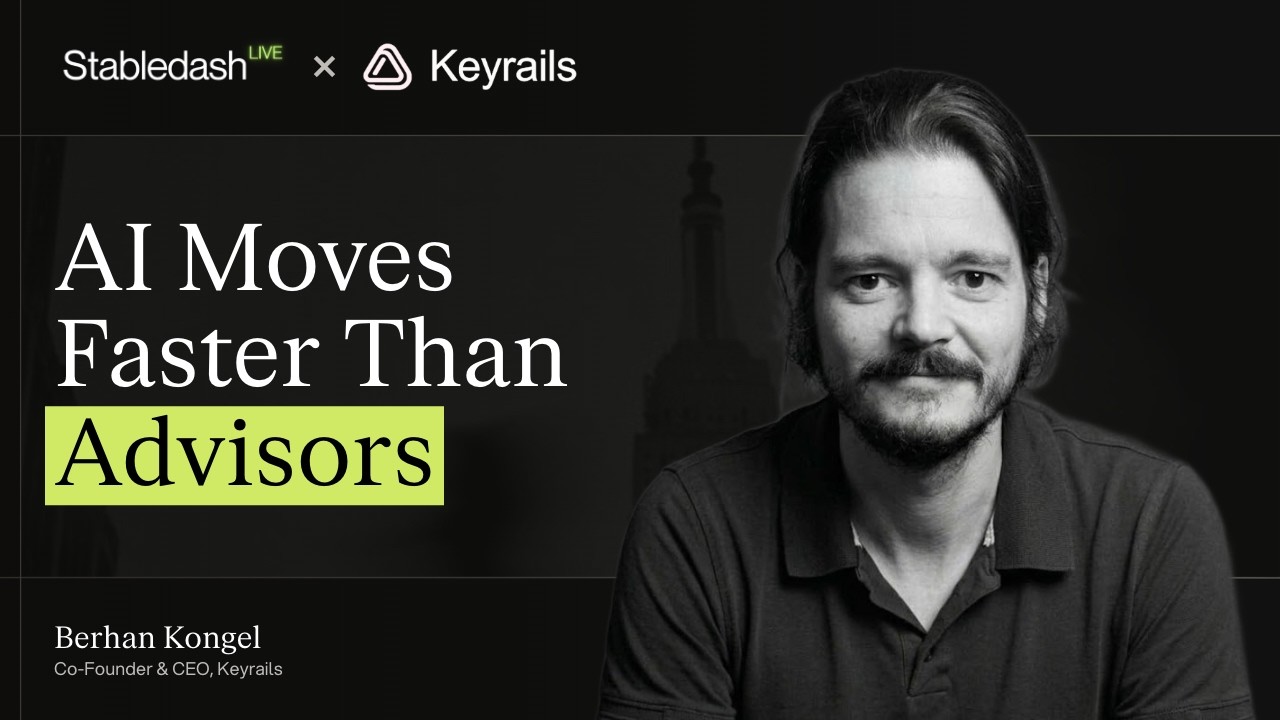
Trade Finance, AI Research and Investing, and Tokenized Collateral with Keyrails CEO Berhan Kongel
Berhan Kongel
Berhan Kongel of Curios/KeyRail discusses the company's stablecoin infrastructure ("Stablecoins 3.0") in a podcast-style interview. He compares USDC's institutional positioning against Tether's broader distribution in emerging markets (Africa, Latin America, South Asia), and describes a new cross-chain, market-neutral swap feature that passes trading gains to clients, which he says shifted their exposure from roughly 80% USDC to about 70% USDT. Kongel details plans for white-labeled trade financing that lends dollars to emerging-market importers via fintechs using programmable wallets, tokenized T-bill collateral, and SWIFT integration, claiming costs of capital around 15-25% versus higher local rates. He also argues that "agentic payments" will be most valuable for complex investment analysis and discovering decentralized secondary-market vaults rather than for routine retail purchases; the hosts propose conducting a live trade-finance transaction on a future episode.
Transcript
23 turns, about 5800 words. Straight from the recording, so it reads like speech.
Berhan Kongel
guest0:00
Berhan, how are doing, man? Great to see you. Welcome in. It's great. Great to be here. Again, I feel like I'm people. I can I can make presentations and all that stuff? Know? Berhan, do you have a favorite stablecoin? I'm neutral. I'm neutral. I used I used to be a USTC guy when when we were at ARF, and we were building ART because, you know, circle and all that. And now you are doing all this Africa and Latin America. I'm more like a Tether guy. More of a Tether guy now? We we just Yeah. Deployed a new
S2
0:31
Canon feature. So we have a stable coin Canon. So we're Great. Shooting some some Tethr right here. I think it's becoming slowly my favorite. Slowly the favorite. Okay. Cool. I guess help like, when you're entering these conversations, right, with maybe somebody that's not familiar with stablecoins, and they may have seen USDC, USDT, how do you frame their positioning in the markets?
I think we look at them, and we may say, you know, USDC is the one for The US, and and then we see USDT and, great, they have a foothold in emerging markets. From from a b to b standpoint and maybe even from a developer standpoint,
Berhan Kongel
guest1:05
how do you look at the lanes Circle and Tethr are carving for themselves? It's just interesting, actually. It's a great question. So so they their carving hasn't changed over the past five years or so. So they are doubling down on their positioning. Circle has always been the, you know, more institutional more institutional products in terms of treasury yields and all that stuff, and Tether is more like that. So their distribution is fundamentally different. They are very, very robust distribution.
We are seeing all this little volatility for Tether, plus minus three, four basis points. Although US, this is always one to one. That's that's because of the the the the decentralized distribution Tether has, which makes them super robust. And all the markets that we are all the markets that are developing super, super, super fast, like Africa, Latin America, South Asia, a VRC, massive penetration by Tether there. Everybody has Tether. And we are seeing this interestingly.
Our tech around Tether wasn't that great up until, like, three, four months ago. And now we built this we built this incredible swap function. This is cross cross chain and market neutral. So we are not making money from that. We are not taking directional positions or anything like that. So we connect to a bunch of liquidity providers, select the best price, and pass all the gains and losses to our clients, basically, which has worked. So it completely flipped materials' exposure to USCC and USCT.
It used to be, like, like, 80% USCC. Right now, it's more like 70% USCT that we are seeing both are being funded. Because the reason is is is very simple because we are because we are not charging anything. It's free to use, and you are passing all the case to the clients.
And and usually, from trading perspective historic trading perspective, USDT to USD redemptions make you money, which means, for example, if you wanna do a $100,000 payment, okay, and you ask how much USDT do I need for that, unless Bitcoin is free falling or something like that, you usually need less USDT than $100,000, basically. The delta is your gain, which is around one one point five up to three basis point that we are seeing.
And and it's incredible because we are charging our clients three to five basis point for the entire payment and then passing all passing the gains to them. And sometimes they just do payments for free with KeyRail. And that becomes, you know, is is has now started becoming a thing for for KeyRail basically from pricing perspective.
Just the other day, it was like a client that was paying us, like, two basis points, and and the the delta on the USD to USD was three and a half basis points, which was each like, which was like twenty minutes or so, but they were at the right place in the right time. And they made point five basis point in case they're from it. We paid them to make a payment, which is completely changes the, you know, entropy of the whole payments infrastructure. So so we are kind of more excited about the Telus stuff, basically.
What what's it like, Berhan, just given your background, what you've built, how you see the world of payments to see
S0
4:11
a business
Berhan Kongel
guest4:12
cost center turn into a potential revenue center? Like, what what is that like from your perspective? It's incredible. So we really simply really stabilized three point o, and the idea behind that is not actual payments. So we are now starting they have now started executing our whole vision simultaneously on different verticals. So we have the yield accounts. Now we are about to do this trade financing. So means and we are white labeled.
So we are providing these yields as a service or trade financing as a service or other fintechs and financial institutions to resell to their clients and make money. So anybody using anything like using Cura's infrastructure, all of a sudden gets exposed to different revenue revenue streams, new revenue streams that are impossible that were impossible before without any additional licensing, without any additional banking infrastructure, or anything like that. Everything automates. It's everything under the hood.
And with the trade financing, we I believe we can get a ginormous portion of the import export commodities market on chain, actually. Because think about it. Think about news states. Okay? So you are an importer in labels. Right? So so you are are selling car tires. Okay? You you sold the car tires. You you you collected naira. Okay? Yeah. Now you you and business is good. Okay? You wanna make another order to your Chinese supplier. The problem is you have naira.
They expect dollars, and it is now very well known and there's a massive lack of dollars in in shortage of dollars across Africa. So what we are building here is what if we blended to you based on your trade history with us? Because your trade story is something we can attest to because we are executing those. We are a SWIFT member. We have direct banking everywhere. We have sanctified currencies all over SWIFT rails. Okay?
So we can we have documentation that makes it less less risky to fund or to lend to an emerging market borrower. And what if we we do that lending through their fintech? Because we don't have direct relationship with the importers. We are not Africans. We are not in Africa. The actual trust relationship is between that fintech and the borrower and and the importer. So why don't we lend through them? And that changes everything. All of a sudden so we had this great orchestration with stablecoins. Okay?
Massive currency exposure all through real time growth settlements for designed for large big payments, import export commodities. And but but how big of a difference does that make? Of course, it it solves a lot of orchestration problems, but that's not the main problem. The main problem is I have naira. I need to pay USD. I can't find USD. There is a lack of USD, so I need to inject USD. That's a very simple math, I believe. Right?
So if a market is lacking something and there is demand for it, you bring that to the market. So so up until now, the problem was it is very hard to underwrite that. Okay? It is very hard to under there are no FICO scores on anything in in Africa. Everything is documented. There's lots of doctoring and all that. So so there's there's not only a huge amount of dollar shortage there. There's also a huge amount of credit, trade financing shortage, hard to $140,000,000,000 a year. There is demand for it.
Most of it is very legitimate, but there is no structural way to underwrite them without taking massive amounts of risk. So that's what we are building and that's what we are about release. And it will be like a fraction of the cost of of the capital that you usually see see in Africa. We are seeing like a 15% per month trade financing solutions in Africa because of lack of suppliers there, And we are coming in right now, and our pricing could be somewhere around 20 to 25%.
And the beauty of that is I can give a range. And the reason for that is we built something that connects payments to yields to to trade financing. So when you do collateralized lending, the prop here is the problem, a very simple problem. So you give the collateral to the bank for them to secure it, but you are not making money from it. So let's say you have a million dollars. You have to secure your facility with. Okay? You give that to to the bank, and the bank bank makes money from that. You are not making.
It's a cost of capital for you. K? An additional one on top of the interest rate you are paying, which is also very high, actually. So you are let's say you are paying 30%, but the TIBUS right now is almost 5% short term right now, so your cost of capital is like 30% if it's one to one collateralized. So what we are building is and you can't have this this yields we have this yields option that is through tokenized money market funds, the Tivo option, and we can lock it.
And everything that you use there to secure your trade financing is actually making you money. But here's it's it's it's a it it has a double double effect actually. So when I say 20 to 25%, the more money you have locked in the t bills, okay, the cheaper cost of capital you have from the APR perspective. Okay?
So in that range, 20 to 25%, you have 20% if you have 80% of the of the facility as collectible in the TPO side, and then you make another 5% from there and you pass it to you, so all of a sudden your cost of capital is 15%, which is insane for for compared to that. So it's it's like an order of magnitude lower cost to what's what we are seeing in the African markets right now, which is insane. About the same risk profile. So so we are changing that. So we are inviting lenders. We are not a lender.
We are a infrastructure. We are programming products. So we are securing, for example, if you have, like, 500,000, let's say, facility that you borrowed, it comes to a very specially programmed wallet. Normally, you secure that via via legal documents like covenants, for example. Okay? You write down, this is how you can use my money and you this is how you can't use my money. It's a very antiquated concept because we programmed it to just do third party SWIFT. Okay? You can only pay your suppliers.
I don't need any legal drug because it's already paid in. I programmed it. It can't do anything else. Okay? So so it's super fast, super lightweight. It's just waiting for you there. And whatever you get from your clients through our USC facilities that USC virtual accounts, etcetera, whatever you get, the system uses it through PayIt monthly. And it's like a six month tenor. And in the meantime, I love whatever you have. In the Tivo side, I'll lock it. You won't be able to redeem them.
Once everything is repaid, you will be able to redeem that plus all the interest you just made. So so it's an incredibly fast, and you don't need any additional documentation to be eligible for the for the trade financing. Because if you have a three months trade history with us, you are eligible. It will be just it will just appear like magic, and and you will be able to say, okay. I will So it would just be like they're like they're just transacting.
S2
11:50
This is, you know, an embedded infrastructure, and then they'll just see, like, they have this offer, like, that this is now Exactly. It's it's
Berhan Kongel
guest11:58
just it's just magic. It's just there. Okay? And when you are transacting, you will be you will be able to give it like, okay. Use my own money because I have it or use my facility. It depends on how you are handling your treasury on the African side because you can make a lot of money in Africa. If the problem with with this is so you have naira. Okay? The problem is to order anything from a Chinese supplier, you have to repay 60% of that invoice.
That's a huge problem because now you have to fight US dollars for 60% portion. Okay? And that forces you to go to black market, and you get a premium rate on the on the naira USD conversion because of the, you know, a lack of supply. And I said, but that's a massive problem. So what we are allowing is is, okay, you can still pay that 60%, use my facility.
I'm telling you, I know African market and African currencies, you can make a lot of arbitrage money from that naira that you just didn't have to convert the dollars at a premium base. You can actually make all that make all that money back in one month because our repayments are cyclical. It's just every month you repay, and then it rolls. Every month you repay, and it rolls to the next month.
So you have one month to make something from that naira that you just collected, which is not that hard actually if you know what you're doing. The fintech can enjoy it. So it's overall a great system. I think it will this is just the beginning, and the future is is much much different than than this actually. This is just like 01/2001. This is just like stone age, what what I just described. Stone age, what we will see in the next five years.
Let let me let me give you a hint of what we are what we are about to see what what financial infrastructure will look like. So right now, the collaterals are very liquid. Right? Everything needs to be very liquid because because if you are treasurer and manager, okay, you have to have some sort of liquid assets because you have to have you may have obligations in the next two days, three days, four days. And all these even T bills have like T plus to settle. Okay?
So all these collaterals that we are we are dealing with, they are very limited in the traditional finance. It's T bills, okay, or it's dollars. It's fine. But what if right now, what's happening, for example, in Dubai, where I live, is Dubai land department is tokenizing deets for fractional ownership of Dubai real estate. This is our freaking ERC twenties, guys. The beach beach and support achievers today. Their idea is smart contract. Okay? They have a full infrastructure. It's fully regulated.
So what's what's what would happen is you will be able to secure your facility with a fraction of freaking pound villa in Dubai because it's now you can liquidate it in secondary markets now. The problem is with all these non money market funds or non currency treasuries and and collaterals is they are not liquid. It's very hard to sell a house. It take it will take you like two months and a month's paperwork to sell anything, but you need the money in two days. But tokenized version is not like that. Okay?
It's a fractional ownership. You can sell it in five seconds if the secondary market is big enough. And that's what we what everybody's building right now, the secondary markets. Nobody can build the primary markets and and be that big. The secondary market that are natural. And and and let me tell you something. That's where the agentic payments is going. Agentic payments is not not for for for payments itself.
But where we are living right now, if you are managing a treasury or or any kind of investment, it's very easy for you to track the market. You look what BlackRock is doing. You look what Citadel is doing. And if you are very advanced, you buy yourself a Bloomberg terminal and do, like, five attracts five, six more different sources, and you have a good idea where the market is.
But with all these secondaries, completely decentralized, you have no idea of what the pricing is looking like, whether you are losing money or leaving money on the table. Okay? And that's where the AI agents will come in.
They will just just go to lightning speed of all all these secondary market, get Oracle pricing, get all the pricing, compare it to each other, and give you an idea at any given time and in any second what the world looks like and execute upon it because they will have these wallets that are connected to these secondary markets. What you are seeing at Curios with Stabiloix two point o is just the beginning. It's just the nascency. We are showing the world how it may look like with all the traditional assets.
So we are not using to buy real estate to secure payments or anything like that. So we are just using T bills, but tokenized version. We are using instead of packet caps, we are using bullets. Instead of, you know, dakao wallets traditionally, we are using faults. So but they are all interconnected, and they are all programmed. They can only do certain things that we are we are we are programmed to, which is the future, basically. And the future is much, much brighter than today, trust me. Yeah.
Berhan, you seem more optimistic than I've ever seen you. We've had many conversations. You seem more now I'm seeing yeah. My my day people have built built into this, and I'm seeing that, you know, these things are coming to life and shift. So, yeah, it's it's makes more optimistic. Of course, I'm an entrepreneur. Our our nature is being optimistic. Otherwise, we wouldn't be able to do this. Ron, so a
S2
17:30
quick sidebar here. I don't know if you saw this. Drew and I were talking about this earlier. Jeremy shared shared that somebody on his team in the base ecosystem used uses Gentic payments to put together a an investment memo for SpaceX. You know? And it didn't make any API calls, and it went out and did that research. And that that reminded me of what you just said there.
Berhan Kongel
guest17:52
Like, what what's what's you say that? Built this for yeah. Yeah. I saw that. Of course. They built this thing, and the AI went to went through and built this incredible report that would take any super top tier investment investment and analyst, like, two weeks to put together, basically. And for a fraction of the cost, fraction of the fraction of the cost, it's one dollar eight and seven cents as you are putting on the screen right now.
And all you need to do is now, you know, tokenize version of SpaceX, and it and the AI can just go by based on its own analysis, and you don't have to do anything about that. Okay? And which is which is which is ridiculous. And then you can take that to SpaceX. Okay? While it's sitting and making money for you, you can use that as collateral to borrow against it $24.07. A bank involvement. It's an economy on its own. You don't have to your AI agent can borrow against it.
If it feels that you have obligations and there is a great facility because another AI agent is looking infrastructure like T rails, We are now the only one to do it, but trust me, in two years, there will be a lot of T rails and different verticals, basically. So because, you know, you have an obligation to make sense to borrow against that SpaceX because the math makes sense. It will make you money. And the AI just decided that in a time frame that your team of advisers can never fathom, basically.
That's where the gigantic payments when we say gigantic payments, we are just, you know, everybody's so obsessed with, you know, retail. And I don't need my agentic, you know, AI to to go buy me coffee or some stupid subscription. I can do it myself. Okay? Because you buy it once. Okay? You don't need this this incredible analysis. That's where the where the where the where the difference is gonna show itself. Okay? I can buy my own subscriptions. Okay? I can buy my own APIs. I don't need agents for that. Okay?
I don't need fractional, you know, payments for that. That's the sole problem. Come on. Let's not push it. Okay? What the agent is is incredibly useful when we have this ginormous secondary market, okay, completely decentralized. You don't know where they are. There is no Bloomberg terminal that you can where you can access them to. And your agents will go there and make these analysis and make investments decisions for you and treasury decisions for you, borrowing decisions for you. Okay?
And they will make they will make better decisions than any of us right now. I mean, I just even think together. That's that's that's how it comes together, crypto stables and all these AI, not on stupid payments. That was the same thing with Bitcoin. The the entire narrative when I first started, like, to 2018 is what why can't I buy coffee with Bitcoin? Because that's not what it is for. Okay?
And and you lost, like, so much time with that with that with that narrative because just like buying coffee is the only use case that it's relevant to because, you know, it's easy to under I understand that. It's easy to easy to, you know, visualize in your head. I'm buying the coffee. Now I have to pay. Now I have Bitcoins here. Now I'm paying. It's in the physical world. Okay? It's same thing is happening here. Atriumpic payments, I go by, you know, newspaper subscriptions because, you know, they are annoying.
They come up, you know, financial times and all that. And why doesn't my AI go buy them? It's not the use case. I can do it myself. There is no, you know, there's not too much difference the AI can make doing those payments. But AI can make the difference making complex analysis and making this this unbiased decisions based on that complex analysis. Right? That's where they differ, not on the on the on the payment side. It's on the doubt side.
S2
21:47
I mean, I think about what you just said where, okay, in two years, there's gonna be how many key rails and trade financing and all those investors are going to need to be doing research around this topic. And how do they find what you just said? How how do they use what you just said to inform their their investment thesis? So, yeah, I think it's an area that we'll be doing more and more Exactly. Faster you around. You build these agents.
You you set them loose into the wild, and they come back to you like little doggies or something like that and just worry about all this stuff. And you can say, okay. This vertical,
Berhan Kongel
guest22:20
your agent, you can decide yourself. Just do do payments, buy stuff, borrow stuff, whatever. We invest stuff up to a million dollars. And this these are mine. So I will decide. So bring all the analysis. I would read it. Maybe they are for the next twenty five years, for example. It's short term, more AI, long term, more me, things like that. But that's where the AI agents will make the absolute difference.
The things that we can't even think of right now, they those will be the use cases, not the, you know, you know, subscriptions or anything like that.
S0
22:54
So so in the flow of funds, in your mind, how you imagine the intersection of key rails, agents, a lot of the trade financing use cases that you've talked about. Just to make sure we're we're clear on this, so where do you see agents being extremely helpful? Is it it's it's price discovery Small. Fee compression? Exactly.
Berhan Kongel
guest23:15
It's it's pricing story, actually, or or finance story, to be honest with you. So how tier business lending works is is is a bit different. So we don't have this sale in USCC vault where lenders come in and pitch in. That's not how it works. We are ourselves connected to a vault in a marketplace, a borrower borrower lender marketplace, basically, that is managed, Not like Aave. It's not fully decentralized. It's managed by a regulated entity, basically, but it's still a vault.
It's connected through a smart contract. Okay? So so the thing is the pricing that we have on here that we are selling this has an effect to that vault pricing on the other side, the stakers. K? So people are staking into that vault, and we are pulling that money and lending it to the to the importers. K? That's how it works. That's the flow of funds. So somebody this vault needs stakers. So the AI agents will come in and and and read these signals that are coming from the vaults. I can give you 5%.
I can give you 20% APR APY. I can give you 30% APY. I can give you 80% APY. And they make a conscious selection, basically, how that both works, whether it's it's within the agent owners risk appetite, etcetera. So that's where the agents come in. So agents will help T rails to raise to to increase the the the facility size, basically. Because they will find these vaults that are owned by our lenders and convince more people to invest in them, which is currently not possible.
How many vaults are there on blockchain right now? How many borrower lending markets are there on blockchain right now? Are there more for these are the big ones. Of course, you know those, but there are also smaller ones. So the AI agent will come in and and say, okay. And you will say to the AI agent basically, okay. Up to a thousand dollars, find me vaults that are slightly higher risk, but in the range of 15 to 20% APY. Okay? But it has to be maximum of one month lock in. Okay?
Not three months lock in, like in Maple, for example. Okay? And the AI agents goes out and starts finding finding beauty stars. Okay? Because you can't find them. You can't Google search them. You know? They are decentralized. They are not being, you know, they are not being advertised like like like centralized entities like Coinbase, for example. Okay? So so so that's where where your agents will will come in, basically.
And so the agent will find it and they will invest in it because you just gave them permission to invest in these kind of faults up to $100,000. And then they will track it, how good they are, what the default routes are, and then they will train. They will be trained by that data. They will learn from those mistakes. And all of a sudden, you have this incredible investment analyst agent that is trained by view like transactions that itself, basically, looking for more data.
And you can hire you you can advance the agent, basically. And I I may say, okay, Drew, I like I really like your agent. Can I use them for, like like, five days? Because my agent sucks, basically. I know I want your agent to train my agent. So it will be very organic, to be honest with you. And and so to all these tight, antiquated bank accounts, rails, okay, that we we are so adamant about trying to solve this, you know, they will be they will be a relic of the past. Nobody will need them.
Even at QRails, you don't need bank accounts. You can do this yield. You can get facilities. You can get yield facilities and payments, one of the the biggest RTGS network in the world, Okay? All from your USDT wallet. You don't need any USD bank account or any kind of bank account for whatsoever. Okay? And I I will do the conversion to Chinese yuan at the last mile, but that's the money is already out of you, basically. It's it's going to to your supply. That doesn't count. It's not going from your bank account.
We can do this with transactions without bank accounts and put your name into those with transactions. So so it it looks like they they are coming out of a bank So we sold that on the altcoins, and we are trying to sold that on the incoming too. So receiving SWIFT without bank account. That's the next frontier. So all everything is already accumulated in your wallet, and your wallet holds all these tokens. So these tokens mean okay. So so when you are USD, you are holding USD in in Bank of America, for example.
You are carrying Bank of America's liability. If you wanna carry JP Morgan's liability, you have to open another bank account because they are pitch and talk to each other. Okay? But in in in an unchained wallet, you are carrying Circle's liability. You are carrying Tadu's liability. You are carrying a bunch of other tokenized money market funds liability, all at the same wallets, and that's a superpower.
S0
28:11
So if you don't lose any other wallets, that wallet is enough for you to do everything on QRS. Berhan, do you something that I'd love to explore with you and with your help, it would be really great to meet anyone from the trade financing side of this. Like, we I think we spend a lot of time on our show talking with the infrastructure startups, the companies, and the founders who are building what the client side or the the demand side will need.
It would be really interesting especially if you have an existing client or partner or someone who you know is actively coming from the demand side of this, on the trade financing side of this, to bring them on either independently or with you to discuss this because it would be really interesting to also hear, like, how are they thinking about this from their perspective and their point of view
Berhan Kongel
guest29:01
Yeah. Especially as you guys Definitely. I will definitely inform you. Once we have the first transaction, we are gearing up for that. It will be very manual. No program hold source. We just wanna see how it works from a flow of funds perspective, but it will be just as, you know, transformative actually. So we are doing these kind of things so we know what to build actually and how it will work so we don't have to build it twice or thrice.
So once that first transaction is there, I will bring one of our clients that did that transaction be fun. Together with a little lender. Basically, we can we can have this conversation,
S0
29:33
how it went, and what it actually means. What if we what if we did the transaction live? Would that be possible? It's a great idea, actually. We could do the transaction live. I'm just talk to you guys. There's just an interesting, like Drew mentioned, where
S2
29:48
there's so much of the world that's beginning to use these products that are not inherently crypto native, and we wanna just show that. Right? It's like it's kinda like the proof is in the pudding. You don't know Oh, a person maybe some of these people don't know that they want to do it until they've they've seen it. They've seen it done. And not to mention, like, one thing I loved about you guys, you took the stable minded episode we did.
And for a while there, it was I think you had on your on your website embedded there. And so we start to think, okay. How can we showcase these products, like, you know, live? And then how does that even turn into collateral you can use when somebody says, hey. I don't understand how this works. You just say, hey. Go watch this. There you go. Exactly.
Berhan Kongel
guest30:28
Yeah. Yeah. Let's do that. Let's do that. Let me talk to the clients and and our our landing partner, design partners, and let's arrange something.
S0
30:37
This is actually a great Even if it's make a we make a whole day of it. We could bring on each partner. They could spend ten, fifteen, twenty minutes talking about their business. And then at the very end, we can all come together and do a test transaction. Yeah. That would be great. That would be awesome. Okay, guys. That's a promise. That's the next step. We'll see you we'll see you in the and I'm I'm excited to see the settlement simulator on the
Berhan Kongel
guest31:00
on the website. It looks like that's on the way too. That'll be fun. Yeah. Yeah. I'll get on with that. It's all be it's all great to see you.
S0
31:06
Verhan, it's always a pleasure to to hear from you, and love hearing the optimism. It's great.
Berhan Kongel
guest31:12
Yeah. And the website looks awesome. It's a great great great one. Thank you. All the credit goes to our chief of staff as well. Love it. She's on it. Completely white coated, guys. Completely white coated, and the entire new design of Eureus completely AI. Wow. Love it. Yeah. Yeah. Yeah. Yes. Yes. I'm serious AI. Are on the compliance side, on the design side. Everything is on the coding side.
S2
31:38
We are becoming this AI native company, basically. It's awesome. Sounds like a perfect shot soon. Piece for our next upcoming segment. So, yeah, we'll we'll see you. Thanks, Bhavan. Thanks, guys.