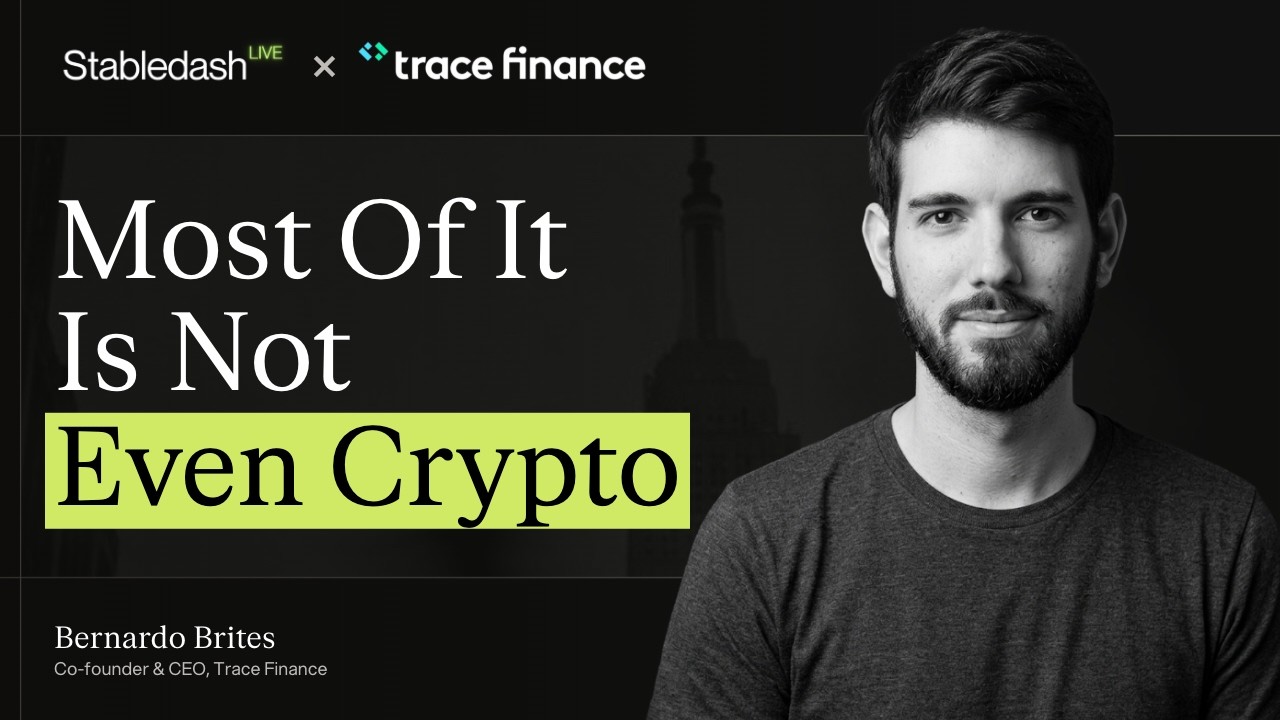
Stabledash Live · · 21 min
Trace Finance Raised $32M to Bridge FX, Stablecoins, and Brazilian Banking
Bernardo Brites
Bernardo Brites, founder of Trace Finance, discusses the company's recently announced $32 million Series A round (raised in December, backed by investors including Coinbase Ventures) and its focus on cross-border FX and payments infrastructure connecting Brazil and other emerging markets to global rails. He explains that most of Trace's volume remains traditional/legacy FX rather than stablecoins, and describes how its bank infrastructure exempts it from Brazil's new $100,000-per-transaction cap on virtual asset providers and the central bank's ban on processing FX transactions via crypto/stablecoins. Brites argues that Brazil's capital controls make local stablecoins and cross-border settlement especially relevant there (unlike markets such as Mexico), and touts Trace surpassing $10 billion in payment volume while advising founders to build product and partnerships rather than fundraise for announcement's sake.
Transcript
22 turns, about 3700 words. Straight from the recording, so it reads like speech.
S0
0:00
His Wi Fi. But, hey, he's on vacation with his wife. Is this your actual background right now, or are is this a green screen? Yeah. It's my actual background. So one of the perks of being a founder is that sometimes
Bernardo Brites
guest0:12
you have meetings
S0
0:14
in really beautiful places. Sounds like you're really excited right now. Yeah. It's it's not a vacation. It's kinda like I mean that hours. Yeah. Where where where are you at in the in the world right now? So it's it's a beach. Picture. A beach? Yeah. I was like Yeah. Can't that. I'll be give a little bit too much. Well, Bernardo, man, exciting week. Were you in CDMX? I don't think we crossed paths, but I wasn't sure if you would if you made it to Mexico City. Yes. I actually did. It it was super cool.
Amazing events. Really cool to see how far we have come over the the last few years. Right? I actually saw people from Apple walking around, which is crazy for me. So
Bernardo Brites
guest0:53
now I think all the big tech companies actually want to touch stablecoins, and now stablecoins are cool. And we're not always just a stablecoin company. Right? So I think we still are not. Most of our volume is still, like, traditional, like, legacy effects because we always had this idea of being the bridge between the traditional, like, effects, legacy roads into blockchain, crypto, and and Web three. So you can think of us being enabled for Web three, but we we also help a lot of companies that are legacy
S0
1:27
into bridging that gap between the two roads. Yeah. I was talking with Dmitry for president at Modern Treasury, and he said in the last few months when they real I forget which product they release, had done about a 100,000,000 in volume, and he's like, 70% of that was real time payments here in The US with FedNow, which I think is probably similar to what you would say your experience has been with Brazil with PIX. Correct? Correct. I would say that PIX is amazing. It's free twenty four seven instant. Right?
But it only covers the domestic lag of the transaction.
Bernardo Brites
guest1:59
So when you think about bridging the local rails with, you know, Swift, not that Swift is low by itself. Right? What makes Swift slow is is the underlying rule sets and and the participants that are posting the the transaction on the on the back end. So when you think about a transaction from BRL into US dollars, you usually have four or more banks involved in that transaction. While with TRACE, you can actually just settle a PIX transaction, and we have liquidity pools elsewhere to be able to transact there.
So very similar to the wise model, but we're doing that on steroids. So, essentially, enabling very large enterprise grade transactions.
S0
2:39
Yeah. Well, help help me help me let's zoom out a bit because I have a tendency to just wanna dive straight in. Hey. Drew's back. There we go. You guys just announced a fundraise. I mean, congrats. I know you guys have been you're you're no new player to this space. Kinda walk us through, like, you're talking with investors. You're raising this series a. Like, what is the thesis for Trace Finance? And I think also the other side of this is we say FX, and it's kind of this umbrella category.
Bernardo Brites
guest3:05
What specific part of FX as it relates to maybe Brazil, PIX, and and other emerging markets are you focusing on? So the cat is out of the bag. I think we a lot of our close partners knew about it. Drew also knew about it for a while now. We actually raised the rounds back in December. So announcing it now is really, really cool. And I I can say I'm not happy about all the the demands and all the the amazing outcome from from announcing the rounds as well.
We were featured on Fortune, on the block, on payments.com, and a lot of other amazing media, now, one of my favorites, Tabaldash. So we actually so we we are actually very happy about what we have done to get you this this point of raising from some of the best funds in the roads and a lot of very strategic partners like Coinbase, Pexels, but Coinbase Ventures, right, and Pexels. We actually actually think that, sure, fundraising ends and getting a series a done, getting a round done is a big milestone.
But at the same time, it doesn't change the the core of what we need to do. What we need to do is scaling our products, being able to sell to bigger and bigger enterprises, having the best product possible, and having, of course, the best team on the back end to power off those ventures. So it's I would say I wouldn't call it easier, but I would say you have more optionality, more more opt or more possibility when you have more cash and and when you have more resources.
But at the same time, it doesn't change the core challenge, which is actually, okay. You have $32,000,000 off a series a plus the money we already had. What can we actually do with that to accelerate not only faster than what we have been doing, but faster than other companies, legacy, or or the the challenging companies that are now coming out of a pre seed seed.
In my reads, I I actually think that the environment is amazing for the type of company Trace Finance is because we are not super early stage where we are just getting out of any idea, pre seed, and so on. But we are also not a a very established company that moves very slowly. So the the current environment for me is is perfect because we can move fast enough, but we already have the trust of some very large enterprises that don't second guess actually working with us.
So a big part of us announcing this series a was getting a lot of the companies that would take three, four months to start working with us because we were a seed company that raised $4,000,000 to now say, oh, no. They raised $32,000,000 and with some of the best investors in the road, so we can actually start working with them Yeah. Very fast. I I wanna dive into this angle a little bit more. I was reading through your your announcement.
S0
6:02
Let me make this a little bit bigger for everybody here. Let's see. I I was I wasn't planning to do this. Here we go. So I love this this this quote here from CoinFund. It kinda ties into what we were talking about with picks and real time payments. It says, the next phase of global money movement will be won by companies able to connect real time settlement in The US to trusted local financial institutions.
Latin America is one of the largest and most operationally complex payments environments in the world, and Trace has built the infrastructure that the world's largest technology and payment companies are using to scale, saving time and cost versus the alternatives. Can you unpack that a bit? Because, again, I think we have this on chain centric approach where everything needs to come on chain and that real time payments actually aren't what we want. This kind of paints a bit of a different story.
And kinda like you said earlier, and I think you even mentioned in this announcement, just how complex some of these workflows are becoming. Help us understand, yeah, what what when we say, you know, you have built the infrastructure here, what is that starting to look like? Well, I love the new regulations,
Bernardo Brites
guest7:12
and I actually love the positioning of the Brazilian regulators and The US regulators because the the core fact is that we were already subjects to regulation before. Right? We were already operating on traditional FX markets in Brazil, moreover, which is one of the the toughest, like, capital control countries in any of the larger economies. So we started out of the most complex markets with so much bureaucracy, so many different effects codes, and we needed to figure that out. So now expanding to other markets.
So, you know, going to The U. And then going to Mexico, Colombia, Chile, going into now APAC, it's actually easier for us because instead of having to add requirements and add complexity, we actually remove complexity, and we we can actually move more seamlessly in a swift way. No pun intended.
So we actually so we actually think that the new regulations, for example, in Brazil are perfect for us because a lot of the other players that are essentially now stablecoin payment companies like doing stablecoin sandwich, they're now capped at a $100,000 per transaction because they don't have a bank infrastructure. So since we actually operate under a bank infrastructure, we don't have the caps that those companies are subject to.
So before the regulation, they would essentially do any volume, and they wouldn't have to follow any rules. With the new regulations in place by the central bank, we actually see more and more consolidation of big players into bank structures. So I don't foresee a company like Meta, Apple, Amazon, and so on using stablecoins through a known bank financial institution. So
S0
8:59
in your world right now, as this container develops, you know, I think when I think of local stablecoins, Brazil seems to be one of the leading markets where there's a there's a few players in the space. How much of this is how much of the thesis that you're building around is driven by on chain coming on chain effects coming on chain, like you said, versus building these payment flows with with real time payment networks and and kinda peep this call it the the building blocks of banks. You know?
What banking licenses can we leverage in certain jurisdictions to build these payment flows? Well, I would say it's less about what we are gearing towards, like what we are
Bernardo Brites
guest9:40
focusing on. It's more like presence versus future. So the thesis of TRACE has always been, okay, Are we going to focus on the 1% of payments that are on chain, or are we going to focus on the 99% of payments that are off chain? And we figure we can do both. Right? So the idea here was always being retrofitted to be able to take in the ZFAT's traditional volume, but at the same time, being able to do stablecoin payments, being able to transact with USCT, USCC, and many other, like, USCT stablecoins. Right?
So we actually think that local stablecoins are a big team for this year, and we already have some pilots in place that make our our initiatives very relevant on a global landscape. But I would say if a company comes to us and says, hey, I want you to move $10,000,000 for this streaming service, we wouldn't tell them I only do it through stablecoins. Right? We can actually do that through Fedwire, FedNow. We can use Swift even.
So I think that having this optionality and having the best infrastructure possible is what really enabled us to get to this $10,000,000,000 in payment volume and what will enable us to get to the next $100,000,000,000
S0
10:54
in in volume. So I didn't know go back a little bit because I know Drew had a few conversations around this in CDMX, but I didn't dive into it too deeply. What is actually going on in Brazil right now with licensing? You briefly touched on it, but can you kind of expand on that a little bit and how how that is impacting, you know, I think the dozens, if not more, companies that we've talked to that are operating in Brazil.
Bernardo Brites
guest11:17
Yes. So we we see the the virtual asset providers in Brazil as being now capped at a $100,000 per transaction, and they can't also process third party payments. So what the central bank essentially, in my reads, did with the regulations in Brazil was, okay. We have this new entrance in the market, and we actually want them to be capped at what they are doing.
So, essentially, being more focused on consumer or more like SME payments, but they want to leave the enterprise volume and the the the payments that are really core to the the health of the financial system into the hands of the legacy players that are more heavily regulated. So we see EFX. I I guess you guys saw the EFX ban on stablecoins. So EFX is essentially any transaction processed by one of the behemoth, like, payment processors of the roads.
So any transaction that checkout.com does, Stripe, and so on in Brazil, that is considered EFX. And EFX is essentially doing mass payments, so essentially doing collections for streaming services, ecommerce, travel, and so on. So that's EFX label actually processes most of Brazil's GDP of transactions into, like, international global companies. And the central bank essentially said, okay. You can't do EFX with crypto, not only stablecoins, with crypto. That essentially means, okay.
You actually need to do that through banks. So if you use banks, you can actually run the EFX transactions, but you're not going to run EFX transactions through a vast, a digital asset provider that would hope to do it at with stablecoins. Right? Moreover, because they are capped at a $100,000 per transaction. I wanted to go back to the local the local stablecoin comment of just, like, being really clear on where these local stablecoins in these markets
S2
13:14
really shine and and where they are misunderstood. Bernardo, I think you have a really interesting perspective on this, and that's something that we're trying to explore more specifically with last week, we were with Ben Reed from Juno and MXNB. We were talking about the specific use case around, like, credit and lending. That was one thing that he called out as, like, a really interesting use case for local stablecoins in emerging markets. But I'm wondering where you see the opportunity there.
I think that each market has different opportunities,
Bernardo Brites
guest13:44
and each market has more of a demand for local stablecoins versus others. So when you think about MXN stables, I don't think that it's really on the cross border payment side, mainly because if you want to send MXN from your bank in Mexico to, a bank in Singapore, they can take in that MXN. They can hold it, and then they can pay another company in MXN as well. When you think about Brazil, you can't actually do that.
So you can't send BRL, Brazilian currency, outside of the country, and you can't have foreign users, foreign companies actually sending BRL into the country either. Right? You need a proxy. So anytime a Brazilian company is holding dollars, they are actually holding dollars with a Brazilian bank that has an account in Bank of New York Mellon, for example, on behalf of them. So it it's always offshore for dollars and foreign currency and onshore for BRL.
So since you have this gap between moving between this local system and the international system, you have a settlement delay. You have, like, a fax spread and and the cost of actually doing that transaction, and that adds up over time. So on the MxN side, I think, you know, you you can do essentially carry trades. You have a lower interest in one jurisdiction.
You have higher interest in the other, and that actually makes it so that you can borrow money from one country and then you lend it's in your home country and you can make the data between those the the spread between those those two prices. Right? I think it's pretty interesting. I I think they they launched, like, recently on Morpho as well. They they're killing it on on that end. But if we ever launch a local stablecoin, I do think there are many, many different use cases,
S0
15:34
but I think that for Brazil specifically, it really makes sense for you to to think about cross border payments. When you think about this world of FX right now and and, you know, we hear Brazil a lot, you know, So we see the euro. Are there any I I was talking with Juan from Capa, and, you know, he mentioned Dominican Republic. I think that's a corridor that we don't talk a lot about. Are there any others right now that are just jumping out in kind of that emerging market umbrella that are severely underserved.
And, obviously, without spilling, you know, giving away too much of the secret sauce, but, you know, I'm just trying to think, like, forward looking kind of where this attention is shifting, know, away from these markets that we've are kinda getting a little bit redundant, not and I'm just trying to think where where we may be going with this conversation. For sure. I actually think that's thinking outside of emerging markets,
Bernardo Brites
guest16:26
Korea really commends a a Korean won stablecoin. Right? Because you you have capital control. When you think about markets like Bolivia, markets like even Peru and other currencies where, sure, you have, like, lower volume, but you have a higher need to have that local currency converted in dollars or into other currencies.
So what we really strive to to build and and to do is similar to the Lightspark approach where, okay, for me to be able to process the best experience possible for our customers when moving money from Brazil to The US or from Mexico to The US or from, say, Colombia to Hong Kong, we actually need to have local regulated infrastructure in both ends of the transaction. So a lot of companies, they they go for, okay. I want to operate in Brazil, and my main corridor is US, So I need to be regulated in Brazil.
I actually think that you should go the extra mile and get regulated in both ends of the transaction
S0
17:30
because that opens up a lot so much more. I guess my last question as we get ready to wrap here, unless Drew has something else for us. Well, you know, when we I I thought it was interesting, and we're we're kinda seeing this more where teams fundraise, and they kinda just sit on it. You know, there's other sides where the minute they fundraise, there's big announcement, trying to use it to generate inbound. I really like the perspective that you said is like, hey. Yeah. Like, the money's great.
Needed to build our product. It does it you know, it's really helpful in our conversations with prospects to just start to build that trust. What would your advice be to others founders kind of going through the the fundraising process and thinking through an announcement
Bernardo Brites
guest18:09
on how they might approach it? So we are still profitable. So we we are not in a rush to essentially artificially say, we need to burn cash, right, just because we have pressure. I do think, of course, we are being very, very efficient, and we are trying to allocate resources towards things that would unlock growth. But I think that you have phases on on companies. Right? So after you have a step up in the business, right, you need to fix so many things before you actually go in and grow the extra lag.
So I would say that the first quarter of this year was essentially, okay. Let's go back to the basics, think about all four flows, automates everything that is unautomated, and make it so that now we can take in this next $100,000,000,000 without actually breaking the the pipes. Right? So I would say that if you are going to fundraise now and then you you want to do an announcement, you actually need to build product. Right? You you need to build a community. You you need to have something meaningful.
So I always like to say that I I wouldn't like to build a consumer company because it it's just so hard. Right? And managing, like, all the marketing around it. But I actually love building and servicing enterprise because, you know, you have this long lasting relationship. You're able to maintain it and to build specifically for some some users, and you're able to actually have a more like, a closer relationship than if you had just millions of users and each of those users has different needs.
So I I would say, you know, like, product announcements are great, but I think you you can navigate around, like, partnerships. We're really focused on on that as well. You will see a lot being announced from us in that that regard. But I I don't think we would just launch a specific product for the sake of announcing it. Right? And and it's to be part of a a bigger
S0
20:11
plan. Awesome. Well, Bernardo, was great having you on today. Please keep us in mind as those partnership announcements get to see the light of day. We'd love to have you and the and the partners on the show. There's like I said, I I'm really put out there. There's no one that we don't want to cover. We want to cover everybody building in modern money, and there's a lot of builders out there.
Like you said, the consumer apps, the l ones, the token people, they get a lot of the limelight, but all that's built on core infrastructure that we think there's a lot of valuable conversations to curate. So enjoy the rest of your your your work trip. Hopefully, it turns into a little bit more fun, and go go enjoy some time out on the beach. Looks beautiful. But we will yeah. We'll see you next time. Good to see you. Can see I'm not on the actual beach. Right? That pays off an invitation. I I
Bernardo Brites
guest20:59
I'm as excited I would say more excited than than ever on the current state of the the market, and



