Stabledash Live · · 29 min
The Two Disruptions Reshaping Payments and Why the Next Million Users Won't Be Humans
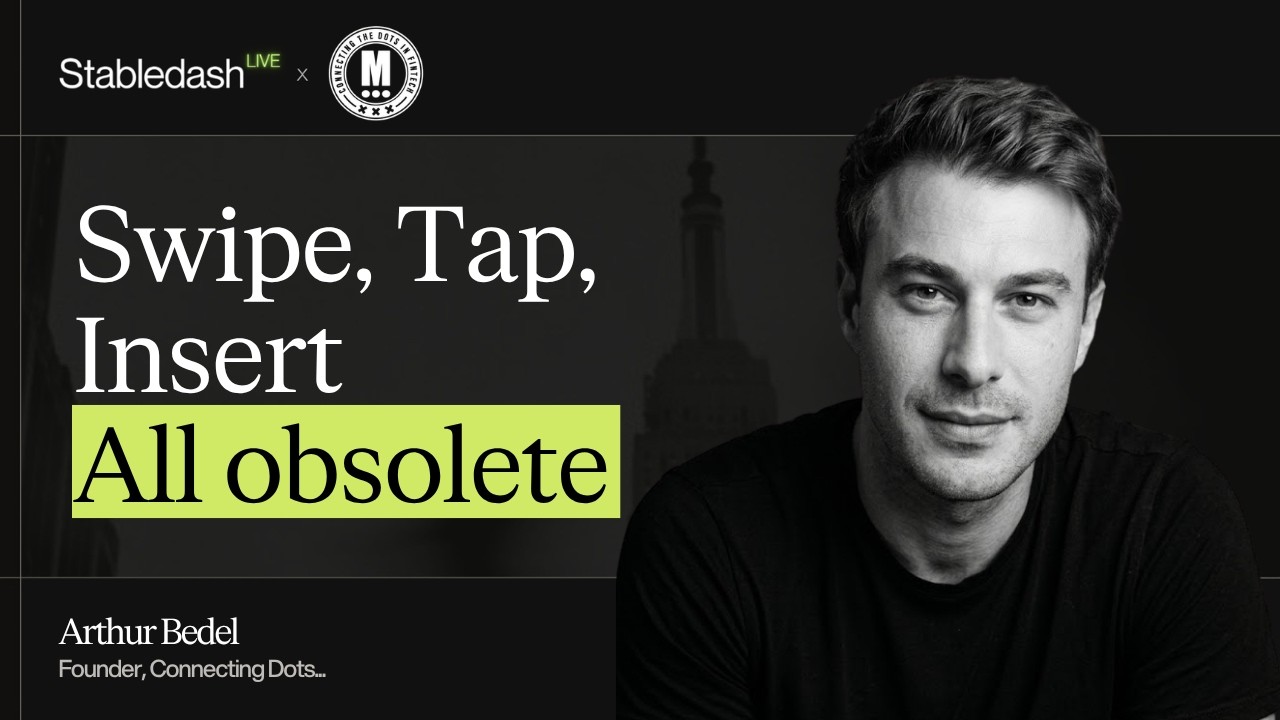
Arthur Bedel
Transcript
37 turns, about 6000 words. Straight from the recording, so it reads like speech.
Arthur Bedel
guest0:00
Hello, everyone. Hello. Good to see you. Got all the confetti. We saw confetti. The We got What are we celebrating? What are we celebrating today? It's a good day. It's just a good day. Like, I went on a run this morning. They're they invented the 5AM club in San Francisco. There's a reason. I would say, like, I lived here for six years. I'm here just for two days. And, yeah, that that run whenever you see the sunrise, it's it's pretty difficult.

Zach Fowler
host0:26
Running in San Francisco is it holds a dear place in my heart. Are you in the city? What what part of the city were you running through, or what part?
Arthur Bedel
guest0:35
I didn't like Embarcadero.
Zach Fowler
host0:36
I ended up in, like, the Marina, Fort Mason. I did that the entire thing. It was Like, overlooking the bridge and all that? Yeah. Of course. I'll send you a picture of it. That's so cool. About it. San Francisco is great because it's so small. It's not actually, like, that big of a city where it's like if you run a meaningful distance, like, you can really get a good vantage point of a ton of different parts of the city.
Like, The Panhandle is Zach knows, like, there's a special romantic place in my heart for The Panhandle and the Golden Gate Park. I love Drew speaking

Drew Rogers
host1:06
really fondly. This is from a guy who was hit by a car running in San Francisco. That's true. I love that you still have positive numbers about it. I mean, it it's just that good, I guess. It's just like It's just that good. It's just that good. We hosted our ever first
Zach Fowler
host1:20
very stable dash in San Francisco with CAST. Shout out to CAST, a new supporting sponsor of the show. But, yeah, man, Arthur, let's talk about you. Thanks for joining. You have so many interesting roles in the industry. And how do you, when you meet someone at a conference, even present or position what you're focused on right now? Because it's it's been fun to get to know you, but you're doing a lot of amazing things. So how do you position it?
Arthur Bedel
guest1:46
I first of all, guys, like, thanks for having me. It's a pleasure to be here. I guess in in in general, the the way I would describe what I'm doing is, yeah, like, I'm I'm a fintech adviser, and I'm also, like, the the cofounder of Connecting the Dots. Connecting the Dots is probably one of the largest modern media platforms covering payments, banking, fintech, Marcel Van who started it, and, basically, like, I became an associate, a partner, and and continue to scale the brand with them.
It's taken a scale that we we never really envisioned, but that was kind of the foundation. I was always passionate about innovation, nice tables, and and everything else, which are, like, kind of the keywords right now. And so, like, right now, I'm to build my own brand and that that voice and authority in the payments and and and fintech space as well as, yeah, like, taking on kind of a portfolio of companies and helping those companies scale in in in the same space.
So, like, anyone kind of focused on innovation, like, of course, have a limited amount of time, but anyone focused on innovation, intelligence and payments, and and in fintech, the the modernization of banking infrastructure, all of that ultimately are things that I am passionate about and try to help companies disrupt in that space. I love it. So you have this collaboration
Drew Rogers
host3:01
that became cofound or that became Connecting the Dots and Payments has really grown, like you said, to a scale you didn't expect. What was the journey to get in here? Give us the
Arthur Bedel
guest3:10
brief bio. Wow. Because I know you've had a few wandering stops along the way to become this kind of, you know, real expert in payments and real adviser in this space. Well, I appreciate. I think the first thing I would say is unless you've built a payment system, like, unless you've actually created the product, like, engineered it and everything, don't I know that anyone is really an expert. So, like, I think I'm I'm very fortunate to be talking to, like, a lot of people that are way smarter than me.
And because I'm I'm doing so right, I'm aggregating so much of that information, and I love being the dumbest in the room, to be honest with you. So it's that that's a fun place to me because I feel like I'm in the right room. That's actually how it kind of started. When I came to San Francisco, I I used to play tennis, then I failed at that, and I ended up in payments. Right? But I came to San Francisco and I did two masters.
It was kind of a dream of mine after, like, my college career to to kind of come back, and I felt like the environment was was perfect. And what better place to do that than, like, the Silicon Valley? So I come I I come back to to San Francisco, do two masters. Friends of mine actually end up going to a party in LA. I was working, so I didn't go. And there's this this this guy called Alexander Simpson that was building, like, serial entrepreneur, amazing guy. He was building a company called Bispy at the time.
He was cofounding it. He wanted, like, someone to be there in The US to help him kind of scale that business. I had no experience in that space. Like, honestly, you fake it till you make it, 100% company, like series a, about to raise a series b. Everything still had to be built in The US. Joined him on journey, learned a lot, and then kind of, like, that was a fintech company, a buy now, pay later because from b two b.
And as that kind of, like, you know, evolved, I started, like, being more passionate about payments, and it was, like, an easy transition towards being more in the payment space. So I joined a company called Nuvae to open up and and kind of disrupt the The US business. And as I did that, I realized I knew nothing about how payments actually worked, and I was in a sales role. And as that kind of first, I hate selling.
But as that kind of, like, happened, I was like, well, if I'm gonna be talking to some people that are managing payments, like, that are building it, I better know what I'm talking about. And so I started learning about things, and and at that point, I was like, if I'm learning about things, why don't I just start posting about them on LinkedIn? And I was connecting with people from the payment space, and that kind of grew.
And it took an end very unexpected turn over the past, like, you know, three, four years now of resonating with my audience and and and ultimately building kind of that presence and and hopefully providing value to the people that that have been following me for for a period of time that continue and join VGS, scale that business, amazing people, Chuck, Jeff, really, really taking a step deeper into payments because that was, like, payments data, so infrastructure.
And then after that, like, as as that was continuing to grow, like, I was approached by a lot of different businesses to help them scale. So to come that journey of, like, wow. This is fascinating. A company like Deuna is is building payments intelligence, a company like Defense, very, very close to Clarus and Chris, like, the the building kind of the the newest way that banking and financial structure should be operating, company like Brace.
Like, all of those businesses out there are just, like, revolutionizing and redesigning how payments and fintechs are operating.
Drew Rogers
host6:25
And so, like, that's that's the journey to to this point. I love it. And what do you so now you have this idea. I love it. You're not an expert. You're a synthesizer. You're seeing all this stuff. You're constantly learning. You're putting out what you're learning. That's a great way to be. Sometimes I've heard it said that answers are getting cheap, but questions good questions are expensive right now. So it's good. Beautiful. That's beautiful. Say that again.
Answers are getting increasingly cheap, but good questions are expensive. Just frame it. Yeah. Frame it. I think we should end I think we should end the show right there. I think that's I think that's enough. I think we're good. Well, let's oh, let's see if I can ask a good question of Arthur. Yeah. Alright. You you give us a good one. We'll see. I don't know how expensive this question is, but I wanna know. You're seeing various trends. Right, Arthur? I know you're watching it.
You're watching what's happening in payments and traditional banking and stablecoins, all this stuff. What are some of the movements
Arthur Bedel
guest7:21
then in money movements that you're really excited about or you're watching very carefully right now? Well, like, there's really, like, two major disruptions happening, like, right this second. There's a lot of them, but two major ones. So, like, one of them is is the rails on which payments are currently, you know, like, being processed that's that are evolving and and and becoming increasingly better, just faster. The technology behind is, like, this case, for example, like, stablecoin rails.
Like, the blockchain is just such a more capable technology that's being used. And so it's it's more than, you know, like, we're we're looking at assets or or use cases that are being built on the blockchain, but the technology itself is incredible. So, like, I think the rails are something that is currently really disrupting how payments has been operating. Because if you think about it, payments is an old industry. Like, payments was actually built for card present.
Like, everything that we're currently doing was built for card present. And so the world in which we live in today is so different. Like, that has to evolve. Like, soon we're gonna have more agents present than actually actually humans. Right? So, like, we have to accommodate for this. And the second trend that I would say is is is really, really interesting is the adoption of AI. We've had, like, machine learning to an extent in this space for for a period of time, but honestly, it's rudimental.
Like, there there isn't that much of a, like, eureka moment. It's been just, you know, like a decision tree and kind of sticking to that. There hasn't been any thinking benchmarking or real understanding of how payments are are like, even from processor perspective, how payments are actually, like, processed. And so I think intelligence is going to really disrupt how how payments are are are being, yeah, being processed.
And then I would say, you know, touching back on on the blockchain and everything else, I think when we talk about payments, at the end, it's money moving from one bank to another. Mhmm. Right? One account to an account. And I think that the account systems, so, like, banks are modernizing today, like, their infrastructure. And so that's also gonna redefine ultimately because they're the core actors. It's gonna redefine, like, how payments and banking and all of financial institutions capabilities
Drew Rogers
host9:29
are are gonna evolve. If yeah. I mean, you think about that evolution. Fast forward with me to 2040. We're in the world of 2040, the world of finance and payments in 2040. I wanna think about we had today the Clarity Act got through the banking committee. There's this sort of TradFi crypto tension, lots going on there, but but we are advancing. And if you think about how does how do payments how does banking how does finance look different if we just fast forward to when we're old gray haired men in 2040?
Arthur Bedel
guest10:01
I don't know. That that might be you. I I won't be old nor gray haired. You'll have a good stand in Miami playing tennis. There we go. That that that's what I'm talking about. I guess, like, a few a few changes will happen. One, we're gonna hit hyper personalization. So everything that we need as consumers or any anything that businesses need, I think, will be hyper personalized. All of the different financial services will be available on demand. There will be a lot of, like, aggregation of platforms.
Like, today, for example, you still look at payments, like, you have multiple rails. Right? And then you have local rails in, like, specific countries. Then you have, like, the card networks. Then you have the blockchains, etcetera. Then you have, like, bank to bank transfers. You have wires. Like, you have so many different rails. And so as that kind of happens, I feel like all of them will be interoperable. Everything will be connected, and and that will make, like, payments or money movements, I wanna call it.
Like, payments, I think is the wrong word. Money movement be so much more efficient, so much more global. And it won't just be just the the payment component of things. I look at the financial systems, and I think, you know, agents will have, like, their own almost like mini bank. They they they'll have, like, the ability to not just have a wallet, but, like, have a lot more services, like, almost like a like a super app, like a like a banking super app just available for agents. Right?
And I think I'm seeing this at a scale which is, like, it's evolving so fast, where AI is just going to disrupt the way that our lives are being lived. I think that the world that we know today, like, the evolution, like, it's gonna continue to be exponential. And so, like, you know, like, I think twenty or twenty five years ago, the smartphone came out or something like that. Like, I think that, like, in a year, we're gonna look at, like, what's happening on on on the agentic front and, like, how we use agents.
And I think, like, it's gonna be, like, just the norm. Like, the new generations coming now are just gonna use them. Like, everyone is going to be savvy. Creating tech, creating apps is going to be super simple. So, yeah, I think 2040, if I have to say, like, everything will be hyper personalized, agents will be the one ultimately, like, creating everything for us and purchasing on our behalf and moving money for us.
I think that's a lot of like, maybe a hot take, but trading trading is going to be, like, dumb at this point because, like, it will just be done by agents. So, like, trading is a zero sum game. So, like, how do you win now? Like, who has the better agents? But at at the it's going to be like the economy, I think, is gonna change drastically in the way that it operates as as its core because it won't be humans competing against humans. It'll be agents competing against agents. So I see a massive, like, redefinement
Drew Rogers
host12:37
of the core principles of how we live and and our economy today. In some ways, trading is based on human error and human ignorance. That's where there is alpha. And if you depending on how good your agents are, if they have all the data, if they have all the information, opportunities could massively shrink. Yeah. I mean, a deal There's also less less friction between, like right now, the difference between acquiring
Zach Fowler
host13:02
a, you know, S and P 500 stock in The US is pretty low friction versus, like, an exotic currency or an exotic bond somewhere. Like, current currently, we live in a world where, like, there is a pretty stark difference between what is the asset and how hard is it to get it. And there are, like, premiums and spreads built in depending on what asset you're talking about or moving from one asset to another.
I think in an agentic world where, especially as more of these things become tokenized, the friction of getting them and moving between them is gonna almost become a race to the bottom. Would you would you agree with that, Arthur? Like, how how the trading operation actually evolves?
Drew Rogers
host13:46
I would say that's pretty spot on. But I will say there will be new opportunities. Like, it makes me think what you're saying through this sort of inaccessibility, creating opportunity. I'm thinking about private markets. And if you wanna get in on a compelling private market, if you want to get in on SpaceX, it's somewhat difficult right now. It's kind of you have to know someone, some kind of SPV, some kind of syndicate. You have your own fund.
But there's opportunities for sort of hard to reach markets, whether that's we've talked about on the show traditional markets that are you can't trade, say, Tesla stock in India, but there's also we can trade that in The US, but what are the things that your average consumer can't trade? Well, they can't trade private markets. Could we make those more accessible? There's all kinds of sort of ways where, like Yeah. People have ways to make their I think that
Arthur Bedel
guest14:36
the thing people are gonna trade on is data. Like, I there's a company I invested in, and and the founder is a good friend. His name is Kevin, and the company is called Royalties. And they're making humans an asset that you can invest in. So think about a celebrity. You can go and you can invest into, like, a celebrity, and you can get a part of the revenue. And I find that fascinating. Right? Like, you don't have to invest in just companies. You can invest in in the people.
So let's say you don't wanna invest in Tesla. Okay. Great. Invest in I find that, like, like, crazy. So I thought it was a really good idea, and I think I was talking about it with my good friend that leads he's the head of AI at a company called YouR AI. They're creating, like, a digital twin of yourself that can ultimately, like, come in and and perform the task the everyday tasks that that you wouldn't you wouldn't wanna do, so, like, replying to emails and and things like this, but so much more, actually.
Really cool. And he was telling me that, yeah, the models are important, but it's what you train them on. And ultimate like, the data itself is going to be a currency that, like, we need to get access to. So I think getting access to information, like, which is as old like, this is an old, like, concept. Right? Like, information is is gold. And I think that is going to be something that most people wanna trade on and wanna bank on because the right information will give you access to everything.
So data is gonna be queen. Yeah. It's interesting to compare that reality with the current reality in payments and finance generally where there are there are so, so many even categories of business that are just built on top of building spread or building
Zach Fowler
host16:04
economics just in between certain flows. It's like trading, payments, PSPs, like, all these different categories for all these different reasons. They're mainly in the business of, like, taking a little slice when value moves from one place to another. In this new world, because of that friction being so low, like, it it it's probably not the most defensible business to go build is, like, the slice of the pie business in my mind.
So, like, I think that's a good point and and maybe, you know, like, hot tech for every processor out there.
Arthur Bedel
guest16:35
If payments become just a commodity, it kind of is already, but it it just becomes one thing like that. Like, why even charge a cost for that? You should charge a cost on on what it actually does to someone, like, in my personal opinion, which is, like, sold a million dollar contract. Right? And I was able to get paid for it. Well, great. I don't think you should be charged on, like, a cent, right, on on transaction like that.
I think you should you know, giving the ability for someone to purchase is something that should be monetized on on on a value perspective. So if you enable, like, a million dollar value, then you should take tick of that. You enable a $10,000,000 value business or contract to be made. You should you have to you should take a tick on that. I think it's it's intelligence and
Zach Fowler
host17:15
Mhmm. Yeah. Like, that was It's the same it's the same thing. It's just attributing who is to who is to be credited with the trade or the transaction versus benefiting
Arthur Bedel
guest17:25
the infrastructure you're using to do it. Exactly. I think That's interesting. I'll give you an example. I was I was just in Peru with EntityData, and one of the biggest regulation changes right now is the the country is creating a a local rail. So think about UPI or think about PIKs. And so, like, the some individuals from Peru went to India to study UPI and learned from, like, their mistakes and what they've created and how that actually behaves.
When you have a local rail, like, it changes the economics of how banks are gonna monetize payments there because it's gonna make just you know, everyone gets access to that rail. You don't need there's no barrier to entry now, everyone can actually process payments. So now, like, from a payments perspective, like, how do you monetize?
Like, banks have to change that, and it's access to the consumer, and it's the data that you're gonna get access to and what you can build on top of that data that will be monetizable. So, like, if the banks start losing access to the consumer, then they're gonna just become a back end infrastructure. They're gonna lose all of their value. So it's those type of changes that I think people need to ultimately really pay attention to.
One thing we are not touching on right now, but it's every region have different regulations. And when you asked me, I think, before about, like, 2040, I would love to see more global regulations put in place where, sure, Europe wants to do something. Great. Awesome. MENA wants to do something. Great. Awesome. LATAM, each country. Right? Like, we should if we want, you know, even more globalization, if we want, like, AgenTik to continue to scale, regulations will need to follow.
And for regulations to follow, we need more first, like, no wars. That would be great. But the second is is we need a lot more collaboration between, like, leaders of this world on enabling kind of the continuity of of of globalization and just, like, global global commerce, which is complicated,
Drew Rogers
host19:11
unfortunately. It's interesting. On a day when a lot of people are talking about US regulation, Clarity Act coming, passing the banking committee, makes me think about, that said, this world is so global. Hey, we got Clarity Act coming down. Test we're testing new features out. You're saying, you're you're saying we've got enablement and sort of acceleration of these in the modern money industry is going to happen when regulation comes in, other rocks.
But when it's so global, this global collaboration, global regulation might be needed. And you think, wow. How could that happen? You know? All these leaders just wanna be at war with each other. But you know how you get somebody's attention is you grab them by the wallet. So maybe the money will make them pay attention. Hope so. Martha, you you were I was just looking at your a quick snippet of your speech that you gave. Was it in Peru
Zach Fowler
host20:02
about the kind of this cash heavy market that's changing? What was that what was that speech about that might be a good thing to just quickly dive into if you have a couple more minutes? The
Arthur Bedel
guest20:13
speech was very much about the implementation of a local local realm in Peru, like mimicking what they've done with UPI. Like, I might have told the banks that they would become blockbuster if they weren't actually behaving and starting to, like, making some moves. Because, again, like, what you've seen in in India is today, you know, banks are just, like, providing accounts and things such as but those accounts can also be provided by fintechs. And so, like, the consumers are not owned right now.
Like, the the the interaction of the consumer is not owned in by the banks in India. They're actually owned by PhonePe or Google Pay. And so, like, banks have lost a massive part of their business. Let's say before you needed to make a transfer, you would go to your banking app. Now you can go to, like, Google Pay or Fonte and make a payment directly from there. So banks don't have access to the data anymore from, like, all of the context that you get from having to check out.
So, ultimately, fintechs got access to this. And the context is in in in Peru, they're gonna build that rail. It's already in motion. Great. But that's gonna create more fintechs from outside to have the ability to come in and start, like, you know, coming to Peru and disrupting it. But the banks have also a massive opportunity because they have VIP and clean, which are the two, like, prominent wallets, which when India started with UPI, they didn't have, like, the the common law is very cash heavy.
But because they have the Appian Clean, and they already have, like, 18,000,000, I think yeah. 18,000,000 customers, like, already on those, banks are are behind those two wallets. They have the ability to continue to invest into those, create super apps to diversify from those payments, embed more services around it, and and continue to, you know, like, be the ones interacting with the customers.
But if they don't start moving to create those super apps and invest into those services and continue to capture, like, those consumers and Shen, it will be it will be a little bit of a problem. So that's those are the conversation that we're talking about. Stablecoin rails also were mentioned just like everywhere else and and intelligence.
Zach Fowler
host22:14
That's a cool point. Looking at those three kinda the three big pictures you mentioned here at least that you posted about. UPI is just the first of three forces, Open Finance is next, Magenta Commerce after that. Any any kind of final thoughts on your time spent here?
Arthur Bedel
guest22:30
Yeah. So like Open Finance is gonna be data based. And so, like, what's gonna be happening is is that local rail is gonna enable data to flow in between more parties and more data to be accessible. And so because of it as I said before, data is clean. And so because of it, like, that will be something that that really empowers Perot to continue to grow, and then AgenTik can will sit on top of this.
If data is flow and and and shared, then AgenTik can start, like, being something that they look at and do that quite quickly. So, yeah, I would say every single not just Peru, but every single country should be thinking about how do we start, like, having the right rules and regulations, but sharing data in between all of those parties to continue to innovate. Because, like, AgenTik is coming, period. It's already here. So interesting.
Zach Fowler
host23:15
More more data is queen. Let's go. I think there's there's a lot more that we can talk about. I know Arthur, teased a couple of things we were thinking about internally when it comes to data, streaming of data. So more to come on that. This has been fun, man. Would love would love to have you as a regular show. And shout out PayUp. We've we've been loving following this. We don't wanna let you go without shilling shilling PayUp. What what's up with PayUp?
Well, PayUp is just like an initiative that I was like, a lot of people now, like, create content that's written,
Arthur Bedel
guest23:45
which is what I started with. But I have a feeling that, you know, like, to make things resonate, I wanted to take it to, like, a new whole new level and and start, like, video content. So I hired, a head of marketing, and PayUp is an initiative to, like, dive into one specific news every single day and actually deep dive into it so that everyone can pay attention to it, do that on every single platform. So not just LinkedIn anymore, YouTube, TikTok, Instagram. Yeah. And the edits are nice.
They're getting they're getting better. Every every every episode or every update we get is just a little bit better. I like it. I appreciate it. I I'll I'll tell my head of marketing that that he's doing a good job. But, yeah, like, the goal is to make finance fun and not an old industry, but a place for everyone to learn and just, like, engage with, like, what's actually happening because there's some crazy stuff happening, which I'm a nerd, but that's fun.
So I'm trying to, you know, break the barriers and the the,
Drew Rogers
host24:39
yeah, the codes of, like, the financial industry and make it accessible to everybody. I really like it, Arthur. I think your stuff always reminds us and your many viewers and listeners and readers out there. This stuff is not far in the future, whether we're talking about EngenTix, Stables, all these various trends. Like, stuff is now. It's happening already. It's just a question of how it gets applied, regulated, rolled out, but it's it's already here. It is.
Arthur, any other than Stable Dash, of course, what other creators or brands or educators
Arthur Bedel
guest25:11
do you enjoy learning from or following in the kind of fintech or money category? Any, like, newsletters or things that you consume that have been meaningful to your growth and learning? So, like, first of all, about Stable Dash. Like, you guys have done something absolutely freaking incredible. So, like, please keep going. Firm believer, and we'll do we'll do some cool stuff together as well. I would say, like, from a live show perspective, like, you guys have the one that I watch the most. So, like, that's one.
Obviously, like, please go follow Marcel. Like, the man has, like, 300,000 followers, I think, on LinkedIn. Like, he's a big inspiration for me. We continue to innovate together, and I think a lot of cool stuff will come. I really like Duane Jeffrey. Like, his take is always raw around, like, very much, like, data driven, good background, knows what he's talking about. Alexandra. I I love someone new goes called Gaspar, Subify. He's doing some really cool stuff as well.
Zach Fowler
host26:06
And then How do spell that?
Arthur Bedel
guest26:08
Guess what? Yeah. D a s p a r d, I believe.
Zach Fowler
host26:15
Check Wouldn't have gotten that right.
Drew Rogers
host26:17
Yeah.
Zach Fowler
host26:18
P a s Yeah. I got him. P a r d, Lessen. Yeah. Yeah. I actually was looking at this guy yesterday. Cool guy. Someone was flaming him. Who was it? I think it was someone from Dragonfly. I don't know. He put something out, and someone ripped it ripped it apart for some reason, but you gotta shoot your shot. Yeah. Like, why not? But Why not? I would say, like, maybe to give one or two more shout outs. I think it was this. This was the thing that sorry to cut you off, Arthur.
This was specifically the post that I was looking at. I'm wondering if you did you come across this one from this guy? Didn't come across this one. This was the forgetting who it was. It was on x, but this was the post that got it was like, whoever said this was like, let's stop doing this. Let's stop, you know, embarrassing ourselves with these like, what but I was like, what is someone what's so embarrassing by this? I think it was someone from base. So it was like The logos. Yeah.
It's sort of intentionally positioning base. You know, like, what I what I would say is is is one thing. Right? Like, with with creators,
Arthur Bedel
guest27:22
I think in general, we don't know everything. Like, I I don't think like, people see us as authorities and stuff. Like, I'm sure, like, we do, like, for for most of us, like, we do the research and stuff. Like, I I got grilled on this once or twice. But I I think, like, we have a brand and everything. We're welcoming criticism and and feedback. You don't need to destroy someone. Like, I think we're we're just trying to, like, have a have a positive impact.
So sometimes, you know, some actually, like, let me take Most of us are trying to have a positive impact. Some of them are crooks, but that's a different story. I think it's I mean, I met him. I can vouch for him personally and and and Will. But, yeah, like, I think sometimes, you know, like, you can also be wrong. In this case scenario, like, the logo and Visa and Mastercard probably should be updated and and things like this. But, like, I really like what he's doing.
I saw a video from someone called Dan Agrizione, I think. It's called one life, and I would urge anyone to go up there. And what it basically says, it's it's don't stand in line. Stand out. Be the crazy one. Just go out there and just be you. Like, you have one shot at this. Just go and kill it. Like, be different. And and and I think, like, making mistakes is just part of this journey. So just for anyone out there that's thinking about doing it, just just don't think twice. Just go and do it.
Whether it's creating something, like funding something, investing in someone, you will lose more time, and that's the Bezos mindset. You lose more time in thinking about things 15,000,000 times than actually doing them and learning from them. So, yeah, I I would like to just give a last shout out. Like, I met Simon Tedder, like, not too too long ago at Agent Connect that we hosted with VGS. Damn, that man is knowledgeable, and he's fun to be around, as well as Rafael from from the Big World.
Like, all of those guys, like, there's really some really cool people out there. You guys are part of it as well. So, like, thanks to everyone ultimately contributing to making this industry actually cool and for nerds to be able to have fun while while while working on things that actually matter and impacts billions of people. 100%.
Zach Fowler
host29:19
Fun place to end, Arthur. Thanks for joining us today. We'll do it again. Have a great rest your day in San Francisco. Appreciate you.