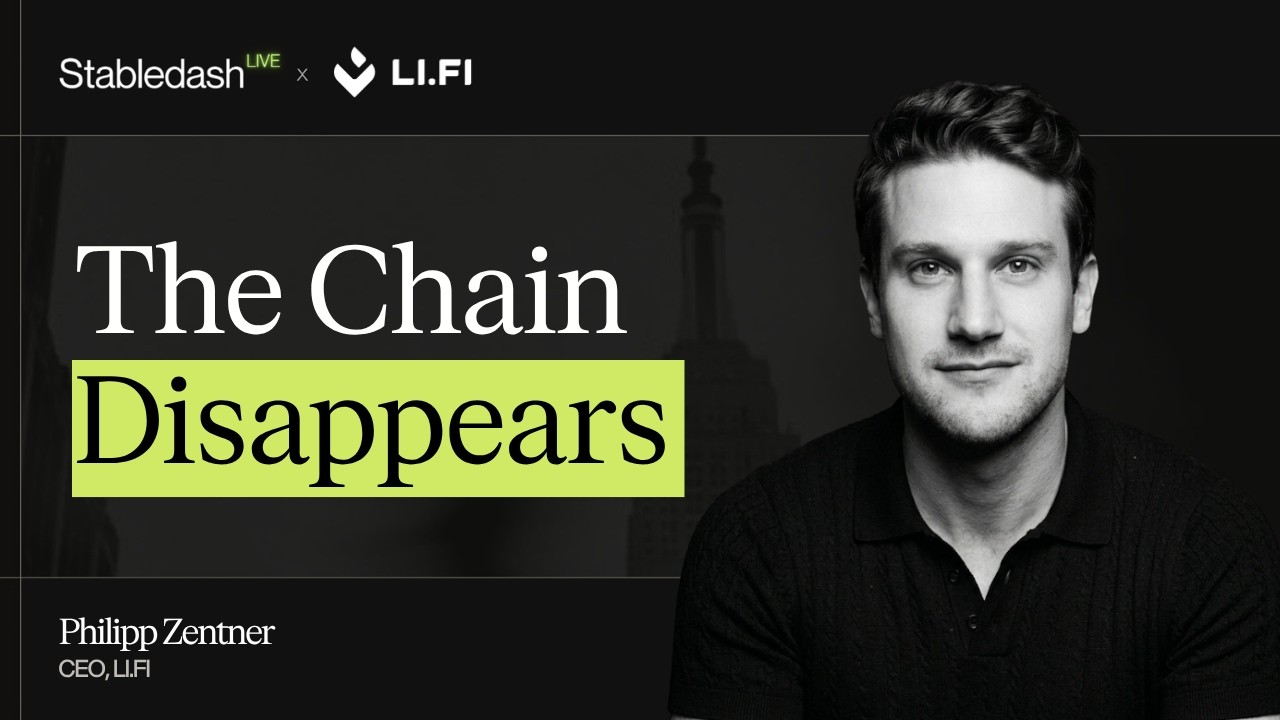
Philipp Zentner, founder of LiFi (Linked Finance), discusses his company's infrastructure platform that aggregates DEX aggregators, bridges, and yield protocols across 70 blockchains to provide developers and applications a single API for multi-chain swaps and asset routing. Originally started as a bridge aggregator five years ago, LiFi has expanded to offer comprehensive same-chain swaps, DEX aggregation across platforms like Jupiter and 1inch, and recently launched an Intent system allowing third-party solvers to compete for best pricing. Zentner emphasizes that modern DeFi applications prioritize user experience—allowing users from any chain to seamlessly swap and bridge assets into applications without leaving the platform—and highlights the Solana community's consumer-focused, scalable building mentality as distinct from Ethereum's more idealistic approach. LiFi powers Jumper.exchange, its B2C interface for multi-chain swapping.
Transcript
15 turns, about 1800 words. Straight from the recording, so it reads like speech.
Philipp Zentner
guest0:00
Thanks for being here. Thanks for having me. Nice to meet you. I got to I got to meet your team last night at my dinner already. You came with Chats. Amazing. Yeah. It was really good. Got it. The Frontier Dinner Series. We're we're excited about the Frontier Dinner Series, aren't we? Okay. So give us the intro. LeFi, what are you building? What's the story? How long it's been around? Give us the info. Yeah. So when we started LeFi around five years ago, '21, we we looked at the space and we saw it fragmented.
We saw tons of chains coming up, lots of exchanges, exchange aggregators, cross chain bridges, and we're like, hey. If I'm an application, and I need to access all these solutions because I wanna get the best price. I wanna have full route coverage. I wanna have fail safety solutions. So whatever solution is down, you wanna have a backup solution. Right? So you kind of need to integrate all these different systems, and you wanna have a smart auto router on top of that. So this is what DeFi provides.
We aggregated all the DEX aggregators across 70 chains, all the bridges in between. So the Mayans and and all bridges, all these different bridges come out of the box. And as a developer, you just implement one API. Everything's homogenized, and it just takes away the pain of building. You go to market much, much faster. And we serve all the large wallets from Phantom, MetaMask, Robinhood, Coinbase to Yeah. Tell me tell me about these developers.
So is that mainly the customer that you're you're facing with most of the developer in the building with this API? It's developers and typically product managers. Product managers like, hey. Want to go to Marco Fass? Also, you gotta build a great user experience. Today, it looks, so back then, the pitch was essentially, hey. Get multi chain capabilities. Today, it's much more about user experience.
So you, have your application on Solana, but you users coming maybe from Arbitrum, so you want to be able to allow them to take any asset they have on any chain, select it, and then swap and bridge and zap it right into your smart contract. And this is what DeFi is building. So you have chain extraction essentially, and you can only use a journey end to end. You don't have them, you don't have to send them away to an exchange or bridge to then come back to your application or not.
Especially, Solana developers are so user experience oriented.

Drew Rogers
host2:00
Thanks, Cloud. Exactly. That that that's what made you big. But but the the reality is that nowadays, everyone is multi chain. Yeah. And what were some of the teams in the smaller ecosystem that you work closely with? What people with great user experiences that you enjoyed
Philipp Zentner
guest2:14
being around? Oh, it's something like Phantom and Drift. There's actually but there's, like, hundreds on Solana
Drew Rogers
host2:21
and a thousand overall. What are the problems that you feel like kind of give them the maybe it's a discovery call or, like, hey. Here's what we can help from it. What are some of those moments or things that they really feel like, oh my gosh. Like, I don't have to do this anymore? Like, what what are those moments? You know what you know what's funny? We started as a bridge aggregator.
Philipp Zentner
guest2:40
And Who else is doing that? Get there are a couple other folks in the space. Used to be. They're kinda all that. Okay. Like, bridge like, all of that. They at least in b two b, they do not show up anymore. Why did they die? Why was that now successful? B two b in crypto is extremely hard, and the margins are very thin. It's kind of the winner takes it all. Right? So and and that's where we really excelled, essentially. We we don't see competition anymore. Not direct competition.
We are more competing with the underlying solutions, with single purpose solution. So the single DEX aggregator, the single bridge, it's a friendly situation. They kinda like us because we send them order flow, but then, of course, we also make it a race to the bottom for them, which wouldn't happen anyways. Right? Either the application is doing it or I'm doing it. It doesn't really matter.
But for the whole industry, LiFi is very net positive simply because everything progresses faster and and altogether, everything can go to market faster and is abstracted, from the get go. So ultimately, it it helps this space progressing. What many people don't know is we started as a bridge aggregator, but nowadays, it's not only that we are the most comprehensive same chain swap,
Drew Rogers
host3:42
provider. Stable chain. Say that say that slowly. Comprehensive,
Philipp Zentner
guest3:46
stable chain swap provider. We are not the the most comprehensive same chain swap. Same chain. Yes. So so what Jupiter is doing but we do it across Jupiter, across Titan, across one inch, across all these other DEX aggregators. On top of that, PUB aggregation and yield aggregation. So our product portfolio has expanded a lot, and that's what most PNs don't know. So they they come to this call, and they're like, oh, damn.
I get all of this out of the box, and that's also why lots of neobanks are starting to work with us, for example. Amazing. Amazing. I feel like the rise of neobanks in the last twelve, twenty four months has been absolutely wild. So if I'm a neobank product manager developer,
Drew Rogers
host4:23
what can I now unlock within my platform that lie that LeFi provides? It's not LiFi, by the way, you Americans.
Philipp Zentner
guest4:30
Levi. Turn it out. Thanks for clarifying that. Historically short for Linked Finance. That's why it's Levi. Oh, I got five. That's a great it's a great domain. Right? It's amazing. So the 12 year old me was like, oh my god. I got a four character domain? It took me six months to get it.
Drew Rogers
host4:46
How did you get it? What was the story there? There was so.fi
Philipp Zentner
guest4:49
is Finn, Finnish. And the domain was registered, like, in nineteen ninety something. And that guy, back then, you had to become a so called what was it? You had to become a doom domain warehouse, essentially, in order to be able to get get the get domains at all. It was not possible to get domains unless you sign up as a reseller. So it he'd it took us a while just to figure out how to transfer that domain because it was actually not really registered. It was, like, bought by, like, a name like a name sheet.
I don't know how you how you call these type of companies. Yeah. It was it was a tricky situation. It took some time, and, also, I needed to convince him to put in the effort. The answer was money. You feel like you got a good deal on it? Yeah. Very good deal. You were saying I know you gotta run here to another thing, so we will keep this brief. But
Drew Rogers
host5:39
you were saying that you've gone through many different evolutions of DeFi and how you explain it, kind of the progress of, like, the business. As you look into the the rest of this year into into 2027, I think even feels crazy to say.
Philipp Zentner
guest5:52
What are some of the things that, like, as you continue to evolve, you you're excited about looking forward? I'm super excited to launch our Intense system. We just launched it essentially. What it allows is that everyone can become a market maker. It's an open marketplace. So we have this combination now of very massive aggregation of solutions. On top of that, we have a a marketplace where third party solvers can simply compete for the best price. But what it unlocks is really it allows to cover the gaps.
If you're an application, you wanna make sure there's enough liquidity for certain assets, you can plug in your own liquidity. So it it just allows us to win much larger clients that have the ability to provide liquidity and then only for their own order flow and things like that. So we can do lots of custom things now, and that really allows us to take, DeFi to scale in a in a way. It's amazing. It's amazing. Alright.
Drew Rogers
host6:44
What do you wanna leave the conference with? When you're going throughout this crazy day of Yeah. May May fifth, you're gonna be bouncing around, going to parties, going to events, going to meetings. Like, what is top of mind for you? What is the most strategic as the leader of this ship? Well, for today, honestly, for today, it's accelerates. So I'm hoping that more and more people are trying out jumper.exchange.
Philipp Zentner
guest7:05
It's our b two c interface. What is the domain there? Jumper.exchange. Jumper. Yeah. You guys are powering that? Yeah. We are powering that. Exactly. And it's just like one interface from multi chain swapping and bridging. You get everything out of the box. It's been around for four years, so it's it's a very good user experience, and it certainly helps to get in and out of Solana or get the best price on Solana. What what makes you gravitated toward the Solana community?
What what's so special about it in your in your view? It it is just like the passion behind the the it's a it's a different mindset. Ethereum was very idealistic, and actually, I when I joined the space, the first month I spent on Tezos, and then I came to Ethereum. And before '21, I didn't have any back. So I there's no backbites. I just naturally graduated towards these different, things. And then Solana came up a little bit later. Yeah.
And you could clearly tell that, people building on Solana, they have a different mindset around, building applications, at scale and consumer oriented and onboarding the next billion users. This mentality, you know, much more present there, whereby, Ethereum is a bit more idealistic in terms of, hey. Well, this still has to be alive in fifteen years from now, and this is how it's supposed to look like.
So things moved slower there, and then, obviously, Solana as a blockchain, amazing user experience so fast and Amazing. Reliable. Thanks for joining us. I know you're here. You for having me. I know it's short and sweet. We'll be See you around. We do this every Tuesday and Thursday. So Perfect. Happy back.