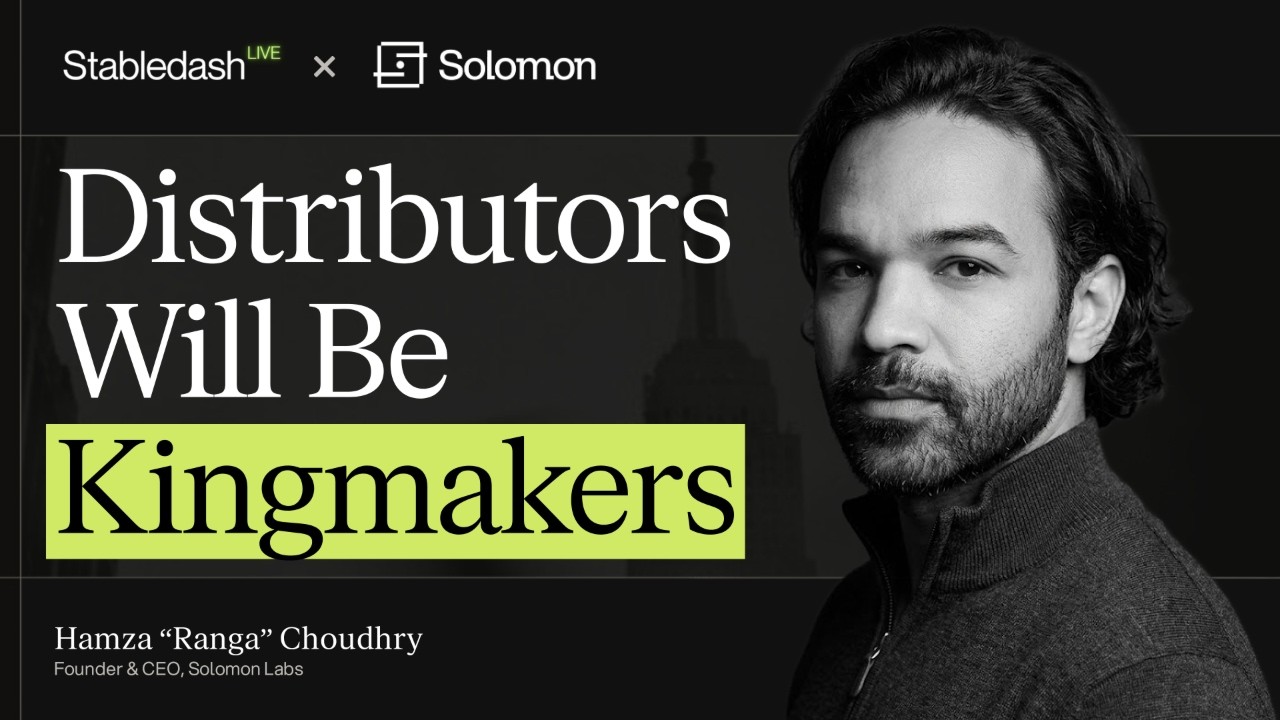
Adam Bergeman discusses Star, a permissionless fundraising platform built on Solana. He describes how Star raised $500k in 24 hours through a livestream in July, then launched "Shark," a live on-chain Shark Tank format where three founders pitch weekly to investors with conditional markets determining which startup receives funding focus. Bergeman explains Star's token models—Sutarky (on-chain treasury with tokenized governance) for crypto-native companies and tokenized equity for traditional companies—designed to let founders raise capital while remaining flexible for future venture funding. He addresses challenges around regulatory compliance, ownership structuring across jurisdictions, and the investor-founder matching problem, while positioning Star to serve 30,000+ annual VC deals and millions of new GitHub projects entering the founder economy.
Transcript
21 turns, about 3700 words. Straight from the recording, so it reads like speech.
Adam Bergeman
guest0:00
I'd like to share a brief origin story. We're the first to raise on the platform we built. No motion, no backing, just a dream and a livestream. We rose 500 k in twenty four hours. Then we turned it into a show. Shark. Solana's first live on chain Shark Tank. Real founders pitching real experts in a live 1,100,000 raised. So we built something that more of our studies. Now the markets decide.
Every day One founder, funded to pay twenty four hours for the underestimated, the undiscovered, the one building when no one's watching. No pedigree, no warm intro, no waiting, just conviction. If you're fast enough, if you're good enough, if you're good enough, don't wait. Man,
S3
0:47
that was was a beautiful intro. How recent well, that is like, wow. Great job. How recent how recent is that? The, like, where we post star post
S0
1:01
live you know, first live stream. When did that all happen? That video is not out yet. It's Oh. This this has not even been released. It's for your iDoli. Live premiere on stable dad. No. It's all good, guys. Don't worry about it. Oh my gosh. I'm so sorry. No. No. No. It's all good. So that's all good. I love it. I love it. I gave you guys the alpha. It's fair. I won't clip that unless Yeah. We'll let we'll let that live live on it. We we have a feature
S3
1:28
where I'm sorry. I didn't know. Will not I was like, man, this is be such a good clip. Oh,
S0
1:33
man. Didn't happen. I it's it made me smile it made me smile to see it and watch it back. We're launching that tomorrow, actually. So we're when you say how how far are we in relation work? We're twenty four hours in the past I'm red. From that going away. Red is a cherry plum. No. It's okay. It's okay. We'll be sure to retweet and engage that tomorrow. Fire. Fire. Fire. Fire. How far then from so this happened, like, what, in the last week? Like, last two weeks that you actually raised then on your platform? Or No.
So we raised we did our own fundraise back in July. That was like our boots bootstrap moment. We the whole story is basically as follows. We set out to raise 500 k in seven days. We were all together in that room that you saw on the video. First six days sucked ass. It was super bad. We raised like 10 k. I And was sleeping in the same room, and I remember every day I wake up and I'd look at the little like razor razor meter. Mhmm. And on the sixth day I woke up, and I was like, oh, shit.
We're it's like looks like we're not gonna make it. But we're in a room, and I was having phone calls. I was pitching investors. I was pitching founders. And I was like, should turn on a livestream and basically put a camera in the corner of the room and just stream and what we're doing because now is the time for people to see who we really are. And so that's like kinda where it all began. We raised 500 k in the last twenty four hours.
There was something about the like mimetic energy of the livestream and people seeing how much we believed in what we're doing that kind of catalyzed. And we we sort of went like mini viral, I guess. And that was back in July. Then after that, we had a a little moment of trying to figure out how to reproduce that effect for other teams on the platform, you know, how to basically solve the cold start problem.
And we realized we needed to find a very urgent and compelling reason for teams to want to raise with us, And that's how we came up with the shot, which is our live stream Shark Tank. And we did the first episode in September. It was nuts. Like, I think it was, 300 k raise in an hour. Wow. And then we did three episode we've done five episodes in total, 1,100,000 raised, the last one being mid February. And then we took a bit of hiatus. We're like, okay.
Let's figure out how to actually scale this in a meaningful way. And so now tomorrow, we're going to be announcing our new fundraising model,
S2
3:44
a weekly show, and a bunch of other cool shit that was leaked today live on stream. Oh, man. Another guest, Shimon Famoto. He said Stable Dash gets all the alpha. Because I think this is my this might be just be a trend with Drew now. Like, just, like, little friendly leaks here and there. So watch out in the DMs. You never know. I am sorry. Again, we don't we don't wanna intentionally do that, but I actually thought that was public already. Tomorrow will be big. What what is the call to action tomorrow?
Like, what are you hoping will happen? People see this video, You know, it hopefully does really well. We'll we'll support that tomorrow and be ready for that. Like, what is the call to action? I'm assuming there's kind of like a two sided marketplace here a little bit. You have the founders that are raising and also the investors or the, you know, people with capital? What what does that look like right now? Yeah. So the main call to action tomorrow is is go and apply. Submit your projects.
The way it's gonna work is we'll have a weekly stream
S0
4:34
where we'll pick the best three founders every week to come into the Shark Tank. They'll get to pitch a panel of VCs, angels, other cool founders, just dope people. And then what's different in the model that we're introducing now is we're introducing this concept called curation markets. And curation markets are essentially conditional markets that are used to trade and determine the best startup to actually go ahead and fundraise. We're trying to figure out a way on how to, like Mhmm. Distill noise into signal.
And if you look at all of the permissionless platforms that have come so far, like, that's their biggest problem. It's just like an overwhelming amount of noise, which a, deters good investors and b, deters good founders. So we're running this weekly show. Three startups will pitch. There'll be a market open for each founder, which is denominated in the conditional market cap of STAR, our native token, in the case that that startup ends up fundraising.
And so what traders are optimizing for is basically the highest conditional market cap of STAR. That project will actually get to go ahead and fundraise and then have all of the focus and capital and attention of the platform on them until the next show. So we're gonna be doing this on a weekly cadence. So the video is a bit outdated. It says every day. We're gonna be running it every week. And then as we see that scale and raises fill quickly and the model work, then we're gonna scale to a more frequent cadence.
Long term vision is to be running these conditional markets, like, four, eight times a day and have basically fundraisers,
S3
6:01
like, curated as we go. And and so when you're like, obviously, I get why you would not do this every day. I'm just going through them, like, 15 founders a week, 60 a month. Like, I don't even know if I could find that many founders in in a week. Think about But but maybe not. Like, I mean, think about how many
S2
6:17
pre seed seed growth companies right now are raising rounds today. Like, there are so many founders The I think the total addressable market's pretty massive for something like this. I guess that's why I was gonna ask is, like, where where do you see this going? I think I saw was it Paysafe
S3
6:34
or, like, a payments oriented wallet that was one company that raised on platform? There's There another one that was, I think, more crypto native. Obviously, this would probably start with more crypto native companies, but, you know, who do you want using Starz? Like, somebody says, I wanna found a organic burger chain. Like, can they come on to Star and use the platform, or is this more crypto native VC? Like, help us understand who who you want to be on Star. Yeah.
So I I think the the first answer I'll share is scaling this to multiple times a day is definitely possible.
S0
7:09
There's an abundant supply of projects that are looking for capital that are worthwhile investing in. And the reason for that is there's a couple stats I'll share. About 30,000 VC deals happen every year. That's growing like 30% yearly, especially in the age of AI where anyone can now stand up a product. There's, I think, 36,000,000 new GitHub projects every year, and that's also growing at an incredible pace. You're seeing like a tremendous amount of people switch from being employees to being founders.
I think on LinkedIn, was like 65% of people on LinkedIn added founder to their bio or to their list of experience. So we're entering what we call, like, the founder economy, and we wanna be the platform where those founders get funded. This can be, like, sort of short tail where traditional VC funding is now going, and we wanna be the first check-in for those founders. We found success with crypto native startups first because that's the ecosystem that we came from. Our investors are highly crypto native.
The next step is to break out and to basically look at, okay, frontier AI, agentic frameworks, fintech products, like, anything that's sort of crypto adjacent. Prediction markets is a big space for us as well. A lot of consumer apps we see that consumer apps have a lot of interest in this model fundraising because they're getting distribution as well as capital, which is more important for them than for, like, a an traditional infrastructure company.
And then down the line, like, yes, the idea is that if your brother is starting a coffee shop and wants to raise $50, like, we'd like to be the venue where that's possible. I think that's a beautiful idea if you can just invest in your brother's business as easy as it is to deposit money into an account. It's like Kickstarter,
S3
8:55
but less like angel investor angle. Like, you're actually
S2
9:01
there there's something at risk there. We live in a world where the reality is there's a lot of commercial decision making. Like, Adam, we've talked about this. Like, a ton of commercial decision making and influence happens completely virtually with pieces of media like this, like this conversation. Hopefully, it's done well, someone somewhere will see this. Maybe they learned something about Star. Ideally, there may maybe as an investor or someone who's thinking about getting behind this business.
And this piece of content, this this conversation can be something that is valuable to them getting to know you, your vision, you as a founder. Like, media is such a whether that's first party media on platforms like X or LinkedIn or, you know, channels like this, I think there is a a underappreciated and massively growing role that media plays in storytelling, in telling telling what companies and founders specifically are about.
And then at the end of the day, like, in the early stages of launching a pre seed or seed round, at the it's it's so focused on investors are so focused on that person, on that founder, who they are, who they seem to be. And to be able to introduce media in this form seems like such an amazing, like, two sided business that you're creating. It's it's really, really interesting. Tell us what what were some of those learnings that you like, I'm looking here. You have some past episodes, Farescale, Surf Cash, Eden.
What were some of those learnings or, like, test test use cases that have equipped you guys? What were some key things that you learned that you're now implementing into this new wave that is coming next? Yeah.
S0
10:37
I think there's a bunch. The main thing being that we realize that we are not the best curators out there. Like, we sometimes and we had a couple raises that failed, Ian Eden being one of them, which is a first person shooter financialized. You kill someone, you take their loot, and you get killed. They take your loot. Mhmm. So you're basically, like, ready player one in with real money, which to me sounded incredibly exciting. I mean, sounds interesting. It's right?
It sounds really fucking cool, but crypto gaming has a very bearish narrative associated with it. And, like, they just couldn't convince the audience despite, you know, adequate attention that they were worthwhile investing in. So we missed the mark there. And after that, we're like, okay. Like, you know, we need to find a way to What what do you mean by that? Well, so back then, we would basically pick a startup, we'd put them on the show.
As soon as they get on the show, they're pitching, and you can invest in them right away. Right? Now, what we're gonna do is we're gonna put three startups, they're competing, and we're using the curation markets to decide who actually gets to fundraise. So we're sort of like widening our surface area, and instead of having to pick the best one, we can pick our three best picks and put them against each other, and the market can kind of negotiate with them live to determine who should actually get the fundraise.
And so a lot of what we think we're solving here is it's like the investor platform matching problem where sometimes we miss the mark, but if we put more options in front of people and this can scale to, like, five, ten options at the same time as well. It's it's really more constrained on the media side than on the on the platform side. We wanna solve for that investor matching problem, basically have investors curate what they want to invest in.
S3
12:18
I have this I kinda wanna get into the weeds of this because I've I've seen a few other platforms, I'd say, like, I think SOAR is another one that I looked into recently. Zohar, as you said? SOAR, s o a r. I say this the the I love the Shark Tank component. That's, like, super original. But what is the actual ownership structure with the tokens themselves? Because I know that that's where some companies caught flack. I think what was there there was the big gosh. I'm looking at it.
I can see them in my head where they had, like, the green logos. They were similar to a to a pumped up fund, but they were very clear that, like, hey. These aren't equity tokens. There's no ownership. Believe. Believe. That's I think that's what it is. And they kinda just died off because it was like, well, then what's the point? Like, we raised these money. Where where where's the connection here? So what's the actual ownership structure like with these tokens from a compliance standpoint? Yeah. So we enforce
S0
13:11
a ownership structure, but founders get to choose depending on what model suits them best. We think that we as a platform should be agnostic and just give them the options that work best for their company. And so there's two models that we offer currently. One of them is called Sutarky, which is also what Star is. Basically, money goes into an on chain treasury. Founders get a monthly allowance sent to them.
Any amount larger than the monthly allowance or any updates to the allowance need to be approved by a proposal. These proposals use also conditional markets to trade what the best outcome should be. So you're basically, like, betting on what you think is the better outcome of the decision based on the token's price. This tends to work really well for crypto native companies where all of their assets, avenues, and IP lives on chain. Mhmm.
And then for companies that are more off chain or have a have a a part of their company living off chain, we have a tokenized equity model where founders can basically tokenize a portion of their equity and sell that on chain. So you can basically say, alright. I wanna sell 10% of my equity for That represents a 100% of the token total token supply, and then you can always issue more equity by minting more tokens.
So this gives founders the ability to, a, raise money on chain, but, b, also to stay open to traditional venture capital and traditional investors who want a slice of equity. And so an interesting example of this recently is you're looking at, the pump fund project that just got funded. I think it's called Pumpcade. They've, in total, raised 5,000,000 in funding, but there's no clear indication of what their token actually represents.
Like, they raised a bunch of equity financing, which is fantastic, but, like, what are token holders actually holding?
S3
14:48
And that's what we run this with a partner called Bedrock. That's what they're aiming to solve is basically bridging off chain equity with on chain tokens. So that's interesting that you brought that up. Like, if the in the future, they wanna go raise. Like, help us understand what do you think, like, seeing where people are now going to maybe get, you know, angel investments, go and get a pre seed seed from VCs. Do you are you trying to say that, hey.
We wanna see the full life cycle come on the star and you can go on to raise a 100,000,000, or do you see, like, hey. We are the accelerant to get you through the pre seed, the seed, and over time, it may be, you know, a mix of retail, maybe slash, like, independent investors, high net worth individuals, little bit of VCs, and then kinda seeing that slowly shift over time to being more VC heavy as they raise. Obviously, this isn't the area.
I'm just curious, like, where you think fundraising and what the how that would change for these these companies that start on Star. I think our goal is to help founders raise the capital they need to get from zero to one. That's, our main that we're very opinionated about solving that problem for founders and solving that for founders who are comfortable pitching on a livestream. So trying to be very,
S0
15:58
yeah, opinionated with who we're going after. On the demand side, we are primarily targeting, like, on chain angel investors to be the capital providers here. We'd like for VCs to participate. We're not opposed to it. But our target audience is people that are putting in, like, five, ten, fifteen, twenty k checks and bring some sort of strategic value with them. That's like the the main ICP on the demand side we're going after.
And then I think after that it this is like by the way, guys, this is like one of the hardest problems I've ever tried to solve. Actually, it's the hardest problem I've ever tried to solve because it's like capital formation. You're dealing with regulatory issues. Like, it's a we can talk for hours on this.
But I think where the future goes is I want founders to be able to raise that first check and not be hamstringed into some model that prevents them from, like, raising follow on financing or somehow structuring the company in a way that actually makes it more likely to succeed. Because they're like, the failure rate for companies is already so high, like, do not want to be the platform that is some additional, like, point of failure for teams.
So our general philosophy on this is like, design a model where you can raise your first round, and then you can go VC, or you can keep raising on chain. It should be as flexible and composable as possible because that's the technology that we're working with. What what's the hardest problem specifically
S2
17:12
about this business model? Is it is it the the difficulty around some of the red tape in terms of those things on the fundraising side, or what what is the biggest hurdle that you're facing right now as you bring this to market? I mean, I think distribution is always forever a problem, but I I don't think that's, like, specific to what we're doing. I would say, like, the complexity in structuring
S0
17:34
ownership models and investor rights around tokens. Doing it properly in the way that I just described where founders have, like, flexibility, token holders have rights, like, this is really difficult, and it's unique to every startup, and it's unique to the category and industry that they're in. It's unique to where the founders are geographically. Like, it's very, very complex. And so productizing this is not easy.
We're going to get there, but I think that operationally, like, that and then productizing it and then overseeing it over time, like flagging bugs, like making sure that founders don't do anything sketchy, that investors are still aligned, that they have governance. Like, this is really, really hard. And I think that this is kind of where if this is figured out, we'll start to see a lot more companies coming on chain and raising through platforms like Star. I hope I hope that happens. I'm confident it will.
I'm excited for tomorrow. We will be resharing that video that we mistakenly already shared, but you for the case there. I'll flip it out. I'll
S3
18:32
schedule it for, like, two We'll wait we'll wait to clip it for see that. Yeah. Cool. Great. Thanks for hopping on, man. We'll we'll chat soon.