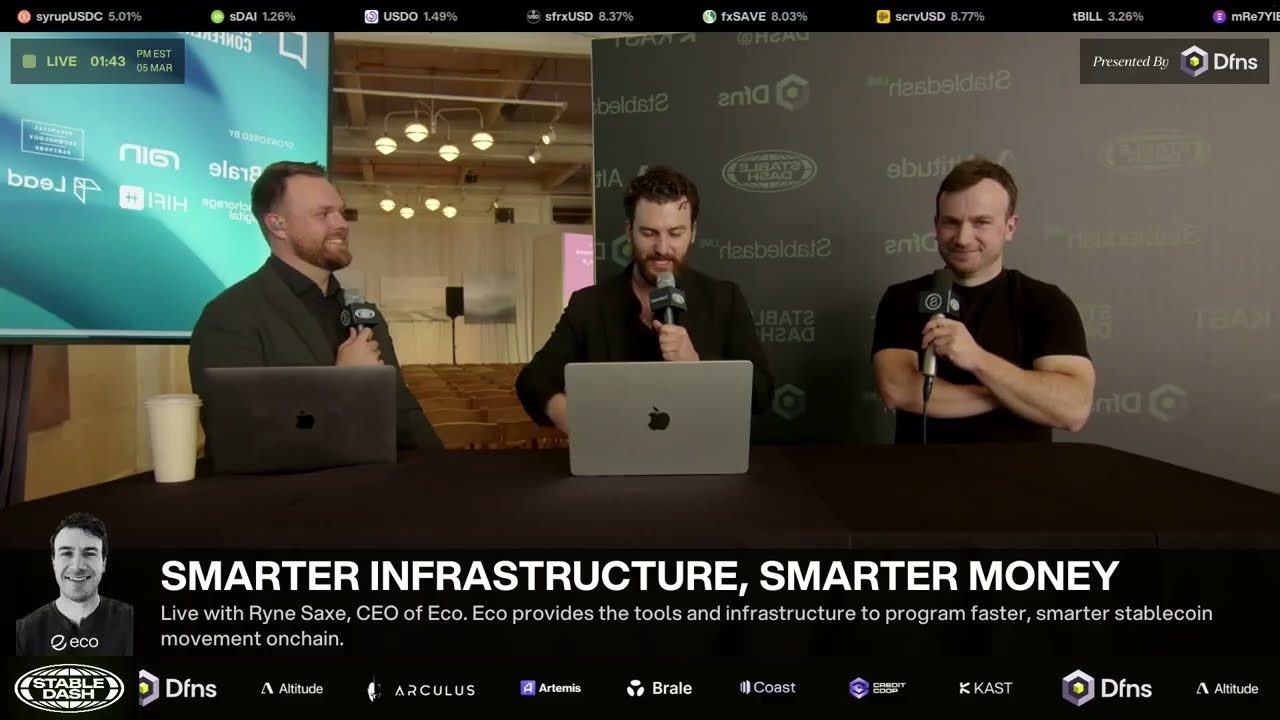
Stabledash Live · · 18 min
Stablecoin Liquidity Networks, Programmable Money, and Moving $10M in Under 10 Seconds
Ryne Saxe
Eco
Drew Rogers, CEO of Eco, discusses the company's evolution as a stablecoin transaction and liquidity network. Rogers claims Eco can move $10 million with 99.9% reliability in under 10 seconds—better than competitors—and emphasizes the distinction between being a bridge versus a full institutional money-moving infrastructure. The conversation covers Eco's multi-year journey through different market cycles, current regulatory tailwinds with institutional adoption stuck in pilot phases pending clarity on stablecoin frameworks, and upcoming initiatives like a "swag run" crowdliquidity program that rewards engagement with stablecoins, similar to their successful Costco-themed hat campaign.

Eco
eco.comEco is a blockchain infrastructure company whose mission is to build software that maximizes money's value. A founding contributor to the Eco Protocol, Eco powers real-time money movement across every major stablecoin and blockchain, ensuring dollars flow seamlessly across today's fragmented multichain landscape.
Transcript
23 turns, about 3700 words. Straight from the recording, so it reads like speech.
Ryne Saxe
guest0:00
You were one of our first conversations when we started this little podcast I was. Over a year ago. Yeah. I think, yeah, you were season season two because I was going back and looking at some of the episodes. So one of one of the OGs. Alright. Nice. It especially even in the grand grand scheme of things. So I think in that conversation, you talked about, like, yeah. Like, we weathered FTX. Like, we've been through it all. Like, stablecoins have always been the goal, and this is where we're at now.
So what what moment are you guys in this year? I mean, especially, I love the unleash the stables, the whole the whole initiative there. You guys have been doing an awesome work. You know you know, to be honest with you, I would I would probably say it's the the first right place, right time moment we've been in since we started the company. We we built a bunch of things we're super proud of.
S2
0:44
In hindsight, they were they were prescient, but in hindsight, a bunch of them were were too too too soon relative to the market cycle and the stablecoin trend. And somehow, in some kind of weird way, all of that experience is relevant. We built the infra layer. We built sort of native on chain. We built to the app layer. We've had some success at those layers that was kind of, like, seasonal. But what it's meant was, sort of we're building toward the stablecoin use case, and we've done it now full stack.
And that experience is is kinda directly informs the way we build our own for today and the way we enable stablecoins to move because we've been trying to make stablecoins move that way through through various seasons of of of crypto history. And so that's how I'd I'd describe where we are. The other thing I would say is we probably move stablecoins on chain better than anybody else.
And that's like, simply put, what ECO does, and there's fancy tech that makes that possible, and there's, you know, an interface that that makes that kind of usable. But at the end of the day, we move stablecoins seamlessly across chain and across DeFi

Drew Rogers
host1:46
as well or better than anyone else in the market right now. That that's a bold claim. I love that claim, by the You you love your hot takes. Drew Like, will get done with the interview, like, man, I had some spicy takes. This is why I'm excited. So, I mean, that's awesome. What what gives you you know, you kinda mentioned, like, you know, you've gone through these different seasons. You've built these different parts of the business that maybe you're repurposing or using.
Like, how how are you now in the position to make that claim? What have you built that allows you to back that up? I think that claim is earned.
S2
2:13
You know, if we're we're Lindy at this point in time. But, you know, there's a performance benchmarks that back back back that up. We looked at the market, you know, maybe eighteen months ago, kind of saw this fragmentation mess emerging. And then not only that, but use cases that are not yet ripe but are inevitable, institutional money movement use cases that require higher degrees of policy automation, agentic use cases, whatever the hell that ends up looking like.
When it hits, it's gonna hit like an asteroid in terms of velocity of money and volume of money. So the fragmentation problem is going to compound at the at a sort of increasing velocity. And we looked at the market, and we were like, there's no infra that tolerates that state of the market. A stable swap needs to look like high frequency trading in the year 2026, not like a manual bridge that might hit in two minutes in the year 2024.
Ryne Saxe
guest2:59
The ten minutes sitting there, like, did I did I put in the address wrong? Yeah. You know, is it gonna show up? Oh, is is there liquidity for USDC
S2
3:07
on this chain that I didn't even think about? A 100%. So what it needs to boil down to, kind of to capture our corner of the market, you need benchmarks on the order of, I can move $10,000,000 with 99.9% reliability in less than ten seconds. Can anybody else do that today? Not that I know of. And that is the sort of scale, the speed, the velocity that's gonna be necessary to kind of anticipate where the market is heading. And also, when we think about moving money well, there's kind of three dimensions in that.
There's faster and cheaper, which is the infinite game that we've all been playing, especially in the intent space for at least two years. And playing that game pretty aggressively. It's a hyper competitive game, drives margins down to to to sort of like the thinnest slice. The third dimension, though, is can you move money smarter? We don't have programmable money yet. I can send a stablecoin. It happens fast. It happens cheap. It happens globally. Those are great value props.
But can I really encode relative to real time market conditions, intra block, how that transaction needs to think as it goes, how it needs to route, how it needs to settle, etcetera? That's an emergent space.
And so another kind of part of my bold claim is not only do we move money at scale seamlessly, fast and cheap, But increasingly, we just move money smarter, and we give our clients, our customers, our partners endpoints and interfaces to tell us not only that I want to move money, but why and how and when do I wanna move money. And we can give them perfect execution against those requirements. And that's a lot of what I think people are underestimating
Drew Rogers
host4:44
about eco right now. What yeah. What do yeah. Underestimation or misconception. What are some of these, like, things that people think you're doing that you're really not? Like, any any, like, record setting right now that would be helpful for the market? Just like, hey, people might think we're doing this. We're actually doing it this way. Yeah. Any any things that you just wanna any whack a moles you wanna have? Eco
S2
5:05
Eco is is not a stablecoin bridge. Okay? Eco is a transaction network and a liquidity network for stablecoins. Now you can use that to bridge really effectively. And, of course, money movement kind of beneath the surface largely, like, collapses into a bridge or swap moment. But when we when we sort of were warming the system up and we're scaling it up, we launched a retail interface that was just a super fast staple send and swap bridge. And we did quite a bit of volume through that interface.
Honestly, it kind of surprised me. My team convinced me to build that. It wasn't, like, on the road map. And so we kind of like started with this retail interface that was doing pretty decent volume, and some people started to realize Eco is back. But all of that was to serve all of this kind of like back end b to b institutional scale tech that we were actually trying to build and trying to scale.
And so the one misconception I think is really important to to to think about is that, you know, ECO is is more than a bridge. We do bridging in the background really effectively. But why would you use ECO? Increasingly, you would use ECO as sort of a more institutional, sophisticated money mover that wants to encode logic in how you move stablecoins on chain. So something we talked about in our first conversation was the journey and
Drew Rogers
host6:17
kind of grueling chapter you went through earlier in the company's life with all of the debanking and all of the stuff that you went through, like, twenty, twenty twenty one, and how how much of an upward hill you were climbing with regulator regulation and clarity. Yeah.
What does it feel like now, you know, as you as you're you're finding this kind of tailwind moment for EGO and and you're you're saying, hey, we've built all of this infrastructure that has taken different forms, but we're now really finding who this is most for paired with what seems like an incredibly momentous regulation backdrop. Like, what does that feel like now? And any any thoughts on just the current moment with what's happening with Clarity or how that feels as a builder right now versus
S2
7:05
what you were feeling before. Yeah. A couple answers to that question. So how does it feel right now? I go back to what I said earlier. Right place, right time. Maybe truly for the first time in the company's history, even though we've had a couple hits in the past. So that feels great. Like, it feels like early product market fit again. Market pulling it out of us instead of us kind of like Excited. Shoving it into the market. Really exciting.
We know what it feels like because the the app kinda had it for a while circa 2021 before it kinda hit a ceiling. So we have that feeling again. There's a there's an interesting answer to that question. My second answer is kind of like a little bit ironic. So stablecoins took forever to happen. Right? We started ECO in 2018. We're like stablecoins are gonna hit in like 2019. You know? And they took forever to happen. But once they happen, they're actually happening faster than I anticipated.
I'm among the greatest stablecoin optimists, and even the market and the traction in the market we've seen for the last twelve months is surprising me now in real time. So that's pretty cool. It took forever, and then just, man, shot out of a cannon. So that's that's super interesting. Obviously, the sort of, like, increasing regulatory clarity was the huge impetus. That's all this institutional money sideline to the understand the incentives, they understand the value props.
They just need the framework to operate within. And last part of your question, think, was kind of about clarity in the current regulatory moment. Is that what you're asking about? Yeah. Anything, like, maybe specific specific to clarity or
Drew Rogers
host8:31
as you think about productization, strategy for the product, maybe things that you're building now or not building now based on I think a lot of people are like generally optimistic. But I'm I'm more so specific on how does that maybe state in Washington or specifics around Clarity
S2
8:49
maybe driving how you're thinking about what you can now build maybe that you couldn't before or anything specific like that come to mind. The inertia there and kinda like the the the lag have led to an interesting dynamic. I was just talking to to Io about this actually off offline, off screen. There is tons of institutional adoption in the early stages of happening that nobody can talk about because it's all stuck in pilot phase.
No one will activate the pilot until there's more certainty either from clarity or from genius rulemaking. Remember, we got genius in congress, but a bunch of rulemaking has ultimately left the agencies. And that's starting to happen now as well. And so I know from other founders, and we're experiencing this ourselves, that some of our biggest opportunities and our biggest partnerships are live in phase one. We're benchmarking performance. No one can talk about it yet.
So we, you know, we we perform, we hit the benchmarks, we scale that pilot, we get it to a phase two. Hopefully, we can talk about it. But one of the reasons why you can't talk about it is in pilot phase, it's not, like, truly live. So, you know, they're testing. Once it goes live, once it goes public, once it goes on chain, you need that that regulatory kind of comfort. Now in the stablecoin space, even if we did not get clarity, we can operate with genius and the rule making on the basis of genius.
So it doesn't truly change that much what we are building. We can kind of operate in either of those, like, yes, clarity, no, clarity app world. I think okay. But where I think it's I I think it has held up some rather bullish signals from institutional willingness and institutional adoption that is happening, but it's kinda like stuck in that pilot phase before waiting, you know, waiting on the answer to, like, what does it mean to go into production?
It's like the worst thing you could tell to media content guys because now we're sitting here and just like, okay. What are we gonna talk about? Like, when when do we do we get to talk about this? There's tons of I think I I think you'll get a chance to talk about those things. I think those things will come to the forefront in the next three, four months because Clarity won't happen. Yeah. That's we still have a framework with Genius, at least in Stablecoins.
If Clarity doesn't happen, it really hurts the tokenization market, the RWA market, some of the other securities concerns, I think. It really throws those for a loop. It is not terrible for stablecoins if it doesn't happen because we at least have a fallback reference that's already been passed. So, you know, you just kind of, like, need to understand, are we are we straddling different rules between clarity and genius? Yes or no?
Once we understand that, I think that we know what we're working with, and a lot of those will come will come out. Yep. I wanna go back to
Ryne Saxe
guest11:27
building with ECO. Who who is on ECO, and and maybe how has that evolved in the past four years? And then kind of second part to that is with this trend of tokenization Yeah. RWAs, you know, we're seeing that a ton. Where do do you think that'll change who's building on ECO and impact that?
S2
11:47
Yeah. Well, so really the last year and a half are most relevant. You know? Because we started building this new protocol two years ago. So four years ago is distant history. We're at the app layer. Really the last, you know, eighteen, twenty four months, most relevant. Who builds with ECO today? So what you know, again, what are we?
Stablecoin transaction network, stablecoin liquidity network, basically, like a highly programmatic, really performant order book for stablecoin liquidity around chain and deep chains and DeFi, major chains. And so, know, there's a few interesting stakeholders in that in that problem statement. One, issuers themselves. They want their stable coins to move faster, move smarter, be more accessible.
We have really good orchestration tech and money movement tech that we can kind of, like, build into their stack to give them more exposure. Blockchains themselves, who are trying to integrate into their developer kit, stablecoin specific. Yep. Who are trying to compete with maybe stablecoin native chains that are coming out who wanna Correct. Yep. And there's gonna be eight or 10 in that scene that I think pretty quickly stratified what I think of the wholesale stable coin market where you move at real size.
And that's kind of where we operate. Interrupt protocols, who oftentimes work with chains and with issuers to make sure that stable coins flow more cleanly. The layer zeros, the wormholes, the folks like that. And chain links, etcetera. Chain links. And, you know, lastly, some of the DeFi protocols that wanna deepen their stablecoin liquidity and, you know, just make their protocol more accessible.
So within those four categories and verticals, we currently work with some people in each one that are pretty meaningful to ensure that their stablecoins move smarter, basically. And that there's really, really good developer tooling, whether it's under Eco's wrapper or their own for building stablecoin related strategies and applications, mostly on on sort of an institutional focus.
Ryne Saxe
guest13:36
Can can you talk to at all about your the crowd liquidity program?
Drew Rogers
host13:39
Yeah. That one's just interesting. I mean, personally, like, the Department of Agriculture, very small niche product, but I just do it. I think if you know it's like in a total if you know, you know thing. Is it totally if you know, you know, like, Friday? It's, like, always great to have it. I don't have it with you. Is it still going on? It's Dylan, I think we need a season two. Season one's been a while. Maybe we'll have fun with it. Season two together. You wanna do that? That could be cool.
I'm actually looking to change the game if you guys have creative ideas like Yeah. Well, you literally we reached out to Rob on your team. Were like, hey, how did you guys do that? Something worth thinking about with the show is like when people are actually tuning in right now Yeah. We could kind of do what you're doing on Fridays on the show and say, you know, hey, you just shared a lot about like the interop. I we could put we could put on the thing right now and say, hey.
What were the three interop companies that Drew just mentioned on the stream? Yeah. And, like, put that in the, you know, tap tap the hat or tap the hoodie or whatever it is. Or even just opening up that that ten minute window, like, at some random point within the stream or if you think in real life events, like, with that you're paying attention, proving that you're engaged, and then we could reward those people with stablecoins.
S2
14:44
Yeah. And we've talked about some swag runs in the past as well. Alright. So we we could do something. The Costco stuff. You guys you guys have been doing some cool
Ryne Saxe
guest14:52
yeah. Shout out to Bobby. Bobby did amazing job. I think he did a lot of the work. Propaganda Bobby. Propaganda Bobby. So,
S2
14:59
yeah, we we've we've done these, like, alpha leaks that have been interesting as we've kind of been building pieces of a new protocol. And, yeah, the protocol is like institutional money movement, but there's some retail hooks in it that are kind of fun and interesting. Crowdliquid is what you're talking about. Right? Like, we're a liquidity network. Our performance is directly correlated with how effectively do we aggregate liquidity and match supply with demand.
And you do that just in time in an increasingly dynamic market. So there's a bunch of different liquidity sources you can aggregate, some on chain, some off chain, etcetera. For stablecoins, it's interesting kind of framework because a lot of nascent stablecoin liquidity that just sits there. So that's surplus supply, and we try to tap it.
So one construct we have, this is sort of like branded, even though we haven't launched publicly, is this crowd liquidity construct where, you know, l you know, sort of vault LPs or just passive stablecoin holders can permit our network to kind of flash bar other stablecoins and solve for cross chain order flow. Aggregate solve for cross chain order flow. And we tested it with Department of Aggregate and hats. So basically, we tested it by saying, hey, here's a $100 hat. Yep. Just a trucker hat. Right?
Just a just a farmer. Clean dad hat. Yield bearing asset. Right? But we're gonna take you know, we're gonna sell 200 of these hats. We're gonna take that money, and we're gonna put it into the first crowd liquidity pool, and we're gonna use that against our solver to just, like, kind of solve this system. And then we're, you know, we're gonna pay those fees out week over week to those who tap within the narrow window of time that is random on Fridays. Really fun game.
It's turned into kind of like a pretty actually high signal community, but it allowed us to dog food that concept, test the tech, and just make it fun. Yeah. It kinda stuck, so we need a season two. Because season one, people are paid off their hats. There's a lot of there's like There's multiple. I mean, I have, candidly. Like Yeah. And it's every day, it's like, oh. How much have you earned from the hat, generally?
Ryne Saxe
guest16:48
I I wanna say close to a 150 to I'm say, not 200. Leading earner should probably be around $1.60, $1.70 right now. Yeah. I mean, if if you're hitting it every week and there's been some it's usually around 5 to $10 a week. Yeah. So, you know, do do the math. But, I mean, like I said, even just, like, the concept and except hooked us in and said, hey. What what else can we do with this? Like, we're stablecoin guys. Like, this was and and the community aspect of it.
Like, if you're in the Telegram channel, I think there's some people who have multiple hats even.
S2
17:14
It's it's just so You know what's funny? A couple people bought four or five hats, but then their friends couldn't get in because they missed the wrap. So they resold them the hats. That's funny. Now we're talking. At cost. Yeah.
Drew Rogers
host17:24
We gotta wrap here, Ryan. Yeah. Thanks thanks for joining us. Yeah. Have a fun day. It's always great to you, guys. I was thrilled to see you were gonna be here. So really, really appreciate you letting me on, get me on kinda on short notice here. And, yeah, great to catch up live for Absolutely. So Tune in for the hook. The hook is the the swag run will be Hook it with the swag run. You heard it here first, I guess we'll say that. Yeah. It's just sometime throughout the year.
And when we launch it, we'll have you back on the show to talk about it. What's jam? Time in. What's jam? Thanks for time.
Ryne Saxe
guest17:52
Thanks. Cool. Cool.



