Stabledash Live · · 29 min
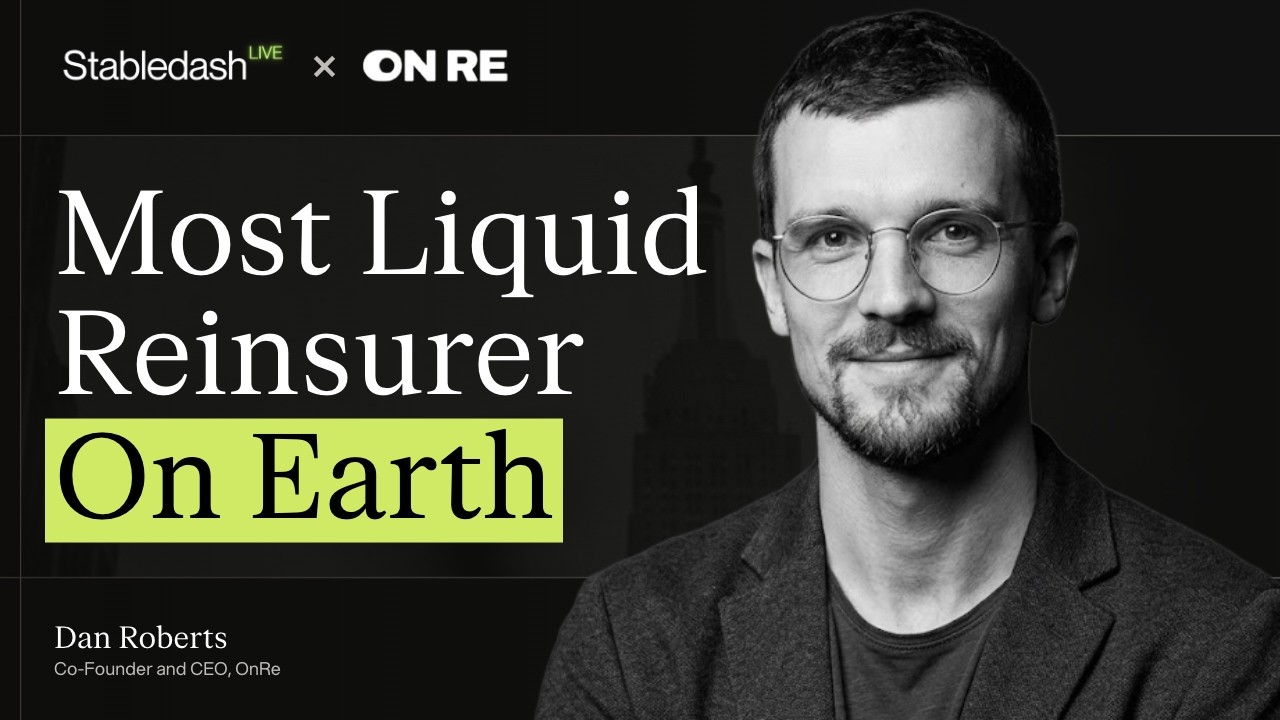
Solana's First Tokenized Reinsurance Protocol Reached $200M AUM in 18 Months with Dan Roberts, OnRe
Dan Roberts
Dan Roberts, cofounder and CEO of StableDash, discusses his company's reinsurance tokenization platform on a DeFi-focused podcast. Roberts explains how StableDash tokenizes property reinsurance into digital assets (NYC tokens) that generate yield from real insurance premiums in the $800+ billion reinsurance market. The company secured regulatory approval in Bermuda and now offers uncorrelated, risk-adjusted returns to DeFi participants on Solana and other chains, with a transparency dashboard detailing geographical exposure, contract limits, and premium accrual. Roberts addresses market education challenges, broker distribution channels (Aon, Guy Carpenter, Howden), and the company's focus on becoming a long-term capital partner to traditional reinsurers rather than a competitive alternative, while maintaining composability with DeFi protocols and secondary market liquidity.
Transcript
24 turns, about 5600 words. Straight from the recording, so it reads like speech.

Drew Rogers
host0:00
Alright. We got Dan on StableDash live. Dan Roberts, cofounder and CEO

Zach Fowler
host0:05
of What's going on? Reinsurance meets Yield on Chain. Dan. Hey, guys. This is a fun one. Thanks for coming on. You're welcome. Appreciate it, and thanks for describing reinsurance as fun. It's you know what? We we live in a really we live in a very interesting segment here. But for for us, it's fun to have people who know who they are and are very clear about that and going after, like, specific use cases. How folks find about it? Loves yield.
And on Re and Figure, you were two of the companies that when people are like, man, this DeFi yield stuff is so scammy. I'll be like, hey. Here's some actually, like, real companies that generate real yield, and you can participate in that. What's so scary about that? So, Dan, I oh, I'm excited to dive in here. If you can kinda just give us the quick tldr. You ran into you run into your mom's friend at Thanksgiving, and she you say, hey. This is what I do. Break it down for us.
Introduce us to Henri and Henri and and the the wonderful world of reinsurance.
Dan Roberts
guest0:59
Oh, yeah. I mean, at its most basic, most boring, we run a property reinsurance company. So property reinsurance, it's part of the broader bucket of PNC, property and casualty. That's distinct from health, life, reinsurance sector. It's a 800 and, you know, plus billion dollar market, generates around 5 Yeah. 100,000,000,000 of So it's a it's a large space.
It's one that's really categorized by a, you know, select few large incumbents to make a lot of money and to provide protection for the economy to continue to operate efficiently as it's essentially a risk transfer, linear risk transfer from core physical risk through to insurance company, then to a reinsurance company, and then retrograde markets and capital markets. So it's you know, it exists to provide economic fluidity as companies and and individuals can can offload risk.
We take a property book, so property reinsurance business, and obviously have tokenized that performance. We've got economic performance of the overall structure, which is generating premiums from insurance companies who are offloading risk. And we accrue that premium gradually every day to the NAV price of the NYC, which is our tokenized asset. But that asset is composable across Solana, DeFi, which is really its home.
And, you know, what you can get from that asset in Solana, which I'm sure we can dive into, is a plethora of risk adjusted returns for, know, for DeFi participants.
Zach Fowler
host2:33
Yeah. I'm pulling up the the dashboard here as we dive in a little bit. We can What what in your history is you know, you I'm sure you you could look at this market. Right? We could say, hey. We the the the world of RWAs is vast. You could go tokenize anything. Why go tokenize reinsurance? What about this stuck out? Like, this is a very specific lane. I don't even know if I another, like, reinsurance tokenization company comes to mind.
So what about reinsurance really stuck out to you as as the opportunity you wanna build your career around? And what was the problem? Like, when did you know this was like, yeah. Let's go do this? Yeah. It's it's been a lifelong dream of mine from a young age. No. I mean,
Dan Roberts
guest3:11
yeah. This this was this was seven seven years ago. We saw, you know, the coming together of a new technology, you know, blockchain, rails, and and crypto and insurance. There were two ways that you could split that up. One was you take there's a whole new risk category of digital asset risk. And I think projects like Nexus and Realm, you know, really approach the market very well in this regard.
This is saying there's cold storage risk, there's slashing risk, DPEG risk, all these different kinds of new exposures that the market wasn't used to, and the insurance industry was gonna play a role in providing that kind of protection. We got excited by the second version, which was how is this new technology, blockchain as a broad broad technology, going to participate in the insurance sector as a as a whole. And so really for six years, we spent a long time solving hard problems.
We did a lot of things right, mainly around how is the regulatory legal landscape in a very old, as you can imagine, and funnily enough, risk averse and innovation averse industry. How is that going to coincide with tokenization and this new concept that people started to talk about six, seven years ago? What we didn't and we did a great job there. We you know, we were the I I think we built a leading position in being able to model digital assets for the purpose of insurance collateral.
We were fully regulated about four years ago after two years in a sandbox. So we're I think we were the first company out of Bermuda to get dual licensed on the digital asset and on the insurance side. But, really, the positioning was this marketplace piece.
And so it was saying, you know, the whole insurance industry now has this new infrastructure that can come online and tokenize their programs and connect to a new source of capital, and that capital can can participate in this very, you know, uncorrelated profitable industry. Of course, it's a very slow space.
And so, you know, fourteen, fifteen months ago, we shifted from pure infrastructure, you know, legal, technical, regulatory, to having the product ourselves, you know, using that infrastructure as the single product that the market can use. You know, to the previous question, there's both sides, and there are different propositions. So the proposition to the capital side is that you now have this large, profitable, and uncorrelated asset class that can be used in DeFi.
And if we spend our efforts, which we do on making sure that our DeFi markets are deep and on a number of environments, then you end up with senior and junior tranche tokens. You can lend if you wanna take a more senior position and loop if you wanna take a more junior position. So there's a risk curve that people can participate on. And if there's decent liquidity, then you can move up and down that risk curve as you, you know, as your preference desires.
Insurance traditionally is used as a diversifier as part of a larger book because of that uncorrelation. But there's also this reinsurance market. So what's the interest to them? One is there's always appetite for new sources of capital. But we think we're probably the most liquid reinsurer in the world as well, which is kind of a shrug. DeFi liquidity is a bit of a know, it's expected I to be in think, you know, it's it's more of a more of a shrug for the crypto market, but for reinsurance, it's a big deal.
And and that's cool because we can be a long term capital partner for the for the space knowing that capital markets now have this avenue to come in with the with the optionality of leaving. Whereas, usually, capital markets are interacting with the reinsurance market. They'll go through a year or two of setting up a program, and then, you know, they'll look to accept positions, and they can't or it's disruptive for the reinsurance space.
So there's kind of a a liquid bridge now that that connects capital markets and the and the reinsurance sector. Dan, can you break down this? I don't know if this is directly related to what you're saying. Is this chart relevant to that last point? I just came across this. Looks interesting. ILS. Yeah. What does that stand for? Yeah. That's insurance linked securities. This is really just showing the growth of this instrument.
This is a you know, think of it as kind of a securitization of insurance risk that gives capital markets direct access to the underlying insurance exposure in property, you know, property catastrophe. So what what that's saying is instead of capital markets having an option to buy, you know, a large insurance company's public stock or deploy, you know, $10,000,000 or a $100,000,000 into a insurance and security fund, which is what this growth is showing over the last twenty, thirty years.
It's you know, now you can deploy $10. And so there's a kind of access question there that we we see as being a a way to continue to see this kind of growth go. And and, you know, remember that this is all about uncorrelation for capital markets.
So if you're holding public stock, you're still somewhat correlated to macro boom and bust, whereas this gives you the pure direct insurance exposure instead of, you know, you're hoping that an insurance company continues to perform and, you know, that doesn't doesn't follow the trends of the market. So if if we're thinking simply here,
Zach Fowler
host8:15
Zach, I was just thinking through, like, how does someone like, how would Zach and I, if we wanted to just test this out Well, that's that's where I was gonna go Yeah. On, like, on on the route of, okay. Great. You established this product. You handled the insurance side. Now it's great. Let me bring this to the DeFi people. Let me bring this to Camino. Let me bring this to the Solana ecosystem. One, what's the education process been like for those teams? Like, hey. This is where the yield's coming from.
Your users want you know, they want yields that is 10 plus percent that aren't just, you know, backed by lending markets that are gonna fluctuate, you know, month over month. So then, you know, people like me and Drew could go, you know, park our dollars there. What what's that been what's that process been like? And just generally, what's it what's it
Dan Roberts
guest9:01
yeah. What what hurdles have you had to overcome? Yeah. It's a a big part of what we are doing is saying you can't just open up access without education keeping up. And there's way, way more that we can do in this as well. The the difficulty is that you wanna make sure, you know, when it comes to live information and how that's pulled through, that you're not being misleading. So, you know, for example, commenting on live events, commenting on, yeah, aggregating claims and activity.
So, yeah, there there's a number of things that we can do going forwards from where we currently are. I mean, I I see in the short term horizon, people being able to communicate with complex data in a very natural way.
Obviously, we've got AI now, you know, these kinds of tools that can understand the complex data well, but then you have to your kind of original sentiment, you know, what do you explain to your mom or your grandma or, you know, to to your brother who's not, you know, involved in finance or anything, but want to understand how this works, you should be able to ask the most basic question. You know, what is this? How is it beneficial?
And then build up complexity that says, what's a potential NAV drawdown on a Hurricane Ian event or a two times hurricane Ian event or a one in a 100 kind of exposure in The US. You know, these kinds of things people can start to quantify. And, you know, for now, we have a transparency dashboard.
It's you know, it outlines our individual reinsurance contracts so people can see geographical exposure, you know, overall limits, which if there's the total potential loss over or the total total exposure covered or potential loss over a single contract. The premium that relates to that contract, which is really received in full at the beginning, a 100% reserved for covering expected claims, and then as I mentioned, accrues to the NAV price every twenty four hours.
And there's some seasonality there based on, you know, when your heavier risk periods are throughout the throughout the season. So, yeah, it's a great question. It's all you know, education is a large part of it. Obviously, we spend a lot of time on calls and doing talks and so forth, but I think our dashboard is gonna continue to be the the main kinda go to source where we're we're providing helpful information. We get lots of feedback on that and did a small iteration recently and and have a Yeah.
It looks really nice.
Drew Rogers
host11:15
Looks really great. Any anything on this page that you would call out or wanna maybe double click on, verbally walk through with us? Yeah. Like, somebody goes to this page the first time, like, what's the what's the one thing they should look at?
Dan Roberts
guest11:27
Well, I'll take the top two things. So the first one about this is attestation. So we do as much as we can to attest to the behavior that's going on under the surface. So on our underwriting, on our kind of financial reporting, you can go in Apex. We work with on attestations for the NAV and and the APY. So that's one.
I think LA have done a great job recently at starting to create benchmarks for these different assets across liquidity, profile, exposure, claims history, and they actually have a decent insurance team or actuarial team, so it can be very specific when looking at our business. Very transparent. We have a lot lot more to come there.
And then the second piece is just being, yeah, clear to people where the return is coming, which is the more exciting part of this is that you now have reinsured well, you you have assets that have returns that are coming from the, you know, traditional world, real value, and that's now being transferred on chain. So, you know, an $8,000,000,000 sorry, 80 $800,000,000,000 space writing about, let's say, $500,000,000,000 of revenue. It's a premium annually.
You know, that's really the the earnings that we're looking to transform on chain for for on chain investors. So those are the those are the top two
Zach Fowler
host12:43
parts of the dashboard. Yeah. Where where are you guys going from here? You know, 200,000,000 AUM. Congrats. Huge. I mean, you obviously even look at the price. You're generating consistent yield. I think every time I at least go look at it, it's above 10. Are you doubling down? Is is reassurance like, hey. This is our lane. We're staying in this lane. Is it building on bringing on more insurance companies? What's your outlook throughout the rest of the year and into 2027?
Dan Roberts
guest13:08
Yes. I mean, there are plenty of more generic tokenization platforms. We're not necessarily that excited about competing in that space. Reinsurance is our key competency, and it's a huge space that we haven't even scratched a surface of. So, yeah, this is our, you know, our vertical, but certainly plenty to do within that time. One is certainly to do with the transparency dashboard, as we mentioned.
So how does data how is data more autonomously collected from those that you're writing writing with, working with, and how can that be cleaned and and then displayed on the dashboard as as close to real time as possible? There are a few, cedents, so insurance companies that we work with, reinsurers, that are starting to be much you know, it's a low bar for innovating in reinsurance, but are starting to be much more innovative with their tooling.
So a very basic example is that the cedents themselves, the insurers themselves, are able to transfer the metadata on all the business that they're writing via an API. You know, that's a big step for a large insurer, but that's starting to come. And companies like us with second you know, secondary liquid markets as well as a transparency dashboard can consume that data in a really helpful way for capital markets on a much broader scale.
You know, the traditional the cap market industry, Travify, really doesn't have this kind of capability over reinsurance as an asset class. So, you know, we see ourselves opening up channels for traditional capital to be able to flow into our markets and tap into secondary liquidity without having to touch wallets and, you know, other Web three type infrastructure. You know, that stuff should be abstracted, but they they're still able to participate in the utility. You know, reinsurance business renews every year.
So, you know, for us, it's about taking the six years of infrastructure capabilities that we built and, you know, building out a track record beyond the kind of year coming up to year and a half of the of the program itself. Yeah. Do do you what's your what's your growth play here? Like, is this the are you guys going to, like, insurance,
Zach Fowler
host15:06
reinsurance, like, these super old school conferences? Drew, forgot who we had on, and they're like, hey. We don't even go to conferences. Stable C from Tanner. I still I still wanna know where he's going, but he's going to, like, John Deere conferences or something, I think. Yeah. Yeah. It's just like it's really, like it's not it's not the typical scene. Like, I'm sure you'll be at, like, Brink Point and these very Solana
Dan Roberts
guest15:26
native ones. But, like, on the other side, like, where where do you meet these people? Yeah. We pull strolls at the beginning of the year, and you have to get all the insurance funds to get the short one. Yeah. It it's basically you know, distribution is largely through brokers.
And brokers, you know, hold a huge amount of utility and that they they have access to the whole market, all of the you know, they're getting that sort of their ears are on the ground as to where pricing is, and they're the ones that are really interfacing with the insurers and the reinsurers on either side. So What are some examples of brokers, just so we know? Like, what are some common ones that you guys either work with today or how we think about that? Yeah.
Biggest ones, Aon, which, you know, around you know, a o n Aon, Guy Carpenter, which is a reinsurance broker of Moff. Howden is a, you know, big player, particularly in the insurance and security space. And, yeah, these are, you know, big public listed
Drew Rogers
host16:16
or some of them public listed businesses that are really interfacing between both reinsurers and insurers. I don't know if you've heard of Aon. Yeah. Yeah. They're I've been seeing some big headlines with them in recent weeks in terms of their DeFi related work. Any any kind of thoughts on on that? I was I mean, they're absolutely massive company. Are you directly involved with some of the stuff they're doing on chain? Yeah. Well so, I mean, we certainly know them very well over the years. We we do a decent amount
Dan Roberts
guest16:42
of business with a few that I've mentioned. Aon, yeah, have been very proactive with, you know, with digital assets. They know the space well. They, know, were the key kind of broker and structure, I believe, on some of the early, I would say, CC covers, which are basically covering cold storage for your I believe it was Coinbase and Gemini. You know, don't quote me on that. But, yeah, they seem kind of very forward in the space to, you know, pushing it forward.
It's either looking at new risks or working with new sources of capital to, you know, to to, you know, build their brokerage. So these so these companies like them, they really bring a lot of the volume and distribution in terms of, like, selling and packaging this up, and they've been doing that for they've also had an extremely lengthy track record, I think, a company like this, for example. Yeah. I mean, you can't do this by yourself as an individual player.
You need to have, you know, buy in all the way, you know, to the top within these, you know, large businesses who are doing a huge amount of the, you know, groundwork to allowing insurers to connect with reinsurer and allowing these contracts to be placed, understanding the novelty of collateral or how things are trusteed and and custodied. So, yeah, it's not seven years ago when we started this.
It sort of felt a little bit like we were one of the very few flying the flag for these two worlds coming together, but you you're really starting to see much more buy in with
Zach Fowler
host18:06
with, you know, the broader space now. I know you said that you're very, very focused on this lane. Are there any adjacent adjacent lanes that maybe you've been tempted to go after, or you're kind of you're watching this, like, oh, if I if I wasn't doing this, this would be what I was doing. And maybe if you were to speak to, like, an an early stage founder that's like, hey. I I think you can learn a lot from what we've done. Yeah. I mean, something interesting about insurance is it's so, so broad
Dan Roberts
guest18:33
reaching. So, you know, you have you have broad industry. You've got insurance, reinsurance retro. You have, you know, health, life, property casualty, with property casualty, you got casualty in property. Then property, you've got cat specialty, you know, all different structures. So you can really go any in any sort of direction with it. I think a pivot that was helpful for us was starting with the product.
That's what people want to engage in, and that's how that's what helps their education is how it relates to their strategies, you know, how what, you know, minimum thresholds do they have, how can they use maybe more senior products, more risk remote products, but then loop those to hit the the minimum threshold. So, I mean, yeah, as I as I mentioned, reinsurance really has a complete blank canvas to, you know, build into.
For original founder, that would be the key one is, you know, I think what we we call it, which is sort of a negative positioning, is that the worst of both worlds in our original proposition because we were too many innovative steps for the insurance market where capital was crypto denominated and, you know, custody was in a small contract and trustees were multisigs. You know, these are two it's too unwieldy, too many steps for the insurance market to come on chain.
And then on the capital side, they had a sort of marketplace of smaller programs, so they weren't as diversified, and they had to choose between them that didn't know how, and there wasn't any DeFi composability. So the utility was lower over, you know, why are you tokenizing in the first place? So the the shift was really going from the worst of both worlds to the best of both worlds where you have, you know, crypto DeFi composability.
You have a single product that you can build diversification and build education around it, but then you have a structure that is very market and works for the insurance industry so that you can interface and yeah. I think we placed about a 140,000,000 of insurance limits over the last six months. So, you know, those two blockers suddenly aligned, you know, in in that way.
And I think for a founder looking at broad tokenization is that seems to be a clean way is you don't have to reinvent the wheel across every single aspect of the business, you know, go to where you go go to where things are already working, and then just innovate the bits that aren't aren't working. And there's been a decent amount of product market fit that I think has been established in a number of different areas that you can, yeah, have some success by being much more focused. Yeah.
We've, you know, we've seen this really interesting tokenization
Drew Rogers
host21:03
showcase with money with stablecoins. This is obviously, like, very different than what a a stablecoin is in terms of form, function, utility, but the the idea of tokenizing something that, you know, has historically lived off chain can unlock certain utility. Like, I think about the dollar access use case that US based stablecoins have had and the kind of ways that those things are really providing real utility and access to folks who would never have it globally.
I'm wondering what that looks like with reinsurance specifically. A market like this that's been around for so long that seems so institutionalized, It also seems to have, like, an access problem. Is that where you're seeing the tokenization technology itself really be showcased here is, like, the yields from this asset class and this and the way that these things are structured are extremely great, but it's just, like, very hard to get access to it or the minimums are very, very high.
Like, what what what kind of pain or barriers are you seeing DeFi and bringing this on chain solve? I I think access is is obviously a part of it. It's kind of the, you know, the cliche war cry of of crypto
Dan Roberts
guest22:12
or for RWAs. I think more interestingly is instead of the positioning being, oh, there's a new alternative source of capital for the market, which is very interesting, and, you know, we obviously take a, yeah, proactive approach to being helpful participant in that market much more as a capital partner towards best underwriters in the space that have very long track records instead of, you know, we're coming in as a competitive underwriter to, you know, take business away from you. So that that's one utility.
But the more interesting one, I think, is that reins sort of the reverse. Reinsurance as this giant industry that has this, you know, modeled historical track record, you know, now being available on chain acts as this liquidity layer for DeFi activity.
So you now you know, really, the goal would be you have a full spectrum of risk adjusted return from, well, 0% yield all the way up to whatever number you like, and you can, you know, tranche and lend and loop, and you can loop junior tranches of higher volatility products, and you can lend into senior tokens of lower volatility products.
So the whole spectrum should be available, and liquidity should be deep enough under all of those products to be able to move up and down the risk curve very fluidly based on your own preference, based on your you know, the profile that you're building. So, you know, this is almost it's wealth management for individuals to come in and build their own structure. You know, perhaps reinsurance shouldn't be the only exposure that you're holding. You should hold a, you know, basket of these different instruments.
But, you know, as liquidity continues to build and DeFi continues to meet the demand for products with the supply of those products instead of the honest being honest, the project to figure out where the product market fit is and spend six months building out that pro program and, you know, launching. And then by then, everything's changed and people are moving on is that DeFi actually, you know, creates all of these different products themselves. And then, yeah, the liquidity is there for people to move.
So I think reinsurance is a great industry to bring on chain because it brings this huge kind of buffer of liquidity for for the space to interact between lots of other asset classes as well. Yeah. You know, so I think you mentioned right now most of, like, on YC is on Camino,
Zach Fowler
host24:28
across the salon ecosystem. Has it even gone down to, like, the apps themselves? Like, I'm thinking, like, the the neobanks of the world. We've seen the launch right now recently of Robinhood mainnet, seen Morpho getting embedded into Robinhood and and Yield. And, again, right now, these vaults are definitely more on on the more conservative side, not to say that that anything on onry is on the riskier side.
But, I mean, that seems like the logical progression to go towards these sources for people that, again, at the end of the day, people want yield. If you can meet that demand, how do you how do you get this into their hands? Yeah. I mean, that's been a huge part of what we focused on as our kind of DeFi integrations on Solana.
I mean, we wanna be selective and careful and helpful because, you know, listing is different from having good parameters and liquidity depth over a particular asset in a particular environment. So, yeah, I mean, slowly, I'd probably get pushed back from
Dan Roberts
guest25:24
from the growth team who are, you know, working incredibly quickly on getting these integrations done. But slowly but surely is kind of how we think about it. You know? There's lots of different opportunities, but these are structured in different ways. And, you know, Camino that you've got up here has been a a real kind of leading market of ours to make sure we're we're being helpful instead of, you know, moving liquidity somewhere else for another, you know, partnership announcement. Yeah.
Camino's been doing some great work. So these these types of relationships with Camino and others are really powerful in terms of getting getting utility and getting getting the pipes going on some of this stuff. It's really, really interesting. Yeah. This this space doesn't have one risk adjusted return with one product. That's what's interesting.
And we don't have to meet the market where they are because the market is creating these products on these, you know, these lending markets and and so forth to show where the demand is, and then that's dynamic. So you have the way I think about it is you have real time product market fit. You know, literally, as someone is pulling out of a junior position, the pricing between junior and senior changes.
So, you know, in in the traditional world, that is a two year project setting up an entire program and strategy and getting seed capital and launching to the world that is literally happening in real time now in terms of market fit. Whatever the market wants, that's where the pricing sits, and it's
Drew Rogers
host26:45
very, very cool for the to be an interface with the reinsurance market who are becoming excited by this now. What do you last question on my end, Zach.
What what do you Dan, what do you think is the most misunderstood thing about either what you're building or just this this conversation that you see a lot of people, investors, people, like potential clients, when people come to you, what what's the most misunderstood part of this conversation that you find people are are scratching their heads about most often that you wanna displace or clarify?
Dan Roberts
guest27:16
I mean, I think the biggest challenge is because reinsurance is generally in the digital asset space an unknown quantity is how can we best, you know, serve that. Know a major part of our portfolio is called property catastrophe. Like, the word catastrophe, you know, freaks people out. But, obviously, you can have, you know, a 50 and a 100% yielding product. I mean, people hedge the downside, and, you know, they go out to really maximize the return. Or you can have a 4% yielding product in property catastrophe.
It's just about risk adjusted returns. So I think that's that's an ongoing I don't I don't know if it's misunderstood, but it's just an ongoing, yeah, education area that we want people to be comfortable on. And I think the answer is, you know, you should be using
Zach Fowler
host28:01
your connection to the project and our dashboard to be able to move up and down the risk curve as you, you know, as you feel comfortable. Yeah. It's great to see more of this. I'm excited to see more of this transparency dashboard come to life. Having more of this stuff is really great, and it sounds like you're supported by a handful of these companies that are coming around to provide more of this clarity. So, yeah, Zach, what what any final questions from from you? No. I think we've got all of mine.
I was super excited to to dig into this today. Like I said, I think I've I've plugged you in a few times during the news, and so it's been it's been great to kinda peel back the curtain a little bit. Would love to check-in six months, eight months down the line. How the how's the growth continued? How do you continue to weather the storm? I'm I'm just particularly always interested around products that can truly decouple from the greater price action.
And, of course, there's some liquidity concerns, but, again, being able to to branch out. Even in the in the world of r w, I think a lot of my focus is starting to go, who who what what's what's out there beyond just, you know, tokenizing stocks and then tokenizing equity. So I appreciate you coming on today, Dan. No worries. Thank you for the opportunity to continue the education. Appreciate it, guys.