Stabledash Live · · 29 min
Polygon's Open Money Stack Explained: How a Blockchain Became a Payments Company
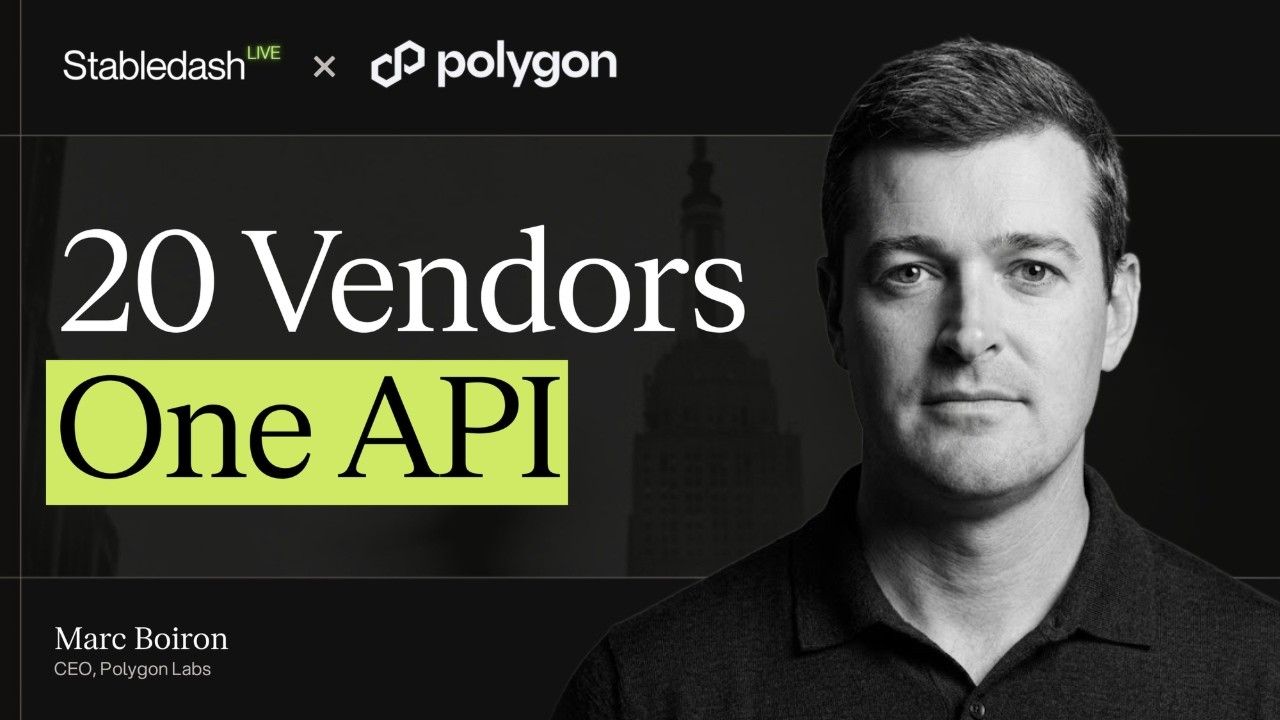
Marc Boiron
CEO
Marc Boiron, head of strategy at Polygon Labs, discusses Polygon's evolution from a blockchain infrastructure provider to a payments platform. He covers the strategic decision to acquire regulated entities, the development of the OpenMoney Stack to solve fragmented payment infrastructure, and Polygon's approach to stablecoin adoption across 20+ currencies. Boiron also addresses competition philosophy, work ethic discourse sparked by his recent tweets, and the vision of moving money on-chain to enable seamless global payments.
CEO
Key takeaways
- Polygon built OpenMoney Stack with a single API to unify wallet, on/off-ramp, and interoperability solutions, reducing enterprise integration from 20 companies to one.
- Marc Boiron competed as a college athlete and seeks aggressive competition, aiming to defeat competitors while respecting individuals; winning is described as mandatory, not optional.
- Polygon has 20+ stablecoins in 150+ countries; success starts with consumer FX markets (e.g., dollar-to-won swaps at better rates than Wise) before expanding to business use cases.
- Global payment harmonization is impossible across governments' fragmented ledgers, but 10 interoperable blockchains could replace hundreds of local systems.
- Boiron clarified internally that Polygon's work-ethic standards apply to him personally and don't mandate long hours for employees, contradicting public perception from divisive tweets.
- Polygon's defensibility lies not in the blockchain itself but in controlling the complete customer relationship through integrated wallets, ramps, and interop solutions.
- Moving money on-chain solves the core inefficiency: with 21 million payment flow permutations across currencies and compliance, netting is impossible; on-chain solutions enable millisecond settlement.
Transcript
29 turns, about 5900 words. Straight from the recording, so it reads like speech.

Zach Hughes
host0:01
Mark, good good, I guess, almost at pretty much afternoon at this point. Thanks for coming on today.
Marc Boiron
guest0:06
Yeah. Thanks for having me. Excited to be here. I love the show.
Zach Hughes
host0:08
Awesome. Thank you. Appreciate it. You got two two Zachs here. I'm gonna actually, I'm gonna flip your camera really quick, if you don't mind, so we can we can read the the polygon on your shirt. On the merch. Actually, it's all the 100 people wearing Always the merch. Always the merch. I know. I need to, like, go get a stable dash hat on right now or something. I get the black shirt, but, yeah, we gotta wrap the hat too. Well, I got I got a hat here, but we need a we need an updated one.
I've been telling Drew that that's gonna be our next piece. But, man, Mark, there's no shortage of of things to cover in the world of Polygon. So rather than us kinda driving this, I'd actually wanna know, like, what is top of mind for you right now? Like, what what keeps you up at night? What is what is going on in your brain when you're thinking about how are we, you know, bringing Polygon to this the the the new era of finance?
Marc Boiron
guest1:01
Yeah. Look. I think it goes really back to solving the money problems that exist in the world. Right? So, you know, we for those who don't know, right, so Polygon obviously built a a blockchain that is one of the most performed blockchains out there, but we've really spent the last, you know, twelve months focused purely on payments. Right? And so we built a kinda whole payment stack around the the Polygon chain and, frankly, every chain because it's very interconnected.
And, you know, when I when I think of this, I'm like, okay. So challenge number one has been we can't get stablecoins into companies', like, hands easily enough. Right? It's been the challenge of, like, integrating all of these different components. We need to be able to, like, solve that. So that's kinda like the first step of what we did with the OpenMoney stack, which, like, bring a single API that allows you to move money around the world.
The challenge now for me is, like, how do we actually bring the stablecoin world and, like, the the nonstablecoin world together? Because you still just have this friction where, notwithstanding the fact that, like, you can move money so freely on chain, most money is off chain. And when most money is off chain sitting in different ledgers, they're not interoperable at all, and they have this issue of, like, it takes time to get them on chain.
So number one, get more money on chain so that we can, like, have this, like, reality of, like, no prefunding, and you receive your payments in seconds, and it's fully transparent all the time rather than what we have now, which is even with a regulated entity in our on our back end, we still need to take the time of moving funds from, like, a bank that is on its own nontransparent ledger into a stablecoin that becomes transparent. So that's really where I spend my time.
It's like, how do we just do this as efficiently as possible and, like, maximize the amount of, like, on chain money that we can possibly have and let it move freely?
Zach Hughes
host2:53
Who brought up this idea of saying, hey. We're as a as a blockchain association, we're or labs, please correct me on the on the correct verbiage. It can get very, very intricate. But who was the first one to say, hey. I think we should go out and acquire regulated entity? Because kind of an unheard move in this space. Like, were you the first one? Was this kind of a team decision? What was the origin of story of, like, when did that conversation start to happen, and what was it like seeing that come to life?
Because that had to feel like a like a a really big moment internally.
Marc Boiron
guest3:23
Yeah. Honestly, we we do a we have, like, a decent sized org, but we do a good job of keeping it flat and getting, like, the experts who are, like, deeper into the org really, really involved. So, like, step number one was just recognizing that, like, blockchains were commoditized. Right? So that that's, like, my obligation, like, leading from a strategy perspective. I'm like, hey. Where are we at? And, like, what's the reality? It was like, hey. We need blockchains to actually do something specific.
Then you look at, like, what it is that we were doing as a whole, and you realize we are really, really strong on the payments front. So that was, like, the second part of it. And and it was really more of a team effort than anything else, frankly. It was, like, some of the folks on our sales and partnership team who came to us and said, hey. Here's, like, a bunch of things that we could do in payments. And some of them was, build your own app and become, like, a neobank.
And it's, that's, like, a really hard thing from a customer acquisition perspective. It's not actually necessarily where we're strong. And then other things was, like, the the b to b side of things, which is where we are really strong, really strong enterprise relationships, institutional relationships. And Polygon as a chain is really, I think, well built for this, and and it's something that we could leverage. And so when they started kinda, like, leaning into this, one of the ideas was, look. Hey.
We've got a few companies that are actually interested in acquisitions, so why don't we start talking about that? And and as we started having that discussion, kind of unfolded more of the problems. It wasn't just like, hey. Polygon needs to be more stablecoin centric as a chain. It was, wait. Stablecoin yes.
Polygon needs to be built better for chains, but we've got a whole ton of things we can build around this to solve the actual problem that exists, which is not we don't have a blockchain that's good enough for payments. It's we don't have one integrated solution that is good enough for payments. And the only way to do that is go and get, you know, regulated so that you can embed that into Mhmm. Your product.
And so that when you, you know, ultimately interface with the customer, the customer comes to you and says, I want to deliver this stablecoin in country you know, in Mexico from The US. Go ahead and do that. And we don't need to go look at five different parties to get them to solve it. Like, we are going to solve it for you. So a lot of that actually came from, like, team members within within the team, not actually the most senior people, which is really cool to see.
Like, getting that kind of feedback and being able to work that in strategically and get to a point where, frankly, we end up making the right decisions based off of that is is pretty cool. So
Zach Hughes
host5:41
how have you seen where where where does this, like, evolution start to happen? Because I can remember, you know, two, three, four years ago, was, like, if you were to go into some more fintech facing application, if they support stablecoins, it was usually like USDT, USDC on on Polygon, and I think deal was one of the the first ones that I really remember. You're you're there, you see people already using, you know, Polygon in this way. How has it evolved?
How do you see it becoming embedded, and how do you really see people start to embrace OpenMoneyStack?
Marc Boiron
guest6:13
Yeah. I think this is, really even more true today. Right? I think when you say you went back and you look at that, I think now I often say, go to LatAm, open a fintech app, and try to see if you don't see Polycom in that fintech app. Like, I think it's very unlikely that that you won't see it. I think that's true in in Africa as well. I think it's true in many parts of Southeast Asia as well and decently true in The US, but not not completely true.
And a lot of that's simply been we had a head start on others, and the chain is well built for this, and we've got a good, like, sales and and partnership team. But what more and more is becoming true in the way we're defending and growing that is by actually having a product holistically that that solves that. Right? So when when right now, if you were to say to a an enterprise, go choose a blockchain to use, you can give them five different chains, and they would all serve their purpose. Right?
But once you go one step deeper, you say, okay. You have the chain. Now go start offering Stablecoin solutions to your customers. Now that's when things get super interesting because it's like, okay. Cool. Like, I have a chain with Polygon. I have a chain with Solana. I have a chain with Tempo, but I I actually, like, need this thing to be useful. I need my customers to be able to hold money. I need them to be able to get the money onto the chain. They might not wanna be beholden to Polygon.
They might actually want to use multiple chains. These are things that nobody is well positioned to do other than us, and that's where kinda, like, the whole open money stack get gets interesting. It's like, now you can say, okay. Company x y z, like, thank you for being interested in using Polygon, but we can go a step further, actually. We can now solve your wallet needs. We can solve your interoperate needs. We can solve your your ramp needs.
And so for existing customers of the chain, it allows us to leverage that into, like, a broader relationship. For new customers, it actually just solves the problem of twelve months of integrations and 20 companies to talk to with one company to talk to and one integration. And that's really how we, like, accelerate ultimately Stablecoin adoption, some of it on other chains and much of it on Polygon.

Zach Fowler
host8:19
I'm I'm curious. You kind of alluded to this with defensibility and a little bit of, like, illusion to some of the competitive marketplace and how Polygon stands out. Feels like you're saying there's a certain switching cost where you come to us and we can solve a lot of different problems for you. How do you see the defensibility of Polygon or Polygon Labs? How do you distinguish this? Like Yeah.
What is the real, like, here's our mode, here's how we defend, or here's how we're going to keep winning now that you've, you've gotten past your first trillion as I saw on the site, which I loved. Yeah. Yeah.
Marc Boiron
guest8:50
I think the, think we're we're we're at 2,700,000,000,000 now, so so doing doing pretty well. I I think we should say not our not our third trillion, technically. No. I think the the look. The recognition is that blockchains aren't defensible. Like, you can plug Polygon in, and then the next day, you can go ahead and reverse that and or or add another chain in there. And that has no, like, real impact on you or your customers other than giving them more options.
And that is something that is not sustainable because when you don't have a differentiator, you ultimately have no way of actually bringing value to what you've built. And so, yes, a chain is great when it is built out. Right? We have network effects on Polygon that are unique. Like, you go and you on and off ramp on Polygon in more than a 150 countries, very few blockchains can you actually do that on.
But, ultimately, you could still bring in all of these other chains who can build up these capabilities, and then you're left alone. So, ultimately, the key is controlling the users. Right? When a business comes to us and they have a commercial relationship with us and we choose to deliver them with wallets and with an on and off ramp and with interop solutions, they are free to choose whatever chain they want. But when they're dealing with Polygon, most likely, they're gonna choose Polygon.
And even if they don't choose Polygon, over a long enough period of time, we're gonna build trust with them. We're gonna have those relationships. We can put products in front of them that allow us to, you know, control to some degree what decisions they make. One of those things is the chain. And so when we're able to put the chain
Zach Fowler
host10:44
I lost Mark's audio right there. Yeah. I was wondering if I lost it too. Mark, can you hear us? Give us a thumbs up if you can. Alright. It seems like it auto muted or something. Okay. We'll be back. You're good. I was wondering if one of those things is the chain. Yeah.
Marc Boiron
guest10:58
Yeah. Yeah. So so you can just swap out the chain, but you can't swap out the entire API and the entire movement of money that easily. And so having that entire offering is really valuable.
Zach Hughes
host11:10
Mark, I'd love to unpack a little bit more the way you think about competition, you think about blockchains, especially in the past year. You know, we've seen this rise of the stablecoin chain and the very purpose built blockchains.
And you had a tweet recently that got a little bit of attention where you were talking about, you know, just this your viewpoint of how you look about your your competitors, you know, I think Zach and I were both both athletes, both college athletes, so we we can understand and relate to this this, kind of duality of, on one hand, I respect that person on the other side of the line, but at the end of the day, like, I wanna win. I'm here to win. Like, like, we both can't win the game.
And there's been this notion and this kumbaya in, the blockchain space that, like, rising tides lift all boats. And, you know, at the end of the day, there's, you know, there's two there's Visa and Mastercard, you know. There there's not 20 or 30 other, know, major payment networks. How do you think about competition? Like, what what keeps you getting up day in and day out? And kinda like you alluded to, you know, staying an hour later, getting in an hour you know, staying an hour later, getting on an hour earlier.
Marc Boiron
guest12:11
Yeah. I was a college athlete as well, and so that's that's that's probably obviously where it comes from. Yeah. Look. I I look. I don't say it lightly. I mean, it's seriously, like, I do wanna crush my competition. That's, like, the the reality. That's, like that that that kinda keeps things interesting. Now some people interpret this as, like, being really focused on your competition.
I think there's a really big difference between using your competition as a benchmark, but while also just focusing on what you need to build. I frankly don't care what my competitors are building. I'm gonna build the thing that solves our customers' needs, and I'm gonna solve those customers' needs really well, and that is what's going to allow me to beat that competition. Now people often ask me, like, you know, like, why why am I in this role? Like, what what interests me?
And the reality for me is it's challenges in competition. Like, that is actually what is fun about it all. Like, I actually don't want no competitors because that's, like, not actually really, really interesting. I actually want amazing competitors, and then I wanna go beat them really, really badly. And the funny thing is, like, you know, when I when I talk about, like, hating competitors and wanting to beat them, it's actually this really abstract concept.
Like, the individuals at companies I compete with, I'm actually like, I like a lot of them. I'm friends with a lot of them. They're they're great people. But the abstract idea of their company is the thing I absolutely want to destroy. And the the the thing like, the the the reason for this is because, ultimately, you have, like, one winner, and everyone else is a loser. And if you want to be that winner, you better as heck be ready to, like, take on that competition with, like, everything that it takes to to do it.
And so, yeah, I love having competitors. I love the people there, but I'm here to win. And if I'm not if I'm not gonna win, I'm not sure, like, what I'm doing here.
Zach Fowler
host13:58
You're gonna win. We love it. One thing I is sort of continuing on this tweet train a little bit. I was looking at this from you recently, and, it kind of caught my eye. The world will never harmonize its payment systems. Right? Like, some some people seem to think maybe that's not true. Tell us a little bit about this take and what you're sort of meaning here and what how OpenMoneyStack addresses this as well.
Marc Boiron
guest14:25
Yeah. So this is really focused around, like, governments coming together to harmonize payment systems. Like, there there's a reason we have the fragmentation that we Yep. Like, you can have think there's, like, a recent effort by the g twenty humanize things. We've got, like, different ISO standards around harmonization. And, like, none of that actually addresses the core issue that you have different letters that are on different systems. They do different things.
And those things don't actually interact very well whatsoever, and they all are built in a way that is just for their needs. And so then you get things that exist, messaging systems like Swift that try to solve all of this, but it doesn't change the fact that you're on multiple ledgers. So really, to me, it's you can have a one ledger that can solve 20% of the world's needs and another ledger that can solve another 20%.
And you can go from, you know, thousands of ledgers or or hundreds in the case of of countries, to actually having just a few that are shared. And then what you're left with is actually a much simpler problem, which is you have 10 blockchains that are the ledgers that operate for money movement. How do you actually bring those ledgers together in a way that can inter interoperate?
Now the thing that's really nice about these ledgers is they're not actually controlled by a government that has a desire for it to work in a certain way or even by a company that wants them to work in a certain way. They just have these open source attributes that you can see, and you can decide whether they're good for payments or not. Well, that is actually really easy to bring together. Right?
This is why we focus on interoperability a lot, is we can bring those together and share assets between those and transactions between those. And now you get to a world where you can actually have harmonization of payments on a chain or across a chain, and that only happens when money's on chain. Now what what you'll see, though, is some people saying, yeah, but it has to stay local.
I think, like, the the their wallets founder, like, recently tweeted about how, like, you you have to have it be, like, global but local or or something of that nature. I actually very much believe that, like, this local fact is, like it's it's inherent to money. Right? Like, money is including private money in the form of stablecoins is a government money, which is local. But that doesn't mean that the way the money moves needs to inherently remain limited by that local nature.
What what I mean by that is that once you have a tokenized deposit in a as a bank deposit instead of, you know, your current form of deposit, that bank deposit suddenly now lives on a ledger that can either be a shared ledger or one that interoperates very easily with a a shared ledger. And you can get that tokenized deposit that is like a local government money to really easily become a stablecoin ignoring that local nature of it.
And it can be ignored both in terms of it being, you know, a a Mexican peso deposit that turns into a Mexican stable, stablecoin as much as it can be a Mexican, peso tokenized deposit that becomes USDC and very seamlessly. And the fact that it is the Mexican peso sitting in Mexico doesn't actually matter because of how seamlessly it can move across the rails. So the fact that it's local in nature just doesn't really matter. You can actually have harmonization anyway.
Zach Hughes
host17:57
So when you when you think about this concept, because look at we've we've brought this up a few times a day of solving this this last mile problem and, going back and forth between local currencies, local local payouts. How do you how do you think from, a polygon open moneys open money stack perspective of of trying to solve and and tackle that problem? And in in your mind, is it a problem, or is it kind of, like, overdramatized in in the in the current space?
Marc Boiron
guest18:26
Like, look, I think it's a pretty major problem. Right? So so when we think of how efficient payments are today, like, this this fragmentation actually results in the inefficiencies. Right? So I think, like, a lot of ways that you solve global payment inefficiencies is through, like, netting, right, of of flows.
The big problem with netting of flows by the way, if you could, like, net flows perfectly, global, like, payments would actually be solved because it would basically just be, like, the local leg of every transaction is what would matter, but you can't. And and I think I actually I I ran this through, like, AI the other day. It's like, how many permutations of flows are there when you start taking into account, like, different rails, different currencies, different compliance requirements?
And, like, at least according to AI, it's, like, 21,000,000 or something like that. Like, it it takes Right. Like, you are never going to be able to, like, net flows, like, actually, effectively. So that means that we actually need to solve the problem of, like, rates ultimately. And if we don't solve them, then then we're not gonna get there. Now the problem is you can't solve ramps because they're inherently local. So what you have to do is you have to move more money on chain.
This is why, like, at Polygon, we talk about our mission being to move all money on chain. Right? It's like move all money on chain so that payments in fifteen years can move seamlessly in milliseconds from one place to another in a totally transparent way. Right? You can't do that with current rails. And so a lot of this is about, like, how do you incentivize that? Right?
And definitely, it's, like, more and more on chain applications as a way to do that, but it's also the actually giving something to do with your money beyond that. So you need to be able to earn very, very easily. Like, to me, that's an absolutely crucial thing. Whatever else you can find to keep that money on chain is ultimately it. And if we do that well, everybody in the space and this is where, you know, you've got competition, then you got, like, cooperation. Right?
Like, you need to cooperate with with every competitor for purposes of, like, this broader goal of moving money on chain.
And if you do that well and we get more and more money on chain over the next, like, five years, ten years, you get to a point where more than half of the money is on chain, and then suddenly, you go from a point where all of these local rails were an issue to actually, I think, all the local rails are racing to figure out how do I actually have my money on chain as well and not actually needing to deal with this, like, difficulty anymore.
Zach Hughes
host20:49
You know, so I know that there's quite a few non USD stablecoins that you have a list of polygontech.technology forward slash stablecoins forward forward slash list, and there's quite a few. There's, like, four different Brazilian reals, a few Chilean pesos, Colombian peso, I think five different issuers for the Mexican peso.
When you're talking about more money on chain, is the vision here dominated by the US dollar stable point, or is this like they're gonna continue to grow like this in in unison as more dollars come on chain, then more on more FX comes comes on chain, and it's kind of this this virtuous cycle.
Marc Boiron
guest21:24
Yeah. I'm, like, really proud of the fact that I think we have over 20 different currencies right now in stablecoins on on Polygon. And look. The the reality is FX is the biggest market in the world in in any type of market whatsoever by far. And most people actually, I think a lot of people view it as that is not something that is gonna come on chain because it's currently US dollar denominated.
And but when you go to, like, why it's US dollar denominated, what you recognize is that it's it's actually US dollar denominated because of trading. Trading being, like, the first use case of of blockchains. And once you actually get out of that and you start thinking about it from a payments perspective, now all you're trying to solve for is liquidity. Right? The the depth of liquidity in FX markets is absolutely massive. And being able to actually match that on chain is gonna be really, really difficult.
So you need to start from where that depth is less important. Right? So the consumer market. Right now, I had somebody on my team actually that did a test of, like, the a swap of of US dollars for the Korean won on chain and then did that swap on Wise. They got better pricing on Polygon than on Wise for, I think, about $250. Okay. This is, a great start. Now we need to get to the point where we can do that with $2,500,000 and then $10,000,000, and that's when things get really, really interesting.
And so to me, this is just a question of, like, how do we, you know, increase the the kind of speed and velocity of that money coming on chain, and and it starts with that consumer use case where that liquidity deepens and deepens and deepens until it gets to a point where you can support that that business use case. For us on, like, the OpenMoney stack perspective, though, you need to find this balance. Right?
We need to be able to serve those FX needs in the off chain market right now until the on chain market gets there. So there's, like, this just two kinda different efforts that go on. It's like, how do we, like, race to get things as far ahead as we can on chain in the FX market while also recognizing that we need to fulfill these, like, off chain needs that that currently exist?
Zach Fowler
host23:30
Okay. I wanna ask you about the race because it is a race. Right? Sometimes there is a speed to market advantage, and
Zach Hughes
host23:37
I'm we're just bringing up all the tweets today. But I I saw this tweet. Right? Did you expect this one to be so divisive, or was this like oh, you're like, woah. Okay, guys. Relax. Like, I'm not that bad of a guy. Because you were getting kinda flamed in some of these comments, and I'm like, I relate to this struggle. Like, I I relate to it internally. I relate to it with Zach and, you know, Drew, our other partner, and I think this is something that most entrepreneurs struggle with to some degree.
Zach Fowler
host24:04
Yeah. I mean, I didn't expect something. Who built the studio was, like told me he slept, like, two night two hours last night. Like, all this stuff. Sorry. Please, Mark. Go ahead. Yeah. No. Look. I didn't expect so many people to want me to die based on this tweet.
Marc Boiron
guest24:17
The comments are, like, insane. They're, like, let's UnitedHealthcare this guy. Or, like, they have that big guillotine, and they're, like, this was invented for you. No. Psychotic. But, no, like, I think look. No. I definitely did not expect that reaction, although I did look. The second you talk about people working hard, things get controversial. I I'm not sure why, but but they do. Now but this tweet straight up says, like, I act and I really do. I, like, struggle with this.
Like, I want people to have the most amazing lives possible. I want them to spend time with their families. I want them to have breaks. It just doesn't change the fact that I'm like, when that happens, I'm like, shit. Stuff's not getting done that I wish was getting done. Now what that translates into at Polygon, people go and they take vacations. They take holidays. They take the weekends off like any normal person does because that's what most people do.
I personally, like I I think different people have different levels, and you should test them on their levels. So, like, I actually was very thankful for this. Like, over over the weekend, a a somebody I played tennis with in college. You know, somebody on LinkedIn posted, hey, you know, x y z. And and he posted something along the lines of, you actually have no idea how hard Mark can work. He has a different level than most people do across different domains.
And twenty years ago, this was the most inspiring thing for me. Now this guy was on my my tennis team, and I still remember, like, we would have, like, late night conversations. And this guy did twice as much with his life than he would have done otherwise, partially because of, like, these discussions. I don't take credit. He's the one who did the hard work. Don't get me wrong. But, like, different people have different, like, levels that they can come out.
And my point is simply, like, I'm I'm looking for the people who have this, like, level of, like, willingness to do it that others don't have. But, like, everyone's gonna go and, like, hang up. Like, I I I I went this week yesterday, Labor Day. Most people are like I think a lot of these tweets were like, Mark must be torturing himself on Labor Day. I was at my daughter and son's fencing tournament, like, six hours away from here.
Now what I mean by not working is I had a laptop on my legs, and I watched them fence, and they come and sat to me, and I joked around with them, and I had fun with them. And when they had to go to the bathroom, my wife took them to the bathroom. I started working. And then they would go, and they would go have lunch, and I would just, like, work away. Then they'd come back, and we'd hang out, and we'd have fun again, and then they would fence.
And then, like, I'd I'd work a little bit more, and we'd drive home for six hours. And, like, everybody was listening to a podcast, and I'd open my laptop, and I'd, like, tethered my phone, and I'd just, like, get some work done. And, like, nobody Mhmm. Me. I'm just sitting there. Like, what am I gonna do? And, like, most people just wanna, like, chill. And, like, I get it. Like, that's okay if you want to, but, like, also, why don't I just get shit done? Like, I might as well.
And, like, to me, like, some people are, like, very pains by this. Like, this is very painful, and they think that, like, you either work hard and are sad or you take it easy and are happy. But there's this happy medium of, like, the people who love what they do, they love winning, but they also find a balance with their lives that work for their lives. Everybody's lives work differently. And if it doesn't work for your life, don't work hard. Go spend the time with your family. That's way more important.
But if you have found a way to work hard and to be happy and have your family be happy, go do that. And by the way, that's the people that I want at Polygon. Right? Like, that's it. I do not want an unhappy person at Polygon. Like, do not come if you're gonna be unhappy at Polygon. That's not the goal of life.
Zach Hughes
host27:34
That's well said. And I think, like, to to your point, there there is this line of, like, where you where you may share these standards and share these internal standards, and people automatically assume that you're now imposing those standards on them. And you're like, no. These are the standards for myself and, like, the personal reflections. Like, I'm not tell like, go live your life the way you wanna do. This is how I choose to work. This is my work ethic, and and this is what works for me. And I don't know.
Maybe I'm open to hearing your thoughts on how I you think I should work. But at the end of the day, like,
Marc Boiron
guest28:03
don't I know. Two things can be true. Something I think that I've I've learned. Exactly. The funny thing is that nobody knows is that I actually simultaneously posted a Slack message internally that told people, hey. By the way, I've I've tweeted this. You guys shouldn't actually worry about this. Like, you guys know how we work at Polygon and how you guys can take vacations and, like, you guys know what our performance standards are and how you're measured against those. Nothing changed. Keep doing that.
And by the way, go enjoy the vacation, go enjoy your weekends, and go take some holidays. Like, that that's the message internally, which is, like, so annoying. That with with a screenshot. Just slap me. By the way, guys, I'm not an evil boss.
Zach Hughes
host28:43
Awesome. Well, we appreciate you on Thanks. Yeah. This is great, Mark. We have a we got a transition here. We we're running out with Dee from Open Reserve, former MoneyLion. And but yeah. Happy to have you back on the show anytime, and thanks for carving time out today.
Marc Boiron
guest29:00
Yeah. Thanks for having me, guys. Take care.
Zach Hughes
host29:03
See Mark. See you. See you.