Stabledash Live · · 25 min
Monad's Head of Payments Says the EVM Was Finally Perfected for Stablecoins
Raj Parekh
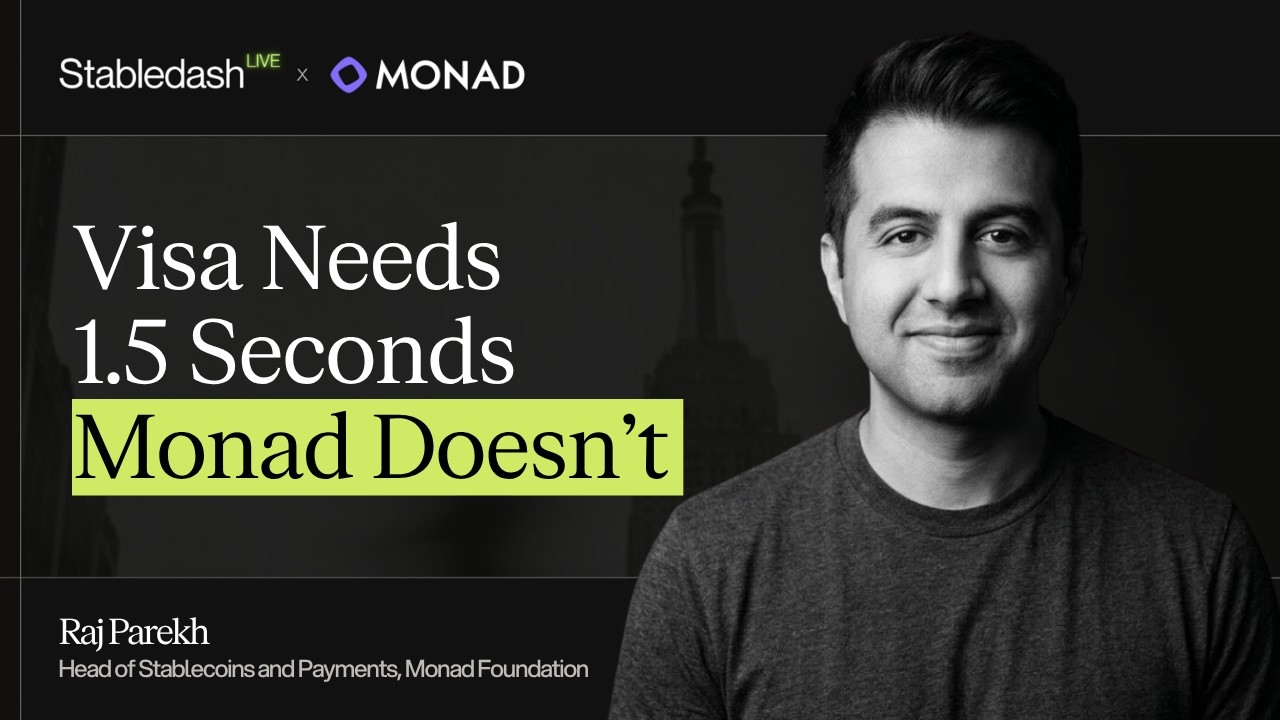
Raj Parekh, head of payments at the Monad Foundation and founder of Portal (a crypto infrastructure company acquired by Monad), is interviewed on StableDash Live about stablecoins, tokenization, and the regulatory Clarity Act. He discusses his career from Visa to Portal, arguing that clearer regulation will unlock sidelined institutional capital and enable global access to tokenized assets like gold, equities, commodities, and treasury bonds. Parekh highlights Monad's technical advantages—sub-second finality and sub-penny transaction fees—for use cases such as card settlement within Visa's 1.5-second authorization window, and describes a collaboration with Etherfuse and Korea's Shinhan Bank to tokenize Korean treasury bonds on Monad and boost their yield through DeFi.
Transcript
7 turns, about 5500 words. Straight from the recording, so it reads like speech.
Raj Parekh
guest0:00
Raj, how are doing? Doing well. Doing well. Great to be here. We have actually just deployed a confetti cannon because you just became a father recently, so we're Ah. Confetti cannon ing you. We have a a confetti cannon now and a confetti confetti wall. Let's see what the confetti wall is. I like the confetti wall. That's nice. The confetti wall. Yeah. That's awesome. That's fun. I I appreciate it. It's been it's been fun. How how is baby? Baby boy, baby girl? Baby girl is almost two months right now. Amazing.
So, yeah, still still fresh, but it's fun. It's awesome. Congrats, man. Thank you. How's your sleep going? That's enough. You know, I've I've been up since 4AM this morning, but, you know, I wouldn't have it any other way. He's ready he's ready for an interview on StableDash Live. There's nothing nothing you wanna do more after a 4AM wake up than go talk about work. I mean, this this stuff gives me energy, so I'm I'm pumped to be here, and this is this is a pretty awesome setup. Yeah, man.
So we were first off, welcome. It's been great to get to chat with you before, and and the articles that you've been posting on on the platform have been really interesting. It's been fun to just kind of stay in touch with you that way. Last time it felt like we really sat down was in Mexico City. Are you are you back in Mexico City this year again? We'll be there. I will be. Sweet. Yeah. We'll be at Bitsow Businesses. Stablecoin conference next month. It'll be fun.
We'll be back in the the podcast booth doing the same thing. So we were reporting when we kicked off the show on all things Clarity Act. Would love your thoughts on that. That's gonna be kind of a thread of today's stream is just how that impacts certain businesses, what's top of mind for builders like you. Any thoughts on that as we kick off the show, and then we can kind of move into more monad focused stuff. Yeah.
I mean, at a high level, I mean, you know, I think institutions, enterprises, organizations have been waiting for this for a very long time. I mean, I was just reading that, you know, Coin Center and some of the some of the major policy groups have been thinking about this for almost, like, a decade now at this point.
And so this is a combination of, I think, just years and years of hard work just to make sure that, you know, I think crypto digital assets is safe for both the, you know, everyday user, for institutions, for startups, and everyone in between. I mean, if you just think about, you know, the existing market cap of digital assets, like, you know, I think 2,000,000,000,000 and, you know, kinda hovers depending on the day of the week, but there's a lot of capital that's just sitting on the sidelines.
It's like, I think I've saw selling about 40,000,000,000,000 that's just sitting out there. And, you know, they're not gonna deploy that capital into something that's not regulated correctly or that has the right structures in place too. And so the fact that you're giving these larger organizations, these family offices, these major banks now the the clarity, like, no pun intended, like, around how to deploy their assets, how to deploy their capital, it makes things really interesting and exciting.
And I think it's a you know, I think overall, the the crypto space is going through, like, a growing up moment where there's a lot of experimentation that was happening before. Now we're starting to see, like, the fruits of the experimentation, and you realize, like, there's actually a lot of boring use cases, like what we love about stablecoins payments as trading. And so I think all this is a great combination. There's a lot of hard work in the industry over the many years, and so I'm excited to see it play out.
Yeah. It seems like some of those boring use cases actually are holding some of the biggest bags of, like, capital that's just sitting there waiting to get deployed.
When you think about the I know we can't, like, forecast exactly what's gonna happen, but when you think about a reality with clarity and clarity in place that actually provides clear rules of the road and and kind of moving in the direction you see, what specific use cases or things get you most excited around seeing come to life given your background and all of the different institutions you've worked with throughout your career? What institutions do you think actually are gonna benefit most once this is in place?
I think it's across the world. I mean, I think one of the main thing that that crypto does really well is just give access to global markets. I mean, right now, if you want to get, I don't know, a US equity outside The United States, just super tricky. I think a combination of tokenization and just giving market access at a at a massive scale is exciting. You know, I was just reading about India's curbing gold access in the market right now.
And you can imagine, like, you know, tokenized gold is actually a fundamentally better product in my opinion. I don't want a physical bar that I have to, like, import and then I have to do all these things around it. I'd rather just have a tokenized version of it. And if you can provide the right structures, clarity around, you know, how to actually deploy your your capital into an asset like that, that becomes pretty interesting.
So I think a lot of times people in the crypto space really focus on, like, some of the the assets that we have today, but there's actually a lot of just, like, existing assets, like equities, commodities that we haven't really seen take place. And I think if, you know, crypto and blockchains does its job right, the ability to build, a global stock exchange or a global exchange is is possible across many, many different assets.
Hopefully, one day, like, the way that we can see just assets on blockchain kinda similar to signing up on Wealthfront where you can say, hey. Like, you know, what's your risk tolerance? Are you low risk, high risk? And then based off of that, it'll basically say, hey. Do you want commodities, bonds, stablecoins, or do you want, you know, like, more esoteric assets like meme coins and, like, what's your risk threshold around it? But that that's how I hopefully see how blockchain really evolve over time.
The globalization,
S2
5:21
like, how this industry fits in with the trends towards globalization and just modern innovation. Access in India, access in Sub Saharan Africa or South Africa or South America. Like, more and more, we live in borderless world. And it's interesting kind of the push pull, like we're trying to put regulation around it to make this safe, but we don't want to regulate or resist at the expense of innovation.
Raj Parekh
guest5:46
And I kind of love the healthy tensions that we're seeing that in, regardless of where you look in the world. Yeah. I mean, totally. I mean, if you're, like, you know, an everyday builder, I mean, this is this is, like, this is awesome. Like, the fact that you don't have to be constrained to, like, a specific market, and you can now start to just, like, you know, just transcend borders and build products, like, this is, like, the ultimate.
Only you know, the only company that used to have this luxury were social media companies like Facebook or something along those lines. Like, they you know, those are the only organizations that could go after 2,000,000,000 plus people and not have to, like, you know, worry about some of the underlying, you know, plumbing and stuff. But when it comes to finance, like, this is, you know, this is as good as it get. Stakes are different, but When still
S2
6:27
you're looking at this whole all the global movement, all the innovation, what's happening at Monad specifically, are there any kind of subplots in this modern money economy that are really exciting to you or that you're really focused on?
Raj Parekh
guest6:41
Man, it'll there's a lot. I mean, you know, I I talk about the tokenized gold, you know, concept. I think there's, like you know, when you when you think about just, like, what does global demand of assets look like. Right? And you can kind of break it down per market. And then, you know, and I I'll bring up the India example again, but, like, you know, markets like India, some of the most bought assets are things like gold. Right? And you you go to another another country, and maybe it's a maybe another asset.
Right? I think when you're when you're a blockchain, you can actually be across all these different markets. You can help provide access to the most highly demand asset in those markets. And, ultimately, you know, people will have better ways to preserve wealth and even grow wealth longer term too. And so I think those are some things that we look at as, like, how are we building this economy? Right?
If blockchains, you know, at some point replace global stock exchanges, I think this becomes a really exciting opportunity. Because, you know, one thing that what a trend that we're seeing right now is that a lot of the capital formation in and assets is kind of really concentrating in The US. You have, like, the New York Stock Exchange and the Nasdaq that's becoming really powerful. Starting to see companies like Wise that are saying, hey.
You know, we we listed on in London, you know, in the the London Stock Exchange, but now they're moving over to the US Stock Exchange, right, because they realize they need to get access to, like, more more capital. When you when you have a blockchain, you can actually just receive capital from from global markets. You don't have to do this. Let me move from one stock exchange to another stock exchange all of a sudden as well.
So I think those are some things that we're really excited about because we know this economy is growing growing even further. We know things are getting digitized and tokenized. And then if you can provide the underlying rails and platforms to do that, that becomes, you know, I think a massive opportunity. Yeah.
Raj, stepping back a little bit, it's been fun seeing you and hearing about your different seasons of building both as a founder at Portal and then even before that at Visa and just kind of the different stages you've had.
I'd love to, one, just give you the opportunity to frame that again for those who are just meeting you of, like, kind of where you've been so far, and then specifically get into what what it was like to build, maybe even in specifically in the portal moment of your journey where regulation was pretty unclear and where you kind of had to had to like, I just would love to hear more about the tension that you might have you may in that as you were trying to innovate and, like, living in that tension.
So frame a little bit of your background. That'd be great. Yeah. I mean, you so I started my career at Visa. So Visa, highly regulated organization. Right? Works with banks, which is the most, you know, regulated organizations in the world. So I think part of my background was just always having this, I think, one understanding of of regulation and compliance. I think these things are just like table stakes, and there's a there's a, I think, a huge amount of importance behind it as well.
I think I also saw the tension between, like, regulation and compliance kind of hampering innovation at the same time too. And sometimes, you know, there's the healthy tension, I think, is great, but sometimes if you over become overbearing, you then, like, start to throttle your growth, and I think that's that's that's not fun. And so I think at Visa, I saw it, you know, firsthand where working with these organizations like banks and, you know, things like Clarity Active.
I I wish I kinda wish I had that back when I was at at Visa because it made my those conversations with banks and even internally with the compliance folks, like, a lot simpler also. Ultimately, I think that was, like I kinda mentioned earlier, like, crypto going through its growing up moment. We were still young back then. I think this was, like, you know, five, six, you know, seven years ago at this point, but we were still fairly young.
And and now, you know, over the years, like, we had better infrastructure, which is, I think, the main reason why I left Visa is because when I was building stablecoin settlement, I realized that there was really no infrastructure out there. And if you wanted if you're a fintech or a bank, an organization and said, hey. I wanted to go, like, build products with this type of infrastructure and these types of, like, global open source rails, there just really wasn't a good option out there.
And so I think that was, like, the, like, the early foundation of what Portal ultimately the what the goal was. You know, I think for us, you know, being at Visa, I realized that borderless economies and, like, a borderless organization is, like, what I kinda grew up at Visa. I was very comfortable talking to, like, the African team or, like, the Middle East team or the Asia team. And so I think for me, like, building global businesses have always been really exciting.
But if I wanted to build in fintech, historically, it's always been, like, a US centric business, and that's basically it. And so I think with Portal, I think the main goal of, you know, being the underlying infrastructure, building on global rails, I think the part that was really exciting for me was one, understanding that, you know, the regulatory, you know, maturity was still kind of upon us.
And so I actually spent a lot of time with, like, with lawyers in the early days of portal, like, where I actually treated lawyers as product managers as, you know, as part of our workflow. And, like, a shout out to folks like Michael Moser who, you know, are great advisers and mentors and, like, helping us think through, like, early architectures, but also understanding, like, the regulation firsthand, not just in The US, but, like, in other markets also.
Because we wanted to build we never wanted to build something that, you know, people wouldn't use. We wanted to show people that you can do things in a compliant safe way, but then also leverage the power of this technology.
And so I think that was, like, very much a healthy tension, and maybe we lost more cycles that you can't really build you know, you can't really move fast and build you know, break things when you're trying to, you know, have a a lawyer as your product manager in the early days of building a company, but we felt like it was an important principle in setting the foundation down, you know, correctly as well.
How maybe just to tie a bow on the Portal story, like, what then happened and where where have you transitioned into now? What was the story of how the success of Portal led into your role at Monad and and maybe bring us in a little bit to what that role has taken shape to be so far? How long have you been at Monad now? It's been a minute. Been a little less little less than a year now. Okay. Yeah. I'd love to, yeah, bring us into that story a little bit and what the past almost year has been like there.
What have you been focused on? Yeah. I mean, you know, so, obviously, Portal was acquired by the Monet Foundation. We announced it back in July or so. So Portal operates as a subsidiary. You know, still business as usual. We still, you know, operate. You know, we work we serve our customers like a, you know, world remit in some of these organizations today. Still move billions of dollars, you know, through the portal platform just in the last quarter or so.
So there's still, like it's been it's been a lot of fun and kinda cool to see as the stablecoin space grows, like, portal team and the portal platform continues to grow with it as well. And so I've got two jobs, kind of one still kinda manning the ship on the portal side, and then, you know, head of payments at on the on the Monet side.
I think what's what's been really cool about the Monet experience is that, you know, and maybe even taking a step back, on the portal side, we we basically enable, like, 20 or 30 plus blockchains at this point. And so during the during the three years that I was building Portal, we basically built it every single time. We know, like, the ups you know, the nuances of every single type of of blockchain out there today.
I think the conversation with the Monad Foundation team really exciting is that when I played and built products with the Monad blockchain, it was like it felt like the EVM was finally perfected, And that you have, like you know? And I I always joke I call it end game architecture because going back to my Visa experience, like, when I built stablecoin settlement, it was actually with with Ethereum mainnet. And so a transaction would cost, like, you know, 10 to $20 just to move a a $100 sometimes.
With MonEd, it's actually, like, you know, less than a tenth of a penny at this point. And so when you have sub second finality, you have transaction fees that are less than a penny. You now have this 10 x kind of, like, exponential leap compared to, like, the existing payment rails, but also, like, existing like, even against legacy blockchains.
And so I think, you know, I think what the the cool part about this whole experience has been, you know, I really enjoy building open source payment systems, and it feels like a combination of, you know, what we're building on the developer infrastructure side on the portal front and then the best in class, you know, the EVM perfected with MonEd is just like a really cool double edged sword to kinda just, you know, go work with, you know, payment companies out there today.
Wanna pop up the the MonEd site as we continue chatting here. It's fun to it's fun to have these conversations and kind of go into the details here. So, Raj, I know we've talked about Monad really focusing and and even your focus going into the, yes, the performance, but specifically how Monad shows up for the payments use cases and, like, the institutional crowd.
How are you thinking about that, and how are you thinking about maybe the kind of conversations that you've been having lately with more of those kinds of customers? I know you care a lot about that specific customer segment. Yeah. I mean, you know, I think a few things. One, we work with a ton of different payment and, you know, fintechs out there today. But we have a a cash you know, you you can actually go through a physical cash endpoint in in LatAm, deposit or withdraw Mexican pesos, and receive USDC on Monad.
We have really interesting, you know, I think cross border use cases between Asia and Europe with a company called NewRails that's also issued a a euro stablecoin. The Korean treasury bond out of Korea, but it's also, you know, also tokenized on Monad as well. So there's just been, like, a lot of fun use cases that have just been popping up all over the world. I think a couple things that I've seen just where Monad actually uniquely solves pain points that I didn't actually realize before.
One in particular is around card card settlement. I think as you guys know, the number of neobanks and, you know, you know, folks like, you know, the friends at Rain, shout out to the Rain team that been able to power, like, all this new class of just, like, you know, global fintechs have been really, really cool to watch. The one thing that we've also seen is that Visa and the card networks require about the settlement to hap like, the transaction finality to happen in one point five seconds.
And most blockchains do not do transaction finality in that time. Like, it takes five or ten seconds, sometimes even longer if you're at EAP mainnet. And so the cool thing about, like, blockchains like Monet is that you can actually do, like, almost, like, four transactions during that card authorization window. And what that allows you to do is actually decrease your float requirements. It allows you to do, like, more programmatic work where you can say, hey. Like, I'm earning funds on on Aave or DeFi.
I can pull those funds out. I can send it to a treasury wallet, and then I can send to Visa after. And so you can do all these sorts of things in, like, subseconds that wasn't really possible with legacy blockchains. And so and and that is gonna inherently go back to saying, hey. I can actually have less float and less capital that's just, like, sitting there.
And now now I can actually build a better business, and the opportunity cost of setting capital aside versus growing that business now becomes really interesting. So I think we've as we've, like, started to unpack the Monad story, unpack, like, and showcase the prowess of the infrastructure, we've actually been able to see that there's a lot of unique properties of of payments and some edge cases that blockchains haven't solved before that we're able to solve today.
So that those are, I think, some of the things that I like to nerd out and geek out about because I can kind of, you know, bridge my my Visa experience and the portal experience over to, like, how making you know, how I can make blockchains a lot more useful for for everyday people and and and organizations. I love it. We've
S2
17:21
covered, yeah, your journey from Visa
Raj Parekh
guest17:24
into Portal, all that you accomplished there, then it seems like you've got your sea legs under you at Monad, right? You're starting to unlock more and more. Where are you going? What's coming down the line? Mean, we're building, like, a, you know, I think a global economy like we talked about in the very beginning. You know, as the Clarity Act, you know, passes, I think, you know, I I'm I'm a firm believer that markets are really efficient.
Ultimately, at the end of the day, like, people are gonna look to build on the best in class, you know, blockchains, rails, platforms out there today. And I think when you perfect the EVM and you perfect, you know, what's possible underneath the head, you can start to then unlock use cases like I talked about with, like, card transactions. But we can also bring that to bringing commodities like, you know or, you know, treasury bonds or gold or some of these new assets as well.
So, you you know, I'm a firm believer that in order to build an economy, it's not just payments. It's capital markets. It's everything together. You start to bring liquidity in, and that liquidity then, like, kind of kind of moves and then ret gets retained, and then from there starts to enable new use cases. And so, you know, I think we're we're I'm just really excited to build this new global economy, and I'm excited to it here at Monet as well. Can we dive a bit into this Korean treasury bond use case?
I'm pulling up a tweet from our good friend, Harry Alford. We love Harry. Shout out to Harry. We gotta get him on next. You, man. So this was a tweet, looks like, couple months back, but help us understand the role here that Etherfuse plays and then the role that Monad plays and the differences there. It'd be good to Yeah. Unpack this a little bit. This was a really fun collaboration because I think what's unique here is that there's actually a bank called Shanhan Bank, which is one of the largest banks in in Korea.
And if you if you know you know, Korea is actually a very large market for the crypto industry. There's a lot of just, like, a lot of volume, a lot of activity, a lot of usage across crypto just specific in the Korean market. And right now, like, if you wanted to go to your local, you know, Korean bank brokerage and, you know, buy the Korean treasury bond, it's like it's like, I think, 1% yield. It's actually not not that interesting.
What's really cool is that in collaboration with Etherfuse, Shenhein Bank, we can actually bring and tokenize the Korean treasury bond on chain on modern. You can then start to bring it off to d five, which now gives it new primitives and new new abilities like earn yield and, you know, borrow from these assets also.
And then from there, you can then instead of giving, you know, 1% yield, you can actually give you can actually give the same exact asset tokenized, but you can actually increase the yield to two or 3% depending on the, you know, the borrow land activity that's happening on DeFi as well. And so you're taking a a market that has historically, you know, really large crypto adoption. You're you're actually evolving an existing product. It's kinda boring.
It's like treasury bonds, and you're now making it even better and more attractive for a user base. And so this is, like, I think, a a really good example of just, like, institutional collaboration that we're doing at Monet as well. Because, you know, historically, in crypto, before the growing up phase, this would have been maybe, you know, like, the EtherFeast team and maybe would have been, a, you know, a ragtag effort.
But this is just, like, another example of, like, banks that are leaning in, that are seeing the power of just, you know, attracting global investors and global users into an asset class and and making it better for, like, an existing market also. This this was a really fun collaboration. We have a lot more that's gonna, you know, that's gonna come from this as well, and we we're just getting started in the in the scheme of things too. How do you describe EtherFuse for those who don't know what EtherFuse is? Yeah.
EtherFuse is a the way I think about them is that they're they're building, like, a pretty ambitious platform around tokenizing all assets that are out there today, and they've started with MXN, the Mexican peso. They're now tokenizing the Korean bond, treasury bond. They're gonna be adding more in the future as well, but it's a pretty ambitious effort to then tokenize existing sovereign debt and sovereign currencies. And then from there, making it available to a global audience.
And then doing it also in a regulated fashion, which is which is really difficult. Like I said, hopefully with clarity, we start to see, like, you know, a snowball effect into other markets. You know, the Etherfuse team is another company. It's it's an as an example of being regulate you know, thinking about regulatory and compliance first versus thinking about it as an afterthought as well. Yeah. So interesting. It's been fun. I it's been fun to follow all of these different pieces and how they come together.
I I can imagine your role at Visa as you were kind of framing how you saw the world. I don't know if you could if you've been able to unlearn this, but I feel like I'd imagine being at that company for so long, you you almost see the market from that vantage point naturally. And it's it's just helpful to have these types of frameworks as you think about, like, where everyone fits and where the pieces are. And EtherFuse, it seems like, is a great piece to this.
I know Braille's involved with another piece on the issuance side. There's so many different pieces that can come together to do really cool things. What are often and maybe maybe the last kind of question here as we as we close for you when we're thinking about your role today, anyone who might be listening to this who is in the conversation around payments and banking and institutions and modern money, like, if they are listening right now, what kind of conversations specifically are you trying to have?
What is the strategic focus for you on the the payments and stablecoin side? Like, if you were to open your inbox after you hop off of the stream and look at the first new inbound or, like, new partner conversation, like, what would that sound like for you? Yeah. I mean, I I think of it as, like, I'm a problem solver.
I mean, I think from, like, the, you know, the experience I've had from just, Visa, building portal, now in Monad, I think the goal is, like, how can we solve pain points and problems that that blockchains and stablecoin uniquely, like, solve for? And so I think that's where I spend a lot of my time.
And sometimes it's, you know, working with a card like I was, you know, like, last week, spent times with card issuers, neobanks, remittance companies, payroll companies, just, like, all kind of thinking about, like, the future of money movement. And sometimes they're, like, they're looking to open up a new market or to put an offer a new product to their user, or they're trying to do something just different and unique.
And and, you know, I think I think of myself as, like, the ultimate problem solver to, like, help brainstorm and then enable that and, you know, use some of the pieces that we have between, you know, mod ed, portal to make that happen. And so I think that's that's where I spend a lot of my time. I would say that I've been really, really impressed with the amount of first principles thinking that's been coming from the institutions and the fintechs that are now entering the space.
They're now this is no longer a conversation of, like, why stablecoins is now with more when stablecoins and when blockchains. And so I've been, you know, really impressed and really excited about that overall trend, and I think now it's a matter of getting into the details and implementations of, like, what this actually looks like and materializes into. And, you know, just, thinking about go to market or thinking about, you know, what's the right angle to take too. Right?
Or thinking about, you know, what are the right markets to to go after. And I think there's a lot of opportunity, and people are really excited about the space too. Incredible. Zach, any final thoughts from you from your side? This is great. Over the world over here. I love it. This is cool. Trying to, man. We're trying to we're trying, man. One one step at a time. But no. But seriously, this is this is an awesome show.
You guys always, I think, bring, like, top notch production, so congratulations to you guys as well, and thanks for having me on as well. Absolutely. And we have a ton of really exciting stuff that Zach and I need to figure out tomorrow for Mexico City. We're launching some cool stuff there. We'll we'll be going we'll try to go big on a couple of fun things. So if you're around, we'd love to bring you into that. It'll be fun. Yeah. I'll be there. Excited to hang. Alright. Thank you, man. Congrats on being a dad.
I appreciate it. Take care, guys. Also also, like, early congratulations to you as well, Drew. Thanks, man.