Stabledash Live · · 22 min
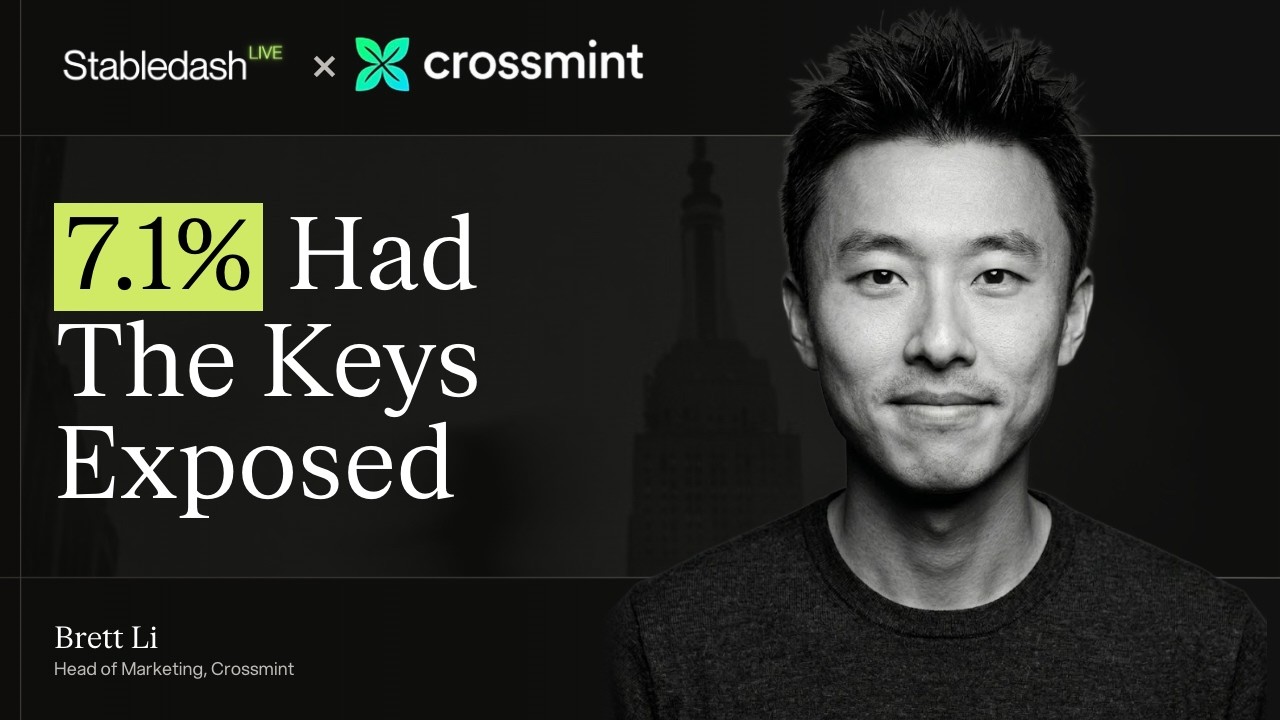
Lobster.cash and the Wild West of AI Agent Payments: Crossmint's Brett Li
Brett Li, head of marketing at CrossMint (previously at Consensys and Flipside, in crypto since 2015), discusses the company's work on stablecoins, cross-border payments, and agentic payments. He explains LobsterCash, a CrossMint-built payment standard for AI agents that supports both cards and stablecoins (built on Solana with partners including Circle, Visa, Mastercard, and American Express), created to address security risks like raw card numbers embedded in agent skills. Li also shares marketing strategy across CrossMint's three overlapping markets (crypto, fintech/financial institutions, and agentic), noting partnerships with companies like MoneyGram and Western Union. He argues AI enables scaled, personalized marketing but warns against "AI slop," emphasizing the importance of authentic human perspective and media/content in reaching audiences with short attention spans.
Transcript
25 turns, about 4400 words. Straight from the recording, so it reads like speech.
S0
0:00
Brett, welcome to the show. How's it going? Thank you for having me. Going great. Thank you for joining. Awesome. We have loved following CrossMint, having Rodri on the podcast before. I think you guys are just everything from the outside looking in seems like you you're building really great things. You move quickly.
The the role that you're playing with, especially Agentic Payments and the role of, like, riding that wave really well and being positioned to win in that in that race based on what we've known that you've built is just it's really fun to watch. So maybe as we kick off, would love your would love your intro. What what are you working on at Cross And we can get into some of the stuff that gets you excited. Yeah. Well, first off, thanks for having me on.
Brett Li
guest0:40
So I lead the marketing for CrossMint and been with the company for about six months, but pretty long crypto journey. I was crypto filled back in 2015, early days of Ethereum. I was able to join Consensus back in 2017 and kinda seen the early days of Ethereum and ICO hype and all of that good stuff. And, yeah, it was deep in the Ethereum ecosystem on the infrastructure side for a while, then most recently was at Flipside looking at crypto analytics.
But I think by and large, Crossman is really my most exciting stop in my in my journey. You know, ten years ago, we were talking about the cross border money movement and kind of new age banking as one of the core use cases for crypto, and now I think we're seeing it in action. I think we're finally seeing mainstream adoption with, you know, folks like MoneyGram and Western Union and Google, Amazon, etcetera, starting to look at the stablecoins as as core use cases.
And now seeing kind of this next wave of agentic payments start to take off as well is also very, very exciting because I think we see the mainstream adoption happening now with cross border money movement embedded finance, but then also we're looking having kind of an eye toward the toward to the future as well with with agents.
S2
1:56
So help us look into the future here with agents because we've seen different models of of launching products, and we've seen companies incubate other products. And so we see lobster cash kind of, you know, has its very own brand identity. It feels like its own stand stand alone product, yet it's very clear that it's built by Crossman when you go to these websites. Give us maybe the overview of I'm really curious just, like, why LobsterCash? Why swim in that specific lane?
And how should people think about the difference between Crossman and LobsterCash? Yeah. That's a good questions.
Brett Li
guest2:31
As we started looking into agentic payments, you know, a number of months ago, I think the thing that rang true is that we don't know what the best form of payment for agents is yet. But whatever it is, it needs to be secure, and it needs to be accessible. And so that's where we started with Lobster Cache is we wanted to build this plug in initially for the OpenClaw ecosystem because that's the one that was kinda taking off at the time to allow people to deploy. Just a bit. Right? Yeah.
To just for anybody deploying agents to have a secure way for people to process payments. You know, we were seeing stats at the time where, like, 7.1% of open call skills had, like, raw card numbers embedded into the agent itself. Obviously, security concerns and risks there. And so we created LobsterCash to be basically a payment standard for anybody, any agent to be able to pay not only with cards, but also with Stablecoins.
And so depending on where the ecosystem would end up, there's gonna be use cases where certain payments is optimized for for credit cards and then other types of payments that are optimized for for stablecoins. And so we built that and now made it accessible to anybody who's launching on OpenClaw. But then furthermore, any other agentic platforms that are starting to take off Cloud Code, etcetera, we built this as a standard for anybody to be able to use.
So that's how it started, and it's behind the scenes using CrossMen APIs, using our technology for wallets, for on ramps, for transfers, etcetera. But we've partnered with Solana, and so that's running on Solana blockchain. We've partnered with Circle because it's supporting USDC. And then on the card side, we've also worked a lot with Visa, with Mastercard, and also with American Express to be able to enable basically any cards to eventually be accessible and be able to be added to to it.
And now from Lobster Cache, this is a kind of end user product. Right? Somebody who's deploying agents can go here and then use the plug in. But behind the scenes, for the APIs that the the LobsterCash is using, people who are building agentic platforms in the future who wanna embed payments as kind of a core part of their platform can also use CrossBin APIs to be able to deploy that. And so LobsterCash is just the start.
We are we're expanding kind of our portfolio of agentic products with Lobstercast as the first kind of reference implementation, if you will, for for agentic payments. I love the trend of, like, using your own stack
S0
5:07
for building what you wish existed. Like like, CrossNet has so many incredible things that are so foundational as building blocks. And I think sometimes we've noticed this. Like, a lot of these infrastructure companies who are sitting on so many incredible things like embedded wallets, orchestration capabilities on and off ramps. I know there's a ton of compliance things under the hood here. Yep. And you're kind of wishing, like, man, we wish x y z existed.
We have all these incredible engineers and developers on the team. Screw it. Let's do it. Let's just go build it ourself. And, like That's right. Give you put the put it out into the world. And it's been really cool to, once, see these types of things come to life. Sounds like this is becoming more of an embedded strategy into, like, releasing more products like Lobster Cash. Would love to know more around what you mean by that.
Like, what other what other types of tools or things are you guys thinking through around what you can now build with these types of products
Brett Li
guest6:01
that CrossMint that CrossMint has natively. Yeah. So at at the core, I mean, when you think about agentic payments, there's certain things that have to be true. You have to be able to support multiple different types of payments. It needs to be accessible. It needs to be secure. It needs to be compliant. And all of those things are true no matter where Agenic Payments ends up. What we don't know yet is where the traction in the short term, medium term, and long term are gonna be with Agenic Payments.
You know, what's gonna happen first? Is it Agenic e commerce where, you know, you want agents to buy toilet paper on a regular basis or buy groceries for you. Is that where it's gonna take off? With kind of subscription, you know, buying tokens for other agent agentic use cases. Is it gonna be travel and having kind of bundling shopping carts, etcetera, etcetera. Right? So there's a lot of different use cases, potential use cases for agents that we don't know what's gonna take off right now.
So what we're focused on is building the primitives that allow wherever this industry ends up, people to be able to support agentic payments in a secure way, in an accessible way that supports all the different type of payments that people are gonna end up with, but then starting to explore also deeper each of these different use cases and making some bets where we can make agentic payments maybe tailored for ecommerce, right, for agentic commerce.
And working with the other builders in that space to explore use cases and seeing what can take off there, or going more direct agentic payments as well and working with other agent payment builders to be exploring that space. So that's where we're headed next is, like, taking these primitives and understanding and exploring different use cases that agentic payments could potentially be used for. I think I correct me if I'm wrong.
I think I saw did Roger post a few months back when LobsterCash launched about how your team's actually using it? I wanna say he posted something like, hey. We've been having it. Like, go and stock up supplies. Like, I I'm also just curious,
S2
7:57
like, as, like, a as a head of marketing, you know, you're managing all these spend across platforms, and I think I saw ad spend in Lobster Cash. Like That's right. Even just you for your career, how do you think about going and and using this this tool? Well, I think we're just scratching the surface. Yeah. We we've dogfooded parts of it internally. And by the way, this is not the first time we've looked at agentic
Brett Li
guest8:19
payments as a use case. You know, about a year ago, we deployed something called the World Store that allowed people to use could be checkout from Amazon in an agentic way. And so this is not the first instantiation of what the the explorations in this space. This is just the latest one that we're now starting to see kind of expand to other areas of of potential. AI is changing the way everybody works. Right?
I I'm in Claude all day every day for various things, you know, looking at content and managing ads and doing attribution, you know, etcetera, etcetera. And so I think there's plenty of opportunity for agentic payments to be added to these workflows,
S0
9:00
which we're just starting to see the surface of being scratched. But I think there's endless potential here that we don't even know, that we haven't yet explored. I think I've seen things like going and buying a new domain, you know? Like, that's just a hassle. Exactly. Hey. Go buy go it's just those little things. Like, or or also, I think I don't know if it relates to this at all, but it looks like this is kind of the like, how do we get people involved? This looks kind of like an interesting way to do it.
What is what is this about? We're just looking at this for the first time.
Brett Li
guest9:30
Yeah. So this is a, essentially, a directory of skills. If you scroll down, you should see a list of skills that have now accept basically integrated Lobster Cash. And so if you use these skills, you can connect Lobster Cash to your agent, and these skills will be able to support Lobster Cash. And so, again, this is in the spirit of, again, working with the ecosystem to give people who are exploring different use cases when it comes toogenic payments a secure and standard way for people to pay.
And we are constantly looking out to the ecosystem to find additional skill developers, additional agent platform developers who don't want payments to be the core part of their business, but just need a way to enable their users to be able to pay through their service.
S0
10:14
But that's Mhmm. That's what we're looking to build. So interesting. Zach, I'm I'm kind of wanting to shift gears a little bit into just marketing in general. I'd love to just hammer I know. I would love to. I mean, we it's it's funny. We, you know, we talk to a lot of founders and operators.
S2
10:27
And, obviously, you know, Drew has a background in in go to market and sales. I have a background in go to market and sales, a little bit of marketing, obviously do a lot of, you know, our content here. And it's so crucial and integral to not only the AI conversation, but how do you even grow a a company in in 2026. So please, Drew, take take it that way. We actually touched on it a little bit with Brian from Glider on Tuesday, but please, I would love to go down that route. Yeah. So, Brett, you came in,
S0
10:55
you said, like, six months roughly ago, and we just live in such a really unprecedented I hate to even use that word, but just, like, a a very new time for marketing and what that even means for a company. We've we've started to see the role of media be a very, very in content, be a very, very core part of marketing and how modern marketing leaders are thinking about things. Just bring us into your mindset and your strategy as someone who's leading the marketing function at CrossMint.
I highly I highly regard CrossMint in terms of what they've done. I think you guys have done a great job of getting your brand out there and marketing your brand. Would love to hear more around your strategy around that. Great question. I and I think specifically with CrossBin, what's interesting is that we play in, like, three markets that are adjacent to each other but not always the same. Right? We come from a crypto background. We are still a stablecoin
Brett Li
guest11:52
blockchain crypto company. Our end users, though, are more traditional financial institutions and fintechs, which is not always the same, right, as the crypto kinda ecosystem. We now have this agenic market that's starting to take off. And I think what's interesting is that, like, each of these different markets have slightly different characteristics, different people, different needs, different attitudes, different risk appetites, etcetera. And we need to be able to communicate with all of those folks.
And so when you think about kind of modern marketing, I think especially with where AI is coming, is that it does allow marketing to be a lot more personalized. And you you can scale much faster from a communication standpoint than you could before. Right? Because you can create content faster, you can automate more things, you can have more market intelligence that used to take months of research and content building to be able to do.
And so I feel like servicing all of these different markets now is easier than it was before. Not to say it's still not a challenge. You you have to take the time to understand each of these different markets, but I think leveraging AI is allowing us to be able to do that even with a smaller team versus what we would have, you know, three different marketing teams dealing with these three different types of markets in the past.
Are there any trends right now that you're seeing in marketing that you really just want to die? That I want to die.
S2
13:15
Yeah. That that you're like, hey, we're just going the wrong direction. Like, let's Yeah.
Brett Li
guest13:20
It's not like let's So what comes to mind is I just said AI is great, and AI can help us scale. But on the other hand, there's a lot of AI slop that you can very easily tell. Right? And I think there is a risk where the more especially in marketing, you rely on AI, you can tell if certain copy or certain creative has been built by AI that hasn't been well checked.
I mean, kind of taken that step of editing and synthesizing it afterwards to make sure that it's still poignant and actually something original that it provides value, that doesn't always happen anymore.
So what I'm hoping eventually will happen and, you know, I'm not saying AI should die, AI actually should thrive, but, like, there needs to be a better human and AI interface with some of these things where, like, things can be over automated and over AI ified very, very quickly, and that's something as a function or as a domain, as a marketing leader, I I wanna push back against. Yeah. I know Drew. Drew, we talked about this a ton, and there's this it there's this weird tension because it's like, hey.
AI is so great. One person can do the work of 10. Use AI to automate your processes. You can't let people know that you're using AI that much. And so you're like, okay. So, like, where's that where's that point? And I even think about, you know, we use a, you know, social media scheduler.
S0
14:38
And There's a word they came out with an AI feature that will scan your post before it goes out to make sure that what you're posting about doesn't sound like AI. Like, I'm not gonna I'm not gonna call out who this is, but this is just a recent video on my timeline. And it's just like you look at stuff like the I was just scrolling, and this is something I saw while we were talking. Right? And, like, it's almost there, but it's just not. I don't know how to describe it. But, like Yeah.
You see this, and it's like I I think for me, I fall like within this. Yeah. I fall on the side where it's like, in my personal opinion, this does more damage than benefit. Yeah. Because for me, it says, like, you you could get all of these shots if you wanted or source them from, like, real places. It just seems like
Brett Li
guest15:22
and I'm gonna stop sharing this so that it doesn't No. At the end of the day, I think, ultimately, marketing is still about moving people, you know, and you wanna use AI as a tool to help you do that. But if you don't have that human touch at the end of the day, people are gonna be able to see it, and they're gonna call BS. And you're trying to convince people to do something, to to change something about how they do things, and that still means connecting with people.
And so, like, I think we need to hold that dear and, like, very core to everything that we do from a marketing standpoint. Like, you know, for CrossMath specifically, going back to, you know, what I was talking about earlier, like, what we're trying to change is traditional finance in in many ways. You know? You have these hundred year companies, MoneyGram, etcetera, who now are exploring kinda different ways of doing things.
And if you are communicating in a way that's, like, very artificial, that's just not gonna happen. Like, you have to understand their needs. You have to understand what they what they're feeling, what their fears are, what they wanna do, what their desires are, and speak to that. And that that's important regardless of how much technology comes in at the play from a marketing standpoint.
A lot of the companies that we speak with and who support the show, who come on the show, who are building building their businesses, I think, are trying to win
S0
16:41
upmarket, and they're trying to resonate and reach some of these institutions and and financial like, more legacy financial players because still that's where a ton of the volume is and and distribution is. What would be your advice to reach and resonate? I think CrossMint has done a really strong job of being able to win some of these really incredible commercial partnerships. You mentioned MoneyGram. I know it was, like, I think Western Union as well. Western Union.
Like, how how what's your advice on resonating and and attracting to those types of of audiences
Brett Li
guest17:16
today? Yeah. I mean, I I don't think anything has changed from this perspective, which is, like, you have to understand what their fears and what their needs are. And even with new technology like stablecoins, relatively, for for those type of companies, it's like what's going to benefit their bottom line? What's gonna benefit their top line? How is this gonna set them up for the future? Understanding, are they trying to protect against competition or they're trying to open up new opportunities? Right?
And, like, what's gonna resonate with them? And so that, I think, hasn't hasn't really changed. And by and large for these larger companies, it is about mitigating fears, mitigating fears of missing the next wave, mitigating fears of a new new entrant, you know, displacing them as an incumbent. Those are things that, like,
S0
18:03
you know, hold true just in general. Like, that hasn't changed. But you're able to balance that too, though, because, you know, you you can get the Marshall Islands, Western Unions, MoneyGrams, but you can also have the Phantoms and Decafs, Cyrexes. These are, like, younger infrastructure companies. When you think about when you actually think about because there's there's a lot here, and there's a different spectrum for each.
But when you think about the ideal recipient or audience of Crossman's marketing strategy right now, Like, who who is that? What are they what kind of role are they playing at these companies? Who's typically the buyer, and
Brett Li
guest18:42
how are you segmenting that out a little bit? Yeah. Good question. I I think the common thread is that right now we're talking to the people that believe that finance is going through a transformation right now. And you'll find people like that in new age neo banks all the way to the most traditional companies in the world. And so who we're marketing to is inspiring those people who believe that there needs to be a shift happening with finance.
You know, you need to explore new rails, new way of doing things, and then giving them the tools to be able to convince their organization that they need to take that step, of whether it's a large company or or, you know, a large incumbent or or or a new new age startup. Equip them with will be different depending on the type of company that they're with, but they need to believe it, and then they can take it and try to sell that internally.
So oftentimes, that some type of product person in the companies that we're working with. For smaller companies, it's typically the founders. Right? So that role changes, but I think that that's the common thread. It's like we want to talk to people that believe in the future of of where money movement, where finance is going. Super. Just
S2
19:48
when when you when you think about that, right, we're making a show about modern money. And and it's there's this intersection of we do our show because we want to kinda fight back, right, around, like, hey. The reliance of of AI marketing. Obviously, yes, we use it to help repurpose content. But at end of the day, our thesis is centered around, hey. Come on the show.
Share your thoughts, your real human thoughts to get in front of your audience, whether that's using our distribution, whether that's sharing it to your company's channels. We've seen altitude. They took a clip. They made it into an ad. I I just love that. It's like the poster child for me right now of, like, hey. Go don't just do this for us. Go on as many media outlets as you can, get the content, and use that. Like, use it in clips, use it in ads, use it in however many ways you can use it.
So how do you gonna see this trend, you know, especially with MTS Live, TBPN? What role does media play, not just on the b to c side, but especially b to b in helping I tell the
Brett Li
guest20:42
think it's immensely important because I think people's the other thing with social media and AI is, like, people's attention spans are smaller than they've ever been. You know, people context switch. Yeah. Cooked. Absolutely cooked. People context switch constantly. And so if you are relying on more traditional content channels, you know, you naturally go to, like, blogs and reports and kind of, like, written content. Those things, people just don't spend the time to really read deeply anymore.
And so I think media plays a really critical role because you can take a episode like this and be able to cut it up, you know, distribute it in different different platforms. People, again, wanna see a human nature. Going back to the whole AI conversation is that, like, you can auto generate an AI, create a lot of content, a lot of blogs, but at the end of the day, if you're coming on and sharing your own perspective, your human perspectives, that is more and more are gonna become more and more rare. Right?
And so I think in that way, like, having more content like this, having more forums where people just communicate, share their raw thoughts with each other, and you can take that and distribute that, over time, I feel like that's gonna have much more impact than something you, you know, just AI generate en masse.
S0
21:53
Super interesting. It's fun to it's fun to be it's like every day showing up and seeing what happens. Feels like we're just kinda figuring this out as we go. That's great. Yeah. Yeah, man. Brett, thank you for joining us. Really appreciate the conversation. If there's anything on the horizon around, like, future things like Lobster Cash, it sounds like there might be. Would love to learn more about those and help the world get to know them too. So keep us posted. Yeah. 100%. I'm sure we'll be in touch again. Cool.
Alright. Thank you, sir. Thanks, Brian. Everyone. Alright. Thank you. Cheers.