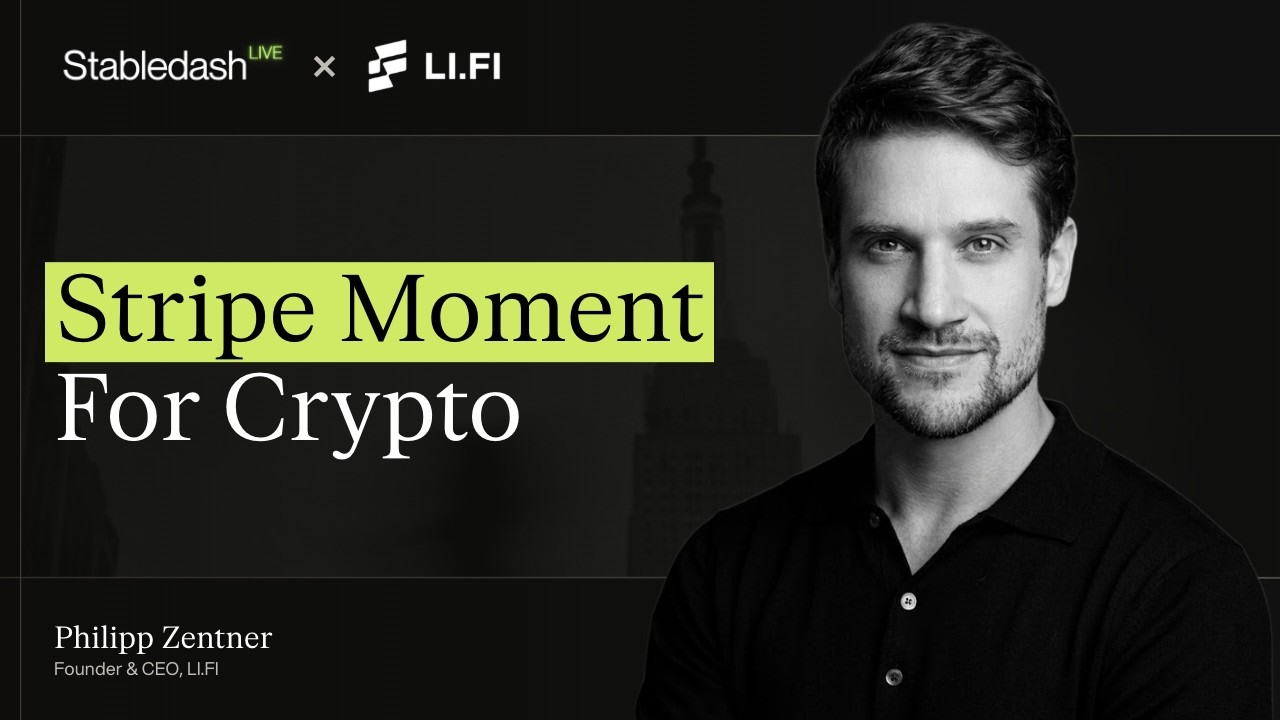
Stabledash Live · · 28 min
LI.FI Intents Just Went Live: The Coordination Layer Cross-Chain Finance Was Missing
Philipp Zentner
Philipp Zentner of LiFi discusses the company's announcement of LiFi Intents, an intent-solver network that went live today. Built on the acquisition of Catalyst over a year ago, Intents shifts LiFi from manual API aggregation to an open marketplace model that can scale to support the rapidly fragmenting crypto asset landscape. LiFi provides infrastructure for stablecoin payments, real-world assets, and on-chain liquidity through APIs that aggregate DEXs, bridges, perps, and vaults—comparable to how Stripe and Twilio consolidated fragmented markets in traditional finance. Zentner emphasizes the modularity and flexibility of the system, which can support different compliance requirements, privacy settings, and execution preferences, and enables complex multi-chain transactions (swap-bridge-swap-deposit) in a single atomic transaction. The conversation touches on consolidation in DeFi, with DEX aggregators, bridges, and lending protocols reaching out for acquisition, and the importance of B2B distribution over B2C loyalty.
Transcript
27 turns, about 5200 words. Straight from the recording, so it reads like speech.

Drew Rogers
host0:00
Good to see you. Your second appearance, first virtual appearance.

Zach Fowler
host0:04
It's great to have think you're actually one of the only people that we've had virtually and in person. So I don't know Right. What you get for that. But you got a confetti cannon.
Philipp Zentner
guest0:13
Unfortunately, I have a little bit of a lag. So if if I'm responding a little bit too late, it's because of that. I don't know. The hotel's Wi Fi seems to be overwhelmed right now, but for what it You're was coming you're coming through
Drew Rogers
host0:22
clear on our side, so we'll we'll do our best, and we'll speak slow. We speak we speak slow anyway. Anyway. So, Philip, maybe I know there's some news of the day today. Maybe we start with what you guys have just announced, and then we can work backwards from there. What's the news? Yeah. Sure. So we announced LeFi Intents,
Philipp Zentner
guest0:44
which is our intent and solver network. This finally went live today. We bought a company called Catalyst a little over a year ago, which I invested in a few years between the founders. That was, yeah, that was a major step for us to shift the company from pure aggregation to having an open marketplace, which makes it a bit more scalable, especially as fragmentation is is growing exponentially with RWAs. So now model of manual aggregation and open marketplace, and that's obviously a huge change.
It makes everything much more much more scalable,
Zach Fowler
host1:17
and it's us preparing for traditional finance. Yeah. So I see I see on the intense, you know, announcement right here, which won great videos. I think it's all video from you, video from the company. Great job there. But you're you're kind of you know, you're hitting infrastructure for stablecoin payments, real world asset, compliant on chain liquidity. I think and please, like, correct me if I'm wrong. I I've traditionally put DeFi more in the the DeFi protocol bucket.
This is, you know, an effort here, like you said, to go more towards on chain finance, and I think we're all kind of trying to break out of that, the DeFi crypto native bucket per se. So, you know, how should people look at this product, and what do you want to see them building with it? Essentially,
Philipp Zentner
guest2:03
us focusing on traditional finance is for me, I do not really differentiate between DeFi and TreTry that much. It is the nature of progression of the industry to move upstream. Traditional finance coming in is trying to adopt these rails and rails. Really, like, we have been building our manual aggregation for the past few years, and we will not stop doing that. It's very important to have that part as well.
And now with, our open intent marketplace, we are able to really partner closely with, with with because what is so special about Deferintense is is that it's extremely modular. So it doesn't matter which type of intent type or transaction domain, let's say, swapping, bridging, perps, the opportunity, all of that can be covered.
At the same how these things are being provided, a market maker or solver or, certain hybrid models in between clearinghouses, which we see for stablecoins, for example, but then also the way things are being verified. So we are modular on the security side as well, depending on what is important to you. If it's a permission system or an or a permissionless system, no matter if it's a privacy preserving rail or any other sort of com compliant rail, we are able to support all of these things very, very quickly.
And that makes our intents system so special. We were building something that is adaptive and modular, and that was very important for us from the get go, which is also why it took us a bit more time to get this live. But now we have something which prepares us for the next ten years to come. You said briefly this you you said the manual aggregator
Zach Fowler
host3:45
versus this model. So can you help us break down maybe the differences between these two models? And I think maybe even just, like, who are the solvers in this in this network, and how should we be thinking about this ecosystem?
Philipp Zentner
guest3:59
Yes. Of course. So on the aggregation the manual aggregation side is and she have a team that manually implements, API over API. So there is a certain bridging sys there's a certain DEX aggregator, there's a certain PERP DEX or Vault provider. We are manually implementing these APIs. That's the aggregation side.
The benefit of this is you really have a lot of control in which And on the on on the other hand, if you have a lot of demand, which Lify has like, we are working with with thou with over a thousand companies, and our pipeline is full. We have a lot of demand, and and all these players demand customizations by now. They have they have especially institutions, they're trying to figure it out, so they have certain ways they wanna go to market. And here, we really come in and, are able to provide flexibility.
Depending on how much these things are aligned with what we have been doing in the past, we can leverage our very abstract and modular back end architecture and the team around it. But when it comes it needs to splice or the customer wants to have a certain amount of control about which market maker is involved. Are they market making themselves, maybe even these things? Then we are like, here's our open marketplace.
We just enable you to provide and solve or market make for a certain type of transaction, rewrote asset, the way you want, and we just provide you the distribution power we have today and will have in the future, and you can simply focus on making your assets available. We just help with the distribution. We are your distribution pipe.
And and talking to all the players that that are, tokenizing, real world assets, from an to a a Robinhood chain, to securitize, like like, all these the the obvious, players essentially Yeah. The space. For all of them, we are a great distribution partner because how would we able to distribute their assets into all these wallets out there? All of them would have to knock hundreds of doors, and all these wallets would have to implement so many different types of assets.
So here, again, we come essentially in, and we provide a a a way to support a variety of assets. We are homogenizing the data. We're doing all the that each individual application would have to do for themselves, but we do that as that as a company and at scale. It seems like there's a huge priority for LeFi to go into the places in the infrastructure stack
Drew Rogers
host6:26
that would need to be built natively or built in house for some of these enterprises. And essentially, doing that work on on behalf of the enterprise, the products that you're marketing here, have swapping and bridging. You have earn. The Stablecoin API, if I'm being honest, is probably the most clearly, like like, I can wrap my head around that the most, like, getting access to all Stablecoins with a single API. Like, that makes a ton of sense. The Intense product is a new one.
I'm I'm still wrapping my head around that. But it it seems like the idea here is that you really wanna be in the base layer creating this, like, very modular flexible system that is, yes, flexible, can be architected to meet the needs of enterprises. I'm very curious, Zach, to go into, like, how companies are using these types of primitives and what they're now able to do with them, but curious if you have any kind of reactions to this.
The use cases here, it looks like, are very focused on, like, payments, neo banking, and Agenza Commerce is kind of on the rise. It looks like I'm I'm looking here at the
Zach Fowler
host7:33
kind of use cases that are being marketed. But where does your mind go here, Zach? By which part specifically?
Drew Rogers
host7:39
Hold on. Let me They didn't understand you. Oh, I thought I I thought I was sharing my screen. Apologies. Just in terms of the the suite that they're building, in terms of
Zach Fowler
host7:49
which part sticks out to you. Well, Philip, I think I think in what we are hearing a lot is, obviously especially in the neobanking world, we've talked with Glider recently. We've talked with Sesto recently building these, you know, baskets of on chain funds. And we're hearing this big push of especially within the neo banking world of it's starting with stablecoins. It's starting with stablecoin swaps.
Where they want to go and where people see them going is, you know, the trading experiences, especially around tokenized equities. So would you say that that is kind of the evolution of where this product is going and saying, hey. Start with stablecoin swaps. Stablecoin pricing is obviously super important. But now, you know, the transitioning into this next wave and building out these trading experiences is gonna be extremely easy because you already have, you know, Levi's protocol infrastructure in put in place.
I think I give you a different way to look at Levi.
Philipp Zentner
guest8:46
DeFi has always been selling the same thing. We always said any fragmented market needs a coating. What it means is if you look at what Stripe did fifteen years ago, there were, like, 200 payment gateways out there. If you ran a software as a service in The US and you wanted to get payments from India, you needed a certain payment gateway supported in India. So hundreds of gateways. And Stripe aggregated all of them and provided a simple API. Twilio camera, and they did the same for communication APIs.
So if you had a US business, you wanted to send an SMS in Panama, you needed a certain communication API to be able to send SMS to a number in Panama. So they aggregated all of these APIs and provided a simple API interface. Now with crypto, the same thing. There are dozens, 100 thousands of assets, different asset standards, exchanges, exchange aggregators, cross chain bridges, and and and we provide one API to engage with all of this.
Now as this space is fragmenting faster and faster, doing all this manually doesn't scale. At some point, we need to say like, hey. Listen, guys. If you wanna be supported by our system, like, you either can wait for two years until we get to you, or you can plug yourselves in. And that's what the intent system is.
You, no matter if you are a provider of yield or if you are a PerpDex or if you are of assets, like, these entities can now plug themselves into our system and get access to our distribution problem they want. And if you look at it from a different perspective, what we have been doing is we have been executing a marketplace execution. So marketplace executions is the difficult thing of chicken and egg. Right? Like, if you are an let's take this to Amazon. Amazon has all the consumers and all the merchants.
But who came first? Day one, no merchant would come because there was no consumer, and no consumer would come because there was no merchant. So what Amazon did is they sold books themselves. They started selling books out of our garage, then they got the first consumers. Then they could go to the first stores and be like, hey, guys. We have been selling books. Do you wanna sell your books online? We have a marketplace for that. And now we're doing the same thing in crypto. So we were, like, proxying one side.
We're aggregating all these liquidity sources and trading venues. Now we got all the distribution powers. Because we are opening up that marketplace and actually make it a marketplace, actually go there and and be open, and and now we can slowly on ramp all kinds of trading menus to be part of that. Because ultimately, yes, of course, some applications want to vertically integrate and implement solutions themselves, And all of that is true for for short to midterm. But this space is fragmenting so fast.
If you have some sort of long term horizon, this is where will really shine. Like like, LiFA is gonna be a behemoth in ten years from now. Right? Like, in ten years from now, there's so much fragmentation, and and and we are building a future where everything's is is starts being tokenized, from consumer data to whatsoever. That marketplace we are building really will be a coordination layer not only for traditional finance, but also for agentic commerce and and any any sort of agentic engagement
Drew Rogers
host12:00
with each other than to my No. It wasn't. No. It's really interesting. Personally, I love your your vigor for this and your ability to see from first principles, like, how this has happened across other industries and other time periods. I think that's really interesting. You mentioned that you acquired a company, Catalyst, like, early in the journey, and that was, like, a big unlock for you.
What other you know, in the Amazon example, you talked about bookstores and, like, how that was, like, a really key thing for them and starting there. What does that look like specifically for LeFi? Like, what is your bookstore, or who are these early partners that you've you've bootstrapped and and kind of forced growth? What does that look like for you guys in in recent history?
Philipp Zentner
guest12:42
Yeah. For us, it was the bridges we started with. We started with bridge aggregation, and then we added DEX aggregators on top of that. So we not only support bridging but also stand, and this is how we started over the past four, five years. We are extending this with, two ways. First of all, like, on the top level, we not only aggregate the sources, we also provide a multichain rail that allows to really offer end to end workflows. So you swap, bridge, swap, and deposit into a certain vault within one transaction.
That's very special. That's essentially, we're the only ones offering that. And then on the other hand, we are extending the amount of trading venue types we are implementing, perps and and vaults, essentially. And there will be more to come, like prediction markets and so on. You double click on the specific area right now. That specific thing that you said that you guys do, no one else does. Like, let's unpack that briefly. Like, what does that mean, and what is so unique about the bridge swap vault flow?
Builders. We build it to a machine. The virtual machine takes or expresses a domain specific language, an EDSL. Essentially, it's, a language that can be expressed in TypeScript, and you can type certain Default workflows. You can essentially say, check user balance. If balance is larger, then swap it, bridge it, and then deposit as collateral. Take the collateral asset and swap that again and stake it.
Like, these types of workflows, you can essentially type in TypeScript, and then it's being compiled into byte code that will be executed on chain in an atomic fashion. And the special thing, whatever this VM outputs doesn't have to be audited. So it's built in a way that whatever it outputs, it's safe. And that makes all of this very scalable. Bridges always had the ability to call any arbitrary contract.
You could send so you you were always able to send meta information alongside a Brexion, and, of course, you will also be able to build some sort of hooks on the same chain. We've seen this with Uniswap. And now we have come built an overarching system that does all of that, and it sends meta information alongside a bridge. It unpacks it. It then has a hooking. But all this is done in a very clean fashion. It's multichain, and it's safe to do that at scale.
So if we have three partners coming to us in the same week, it doesn't take us more than an hour to actually support that use case, and that is that's the special thing. And it's compounding, so the more protocols we are supporting, the easier it gets to support the next one. So this is essentially what we've been focused on over the past years, two years, and that gives us a huge edge in serving all kinds of use cases from payments to trading desks to liquid funds rebalance in their portfolio.
Drew Rogers
host15:25
Yeah. Zach, I wanna I wanna I know we have the intense video pulled up here and that we can we can share that. Before we do that, what questions do you have for for Philip around what what we're discussing here, Or should we play this? No. Let's go into the video, and then then then we can go forward. Philip, but we we prepped this. Forgot to show it in the beginning, but wanted to just share the intense video today. So let's pop this up, and then we'll we'll be right back.
Philipp Zentner
guest15:50
Sounds good. After hundreds of integrations, we asked ourselves how to yield even better pricing for our customers. Today, LiFA Intense opens up billions of order flow from hundreds of applications to an open marketplace of liquidity sources. We're working closely with market makers, solvers, and chains to provide the best user experience possible.
DeFi intends not only on not for their pricing, but fully customizable execution and a vast amount of use cases, from RWAs and stablecoin payments to fully compliant rails and privacy preserving rails, we got you covered. If you're building on chain, let us help you to go to market faster and at scale. Beautiful. So
Zach Fowler
host16:27
I think where I where I feel like for so long, the conversation, even just in the stablecoin world, is just pricing pricing pricing. Right? How can we get costs down as as low as possible? The the the more and more I've seen this, the conversation shift to the modularity aspect, especially when it comes to compliance. We've talked with teams like predicate where especially with all these jurisdictions, you need the you need those those modular aspects.
Breakdown, especially when we're talking about the different layers of compliance. So we have pricing. We have compliance. We have privacy. How do you balance all those those those pieces of the puzzle? And when you're talking about what people are actually building with, you know, how are they leaning one way to or another where maybe they're less hands on with some compliance and they're more leaning into the decentralized aspects of the products they're building.
Others are building more regulated products, and they need all these compliance guard rails. How are you maybe serving both of those personas and, like I said, giving them them that mod that modularity?
Philipp Zentner
guest17:36
Yeah. Because we were always on this meta level, we very early on had to learn how not only fragmented the space is, but also, like, how nuanced customer demand is. And that made us reflect a lot on the architecture on how we build things, and that ultimately really allows us to react to each customer's requirement fairly quickly. So if you require a more privacy preserving rail, we are able to plug this in without without having to refactor the whole system.
If you need a combination of something that's privacy preserving and AML regulated, and geofence at the same time, we can do these things without having to refactor a lot of code. Everything has been developed very abstract and modular for exactly that reason, and that was kind of a design choice from the get go. We wanted to make sure exists. So we were not rushing to go to market. We were really thinking long term, how do we build a system that scales depending on how the demand changes?
Because building a system purely for Tratify right now is too early. Building a system purely for DeFi is not enough. Right? So we are in this weird gap in the market right now where DeFi has been consolidated a lot, and TradFi is still trying to figure it out. So we have to bridge the gap and be able to serve existing clients and clients we are signing right now while preparing ourselves towards what's what's coming next to reinvent, the wheel, in in a year from now.
So, yeah, the answer is simply, it's the architecture behind everything we have built and modularity from transaction type to, which type of escrow. I'll you an example. Some intense systems are using seven six eight three. Some are using certain escrow mechanisms. And, we are modular on top of all of that. We use we can use resource locks. We can use seven six eight three. We can use any type of ESCO mechanism, really. Like, we are flexible the way we do this, and all of these and that's the thing also.
Like, there is no PUD system. There is no perfect DEX aggregator. No matter each and any design choice always ever has trade offs, advantages and disadvantages, and especially in such a complicated space, you wanna make room for all of that. You wanna make sure that each of these systems come into play when they matter the most, when they are the best choice. And that is really what is so special about LiFi in general.
We are able to really shine in a way, that no one else can because we give access to all these solutions. There are these there are these solutions that make sense if you wanna optimize for speed. There are those that make sense if you wanna optimize for security, and then there are those, if it's all about, getting the best price possible. And then those are, then there are some that are good for, like, small trades and for large trades.
Like, there there's so many factors, and you can't optimize for all of this with one system. That is the ultimate truth. So what we have been seeing as part of the DeFi consolidation is that people are picking their niche their niche. Some new intent systems are really trying to cover the corner around non v non non VM systems. Some others are really good at covering long tail EVM, right, like the abstracts and Mega Eve and and all of these chains.
So, really, like, getting access to all of this at the same time gives you the best coverage and execution possible. Philip, what are you what are you seeing consolidate?
Drew Rogers
host21:08
I think we we've spent a year and a half going on to covering the infrastructure layer of stablecoins, modern money. We we are starting to see this, like, really interesting consolidation period with companies who are either, like, failing to exist, getting purchased, struggling to stay competitive. Some companies are able to really rise and shine and find their niche. What categories are you seeing perhaps that were stand alone businesses that are now kind of collapsing?
We we have talked about, like, the wallets as a service one mostly, probably so far as just, like, APIs for wallets. Like, what other categories are you seeing struggle to stand their own ground by themselves? I think seen
Philipp Zentner
guest21:53
at least five DEX aggregators reaching out to us wanting to get acquired or shutting down. We see it in the bridging space. We see it everywhere, really. We see it in the lending space. There are some seemingly large lending protocols that are also willing to just get bought and and and shut down. Really, like, there's I I don't think there's any category relieved from this from this fact. You either have distribution you can build on and monetize on, or you don't, really.
And I think many people were betting too much on the beat of things. B to C and crypto is not very loyal. If that's all you had for some, it works. For some, it works. But I think you're also more and more realizing how important b to b is. Yeah. Well, at the same time, I think what's also happening is, like, the vertical integration from applications that have enough power, like a Phantom, for example, or MetaMask. Right?
Like, these candidates, they they are trying to do everything at the same time, including vertical integration. And for for larger players, that's fine. For smaller players that have not had that because they were too dependent on that one integration, that's bad. Right? And so they die. We also see a lot of m and a opportunities. What I mean by that is simply companies reaching out, wanting to get acquired.
No one knows like, they're not acquired yet, but we have, like, a full pipeline of companies who could buy right now. And that's obviously a clear sign of the market. And then the declining volumes, the three wars we have been seeing with Ukraine, Israel, and Iran, the dollar tank. We saw blue oil collapsing, the derivative market. So the market has been really bad for crypto, and as the volumes have declined, revenues, and that just hits. It's so fascinating. We're gonna have to wrap here. I'd love to
Drew Rogers
host23:45
dive into I mean, just the way that you think about as a as a leader, as a as a founder, it's fun. It's great to here's what it sounds like you're in a position of strength going into this, which is awesome. And it's it seems like that's really coming from a focus on the customer and focus on distribution and being able to continue to also maybe focus more on that b to b side of things. And it is interesting.
I I think we're we are in this very awkward period of you know, it's it's more bullish than ever, but we are still getting our legs with what is actually required to go work with some of the biggest names. We just before this had Jim from Superstate on and just like they are you know, those are the type the types of companies that they're working with, the Invescos of the world. And, like, that is so we're so early with with those types.
It's gonna be multiyear process to get those types of companies on base with this. But we're also not new, and we're not, like we're we're many, many chapters into the story where, yeah, did the the origins of DeFi, the origins of all of this, like, in this really interesting middle period where consolidation is happening, m and a is going is really hot. Fundraises, there are like, it's an interesting time to be raising capital and building an early company.
Zach Fowler
host25:03
So it's it's great to hear that you guys what are what you said earlier about, you know, kind of this, like, chicken and the egg conversation with, like, Amazon. Do you need the liquidity for these products to for these people to go build products that consumers enjoy using, and it's a good experience where there's no slippage and, you know, your trades are getting executed and they're not failing? Or do you need to build a good user experience first?
And then once that is happening, then, you know, then the liquidity is gonna come. And then everybody then, you know, like and we're at this, like I said, just this inflection point of the liquidity is coming. The infrastructure, I feel like, is there. And now it's great. What's what's the form factor? What are these consumer experiences gonna actually look like? Or even these b two b experiences going to look like.
Drew Rogers
host25:51
I have one more question selfishly before we go just on this thread. What are the when you're thinking it sounds like there are a lot of companies reaching out to you right now looking to join the momentum that you have and are are seeking acquisition.
Without naming names, just categorically speaking, what types of companies are you finding actually are interesting for you as you think about, like, hey, you know, we actually could go buy this versus build this, and, like, there's sort of a respect and appreciation for that versus something that's, like, maybe more straightforward to go build in in house? Like, how do you see like, what what categories are you finding right now extremely valuable or interesting from an m and a standpoint as a founder?
Philipp Zentner
guest26:32
Polyphi, I think whenever you wanna go up and down the stack and you wanna leave your core business, an acquisition makes a tremendous amount of sense. Right? The moment you wanna go about leaving your your your field of expertise, so you need you need a whole talent squad. And then if they already if there's already tech in the market, you can you can purchase. Or and that's also interesting. If you have the distribution power, you can go to founders and be like, hey. Listen.
We have somewhat and that's what Stripe did with, like, a privy. Right? They're like Yeah. Hey. Listen. You wanna grow big, though. We'll give you here's a massive equity deal, and now you can leverage our distribution to make that equity worth a ton. And, you know, like, this is a similar play. So whenever I have this kind of scenario where I can leverage my distribution, where at the same time, I I can save time to market time to market is is so important, speed and aggression when it comes to execution.
And and this is really where you wanna leverage M and A and be like, alright. I'm gonna I'm gonna corner this. I'm gonna go there. I'm gonna be faster than my competition, and this is really where that's that's how I think about M and A. Yeah. It's good.
Drew Rogers
host27:40
That's good. That's probably That's probably Gotta wrap here, Philip. This was fun. Thanks for taking the time to to do this, and keep us in mind with any other announcements like intents. We'll continue to follow the follow the progression. And, yeah, especially if there's any we love covering m and a too. So if there's any fun stuff on m and a, let us know. Those are always fun. It is a it's a it's m and a season. I I think we can so much for having me. Yeah, man. Have a good one. Thanks for joining. See you.
Thank you.



