Stabledash Live · · 22 min
Inside Cap with DeFi Dave: $400M in 9 Months, Onchain Credit, and Why Protocols Beat Promises
Dave Liebowitz
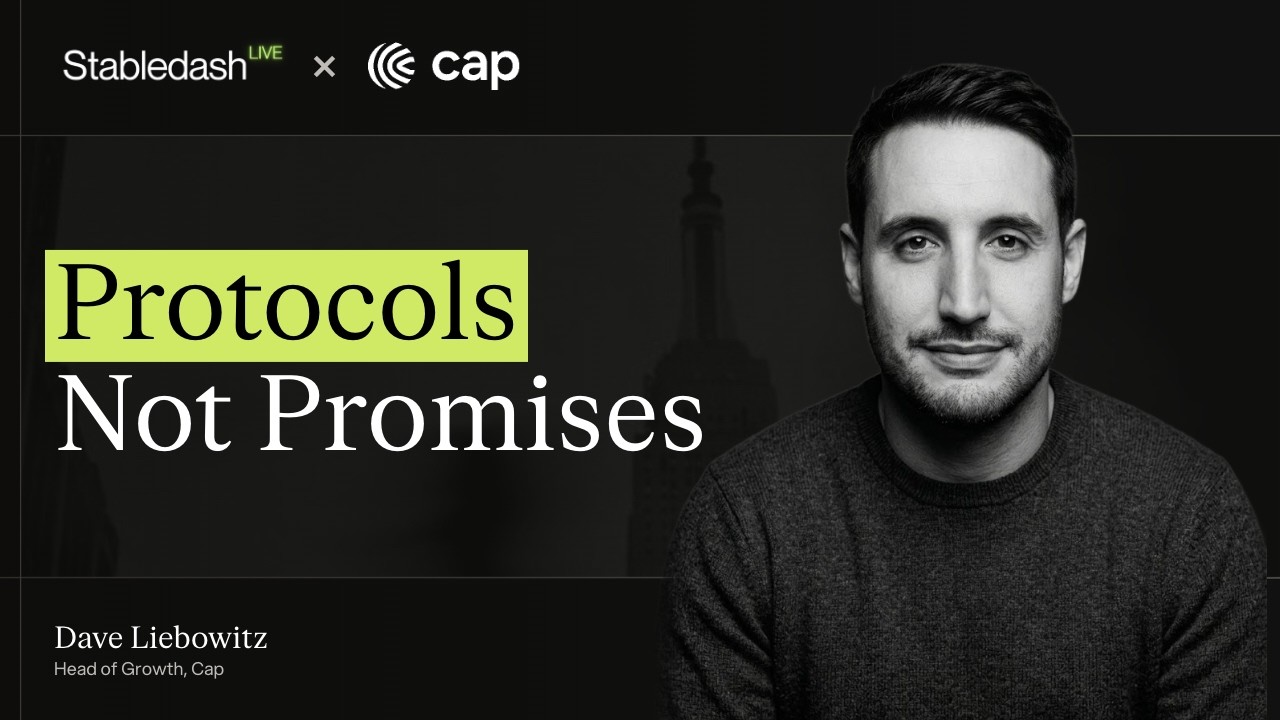
Dave (aka "DeFi Dave"), who leads growth at the stablecoin/credit protocol Cap, is interviewed about how the platform works. He describes Cap as an autonomous, market-driven credit platform built around a three-sided marketplace of depositors (who mint stablecoins like cUSD using USDC and tokenized money market funds such as WisdomTree's WTGXX), institutional borrowers (including Susquehanna, who take effectively uncollateralized loans and pay 2-4% fees), and underwriters (who stake ETH/BTC to vouch for borrowers and absorb downside risk, providing depositors principal protection). He notes Cap launched in August 2024, has over $400M TVL and roughly $150M in delegations, targets 5-7% APY, and aims to expand into real-world financing like LBOs, supply chain, and film financing. The conversation also covers institutional adoption of blockchain (citing JPMorgan tokenized deposits), the split between "efficient finance" and "alternative finance," privacy trends, and Cap's media/podcast and SEO/GEO content strategy.
Transcript
24 turns, about 4200 words. Straight from the recording, so it reads like speech.
Dave Liebowitz
guest0:00
Dave, welcome to the show. How's it going? Thank you for having me. And I have to say, that was such a cool intro.
S2
0:06
You deserve it. You deserve cool intros, man. Thanks for taking the time. Thank you very much. Joining us. The very very pleasant surprise as we were starting the stream. I think we were both sitting there, like, looking out of the corner of our eyes, and we're like, oh, shit. Hey, guys. Change the van. Change change the lineup. But, no, we're great to have you on. Like I said, I don't know if you heard. We were There we go. Andre, last week, while you were out while you were out, he shipped all these fun things.
So more to come on this. Andre Andre doesn't stop shipping. I kinda saw those sitting down there, and I was kind of keeping my hands off of them for now. But I think that was a that was a great time to use them. Awesome. Man, Cap Money, been growing. Cap Money, Cap Labs, Cap? It's just Cap. Just Cap. Just Cap. Just Just Cap. Cap. Just Cap. Cap. Yeah. Just Cap. Cap. Cool. Well, Cap has been having a a great year. See it all across my timeline. You guys have an awesome, awesome community. So congrats on on launch.
My job if you're seeing us on your on your timeline. Yeah. And like I said, I think this is a full circle moment for us. We've had a few people I know in the community. I'll I'll message them on Telegram and say, hey. We finally sat down with Caps, so go go watch this. But for those who don't those that don't know in the modern money scene, you know, you you guys sit at this very interesting intersection, you know, with the with this marketplace and very DeFi native while going towards this this institutional crowd.
I know you've done a lot of lot of work on the ground trying to bridge that gap and bring us into the moment that cap is in and and really maybe what your past years looked like and really what the next year is gonna look like.
Dave Liebowitz
guest1:43
Yeah. Of course. To set the stage here, the evolution of stablecoins have been quite interesting the past six years. I mean, yeah, early on, we had all these different experiments. Some went well, some didn't. And we figured out what works and what didn't work. And you see with this evolution of stablecoins, you have things that are manual strategy, which is just like, you know, just one strategy. So it could be either treasury bills or something else.
Then you have, like, a lot of stablecoins that are manual allocation where you have teams deciding like, oh, let's put it in this strategy. Let's put it in this firm. Let's see what happens. But with each of these, you have people managing things. It's all manual. This is really the first one that is autonomous allocation. And instead of relying on humans, you rely on markets to make the decisions. And with that, things are much more efficient. Things are less prone to conflicts of interest.
And so at CAPP, we're actually more of a we're a credit platform that offers principal protection on all deposits and are powered by financial is what powers the entire marketplace of CAP. And what is this marketplace? It's a three sided marketplace where you have depositors, borrowers, and underwriters. So the depositors, these are the people, the firms, the institutions. They mentor stablecoins, c USD, with USCC money market funds like WTGXX and soon other ones in the future.
Then you have borrowers, and these borrowers are institutional grade borrowers. So right now, we have Susquehanna borrowing from us. We have a a bunch of others you can see on our, dashboard there. And they have Edge. They get yield for a living. They do better than us, so we outsource it to them. And then you have underwriters, and underwriters backs up the entire system. In orders for borrowers to access theirs our system, they need to basically come to an agreement with underwriters.
And so how the system works is underwriters and borrowers, they team up. The borrowers will say, hey. This is who we are. This is our strategy. The underwriters go through the due diligence, not the team, not the depositors. It's the underwriter's responsibility to do that. And then they come they actually come to a legal agreement. And the underwriters, once they do the legal agreement, they vouch. They basically delegate their ETH, their BTC, or some other alternative asset, and they vouch for the borrower.
And with that vouch, the borrower can access the underlying capital of CAPS. So they can access that USDC and whatnot. They go ahead, they take out the loan, and they execute their the loan, and they pay fees to the underwriter, and those fees are anywhere between two to 4%. And then all all there I go. And then all the money they keep they they make, they keep at they basically made at no cost of capital.
So what's really interesting about CAPP and what makes CAPP unique is in the eyes of the borrower, they just received an uncollateralized loan. But remember, because of the vouch from the underwriter in the eyes of the protocol, the loan is fully collateralized. So borrowers love it because they get uncollateralized loans. Underwriters love it because they're able to actually earn real yield for the ETH and BTC of two to 4% USD denominated for vouching for for the borrower. And users love it.
The depositors love it for two reasons. The first reason is they're always protected from downside risk. So let's say a borrower this something happens and the borrower, like, runs off or something. It's the underwriter that takes the that gets flat, responsibility, and they get penalized. And then what gets penalized is sold back into the protocol. So depositors, principal projection, always protected from downside risk.
And the second reason is I like to call CAPI infinite canvas of yield because instead of relying on one strategy or relying on, like I said earlier, humans to decide where to go, it's markets deciding. And you have all these different borrowers with all these different strategies, and the marketplace is constantly shifting and allocating to the highest performing borrowers. So you really have this unique system that doesn't exist anywhere else.
We launched in August of last year, and we're we're I think we're over 400,000,000 TBL. And we have over I think it's, like, a 150,000,000 in in delegations and vouchers. So the system is, I think, you know, hit PMF. It's growing. We're seeing people who are noticing whether they're depositors, borrowers, and underwriters. And even through, like, all you know, we launched nine months ago, and it's been there's been a lot of ups and a lot of downs.
And, you know, we've not only survived, but we thrive in each of those downturns. You know? And I think our protocol yep. And so, yeah, I'll stop there. No. I was just gonna ask, though. So we we were just talking with AJ about USDAI
S2
6:24
and, you know, debt financing. What are borrowers using this capital for? I think I remember some market making, maybe some hedge fund strategies. Please correct me if I'm wrong. You know, what do you want borrowers to be? I guess that's maybe not the right question, but there's the side of what That's actually a great question. Yeah. What do they want to do with the capital, and then what do you want them to do with the capital? Yeah. No. That's a great question.
So right now, we see a lot of market making hedge funds.
Dave Liebowitz
guest6:50
People right now are using it for a revolving credit facility. So if they need loans on demand, they can just use cap and access it. But we see, you know, a bunch of of our borrowers do that. In the future, we would we would love to see, and we are going to see cap really being used in the productive economy. So not just in crypto, but for all different types of use cases. So think, LBOs. Think, like, you know, specific industry financing, like, where it's historically hard to get credit.
So think supply chain finance, think film financing,
S0
7:23
all these different financing. So This is an interesting chart here just showing this right now in terms of the different assets in reserve and where they're sitting. Yeah. I like this visual here. You have, like, the borrowed debt, steakhouse, gauntlet. Maybe speak to some of these we were meeting with Stable C, Tanner, and what they're building over there and WTGXS. This is this is the WisdomTree product. Correct?
So how how is this taking shape and maybe, like, double click on this and and what that means for potentially other folks like them? I'd imagine there there could be many, many, many, many boxes on this side of the of the house. Correct. So what you're seeing here are all the reserve assets of CAP.
Dave Liebowitz
guest8:05
So we have, like, about half of our our USCC being borrowed right now for borrowers for various different strategies. And then, of course, we have USCC and Morpho at the moment earning that's our base rate. And then we have WisdomTree. So WisdomTree so let me break it. Let me, go back up a second. So you have stablecoins, and then you have tokenized money market funds. And these money market funds have been a regulated product for decades.
They've been around, and they've been actually quite easy to plug into blockchain. And they've been around since for the past half decade or so. And they've really hitting they've really been hitting a moment over the past few years. I think they've gone up over 3000% over the past few years or something like that. And so you have different ones like Benjie, BlackRock, and WisdomTree.
And what's cool about our integration with WisdomTree is that any WisdomTree customer, so they could be, you know, regular institutions, could be individuals, they can access CAPP through WTGXXO. If they wanna access our yield, they're able to do that. And so this is us connecting to the real world, and this is the real world connecting
S0
9:15
to cap and to DeFi and to on chain finance. Yeah. Super interesting. Are there other products that you would you would equate to other other companies or other builders like WisdomTree
Dave Liebowitz
guest9:28
that are taking similar approaches that you are wanting to work with or see doing similar things that could integrate into this? Yeah. Of course. So like I said, there's other money markets funds out there that that are tokenized. You have Benjie from Franklin Temple Champ, and you have Biddle from BlackRock. You had JPMorgan. They just announced a tokenized money market fund.
So, basically, any of these different traditional firms with money market funds that are tokenized, they can be I would love to see them in cap in the future to access our capital. Know, you're you're leading growth. Right? You're having conversations with this entire marketplace.
S2
10:04
Mhmm. What how have those conversations changed from maybe, you know, prelaunch, you know, getting them on board pre August 2025 to maybe people you're trying to invite into this marketplace now that you have this proof. Right? Hey. This thing I was talking to you about a year ago, like, it's actually working. How has that those conversations evolved and changed?
Dave Liebowitz
guest10:24
Yeah. Another great question. So I think before Cap's launch, it was all about education and awareness and getting the word out there. And when it comes to awareness, you're not just competing with other DeFi protocols. You're not just competing with all crypto. You're competing with everything on the Internet. Attention is scarce, especially nowadays. And so when you have a moment, there are, like, certain moments where you're able to get people's attention. Maybe it's a race announcement.
Like, in our race announcement, we had Franklin Templeton, a leader seed round, along with a bunch of other fantastic firms that are part of our round. With those raise announcements, you're able to, you know, give people the one liner of who you are. And so that's why, like, every, like, big announcement that you have a chance is so vital in education, whether it's the raise announcement, whether it's the launch, or whether it's, like, other big announcements.
It's really important to get those things right and have your communication down pat. So a lot of education when it comes to announcements. And then also, like, just talking to people one on one, getting on phone calls, knowing who you're talking to, whether if it's a borrower, whether it's an underwriter, whether it's a depositor, whether it's an integration. Personally, for myself, I handle a lot of integrations when it comes to depositors. So talking to different neobanks.
And, you know, it's a process because it's not like that they have other timelines. They have other priorities. So it's not gonna be overnight, but I like to say be persistent but not pushy. That's the key to be deep. Persistent but not pushy because if you have a great product, it'll just sell itself, and you just kinda have to be a shepherd and guide it along. And I believe that Cap is one of those great products,
S0
11:59
and I'm just here to, you know, be its guide. There's a lot going on, though, like, for this to make sense and for people to I'm sure those who you're talking with are native to this industry, especially how it looks off chain or in the traditional world. I'm sure, like, it's a it's a more familiar conversation.
I'd imagine there are, like, key blockers or, like, educational gaps, though, for them to make this conversion, whether even even those who might be already doing stuff on chain, like the names you mentioned. Like, what are some of those key hurdles or blockers or, like, points of misunderstanding or contention that you sometimes run into?
Something that we're Zach and I really care about is, like, how can we program the show better to educate in these ways so that, you know, people who are doing what you're doing can can, you know, share this type of content, accelerate these types of deals. The stakes are high here. Right? Like, we've seen even in recent months, like, it's hard to know who to trust and what's happening on the back end, especially, like, how these things are architected. So what does that look like today?
And then, like, what what type of content would be more helpful? Yeah. I think for CAP,
Dave Liebowitz
guest13:10
because we're a newer protocol, it's all about it's all about establishing Lindy. So we've been around for nine months. So we've been we've been around for a bit, but still, like, you know, a bit more time would be helpful just for a case. And like I said, it's all about being persistent, keeping in contact with all these different leads, whether they're neobanks, borrowers, or underwriters. Neobanks in particular are quite interesting because their end user is different than your native crypto native user.
I like to call your create crypto native users your first followers. They're not afraid to get on chain. They're not afraid to be the first to try a protocol. They're willing to take the risk. But when it comes to these neobanks, you have a lot of everyday people who may not have a wallet, who, you know, may not have the same crypto native experience as a lot of people we've considered crypto native. And so then, it really matters less of, like, what which what protocols are in the back end.
It's just that it's safe and that it works. And so with TAP, our main selling points are, hey. We always have marginally better yield than the TBO rate and then the base rate because of that bar because of that, the borrowers that we have. There's always gonna be a little bit higher yield. And, also, we have principal protection. So and like I said earlier, everybody's protected from downside risk because of the underwriters. So we have a lot of unique selling points. And you can just go to our website.
You can go to our dashboard. You can see the performance over time. We're always between, like, 57% APY. And so we're performing the numbers that the neobanks want. We offer the protection that the neobanks want, and that's why we're here. I got one last question for you. Oh, go ahead. Andrew. The programmatic nature of this seems really unique and new in terms of, like, removing humans from the loop in the
S0
15:02
routing and efficiency of selection and management. It seems like that is a very, very unique part of this. I wanted to just double down on what that looks like practically and maybe some of those things that you've built on getting this three sided platform to work and perform versus maybe, like, how others have structured it. That seemed really unique to you guys.
Dave Liebowitz
guest15:26
Yeah. I like to think that cap is really built in the spirit of the crypto ethos. It's really built in the spirit of Ethereum where we rely on smart contracts than than people. We rely on co we we rely on protocols, not promises. We rely on code much more than others. And so that's what makes us unique. And we're really this, programmable credit platform, powered by these financial guarantees, which offers these protections and offers, this type of allocation strategy for our users. Go ahead, Zach.
S2
15:59
I was gonna ask. I was just I was looking at your LinkedIn, and I was I think I was going all the way back to, you know, you have you had interned at a a media company. You did bit Bitcoin for plebs. You know, you've just you have this re rich, like, DeFi DeFi kind of just origin story kinda accumulating to Yeah. To to cap. And it looks like you can spend some time more on the media side and kinda have bounced back and forth.
I mean, how has your thesis around DeFi and on chain capital markets evolved over the years? And, obviously, cap probably gets you excited this year. What what does the about the future of on chain finance gets you excited?
Dave Liebowitz
guest16:38
Yeah. It's been quite a journey. I've been in crypto for nine years. I've been doing DeFi stuff for the past six, but I've always been writing. Writing's really the basis of my career. I feel like I learn through writing and through talking to people. And how my thesis my thesis has always been the entire world will come on chain. It's just a matter of what it looks like and how it happens. I think what's really interesting over the past year or two years is how much institutions have truly gone into the fold.
The institutions have been here for a while. They've been experimenting, playing around. Their blockchain strategies have usually been a smaller part of their organizations. But now as we receive regulatory clarity, no pun intended, over the past few years, they're really going all out. They're really going a 100%, you know, pushing on the pedal to integrate blockchain technology into their regular core business. Like, look at JPMorgan.
They have these tokenized deposits that are over, like, a trillion dollars, and they're able to do, like, interbank transfers with those. And so I think how my thesis has changed is, you know, with institutions much more in the fold and that their capital coming on board, you're probably gonna see the industry change a bit. And we have in terms of the nature of participants, the nature of, you know, how different protocols function. And you're gonna see a split.
So you're gonna see us I think, Merck project, put it together really nicely between efficient finance and alternative finance. Efficient finance is basically institutions using our technology to make their core business more efficient, to make their to make their business to help their core business, basically, in their bottom line.
And then you have alternative finance, and I see that I wrote about this in January, but I see things like privacy becoming more into the fold and things that we traditionally think as the crypto ethos really coming up front. And I feel like the last bastion of that is privacy, which is why you see things like CCash really take off. And so I think there'll always there'll always be that spirit of, like, what we think of as crypto that, you know, that we thought of in, like, 2017 and 2021.
The spirit's still with us, with you know, in certain areas. Yep. That's it. Privacy in the cyber funk revival. And I think, what's really beautiful about crypto and, you know, how it gets we get to play with our identity. Shout out Satoshi, the first. And, like, the fact that we can choose, like, how we're identifying what we're called because it's really a matter of safety. Because, you know, when you hold your own keys, that's a big responsibility instead of relying on an intermediary.
And so there is a reason why, like, anons exist. It's not something to, like, play around with because, like, oh, it's but, yeah, I guess, like, I'm, like, half anon because I do have a LinkedIn. I have my real name out there. But it's, like, nice to just, like, have an identity like, to put on this mask as as Dee by Dave as I work in this industry, and then I can just be Dave outside of it.
S2
19:34
Yeah.
Dave Liebowitz
guest19:35
That's awesome. Yep. Any shows for the recent media on cap? Looks like you guys started a podcast, or you're doing some new stuff there. What does that look like? Yeah. So we have the CAP room going, and then that podcast hosted by me. We like to highlight our partners and what we're doing.
And I like to think of it as, you know, if you if somebody wants to look up information about how CAPP works or what a partnership looks like, whether it's something around, like, a borrowing strategy, whether it's something around our safety measures and precautions, they can just go to our podcast. And another thing I like to do and, like, can I show more clips of on that? And another thing I I like to think of is with AI and bots and GEO out there, they're gonna be looking for information about CAP.
And so I would, you know, just, put in our transcript and make it put in our our transcript, make a description, and make it basically readable for these bots. So there's a two pronged strategy in there for both
S2
20:29
research, SEO, and GEO. That's a whole another rabbit hole. I think I I I I was gonna say Drew's sitting here like, I hate that you brought this up right now, and now we're gonna have to wrap. Let's talk more about that. Our our conversation. Did you talk to have you talked to the royal dot I o team? No. Not yet. Yeah. That could be interesting. To you. That could be interesting. I think Zach cut out. No. I yeah. My my mic unplugged, so I was I was scrambling. That's what this searching for.
What what did you say to the the royal team? Yeah. I think they're thinking about similar things. Yeah. Worth talking to Michael from there. He was just he'll probably be on the show show, and he was just on tokenized as well, I think. So you guys would probably enjoy a conversation around around that that topic and and discoverability as well. Cool. Poof. Shout out, Royal.
S0
21:14
Dave, any final thoughts from you from your side? I know this was a quick quick hit bouncing around on CAP, where people go, what you're what you're getting excited about. Indoor cigs, it looks like, a big one,
Dave Liebowitz
guest21:27
which I think is hilarious. Yeah. See, that's e pushwick. That's a whole another conversation. But with CAP, you know, if you wanna learn more about us, go to cap.app. You can follow us at Cap app. You can follow me at DeFi Dave. And, yeah, we're the next evolution of stablecoins. It's here. It's ready. It's ready for the big time. It's ready for institutions. And if you wanna come along, enjoy the ride, just come go follow us. Awesome.
S2
21:51
There we
Dave Liebowitz
guest21:52
There we go. Shout out freedom. Shout out freedom. Dave, thanks for the time, man. Thank you for having me, guys. Have a good day.