Stabledash Live · · 26 min
How a Wyoming County Spent $70K in Card Fees Collecting Taxes and Why Stablecoins Fix It
Anthony Apollo
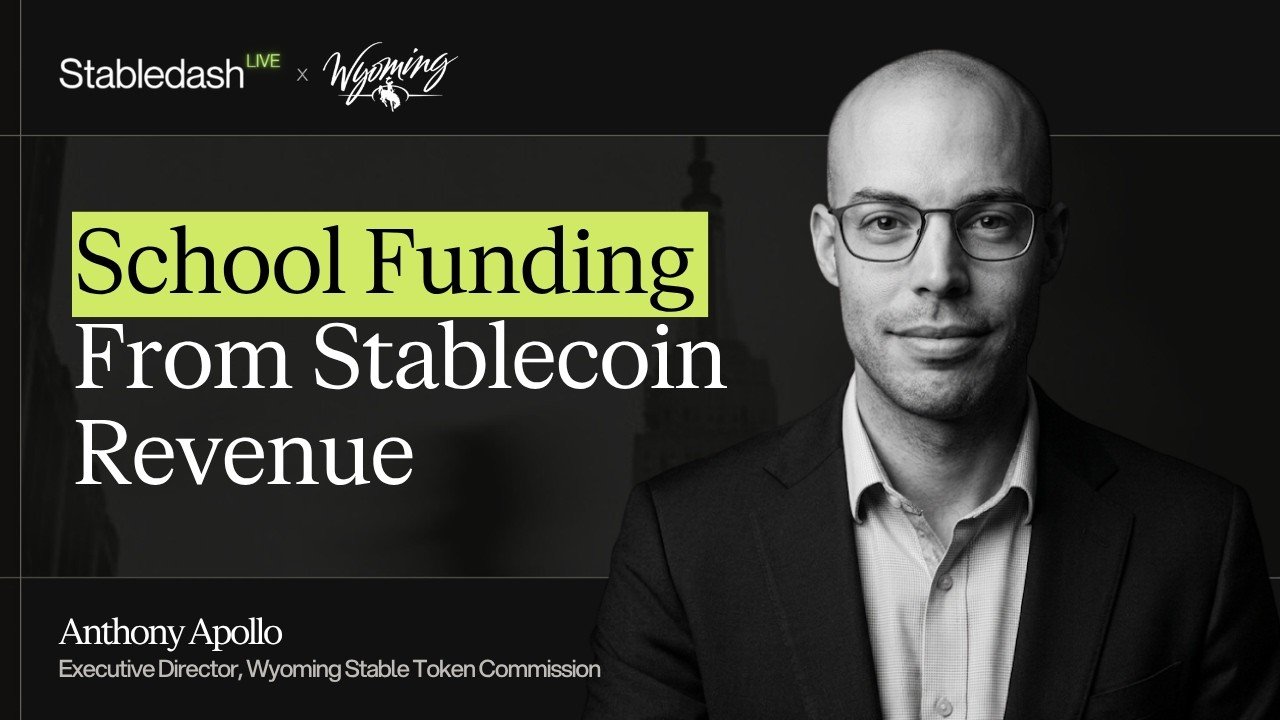
In this interview, Anthony Apollo of the Wyoming Stable Token Commission discusses the state's stablecoin initiative, including the Frontier Stable Token—described as the first fully reserved stablecoin issued by a US public entity. He argues that Wyoming's sovereign-issued token is not subject to the federal Genius Act, which he says defines permitted issuers without including sovereign entities, though the commission follows Genius and Clarity Act developments for best practices. Apollo explains the token's goals (revenue diversification funneled to Wyoming's school foundation program, reduced transaction fees for taxes and unclaimed property, and fraud reduction) and notes new statutory authority allowing Wyoming to coordinate token issuance for other states, having spoken with 20 states and four territories. The conversation also references the Clarity Act advancing out of the Senate Banking Committee in a 15-9 bipartisan vote and North Dakota's "Rough Rider" coin, developed with Fiserv for intra-bank settlement.
Transcript
27 turns, about 5400 words. Straight from the recording, so it reads like speech.
S0
0:00
Alright. Good day to you, sir. Anthony, how's it going? We are currently getting mutedness. Let's try one more time. Check you. Try one more time, Anthony. Mic check 1212.
Anthony Apollo
guest0:10
There we go. We got you. We're back. Good thing to do those sound checks. Right, boys? Cannon. That's right. That's right. We just added Cheyenne, Anthony. Live from Cheyenne.
S0
0:18
I love it. Let's go. We were on we're really excited to have you on here. We've been earlier in the show, we were covering the Clarity Act and all the fun stuff there. We actually are streaming this right now or restreaming it, I guess. How are you give us your kind of current moment. What's your take on this? What are you following? Maybe we can start there as we kind of kick off. Sure.
So I think most people are probably aware that a lot of the back and forth on the Clarity Act has been around yield and rewards and interest and all of that. So we're taking a look at all of that because I think it'll be fundamental for the industry, but just because a lot of the dialogue
Anthony Apollo
guest0:53
has been focused on that discussion and that conversation. I think people shouldn't forget that there's a lot more that the Clarity Act does around just generally market structure, and I'm excited to see all of that go through. One thing I will note is this is and again, like everything that comes out of my mouth during today's conversation, this is my own personal opinion. Out. Get it out.
But it is my opinion that the Wyoming stable token, right, Wyoming stable token that we issued, including the Frontier stable token, which is the first that we launched, is not subject to the Genius Act. If you look at how they define permitted payment stablecoin issuers, they define other persons, individual banks, trusts, fintechs, and other business entities. It does not include sovereign issuers. So to a certain extent, we're a little air gapped from that. We still look at things like Genius.
We'll look at things like Clarity for best practices. We're certainly paying attention to all the rule making going on with Genius. Saw that a few weeks back. You had the treasury, OCC, and then the I think, all put out their proposed rule making in, like, a two week period. So there's a lot going on. So with the Genius Act, we're paying attention to all that for best practices. But I would say and I would consider ourselves to be a little bit separated from what's going on in DC.
One of the things we are looking at closely is today in Wyoming was the opening in the secretary of state's office for all of the registrations for people who wanna run for office in this August and later the year. Wyoming skews fairly conservative, so the primaries in August are functionally like our election. But we're looking at the different races because as you are aware, this agency, this commission is overseen by the governor, treasurer, and state auditor with the governor serving as chairman.
So if those roles happen to switch and the governor does term out at the end of this year, there's going to be some changes to the composition of our commission. So while I am certainly paying attention to everything happening in DC, for the time being, it's a little bit more of a local focus. Yeah. What did you see this morning? It sounds like yeah. What what's the kind of inclination or what what is what you saw this morning? What does that indicate for you guys? In terms of the filings in Wyoming? Yeah.
Like, what what did you see morning? Or Not much because the secretary of state's website went down, so they're fixing that. But so I'll just shake up that magic eight ball and ask again later. But there are no, obviously. You know, I don't wanna get too into the weeds of it because, you know, I'm gonna I'm a political appointee. You know? It's not my job to to lobby the legislature, not really opine or or endorse anybody, but, you know, there are people who have been announced to run.
There are people who've already received endorsements from senator Lummis, from the president. So we'll see how that all manifests with the local elections, but we'll see who else emerges as of today.
S0
3:28
Cool. Well, I'd love to just double click as we kick off what you're building, what you guys have launched, everything about just just the business here and and how you think about it or the organization rather. To help just redefine the Genius application here and and the where Genius applies and where it doesn't, I just wanna make sure that we're defining that because I think that's a really interesting thing to call out.
You know, clarity, there are and genius, like, certain organizations and certain entities where obviously it applies, but then there are some where it doesn't, and there's case cases to be made for that. What does that look like for you guys more specifically?
Anthony Apollo
guest4:06
Sure. So let's just take it back and talk a little bit define what it is that we're building here, and then we'll bring it forward to Yeah. How we get here. Evolving evolving federal situation. So the state of Wyoming created the Wyoming stable token commission back in March 2023, which did two critical things. It created the commission. It also gave us the remit to issue the Wyoming stable token. The Wyoming stable token being the first fiat backed and fully reserved stable coin. We call it a stable token.
We can get into that in a second. But the first fully reserved stable coin to be issued by a public entity in The United States. It's intended to do several things for the state of Wyoming. One is create cohesion between different digital asset initiatives. So the state of Wyoming, since 2016, has put forth 80 plus different bills on blockchain, cryptocurrency, and digital assets. 50 plus of those have passed and been enacted, the vast plurality of them under our current governor, Mark Gordon.
So when you have the ability to pay taxes with cryptocurrency, you have a digital asset registry in the secretary of state's office, you have Dow LLCs, and more recently, the DUNAS, the decentralized unincorporated nonprofit associations. When you wanna move value between these digitally native, yet perhaps disparate initiatives, well, you want a stable mechanism and a digitally native mechanism to do that. Stable token makes great sense. Second, and probably slightly more important, is revenue diversification.
Wyoming is an oil and gas state. We're not trying to diversify away from oil and gas, but the more income streams that the state has, the better. Lower the tax burden, we don't have a state income tax, we have property tax, things like that, sales tax, but anything that could reduce the tax burden on Wyoming citizens, put actual dollars back in their pockets, the state's going to drive towards. So we generate revenues because when dollars come in for the purchase of the stable token, we issue those out.
Those dollars get invested into a very conservative blend of, you know, US Treasury securities with three hundred and sixty five days or less of maturity, repurchase agreements thereof with thirty days or less of maturity. And in that context, we don't match one to one with things like the Genius Act, but we're we're pretty damn close. We're materially close. So the revenue piece is another one.
And I will note that when those revenues come back to the state, those are intended on a quarterly basis to be swept into the state school foundation program. So this is a public goods project for the state. Unlike private issuers who have shareholders, if they're public companies, it's their their remit is definitionally to return funds to shareholders. We do that for the state. The citizens of Wyoming are our stakeholders.
And then a final reason and rationale for bringing the stable token forward in Wyoming was because this state put a lot of effort in to creating a financial institution called special purpose depository institutions. So if you're familiar with Custodia and Caitlin Long and and her plight in DC and and fighting the former administration, That's a chartered financial institution that Wyoming put together. There's a 772 page examination manual behind it.
The division of banking has been working on that for a good long time. But, again, they they encountered a lot of issues with the prior administration, and the stable token emerged as a second mechanism by which people in Wyoming and beyond can know that their dollars were fully reserved in some kind of financial instrument. With the SPDIs, they were fully reserved bank. We have a fully reserved stable token, unlike when you deposit a $100 in the bank and 95 plus percent of it is lent out fairly instantaneously.
So that's some of the rationale for bringing this all together. Again, Genius purports to have oversight over specific types of issuers, and there's nothing in there about sovereign entities. So from my perspective, it's not applicable to us. Congress can always vote to change that. Maybe they will, maybe they won't, but, you know, that's all in due time. And I will note that we were live with this effort before the Genius Act existed.
Our rules around reserves management were were promulgated, I believe, before Genius was was was signed by the president. Now we've got rules in place around token management. So we've got a pretty robust framework that we've built in house in Hawaii. It's really interesting.
S2
7:57
So Wyoming has done this. You were talking about some of the early use cases, and then you said maybe even more importantly, this kind of revenue generation side. Pretty compelling. Can you talk about how this differs from what other states are doing this? Does this make sense for every state? How does this look really different than what's happening in some of your neighbors or some states maybe far across the country?
S0
8:19
We forget, though, you gotta you gotta disclaim
S2
8:22
why you care so much about Wyoming and your I a former Wyoming resident. Where were you? This was your first was this your first job? This was in Wyoming? Yeah. My first job out of college. I I I was I was one of the temporary Jackson Hole whites, so I can't claim to be Temporary. Yes. Somewhat temporary. I mean, I was there for over a year, which is long for Jackson Hole, but short for Wyoming. But I do have a lot of affection there, and I I love to be back in Wyoming. And it's just a big, beautiful place.
I mean, people go to Jackson and the Tetons, and, obviously, they're a national treasure. There's a lot of there's a lot of Wyoming too. Anthony, what part of the state are you based, you said? I'm in I'm in Cheyenne. I'm down over over here. Map is perfect. We're perfect map utilization right here. Honestly, one of my favorite things that I got to experience as far as sort of, like, thinking about the whole state was I was a teacher and a coach while I was in Wyoming.
Sports, high school sports in Wyoming are really interesting, because where I grew up, you know, you only played against teams that were generally, say, like, twenty minutes drive away. But Wyoming, you got people pretty spread out. So if it's a track meet or, you know, cross country skiing, football game, whatever it is,
Anthony Apollo
guest9:31
you're sort of reaching all the corners. And it was fun to see that and just different parts of the state competing against each other and how that looked in in Wyoming uniquely. Yeah. It's it's funny because when I have meetings with folks over in Europe, you know, they're in Ireland, they're in Dublin. To get to the other side of the country is, four hours. No one ever no one ever drives out. I'm like, I just did another six and a half hour drive from Cheyenne to Jackson. Beautiful. Just drive through the Tetons.
It's It's great. Make sure you got your music saved down your phone because that service dies about a few thirds the way. It doesn't come back until you get to the hotel. You've got pronghorn antelope, but you do not have service. I'm segueing I'm segueing back or I'm going to attempt to. Well, you did say that the the stablecoin, some of the revenue mechanics are actually benefiting schools, so we weren't too far off there.
Anthony, we were asking you about, and I know this is something we've talked about, something that you are excited about, the idea of, like, the learnings here within Wyoming,
S0
10:24
how these things can apply to other states, sort of methods or methodologies you're seeing to actually help other states adopt to this type of framework. What does that look like right now? Yeah. So let's not let's not bury the lead on this one. As of our most recent legislative session, there were amendments passed to the SABLE Token Act that now explicitly
Anthony Apollo
guest10:42
give our commission the authority to coordinate issuance on behalf of other states for their SABLE tokens. Now the we have to work through this, but my belief, my assumption would be, they would have to kind of sign on to the Wyoming stable token framework. And that's why you'll hear me utilize Wyoming stable token versus Frontier stable token. I would say the Wyoming stable token or a Wyoming stable token is any stable token issued under our statute, so the law of the state.
The rules we've promulgated around token management and reserves management, our blockchain selection exercise, which we do on a quarterly basis to kind of confirm which blockchains can support our use case, and that's all public, and you could see that on our website. You know, we've got daily attestations, we've got vendors, and we've got a distribution network that we're trying to scale throughout the course of the next year. If you wrap all that up in a package, that's essentially the Wyoming stable token.
I mean, its first issuance is the Frontier stable token or FRONT token. That's the one that's currently in circulation. But the thought is we could apply that framework to any number of states. And at this point in time, I think I've spoken to 20 different states and four territories about, you know, who are investigating. It's not gonna say we're gonna turn a key tomorrow and move. Governments do not typically move fast.
I would say that our agency moves at light speed in comparison, but even so, it takes takes some time. And I think there's a big educational lift. Part of that is because every state has a different agency that's interested, whether it's the treasurer's office over here, a financial regulatory body over there. I'll just mention publicly, New Hampshire has a stable token study commission. I've testified in front of that organization twice, They're obviously actively researching this. Mhmm.
There's a lot of mechanics to figure out, but we now have an express and explicit remit to go and try to achieve that and get different states signed up to our infrastructure. They'd call it something else, but we've manage it on their side. We'd manage the reserve. They'd probably be kind of a revenue share to make sure they can fund some of their public infrastructure with what we're doing. And all that, would expect to come together over the rest of 2026.
That being said, one of the questions Drew asked before was around what our neighbors are doing, and they're we're seeing some some movement. Oh, you have the Bank of North Dakota, one of the only state owned banks or state banks is putting out their Rough Rider coin. I will note that that is not meant for public or retail use. It's meant for intra bank settlement inside of North Dakota, and they're working on that with Fiserv. Okay. So I missed this. I totally missed this. When was this?
That announcement was a few months ago, maybe towards November of last year. Rough Rider kinda blend together. Like Theo Roosevelt? Like, yeah.
S0
13:14
That of North Dakota. Here we go. So one word, Rough Rider coin. Really interesting. Okay. Yeah. And so this is this is a different this is a different model, though, in in certain ways because of the state owned nature of this bank. So this would be a different flavor
Anthony Apollo
guest13:29
of how you guys have architected it. Absolutely. And and Don is great. Highly recommended you speak with him. They've got a very different remit than what we have, but I had a chance to present kinda side by side with him at a ICBA event back in March. You know, there's different flavors we're all trying to get to a certain extent to the same end goal, which is making settlement easier inside of financial institutions. I think our goal's
S0
13:53
a bit bigger, but they're working towards that same end as well. And the state owned nature of BND or the Bank of North Dakota, that seems like a kind of a unique instance. Like, that's that's kind of atypical from your perspective. Right. Okay.
S2
14:06
What is the what is the Go ahead, Zach. No. You got it. I was just wondering. Will I I'm thinking about this. I'm thinking about what's possible. You guys were on the frontier of this, literally. You're 2023. I mean, you're ahead of the genius act. You're moving early, which I love. Wyoming has a lot of firsts. First state to have women to vote, right? Correct. A lot of governmental first to adopt the LLC in The US.
And I'm thinking, will I, Well, I or more confetti or other people, are they gonna pay taxes and get returns in stablecoins one day? Are you gonna get government benefits in stablecoins? Are we gonna have different transactions? Like, when you think about what's possible in this world, maybe not immediately, like you said, governments move slow.
Do you think this sort of technology, this sort of vehicle has use cases where either from an effectiveness, a speed, a security standpoint, it's like, oh, yeah, this makes a lot of sense for governments to use this sort of financial vehicle. Absolutely. And I will point specifically to testimony we received in November,
Anthony Apollo
guest15:11
I believe, from the Converse County treasurer, again, over there, Joel Shell. He is someone who's familiar with this technology, been following what we've been doing, and he testified in front of the commission that his county collected $3,400,000 in tax remittances in 2024, and it cost his constituents $70,000 in credit card processing fees for the privilege of paying their tax bill.
So he is very excited to get on a system that would use the stable token where we can get those fees down to fractions of a penny, and that's what we've seen with with the infrastructure we've built so far. Getting to that point is to, you know, like you said, Zach, we have to figure out statutory compliance because a lot of these different agencies that handle money writ large, there's specific statute of what they can and can't handle.
And sometimes these things are defined differently based on what you're looking in the state law. So the way the money is defined for counties may be different than how the treasurer's office or the auditor's office defines monies when it comes to the actual moving of funds around the state or paying vendor invoices or things like that. One of the things well, maybe I'll give you an example of how it can be used as well beyond just taxes, this is something we've talked about in our public meetings as well.
We are corresponding with the treasurer's office, specifically the department for the division of unclaimed property to figure out how we can better return funds to valid claimants using the stable token to cut down on fees. Because if you've got, you know, $40.50 bucks of unclaimed property with the state of Wyoming, and you're paying for wires and ACH fees and correspondent bank fees, eats away that pretty quick, but we want valid claimants to get their claims back.
So, again, moving on to the stable token where we can get rid of that fee structure and just give people their funds is something we're very interested in doing. However, unclaimed property division could take in intangible assets, which includes monies, but doesn't include a virtual currency as we're defined in the state statute. So there's there's things to figure out around that.
This thing I flagged to the select committee and the state legislature during last year's interim session that went to they took that in a different direction, started discussing perhaps a cash equivalency for stable token. Again, my my public testimony on that was, well, that seems like an easy button. If you go ahead and smash that today, it may have issues down the road where we start looking more like a currency, and states cannot issue their own currencies.
We're certainly not trying to contravene the US constitution. Yeah. And then if there is interest in creating a yield bearing version of our stable token or adding that feature to the frontier token, if you're a cash equivalent instrument and now you take on something that looks more like debt, you may break things today that you won't understand the implications of later. So I did put a little bit of ice water on that concept. It's something that we're actively discussing. About.
It's it's an active topic of conversation. Yield bearing lottery potentiality.
S2
17:54
I'm sure there's a few different things that worth exploring, but like you said, there's a lot of sort of need for
Anthony Apollo
guest18:02
cautious action as well. Yeah. And we're and and to be candid, we're invoking sorry to just pop this up. I'm just just Breaking seeing
S0
18:10
news. It looks like the Clarity Act just advanced out of the Senate Banking Committee in a 15 to nine bipartisan vote with two Democrats voting in favor. Shout out to Eleanor from Crypto in America for also already having over a 100,000 views and, like, good good for you.
So I just wanted Anthony, while we have you live here, just wanted to see, like, what does this mean, I think, for us nonpolitically sophisticated folks, the difference between even, like, what does this mean in comparison to the senate banking committee versus the full senate? How could how should we be thinking about this even just generally in terms of progress?
Anthony Apollo
guest18:47
How do you see this? So I would say this is fantastic news. I would congratulate senator Lummis and her team for all the incredible work done around this. I I know how much effort has gone into this, so congrats to all those involved. I will note that this does not mean we're out of the woods yet. It does need to get in front of the full senate for a vote. I don't think that would be much of a holdup being that it is a Republican controlled senate.
This is kind of coming out of Republican initiatives, so I would expect that to go through. And then this the next step after that would be a full congressional vote, which would require some kind of discussion between the House version of Clarity, which passed last year, they've been sitting on it, versus the Senate version.
Now what I've I will certainly couch beyond that, this is my opinion, a little bit of rumor and speculation, when the STABLE Act was being worked on in the House and the Genius Act was being worked on in the Senate, there was always this effort in the House to make amendments to kind of bring their version of the bill further into conformance with the Genius Act. By the time it hit the floor of Congress, you had a lot of alignment on that, and that was able to kind of sail through.
And the thought was, well, the Senate kind of ran that process. Perhaps the House would be the one pushing on the Clarity Act. But the version of the Clarity Act in the Senate does look quite different than the one that passed in the House. For example, the ancillary asset test, that is something that's not, to my knowledge, included in the House bill. So there will need to be some kind of conformance between those two things before it hits like a full congressional vote.
And, again, things could go any number of directions with that, but I would think this is a very clear step forward.
S0
20:18
And what I'm hearing now is a desire to sign the Clarity Act into law by the president on July 4. On July 4, that would be epic. Is that just for is there a certain reason that it has to be on July 4, or is that just for dramatic effect? Dramatic effect. July 4. I'm Two hundred and fiftieth. Yeah. Oh. One fiftieth anniversary. I am I am happy that they moved the UFC White House fights up to mid June, though, so it doesn't, you know, it's caused that. One thing I want You you gotta keep the priorities in order.
You know what I'm saying? Anthony, we only have a couple more minutes.
I want to, one, just make sure that we're capturing the personally, what we get really excited about, also what I think there's some excitement in Missouri where where we are around this idea of just, like, how do we take what Wyoming has adopted and implement it and learn and accelerate initiatives like this mainly from from the benefits that this initiative can give to citizens, businesses, regular people without having to go through, I think, a lot of the expertise and focus that your team has gone through in the last few years just around getting to this point.
There's a lot that you guys have done. There's a lot that's already live. All of the infrastructure decisions that you've made along the way, which we've covered in the past. We didn't say this top of the top of the conversation, but go back and listen to but when we post a couple clips of of this, we'll share your original conversation kind of framing this that we had with you, which was great.
But what what is the kind of core value or the ways that other states like Missouri or others who are maybe in a more early position here, and they're just just now getting started, and they're seeing news like the Clarity Act stuff, and they're saying, okay. Like, let's go figure this out now. What what have those conversations been like, and what are those key kind of initial steps that that you're seeing other states take with you guys? It's a great question.
It's a complex question because the kind of format of every state looks a little different. There are plenty of states we've talked to who are educated on the topic but may not have the kind of political push to get this done. Although, again, I would expect that to change with with Genius and Clarity going through. We've seen that from the community banks and credit unions. I've talked to again a little bit different in the state question, but, you know, there's a lot of trepidation with those institutions.
And now that Genius passed, they understand this is not going anywhere. They need to get involved. They're getting to speed, and Stephanie Chan on our team is doing a lot of educational lift around that locally. For other states, it's interesting to see that their interest in education don't always have a direct correlation.
Anthony Apollo
guest22:45
There's one state's treasurer's office who I spoke to who was extremely excited to launch a stable token, and I asked, well, you're so gung ho about doing this. Like, how far along in the process are you? They told me it was their second meeting about blockchain. So there's gonna be some more educational lifts.
When we speak to these states, one of the things we do wanna impress upon them, Drew, is like you just mentioned that we've been at this for about if you look at the original version of the Stable Token Act that went, you know, in front of legislature in 2022, this is a four plus year initiative on our side to bring this to market. So if you're starting from scratch, it's gonna take you some time. Meanwhile, we've already built all of this infrastructure. Look to us. Everything we do is public.
If you wanna just copy and paste what we've done, go for it. If you wanna work with our organization, our agency, our commission to do it on your behalf, we're more than happy to facilitate that. Could do that quite quickly. What I will say as one quick point is while we may issue tokens on behalf of other states, I don't expect that we'll be managing tokens for other states.
So we'd wanna see states that could come to the table with wallet infrastructure set up with people who have some kind of education or even certifications on digital asset management to make sure that we send a 100,000,000, you know, Sunshine State stable tokens to Florida to whatever office that would be, they've got the wherewithal to manage that, and they've got support within their agencies to actually use and deploy it.
And I think it's gonna be a great vector for, you know, again, raising money for public public goods, public institutions, but also creating more transparency and lowering audit costs. We think that that's a big potential for this technology. If you know where all your dollars are going, it's lot more easy to track and trace. And then third is cutting down on fraud. It's not a problem we really have in the state of Wyoming. We're third lowest in snap fraud.
I think we've had like 14, sorry, $400 of, like, questionable Medicaid payments on a billion dollar balance. That's not really a problem we're solving in Wyoming. It's kind of already solved here. But for other states that are combating that, we'd hope that they could adopt something like a stable token to really clean up some of the ways in which state funding gets distributed. Yeah. Excited to see more of this. It sounds early. Education is needed, but you're in this you're in these conversations.
Committees are forming around The US. There are certain states like like we've mentioned, North Dakota taking really interesting approaches to this. So
S0
25:01
excited to have you back on. Would love to just continue to consider ways to help accelerate learning and education for these types of organizations. So keep us honest on, like, what we can be doing there and and supporting you guys. We love we love seeing the work that you've that you've been doing. I think the the foundation you've laid in in recent years is is gonna be something that more more and more states stand on.
Anthony Apollo
guest25:25
Thank you for all the work you're doing. Thank you. I'll I'll leave you with this, Drew. If you could help me have some of those conversations in Missouri, maybe you get a chance to name the token that we launched there. Rider
S0
25:32
Rough Rider token is gonna be hard to beat. North Dakota's got a good one there. Well, yeah, we'll think about it. That'd be fun. Travis, shout out to Travis Fitzwater if you're you're listening to this. He's pushing this pushing this sort of conversation forward in our neck of the woods. So alright, Anthony. Thanks for the time, man.
Anthony Apollo
guest25:48
Thank you both. Talk soon.