Stabledash Live · · 29 min
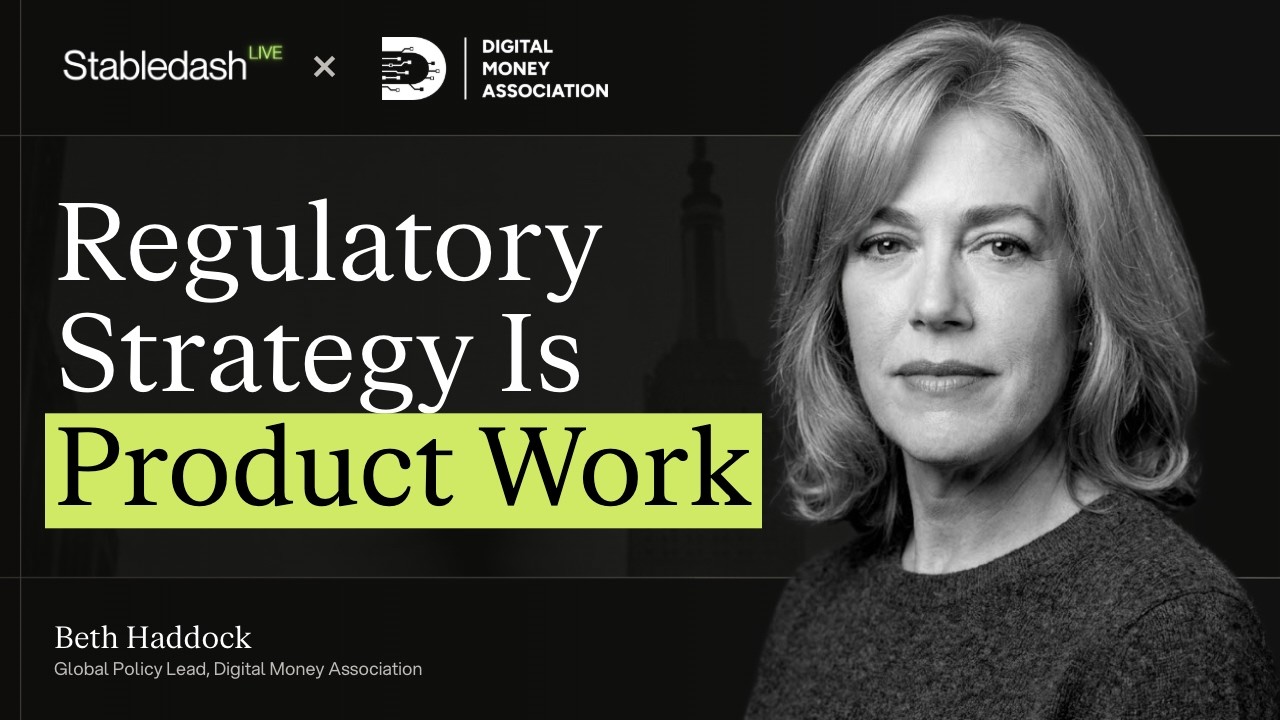
Founders Need a Second Roadmap: Beth Haddock on Regulatory Strategy
Beth Haddock
Zach Fowler and Drew Rogers interview Beth Haddock, a policy and advisory expert who works with the Digital Money Association (formerly Stablecoin Standard). They discuss the evolution of the organization from focusing narrowly on stablecoins to encompassing the broader digital money ecosystem, including CBDCs, tokenized assets, and cross-border payments. Haddock explains her work helping founders navigate regulatory environments with responsible innovation, her approach to evaluating founder trustworthiness through curiosity and openness, and the importance of media in educating the industry. The conversation also covers recent U.S. stablecoin legislation, the role of industry bodies in combating misinformation, and Haddock's vision for how the community could engage through smaller, more intimate settings and diverse content formats.
Key takeaways
- Digital Money Association expanded from stablecoins to cover all digital money products, CBDCs, and tokenized assets as distinctions between them became less important.
- Beth evaluates founder trustworthiness primarily by assessing curiosity, openness to dialogue, and whether they sought policy expertise voluntarily because they wanted to grow responsibly.
- The DMA policy framework rests on three pillars: consumer protection, operational resilience with safe reserves, and ethical standards for founders.
- U.S. stablecoin legislation still needs work on enforcement provisions and exemptions before August Congressional recess, but founders can continue building using existing rules like the Genius Act with agile regulatory strategies.
- Beth prioritizes decentralized media outlets and objective reporting over centralized institutions or hype-driven coverage, preferring readers have multiple sources to form their own opinions.
- Agentic commerce authentication and verification layers are underdeveloped and represent a critical gap despite rapid growth in agentic payments.
- Smaller, intimate networking events and content with multiple formats (video, audio, text, summaries) are more valuable than massive crypto conferences for meaningful conversations.
Transcript
38 turns, about 4800 words. Straight from the recording, so it reads like speech.

Zach Fowler
host0:00
The new core for the next era of finance.

Drew Rogers
host0:18
Beth, welcome to the show. Great to see you going today.
Zach Fowler
host0:23
It's great. Thanks for having me. It's great to meet Great to meet you. I'm Zach. This is Drew. I feel like we probably should start doing that sometimes for people that actually haven't met us instead of just joining these two random guys talking to you on the stream. But, you know, thanks for coming on StableDash live today. We've been I've got my blue. Know. Yeah. You're you're right there.
Beth Haddock
guest0:43
To counteract your black, but I do love the music that's coming in. It's sort of, like, very groovy. To keep try to keep the vibes good.
Drew Rogers
host0:51
It's been cool to follow the I think that just the early journey of of stablecoin standard, and this is the first time I'm seeing digital money association. We've met, like, Rami and and Christian, and we've been around some of the influence, obviously, that you guys have had in in the space. And it's been really it's really been really cool to see. I'd love I'd love to hear, like, maybe from your your vantage point, a little bit of the story of, like, how this all started.
I know you have a very, very key role in all of it, and then would love to hear more around the like, the rebrand or the evolution into digital money association.
Beth Haddock
guest1:27
I saw your tagline that said stay stable, and this is probably the opposite of that, which is the team realized primarily non US issuers as well as early stage issuers needed a place to come together, sort of like an ecosystem or a DAO, however you wanna put it.
And then as stablecoins have grown and we've realized the distinction between, say, CBDC, tokenized assets, and stablecoins is becoming less and less important, that it's all about digital money, that's when it's really the same group of different partners, but we're making room for more institutions
Zach Fowler
host2:11
to join as well as broadening the tent so that it's everything about moving money. You know, it's funny. Stay stable to a degree is a little bit of, like, our roots. If you know, you know. We had that tagline two years ago. And even though we're still Stable Dash live, so much of our show is that great stablecoins are the backbone, but there's so much more to the world of on chain finance and digital money than just stablecoins.
You know, we have a section now that's focused on cross border payments, FX, localization of stablecoins, the intersection of AI. We're getting more into modern modern markets and tokenization. So in this world, though, where does mostly your focus land? Like, at Digital Money Association,
Beth Haddock
guest2:56
previously stablecoin standard, what do you spend all your time thinking about? Yeah. So I'll I'll pick up on pick up on that again and say when I'm working in this space, it's not so much stable, but it's a derivative of that really sort of responsible innovation. So I'm helping those that are within the digital markets association, digital money association, as well as different founders that I help. So this way, you have a stable foundation and it can be agile.
So it can move and deal with regulatory developments which are inevitable and also to really sort of promote interoperability. I don't necessarily expect harmonization across the globe, but to avoid fractionalization and to allow all of the digital money products to grow, I do think that you need to have policy and regulations that complement each other and allow founders to really grow from one region to another.
Drew Rogers
host4:05
When how would you compare and contrast the because I know advisory and and working as an independent party with, I'd imagine, a handful of different what you might consider clients or partners has evolved a lot in the last twelve months as we've seen regulatory clarity, you know, hopefully get clearer and clearer. How would you compare and contrast that a little bit? Like, what are the conversations like now versus what they were a year or two ago? Yeah. So it depends on whether
Beth Haddock
guest4:37
you all are a glass half full or half empty group. We're totally half full all the time. Me too. Me too. So here's what I'll say, which is it it sort of made me sad, and then I was like, it's okay. I started financial services. I left about ten years ago because I did believe there's a better paradigm, which is all of the innovators in Web three.
But now in the last year, with all the institutions coming in and getting excited about digital money and all the other different digital assets, there's a different type of conversation.
And in some respects, it's the conversation that I was having when I started in my career in financial services, which is there are rules and laws and regulations, but then there are tons of exemptions and exclusions that American ingenuity and then just entrepreneurs globally have always used to balance and sort of be innovative, but be responsible so you have that stable layer in your project or your company.
But you should be able to find that wedge and bring that service or that product product to an audience that isn't being served or somehow improve. And I feel like the conversations now are sort of revisiting that precedent or those tenants that have been around in
Drew Rogers
host5:58
our global economy for a long time. When you think about I know just the the relationship here with policy is very deep. Where where did that passion or interest or ability to because like you're saying, as for founders and builders, it's so key to know where you sit on the risk spectrum of innovation and how far you wanna go in of what seems like a unclear regulatory environment, understanding the guardrails and where we sit with policy is so important.
How have you seen just because you all and your organization is so seems so plugged into the policy side, how has how have you seen that impact the kind of innovative spirit of the industry in the last six to twelve months as policy has gotten more more front and center? Yeah.
Beth Haddock
guest7:00
Policy right now has become very political in The United States. I don't necessarily think that's the case if you were to go to other jurisdictions, but I started out my policy journey. I worked on Capitol Hill. So to me, that's probably why it's a little bit more intuitive in how I work. When we built the policy group at the stablecoin standard, now DMA, we decided we wanted a diversity of thought.
So we have had we released a couple of white papers, which were really meant to be the placeholder until there is a little bit more I'll just use the word clarity, but with a little c Mhmm. About what the requirements are. So we have all these different frameworks.
So the only way to get those frameworks was to decide that we need to have people at the table that disagreed with each other, but that we're gonna be intellectually honest and sort of push back on each other, debate, and come up with something that's not just watered down because there was a consensus, but because you had academics, you had founders, you had attorneys, you had regulators and compliance professionals. So that's that's really how we approach the policy angle.
We just had a webinar earlier this morning, and that was a really good example of it. Instead of just going straight at the headlines, because we have that those kind of stakeholders in the community, we were able to go pretty deep, which was fun. Yeah. What would you say about this of this morning's webinar? Yeah. We covered, like, how can you fight illicit finance and protect personal privacy?
And there were a couple of other topics like that we feel like are missing from the headlines, but everyone knows that that's super important. So we try and kinda remind people again.
Zach Fowler
host8:53
Cool. Actually taking a note right now. No. I was taking a note be I was gonna ask a similar question, I mean, Beth, because we're we're hearing similar things right now. You know? There's there's the high level issues that you see plastered all over the news, but it's like, what are the what are the practical things that founders are are struggling with right now? How how would you even approach trusting founders to a degree? You know, I feel like we have this inclination that, oh, this person's raised money.
We they must be inherently, you know, a good person, and we can trust them. And then, you know, you see all these all the all the other headlines. How do you approach working with with with maybe newer founders or even well established founders?
Beth Haddock
guest9:33
Yeah. What a interesting question. Thank you. So I am pretty careful because I do think the philosophy has to be aligned in order for you to be able to help a founder. And I also think risk tolerance can change. So I don't think it matters day one. I I kind of go for the big themes, which is is the founder curious? Is the founder open so that you can have a dialogue sort of like what I was describing with the stablecoin standard?
And then does the founder either know that this is their blind spot and that's why they want someone with a policy background there, or is an outside constituency making them get an expert like myself? So is it their board, or is it investors, or or is there a problem, or is it coming from them because they're ready for the next step?
And if you can get a curious, open minded person that's doing it because they wanna grow and they want it to, like, get a good ROI and not, like, build stuff that's too heavy or build stuff that's too light, that to me is the trifecta.
Zach Fowler
host10:46
What are the telltale signs of a curious founder?
Beth Haddock
guest10:50
Like, how do can you tell if somebody's faking it versus, like, they are genuinely curious? Well, we're I probably should start with this. This obviously, this whole podcast is just my opinions. And from my from my experience, I think if you have a conversation and the different questions that you ask and whether you can you can tell that they're listening because of how your dialogue is going, I think that's a really good indicator. A second one is just like your podcast here. Founders can just be like
Drew Rogers
host11:24
bulls in China shops just like, I'm going where I'm going, and, like, you can't get in my way. Whatever you say is like I I like, yeah, being receptive and, like, open to feedback, and that's a good that's a good one. But even like, I think you can do two things at once. You can be hyper focused
Beth Haddock
guest11:41
and really intense on what you wanna deliver, but still be open to someone who's telling you from their perspective what could be a blocker. Right? So
Zach Fowler
host11:52
yeah. Yeah.
Beth Haddock
guest11:54
But I also think all the content, like, all have great content. There's all kinds of content. So before you have a conversation with the founder, you're obviously gonna go and look and see what their digital footprint is and how they answered questions that you all asked them or whomever else. And you can get a sense of people's perspective.
Drew Rogers
host12:13
What what's the role in your view of media right now in education? I know that's such a big part of DMA and how you're thinking about the value of it. Like, how have you seen the role that media plays in helping an industry form and and grow into a successful, like, robust ecosystem?
Beth Haddock
guest12:33
Why is media so important? Yeah. I feel like the sky is the limit right now because it's so decentralized compared to in the past. But the risk is that there's hype and junk. So, you know, the Clariac dropped yesterday, and, like, there's just, like, a lot of stuff that's out there that's not helpful because there's so many different media outlets. You know, the outlets feel like they have to do something to get to get the attention.
So I feel like some of the great media like, you go to you go to X before you might go to one of the national newspapers to get real timely developments. And I focus in on those that are going to have that press approach instead of hype or opinion related. But that's just my taste. I'd rather hear the info and make my own decision and listen to more than one outlet. So I hope we just have more growth from that perspective.
Zach Fowler
host13:45
Yeah. I mean, think it's interesting. We've seen this kind of I don't know if you follow this wave at all, but there's this in in the creator economy, there's been a rise of local media outlets where instead of going to the newspaper, it's, you know, individual entrepreneurs going out, and they write a newsletter specifically tailored to their to their community. And, again, it's it's less opinion, more objective. This is what's happening. This is what's going on. You need to know about this.
Not not that side of, you know, you're kinda wondering what perspectives, what overarching figure might be crafting the narrative in that way, and it's interesting how we've even seen a lot of the newsrooms die off along the on the larger crypto outlets. I think for that reason, you know, it started the the the lines start to get really blurry of, is this actual news, or is this somebody paying for a headline because they have some other incentives to, you know, go pump a token or or something like that.
And I think it's something that we've even we started off doing some sort of news, and we realized we care more about talking with the people actually behind the news, and what do they think? What are their opinions? And those probably matter more than what we actually have to have to say about the the
Beth Haddock
guest14:59
subject. Yeah. If I had an emoji, I would do like a cheer because I I love that growth because I do I believe, it sort of should take take a point that you raised about trust. There really isn't a lot of trust for central institutions, whether it's financial services or governments or media. So the more that we can rethink that and have it be decentralized, the better.
And then the readers can decide, do you want to go to more than one source and make and do your opinion, or do you have a way in which you prefer to consume? And I like having the option and the choices. I would be more worried if there was such consolidation and centralization
Drew Rogers
host15:47
that we had less choices. I really like from what at least what I am observing of the business model or the way that an or like, a industry body seems to work from an incentive standpoint.
It seems very aligned versus I think perhaps what you could you could feel with a media business where we we have to feel we have to feel this tension sometimes where we have to be really careful, and I think a lot of media companies will take the bait or, you know, do make mistakes with sponsorship money or following the wrong the wrong incentives.
I like how an industry body like, the incentive structure seems so clear and interesting, at least when it at least when it comes to media and, like, how you work with partners to create it. So it's been it's been great to follow the the content and everything that you've been putting out with that. We've been following along. Any comments since you mentioned clarity? It sounds like yesterday, there was some big some big news or or or movements that you were following.
What what happened yesterday, and what stuck out to you? Sounds like you you've been following this pretty closely. Yeah. Well well, thank you for that. We do try and be as objective as possible,
Beth Haddock
guest16:57
and that's why the more people that join, the better. Because to your point about misinformation or misconceptions about the space, it's not just media. It's also these different self regulating groups. So they're really important. And then with regard to the latest US legislation, there's it already has been a news cycle to our point about it so evolving. So I don't know how much of your audience is already caught up, but I would say that you could see that it's moving along.
Everyone is still trying and, you know, crossing fingers that there can be some real momentum before the August recess of the US Congress. But there's a lot that needs to be done between now and then. The main issue about whether or not the proposed ethics provision is sort of fit for purpose for what would get bipartisan agreement. It does seem like we're not quite there yet, mostly because there's a sunset.
There's also some exemptions and some exclusions when it talks to how you can really enforce any kind of breaches. So I think it's just something to watch. And I would say, we have the Genius Act. We have lots of rules and laws and regulations. So even if it doesn't pass, I do think founders really can still continue to build and grow.
They need to have a strategy, and they need to do the work to just have that be an agile strategy and spend as much resources on, let's say, for their, like, product road map, for their regulatory strategy road map, and just keep keep adjusting as things change.
Drew Rogers
host18:50
What do you think, at least from your just legal opinion, perspective, whatever the right term is to ask this, you you have, you know, just such an esteemed background in, yeah, the the policy side of this. Like, what what do you independently feel like, you know, if you were to if you were to go back a few years ago before all of before all of this was even on the table?
What are some of these things that you're really, really proud and happy to see in this act versus the things that you wish maybe weren't there or surprise you a little bit, like, on a macro just give us a little bit of the macro, especially for people who are just kind of getting up to speed on clarity. Like, how do you look at it from a macro standpoint? Yeah. It's a great question, and I'll and I'll keep it very macro because so the stablecoin standard or the DMA, we did a global
Beth Haddock
guest19:41
inventory across the world. What are the regulators worried about, or what are they doing? And we used that to create these pillars for a stablecoin framework. And that would be my answer to you, which is that framework talks about consumer protection, and everyone is focused on consumer protection. We're just debating so that we can get consensus on what is enough versus what can go into legislation and what can go into follow on rules, laws, regulations, maybe even legal precedent over time.
The other pillar is just the concepts that make a product responsible and innovative. So what does that mean when you talk about stablecoins just as one part of the digital money ecosystem? That would be making sure that there's operational resilience, that reserves are safe. And we have that already in Genius. We don't necessarily need to see that again in Clarity, but Clarity is much broader. It goes to that concept, but more from a market structure perspective.
And then lastly, and this to me is a little bit about what we were just talking about. When you look at the founders, you should have certain standards so that founders know they can reach for that moonshot, but there are certain obligations to your users, to your different stakeholders. So in The UK, they call it sort of standards for anyone that's allowed to be a founder. You have to sort of adhere to certain codes of ethics and certain standards.
And I like that although this discussion is causing a lot of back and forth and it's become slightly political, I like that we're talking about ethics. I I had a podcast at one point. It was called What's Ethical? Because I do think people can disagree, and I think it's an important conversation to have.
Zach Fowler
host21:49
Beth, I have a bit of a somewhat selfish question, but you also brought it up earlier when you're talking about media. And, you know, we think about this a lot. What what does the community want? What do people like Beth want when they consume media to get to know founders to where when should things happen on a virtual format versus going in person?
Is there anything that jumps out to you right now that is missing in the current community when it comes to either events or types of media that you'd want to see happen?
Beth Haddock
guest22:22
Or right now is the simple answer of maybe we just need to get in the same room more often. Yeah. So I would say I'm gonna answer it because we say we're glass half full, people. I'm gonna tell you what I love and that I would love to and I would love to see more of it. One is to I don't know if you saw the agentic economy treatise from one of the cofounders of USDC. Anyway, if you go and you look at it Yep. You can you can choose how you want to absorb that information.
I love that because some people want a video, some people want audio, some people want a chart, a summary, and some people want the whole thing. And I like to toggle back and forth. So I think with AI, whether you do it through, like, Gemini's notebook or you just see there you go. Or you just see more and more content that allows optionality. I love that because you don't you're not you're not limited to the sound bites. But, also, all of our attention is pretty small because there's so much going on.
So that's one thing I love. The other thing I love to your point is the in real life but smaller groups. I'm pretty much an introvert. So like if you really wanna get me nervous, you can talk about going to one of the massive crypto conferences. And that's just not it's just not my thing.
So I love to go to, like, the meeting before the meeting or the meeting outside the meeting, which we've seen in a lot of the events because I think I'm not alone, where people wanna have meaningful conversations with their network and new people in their network. And it's really not as easy for everyone to do that in these massive conferences that we've we've been sponsoring, and there's so many of them for many years.
And when I get into those rooms, whether it's a dinner or just a side event, I learn so much, and I kind of like that. If you were to host a dinner
Drew Rogers
host24:26
tomorrow night and that you had, like, 12 people to invite and you could you could run the agenda of the dinner, what would the and you could, like, kind of, you know, pick any one city. People flying in. Yeah. Like, what what would that dinner be discussing, and how would you like, what kind of room would you build? Like, what's what would be the, like, the topic of discussion and the type of guests you would want right now in this current moment of the market? That would be so fun.
Beth Haddock
guest24:53
That would be so fun. And everyone had to come. It was just like, everyone's there tomorrow night. Yeah. It's like I'm the principal, and I'm calling them, and they're they're not gonna come. Okay. So I would say that I I feel like agentic commerce is the issue that I would wanna talk about. Of course, we could talk about it as you have agentic payments.
But the lack of having figured out the authentication and the verification letter, the layer that there with everyone building already in agentic payments is to me a really important issue to talk about. So if you get people in a room, you're gonna get past the highlights. You know, no one's gonna be fearful of agentic commerce. Right? So you could talk about it. And then I would have a mix sort of like what I mentioned for our webinar because I learned as much as as anything from we had six people on the panel.
I would definitely have an academic. We had someone with a PhD. Mhmm. I would definitely have an academic, not a general academic. Somebody that has been like, you have to have more than seven years experience in crypto. Crypto slash AI. Right? There's not gonna be that much in AI, but you get the point. And then I would have a couple of founders, some who have been the victim of a very big hack. I unfortunately have had clients that have had 100,000,000 stolen and without giving any kind of names.
So I would definitely want those that were really serious about security, but ended up to be a victim of the hack because I think security and cyber is something that we don't talk enough about. And then I would go ahead and invite some of the detractors, whether they were policy leads or regulators, as long as they agreed that there wasn't gonna be a downside. So you have to be careful. It might have to be former regulators.
But I would at least include those groups of founders, academics, and policy slash regulators.
Zach Fowler
host27:01
That's good. That seems like a really balanced way to look at it. One. Drew, gonna Yeah. We'll take or, like, a master class session. Outside of that, I would probably be like, that that this would be the event before. You know? Do a master class. Let them let them kinda do, like, a mini back in college event, and then afterwards, you know, go to dinner.
Beth Haddock
guest27:17
Swalil, you did. Like, you probably know this. There are if you think of LightSpark and some others, right, there are academics who are founders.
Zach Fowler
host27:27
I I that's I I really have heart right there. You said LightSpark. Yeah.
Drew Rogers
host27:34
Yeah. Are you thinking of Christian with that? Name.
Beth Haddock
guest27:36
I'm seeing it. Christian Gray. Christian's gotta be there. Christian's on the list.
Drew Rogers
host27:42
That's great. Are these webinars public, or are they closed door? Like, could we tune in to some of these or participate anyway? They're public. We announced some on LinkedIn Okay. And on the website. That's really great. Yeah. If there's any way to yeah. I'll think about that. We would love to just, like, find ways to work more closer with your group, whatever that looks like, how we can support, amplify. Yeah. Let's let's think through more of that. We're we're kind of a content machine.
So point us in the right direction, and we'll we'll go there. Beth, anything we missed Thank you. That that you wanted to make sure to to cover today? Any topics or things that are top of mind that we that we did not hit on before we part? No. Thank you for including me today. Yeah. It's been great. We would love to have you on regularly. I feel like we we don't say this to everyone, but your perspective regularly would be extremely helpful, especially around things like policy and and the nuances of that.
But, yeah, I really appreciate your time today. Yeah. Thanks, I welcome that. Maybe we can get that dinner going. Let's do it. That sounds like a plan. A DC dinner. Talk to talk to Z about it in the Green Room. He's he's our he's really good at events. So