Stabledash Live · · 26 min
Coinflow and CMT Digital on Where Stablecoins Actually Work Today
Sam Hallene
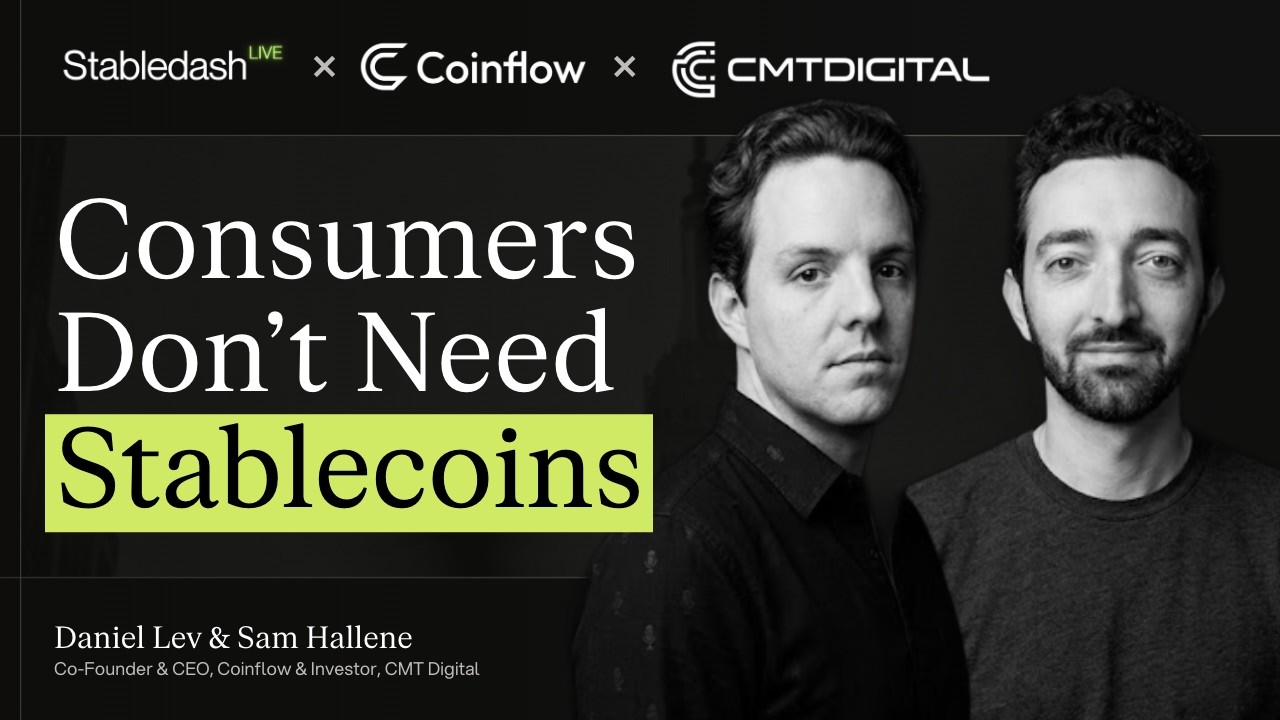
Daniel Lev (Coinflow) and Sam Hallene (CMT Digital) discuss the Chicago Stablecoin Day and recent developments in stablecoin infrastructure. They cover Coinflow's mission to enable instant money movement through stablecoins across payment rails, the evolution from prediction markets to payment infrastructure, partnerships with Braille on multi-currency settlement, and the emerging agentic payments space. The conversation touches on non-USD stablecoin opportunities, the Genius Act's future impact on stablecoin issuers, and skepticism about near-term mainstream consumer adoption of stablecoins in the US.
Key takeaways
- Coinflow enables final settlement in under five seconds by connecting any payment method to any stablecoin currency, versus 20 minutes through traditional banking.
- Sam Hallene believes next-generation loyalty programs will resemble stablecoins once the Genius Act implementation begins in January 2027, potentially allowing businesses like Amazon to issue stablecoins and share treasury yield with customers.
- Daniel Lev remains bearish on consumer stablecoins for everyday purchases like sandwiches absent compelling incentives, but sees confirmed demand from prediction market users and traders avoiding banks.
- Agentic payments represent a massive opportunity because agents operate at internet speed, requiring stablecoins as the only infrastructure that matches that velocity for commerce transactions.
- Chicago has strong financial services concentration including trading firms, Discover, and banks, creating ideal environment for stablecoin infrastructure discussion and enterprise adoption.
- Coinflow joined the Agentic Payments Alliance with Rain and Tempo to provide infrastructure enabling AI agents to transact and settle instantly across currencies.
- Multi-corridor expansion in Euro, GBP, and Mexico shows revenue opportunity today, though USD stablecoins remain dominant by far in current market demand.
Transcript
35 turns, about 4800 words. Straight from the recording, so it reads like speech.

Zach Fowler
host0:01
Alright. We got Daniel Lev and Sam Helene joining us.

Drew Rogers
host0:06
Guys, Sam, man. What's going on?
Sam Hallene
guest0:09
Great to be back. Thanks for having us back on again.
Zach Fowler
host0:13
I was gonna say, for the first time we've done, like, investor and and start up together, this will this will be really fun. It's good to see you guys.
Drew Rogers
host0:22
Yeah. Dan, your first time, I think, on on stable dash live. Pardon? I mean, your first time on stable dash live. Right? You or were you have you come on before? I Only pod. Only pod, I think. Only pod. Yeah. Only only pod. Well, excited. You know, I we had, we had Andrew reach out, and, unfortunately, I don't think we made it out to the the Chicago stablecoin day, but that's kind of the basis of of why we're talking. So kind of bring us into this moment.
We see so much happening in New York, little bit of love in San Francisco, but Chicago. What I mean, I know your office is there, Dan. What was Chicago's Sablecoin Day like? What's what's the community like there, and and what's been going on?
Sam Hallene
guest1:08
Yes. Sandy, you wanna take it away, or should take a crack? Sure. Yeah. I mean, I think Chicago's the is the epicenter of a lot of financial innovation. You know, we come from a trading background as a as a firm, and one of the killer use cases for stablecoins in the early days was was really the the movement of of dollars from from one exchange to to another to facilitate cross exchange arbitrage. And so to see it come full circle in a in a way where now stablecoins have expanded to such greater use cases.
And that was what what the vibe at at at the Chicago stablecoin day was was really all about. Just seeing the breadth of companies using stablecoins for for different purposes, whether there be remittances or final settlement or some of the really interesting stuff that that that is doing as well. Agenic payments, it's all, you know, really blowing up at this point, and
Drew Rogers
host2:13
that was very evident at at the stablecoin day. If you had to rate the room, like, one is, like, first inning, we gotta explain stablecoins to everybody in here, and 10 is, like, the Dan and the Benz of the world, you know, that are just stablecoin maxes. Right? Where where is the room right now?
Sam Hallene
guest2:33
Yeah. Go for it, Dan.
Daniel Lev
guest2:36
Like yeah. We had a diverse crowd at Sablecoin Day. I mean, there was people that were, like, very new that are finance veterans, fintech veterans that wanted to see I mean, they've read about Sablecoins, but they haven't gotten the chance to talk to people that are Sablecoin Maxis like Ben and Dan and hear what's happening and see it, like, live in the ground. So that was really cool.
And then and then you had a bunch of people in the middle that were using stablecoins or they had a mandate or remit to go learn more about stablecoins and enable them in their business. So I would say it was really interesting. You have people all the way in 10, like, building on top of Coinflop, building on top of Braille, pitching to investors, scaling their businesses on top of stablecoin rails, which which is how you build a community. Right?
Like, it has to start with these early cohorts of I don't know anything about it yet, but I've heard about it. And then I will and then it's people that are, like, building and then people that are like, okay. This is, we are infrastructure to enable the people that are earlier before us to to enable them. So that was great to see. Yeah. A lot of excitement. I I think one thing I've noticed still it's still early innings.
There's not many people that are I wanna say, like, we're a late stage stable coin cycle or, like, even late stage of coin, but it's, like, as a company. But, you know, we're one of the category leaders and probably the ones that are doing the most volume from most payment networks to stable coins, and I would say we're an early stage company. On the flip side of that, Chicago has a lot of financial institutions that are not early stages set.
Sam said all the way from trading to card networks like Discover is out here, to banks, to large fintechs, etcetera. And a lot of people there were presence in audience learning about it, how they can enable. They some of them have live RFPs in the market, etcetera. So that's that's really exciting.
Zach Fowler
host4:23
Yeah. As as we kick off here a little bit, Sam, maybe question for you. Speak a little bit about just intro of the firm and then the relationship to Coinflow and how you guys kind of met. That might be a nice place to start. Absolutely. Yeah. So CMT,
Sam Hallene
guest4:37
Digital is the venture capital arm of the the CMT group, really aiming to invest in blockchain enabled businesses, building the the digital economy, and and and we've been at it for the last nine years. The CMT Group is a is a trading firm that is about 30 years old at this point and has been innovating in financial markets, investing in financial markets, investing in global money movement all along the way and really was was formed out of a desire to embrace electronic trading in 1997.
Zach Fowler
host5:17
And how did the relationship to Dan come to be?
Sam Hallene
guest5:21
So we we learned about Dan. He he was, he was a resident at the, Chicago, Solana office back in the day. He was building a different project at the time, and and we were interested in in in in that project. Well, really, were interested in in Dan and Ben and their their founding story.
We're founder focused investors at the core, and these guys just had an awesome story having gone to college together, a lot of familiarity, and just a deep knowledge of the blockchain digital asset space combined with a incredibly deep will to win tenacity, almost a need to produce, you know, something of of of value in in this world. And, you know, we watched their story evolve. We we invest in the in the pre seed round, and then we led the seed round of of Coinflow, I think, in mid twenty twenty three.
And it's just been relationship that I really value with with Dan and and and his business for a multitude of reasons. I mean, I learn from him every day, and I get to get to talk with him every day. So, yeah, we, have invested in every round of Coinflow and then some.
Zach Fowler
host6:42
That's awesome. Dan Dan, as you think about the, man, even thinking about 2023 and what you were building before, what was the the the name of the Solana business before this? I'm forgetting.
Daniel Lev
guest6:53
Yeah. Yeah. We had a business called Fantasia. Fantasia. Yeah. Like, a sports market fantasy sports. I guess now you'd brand it as prediction markets. Yes. Early early once again. Too early.
Zach Fowler
host7:05
Yes. What does it so what does it feel like now, Dan? I mean, you you guys have having followed this journey for a for a while, it's been really obvious that you've what what seems like the the architecture and the the payment infrastructure that you have been building behind the scenes is definitely before its time in, like, a a really good way. How are you feeling currently about the the platform itself? How it's being utilized?
I know marketplaces and and how you're serving them has been just, a really great fit historically. Bring us a little bit into Coinflow lately, the last couple quarters, and, how you guys are are doing on go to market. Just what what's the current update as of the last couple quarters?
Daniel Lev
guest7:52
Yeah. I mean, the mission stayed the same since day one. It's really to to make money move with the speed of the Internet, which is instantly. Right? We're we're talking data is moving. People are hopefully viewing this from all over the world. Not the same for payments unless you're using Coinflow. You swipe a card, use a bank, whatever it is. It takes multiple days to get your money.
With Coinflow, as soon as a business accepts funds from the user, they get their money instantly, atomically, a few plus five seconds. Those funds then are good to do whatever with, and that and that's really what we've focusing in the last few quarters. So as soon as funds arrive at the business, they can be spent off a a card. So, you know, reinvest it back into the business as fast as quick as possible, and that create and compounds over time.
So example, your your digital marketplace, you're looking at a bunch of our companies. All of them spend money on ads. Right? If you swipe a card on a Thursday night or Thursday afternoon, you don't get your money till Monday, you can't reinvest as much. But if you can use that for ad spend or if you're Felix Pago in in the case you can instantly pay out someone in Mexico and your user feels that value of getting their money in five seconds versus waiting multiple days, that's really empowering.
So, yeah, really, what we've been doing is adding more corridors, adding more payment methods, adding more payout methods, and really building this network of networks, plug into any payment rail, plug into any payout rail. And as a business, you can accept money instantly, you can pay out instantly. And then on the go to market side, yeah, we've been growing extremely fast. Every month, we it's been compounding really quickly and still impressed by the rate of growth we can keep at.
Our customers are also growing very fast, not only our customer base, the customer we've onboarded. We are powering the world's fastest businesses with the world's status payments. So it's cool to see that we're getting these tools to go through hyper growth while we're going through hyper growth. And Mhmm. Just a nice story altogether. You see your friends win. Your investors are happy. Your customers are happy. You're happy. So yeah. Yeah. Times are good.
Drew Rogers
host9:47
Dan, it's no secret that the break that you you and the Braille team work work closely, especially with, with CFUSD. Can you speak a little bit to, like you said, when I thought of this when you mentioned tooling with the ION protocol that was announced at the state Stablecoin, Chicago Day. Can you help, break that down a little bit? What what does that enable for your business, and like I said, in this this future road map and just continuing to build and and iterate?
Daniel Lev
guest10:17
Yeah. The so we we part of Braille in a few few ways. Right? Like, we have our own stablecoin where if if a merchant doesn't care about stablecoins particularly, but they care about all the value props that comes with it, one being, you know, making money after the money that's sitting there, then we just use our stablecoin, CFUSD.
If you have a particular use case, which a lot of people do to make their own stablecoin and they use Braille, Coinflow can not only plug into any payment network, part of it is foreign currency effects. So if you're in Canada, you might want CAD. If you're in UK, you might want GDP, euros euro euros, etcetera, etcetera, etcetera. And then in the digital world, there's also digital currencies.
So if you're if you're a business and you wanna be settled into USDG because that's the main currency in your exchange, Coinflow can accept money, let's call it credit card, and instantly settle onto those funds on any Braille stablecoin. And then if you wanna swap onto another stablecoin, you you know, the ION Pro call enables that with instant liquidity. So simply put, we we need to be able to pay in and pay out from any payment method and settle into any current users want.
So you're you're seeing currencies there, USD GLO. And if someone wants to swap into a different currency, we need to be able to enable that on our platform as well.
Drew Rogers
host11:36
Well, currencies are top of mind right now. You know, obviously, we see these these US dollars table coin flows, and that's that's happening more and more. Braille Braille seems to be at the center of this, you know, the coin flow on in in your work on the payment side, then tooling with SBC on wallets. Where is it going, though, when we're thinking about non maybe non USD stablecoins? And you've even kinda mentioned this other with with other corridors that are top of mind. Where where are you thinking about?
Where where does Coinflow even need some of these funds? And, Sam, last question for Dan, and then we'll we'll go back to you after this.
Daniel Lev
guest12:08
Yeah. I think I think it'd be interesting to hear Sam's thoughts. We have different perspectives. Right? Like, I think investors are are earlier than us in in ways, and, like, we we we care about where there's revenue and demand today. And they care about, like, tomorrow and in six months and a year. So, yeah, like, today, the corridors that this is happening in is the corridors where there's activity, like, Euro, a little bit GBP, like, Mexico because there's lot of remittance.
So those are, like, the place of need, and then people like Coinflare are like, alright. Cool. There's revenue there today, we'll provide that work with partners. That's where we're seeing it, like, markets that have no brainers. And some of them, like Argentina, don't see us because they don't necessarily want their local currency. They want USD. I mean, countries where you do still wanna have businesses wanna hold that currency, Europe being a huge example, and especially with regulation like MICA, we see that.
So that's, like, practical today, but still US US dollars, stablecoins are by far number one. But, yeah, Sam, what are your thoughts on what's what's what's coming next? Yeah. I was gonna say, you know, revenue. That's ew. Disgusting.
Sam Hallene
guest13:13
No. I I think, you know, maybe I'll frame it a little bit differently. I think that the issuers of stablecoins are are going to change. I mean, you saw the OUSD announcement. I think, you know, like, I always have to remind myself that, yes, the Genius Act was, passed into law, but it has not yet been implemented. And, like, we're targeting a January 2027 implementation for, you know, the Genius rules. And what does that allow?
Well, that allows, you know, other, folks to compliantly, big businesses to compliantly issue stablecoins. And so I think, like, you know, one of my one of my thoughts is that the next generation of loyalty programs is gonna look more like a like a stablecoin. Right? We can't, through the Genius Act, share the yield directly with the end client, but we can, you know, at least in the current drafting of the Clarity Act, pass that along in in different ways.
You know, that and that and that treasury interest income revenue, you know, can be shared in creative ways with with with the clients. So I I imagine a world where in you know, I don't have any sort of information here. But just for example, you know, Amazon issues a stablecoin. And if you treat if you start to treat Amazon like your bank account, you could and and hold dollars in there for a certain period of time. You can unlock certain tiers of discounts on products.
You can, you know, unlock different access to to to merchants and platforms, things like that. And so I think that's you know, I always have to step back and just remind myself that, you know, we haven't even seen, you know, the effects of of of Genius yet. And and and and so I think we're gonna see a lot of opportunity in in in that era. And I think the the issuer landscape is gonna change a lot.
Zach Fowler
host15:05
Dan, how do you think of loyalty and rewards as it relates to Stablecoins themselves as, like, bridges into the that world. How do you do you agree with that take, or what are your thoughts there?
Daniel Lev
guest15:20
Yeah. I I think it's it's interesting. We haven't seen anything, like, been done there that's, like, super yeah. We haven't seen anything, like, super innovative or it's taking maybe not innovative, but it's taken there there's what problem is it solving is I'm trying to still answer. I mean, native yield is great, and composability. But outside of that, I'm not, like, convinced that something's, like, really taken off. How however, I am very bullish on all these things coming together to to move the needle.
For example, like, some of our customers, like, instance, don't wanna get their money instantly. Great. But without being able to, like, spend or use it, it's like, alright. Cool. Like, you have these funds. Like, but how do I use them? Same thing with loyalty. Like, okay. Maybe loyalty is not the tip of the iceberg, but adding a card to it so now you can spend it globally, or you can transfer that instantly to someone else, whatever it is.
But inter I simply put, like, interoperating all these use cases together and compounding all the benefits is really what moves the needle from what we've seen. That's why we keep adding things to our platform. We're like, you have to keep adding these stablecoin primitives and not like one silver bullet feature is gonna, you know, win win it all and take it to the moon, at least not anymore.
Zach Fowler
host16:44
Yeah. We saw yesterday or maybe earlier this week the speaking of, like, these different primitives and and having a modular stack, the AgenTek Payments Alliance with Rain. Maybe speak a little bit about the, like, the Rain relationship and the AgenTek Commerce has been a continued theme here for us. Why why join an alliance like that? What are you what are your hopes as a a member of this?
Daniel Lev
guest17:09
Yeah. I mean, Farooq Farooq and I are friends, so now we can just expense our our dinners together. Now that we're part of an alliance together. Big joke. But, no, we we really see that everyone who's doing anything with AI in terms of commerce, there has to be a way to move money instantly. Like, agents move the speed of Internet. No other currency and infrastructure moves at that speed, so it has to be stablecoins.
Coinflow is, as I said, like, the the category leader in moving between stablecoins and traditional rails. So you wanna be part of alliances because they get you distribution. They get mindshare. We're still very early innings. Like, we we did something with Tempo as well for MPP empowering them for their agenting payments and getting into currencies that agents can exchange with.
But, yeah, being early days, like, you wanna be along the the coattails with other winners, empower them with your infrastructure, and then motivate other people who are just starting out. The same same thing as I said about stablecoin days, like, being having Ben, Braille, Sam, CMT there, like, you know, we've been in this space for a really long time a really long time. It's evolved a lot.
There's people that are, like, in, you know, middle innings of it that are building, starting to scale, and there's people that are just learning about it. So you wanna be around those people and empower them together and offer something that not only Coinflow has, but maybe that Rain has or anyone else in that alliance has to build, like, a full solution.
Drew Rogers
host18:38
Yeah. I I think it's interesting. And and, Sam, I'd be curious to hear your take. Like, you see Dan working with kind of these, I don't maybe frontier program is the right way to say it where, you know, we we see that there's something here. We don't know how it's fully formed with the Jentic payments. Dan, you obviously work with a lot of marketplaces that if we were talking about them a year or two ago, you know, volume was minuscule, they've just seen this meteoric rise.
How does that start to shape your investing outlook, Sam, when you see portfolio companies like Dan's serving a specific customer or, you know, really just seeing this this this growth growth or seeing their volume grow because they're serving this ICP really well.
Sam Hallene
guest19:19
Yeah. I mean, like, you know, if if you're not moving, you're you're you're falling behind. And, that's why I think there's been such an emphasis not only from the venture community, but, you know, now you see, like, ETFs founded around, you know, founder led businesses. Right? Because founders have agency. They're they're hungry. There's something about, you know, you know, Dan and and Ben where they just need to have the information and and understand what's coming down the the pike. And, like, I love that.
You know? So I try to get as much mindshare of Dan as as as I can. As as it relates to, you know, Agencik payments, I think Agencik payments are gonna be absolutely massive because, you think about Dan Dan said something really interesting that, like, the you know, agents move at the speed of the Internet, and the only, you know, money movement rail that can do that is is is stablecoins. I I agree with that statement. Think about how much economic value, you know, a a agent to commerce can bring.
If you can cut down the RFP, you know, for, like, a precise alloy or or paint by, you know, 90% of the time by having two agents talk to each other and then agree on the standards and then agree and send the invoice and pay in stablecoins. Right? Like, how much does that speed up our our economy and our procurement process? I mean, it's it's a it's absolutely massive. And so we don't really need any convincing on on on Agentic payments here.
But I think, like, you know, when we zoom out and I I think, like, the mic drop moment of the Chicago stablecoin day was when Ben from Braille asked Dan, you know, like, so what like, what is it that or or the the moderator asked, Dan, what is it that, like, Coinflow can do, like, better than anyone else? It's enabled by stablecoins. And Dan was like, you know, final settlement. You know? And and and Ben from Braille was like, oh, yeah. That happens in, like, you know, twenty minutes. Right? And Dan was like, no.
That happens in five seconds. So you have final settlement for payment in, like, less than five seconds. That's absolutely, like, revolutionary.
And I don't think that the, you know, the the broad consensus of, like, the the banks that were there, the representatives of the banks that were there, the the fintechs, even the card networks that were there, like, I don't think they really understood that until they had it emphasized to them in in that way that, you know, this is a this is a global methodology for final settlement that, you know, is absolutely gonna be at the crux of Yeah. You know, our payment infrastructure, going forward.
So, yeah, those I mean, for us, Agencik Payments, hugely excited about about them. I think, you know, if you just called the inning globally based on the Chicago stablecoin day, we're still just so early.
Drew Rogers
host22:22
Yeah. Oh, okay. Hold on. Bring you guys back here for a second. Drew had to drop something that's going on with his computer. I was trying to switch layouts. We're just gonna stick with this for a second. Dan, question for you. We we we so much of this conversation starts to drift obviously into emerging markets and and rightfully so. I still especially when you talk about how fast people can get their funds, I feel like that's super relevant to merchants in The US. Is that top of mind right now?
Is that, like, we're just not there yet? Stablecoin still haven't been able to meaningfully penetrate, you know, merchant SMB the SMB merchant and SMB market. Obviously, in The US right now, we see a ton of, like, there's there's see the dual pricing and you pass everything on to the to the consumer or you just suck it up as a merchant and pay processing fees, who knows how long it'll take to get you get your funds.
Any developments specifically when thinking about the consumer market and maybe the role stablecoins play in the future here in The US?
Daniel Lev
guest23:25
Yeah. It's a good question. I keep going back and forth. I'm still on the fence. I'm still actually pretty pretty bearish on, like, it being a massive consumer rail. I I think it'll be an alternative payment network for sure. Like, it'll have some market share of wallet, meaning that, you know, as a merchant, you wanna accept all the payment methods that your users wanna pay with. And Sablecoin will be one of them in specific certain demographics, like prediction markets, for sure. Users wanna pay with Sablecoins.
Whales want us to pay with Sablecoins. They don't wanna go and mess around with their bank, holding their funds, seeing their, you putting money in a prediction market, asking them questions. That that we can confirm, and that's here to stay and grow. But for you know, if I'm paying for a sandwich at lunch, I don't know if I wanna grab a wallet and, you know, pay with my Sablecoins. And you really don't get any benefits for doing so right now. So the incentives aren't there for the user to do so today.
Do you know, would I bet on that changing? Because some entrepreneur comes up with a way to use Sablecoins under the hood in a really awesome way and give those incentives to consumers, make it a better experience, like, definitely non zero chance. I think that's very realistic of happening. But until that does or we see someone building that space, then I'm pretty bearish on people just using stablecoins for sure.
Drew Rogers
host24:50
I think about a lot too, and I think about how much now it's like you go to any fast food chain and and, you know, hey. Download our wallet. We have a loyalty program. We have something to do. It feels like it's close, but kinda like you said, there hasn't been that that big moment. But there does seem to be you know, everyone wants to act like the SMBs and merchants, like, love their payment providers, and I don't feel like that's the case. So it seems like they want a solution. The solution hasn't been presented.
You kinda have two two not great options, which is, you know, pay your 2.99 and plus 30¢ or pass 4% or 3% onto the the to the customer. It's like, is there something in the middle ground that we haven't just seen come to fruition and that gives everybody their money faster, which I think, like you said earlier, is sometimes more valuable than just having lower payment fees.
Daniel Lev
guest25:41
Totally. Yeah. I mean, that's that's it's a problem, which hopefully someone solves it, and I bet that will empower them to solve it from infrastructure standpoint.
Drew Rogers
host25:50
Hopefully soon. We'll we'll we'll I'll have my, my VC scout hat on, for that company that pops up because I think that's something I'm just passionate about, which is, you know, we have so much conversation around the emerging markets, and I'm like, it's good in The US. It can still be better. But, guys, we're gonna we're gonna go to a quick break here before our next guest. We have to troubleshoot some fun technical issues. It was great having you both on.
Please let us know next time you have the Chicago stablecoin day. And and I know Drew Drew is a lot closer than I am, but, I wouldn't mind a a trip out to the Midwest. So thanks both for coming on stable dash live today.
Sam Hallene
guest26:24
Thanks for having us.
Drew Rogers
host26:26
See you both.



