Stabledash Live · · 27 min
Aerodrome Is Where Coinbase's Tokenized Stocks Trade, 24/7
Alexander Cutler
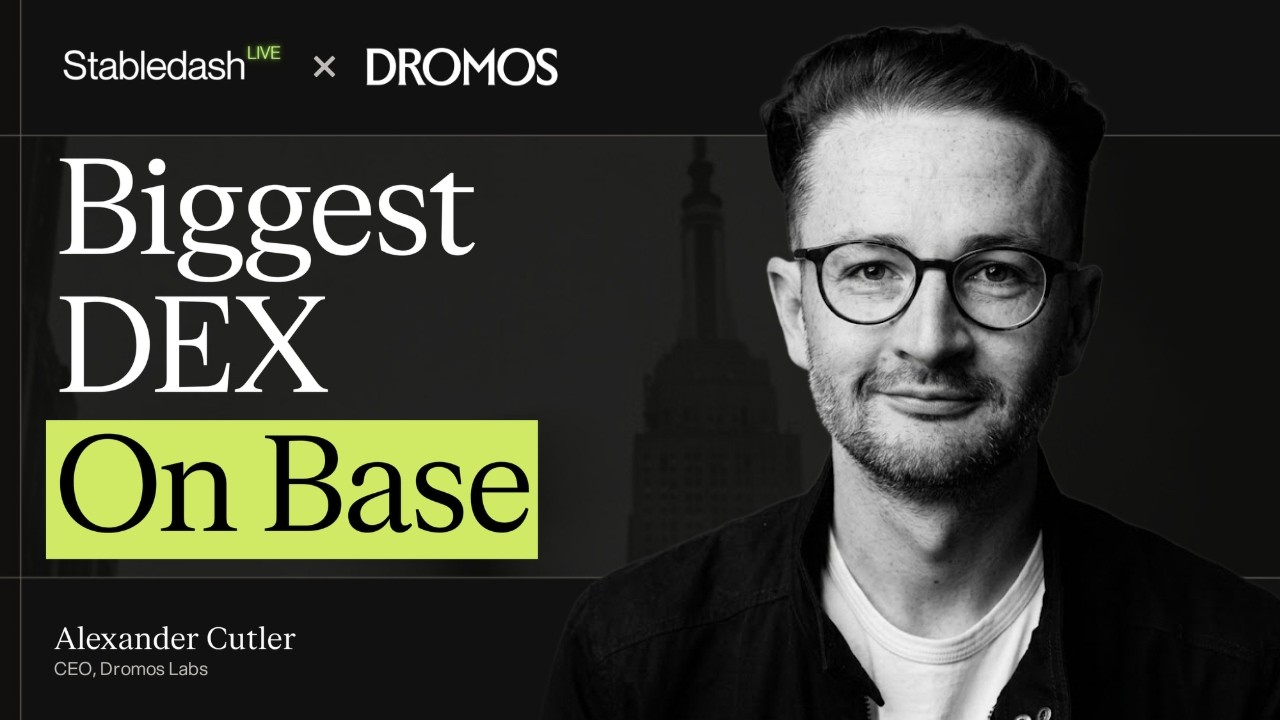
Alexander Cutler from Dromos Labs discusses Aerodrome, a decentralized exchange on Base that facilitates trading of tokenized assets including stocks, currencies, and digital assets. He explains how Aerodrome has become the largest DEX on Base by volume and the chosen venue for Coinbase's tokenized stocks, highlighting the shift of traditional economy assets onto blockchain. Cutler outlines his vision for 24/7 composable on-chain markets, price discovery advantages over traditional brokers, and introduces predictive allocation, a new mechanism combining prediction markets with spot market liquidity provision that will launch soon.
Key takeaways
- ["Aerodrome processed more volume on Base last week than every other DEX combined, roughly 2x the next competitor, and serves as the primary venue for Coinbase tokenized stocks.","Tokenized stocks on chain enable 24/7 trading and off-hours price discovery versus traditional markets open only bankers' hours, creating opportunities like trading Nvidia tokenized stock after earnings announcements.","Predictive allocation, launching within two weeks post-audit, lets users bet on market volatility and volume rather than directional price movements, without requiring exposure to either side of the market.","Agents and algorithms will optimize based purely on value earned, not brand or marketing, forcing protocols like Aerodrome to maximize revenue capture and minimize off-chain dependencies to remain competitive.","Aerodrome deliberately stays focused on on-chain spot markets (the largest DeFi opportunity at $5 billion in annual fees) rather than launching competing apps, wallet services, or chains to avoid extracting value from partners building on top.","Interactive Brokers' 80% margin model represents a major opportunity for Aerodrome to disrupt traditional financial institutions by offering better execution and global accessibility on-chain.","Velodrome launched four years ago during the Luna collapse with five founders and no fundraising, then became the largest DEX on Optimism before expanding to Base as the third-largest exchange globally serving only 10% of EVM volumes."
Transcript
24 turns, about 4600 words. Straight from the recording, so it reads like speech.

Zach Fowler
host0:01
Alex, welcome to the show. Happy to have you on. Hey. Thanks for having me.

Zach Hughes
host0:06
Thank We're Zacks. I'm Zach. You can call him z, but we're both we're both Zach. It's just yeah. Just so if in case you you blurred out Zach, both not both not chirping at you. But appreciate you coming on on today. Quick question. Alex Alexander?
Alexander Cutler
guest0:20
Alex is just fine. Thank you. Alex is just fine. Awesome.
Zach Hughes
host0:24
Well, we're excited to dive into this. We had quite the lineup. Was it Zach? Last last week with Bitwise, Bass, Brian from Glider. So a lot of talk, a lot of chirps around tokenization. But maybe tell us just really quick, like, what's been going on in your world with Dromos Labs, especially with Aerodrome and and the rise of, say, like tokenization and where you fit into this conversation.
Alexander Cutler
guest0:50
Yeah. No. Thanks so much for having me. And, yeah, I mean, look, I think this is just an an incredibly exciting time to be a builder on chain. I think we started our journey about four years ago in launching Velodrome on Optimism Mainnet. And I think all of us in the space have this vision of, well, if we can build the right infrastructure, right, if we can build these permissionless blockchains, we can make them faster, cheaper, more secure.
If we can build, things like automated market makers, deeply liquid spot markets, derivative markets, lending markets, that we had all the composable building blocks, for building basically the world's most, like, vibrant, most real time, most always on market. And we know that this technology has worked for some time, because people have come on chain to trade any number of different types of things.
But what we are starting to now see is this very exciting moment where we are starting to see the real economy come on chain, right, or the traditional economy I should say. We're seeing tokenized stocks now come on chain and these aren't the synthetic stocks or debt claim stocks or derivative wrapper stocks. These are the real true things. We're seeing things like tokenized currencies come on chain and those on chain FX pools like we have on Aerodrome, growing significantly.
So Aerodrome's role in all of this, right, is to be the decentralized exchange infrastructure that powers all of these new on chain markets from digital assets to on chain effects to things like, tokenized stocks. And we do so very very well. Right? As I think you can see from the fact that, you know, last week, Aerodrome did more volume, on base than every other DEX combined. Right? More volume I think two x the volume of the next closest competitor.
And it's obviously the chosen venue for Coinbase tokenized stocks in these markets and for other assets like CB Hype and CB ZEC also launched this past week. So we're super excited. This is the moment where everyone's coming on chain, in a very big way. And, yeah, Bitwise was a super exciting one. Right? Building a product literally on top of these tokenized stocks, on top of these markets, and things like that. But I think this is just the beginning. We've only got 10 of these things live so far.
We've only just started to, I think, unlock the composable network effects. So I think the future is gonna be very bright for the on chain economy and, of course, for, like, on chain markets like that, the ones that Aerodrome facilitates.
Zach Hughes
host3:43
Can you unpack a little bit more about your vision of these composable markets? Because this is this is a trend we've heard a few times of, hey. It's one thing to get the stocks on chain, but once the stocks on chain, they're only as good as what you can actually do with them. So they're here. People are trading. That's obviously great that they can provide liquidity for them. But I think last I checked, the yields are very attractive.
Not financial advice, but I'm sure you're, you know, you're happy to see that as well. What do you think though? And what what is your vision of these composable markets? You know, as they continue to mature, more products come on chain, you know, maybe compare and contrast that with traditional markets or even how DeFi looked, you know, two, three years ago.
Alexander Cutler
guest4:24
Yeah. Well, I think, we've already seen some, like, early glimmers of this even in the first, like, few weeks of these Coinbase tokenized stocks, being live, and there's a few examples I'll I'll give on this. So for most people all over the world, right, if you're going to, try to access these types of assets, right, you might have to go through somebody like Interactive Brokers.
And Interactive Brokers, is obviously a very traditional type of of business, with billions under management with, you know, I think, like, 80% margins on on their activities and, you know, a bit of a clumsy traditional type of experience. And so there have been moments in the off market hours where, according to some of the stuff I've read online, you know, you could get better execution on something like Aerodrome and based on these tokenized stocks than you would have through something like, Interactive Brokers.
And so if you can provide that better execution, if you can provide these twenty four seven markets, and make them globally accessible, that will be something that people increasingly tap into and choose to use, you know, rather than these, traditional, institutions or businesses. Another piece of it that I think is very interesting is that these traditional markets, I mean, they trade on bankers hours.
They are only open for about a third of the week and we've already seen a few moments here where markets close, but there's an event. Right? Nvidia is announcing earnings and, you see on chain, market makers begin to position around it. And by the way, market makers on chain doesn't mean Citadel. It means literally anybody participating, in the active market making. Positioning on the buy side or sell side, you see then the assets being traded like they would in an aftermarket, as, news is released.
And because the tokenized stocks here are actually one to one with the real things, that is actually organic sort of price discovery. That's people sort of betting on where that price will be when the market next reopens. And so I think there is a world in which, right, increasingly, the price discovery for these markets, for these types of assets is happening on chain. And we know that there's demand for this, right? Like hyper liquid has proven this.
There is a lot of demand for betting on the price of a of an asset when markets are closed. But derivative has to derive from something. Right? And so when markets are open, Hyperliquid has an oracle. Right? They can just pull it right off the the Nasdaq. When markets are closed, they have to kinda keep it bounded. So you can't truly have on chain price discovery, you know, on something like HyperLiquid, it's gonna be capped a bit to the high or low side because it's self referential on their own books.
But the future here is these on chain spot markets, if they are the venues for on chain price discovery, those can even be the oracles for this that, something like Hyperliquid can plug into, you know, just like the CME needs the NYSE. Right? These are two important building blocks, of, of an economy. And so those are just two of the portions that I'm very excited about, but we haven't even started to see lending markets, for instance, be able to offer these types of things.
And we also have some very exciting things coming in the all new era that I think will enable some things that were never possible before. That's interesting no matter the type of asset, but in particular around this idea of like, after markets and how to sort of bet on them.
Zach Fowler
host8:24
You mentioned upfront, you were talking about sort of the real economy coming on chain and also sort of doing this juxtaposition between something traditional and incumbent like Interactive Brokers versus this. The main thing you hit on so far is this sort of always open versus bankers hours. Are there other fundamental differences that you're saying, hey. This is a real advantage to doing more on chain markets. The obvious one is is twenty four seven versus nine to five. What else?
Alexander Cutler
guest8:55
Yeah. I mean, I think it you can't understate the compounding network effects of open participation in these systems. Right? Like, it doesn't matter how skilled I am. I can't go out tomorrow and make markets in traditional systems. Right? Even if I thought I had some sort of edge, know, especially now with Claude, know, where any of us could be, in theory be brilliant at anything. Right? I don't get to play in those markets.
And, I think one of the most amazing things about this, and I'm not sure if you guys saw, but Banker built an amazing integration, on top of us where just through natural language with your own Banker agent, you know, you can have it jump into these stock pools, provide liquidity, manage your ranges, all that sort of stuff, and basically turn you into Citadel for a moment. So I think that's super exciting.
But we wanna talk about like a really cool one that I think is only possible on chain, but also only possible in the all new era, which we which we will be launching very shortly here. It's something we call predictive allocation. So predictive allocation, in essence, it brings together the, like, truth discovery and asymmetric upside of prediction markets and applies them to smart mop spot markets for the first time. So you can think about it this way.
On Aerodrome, when you stake your Arrow, you get to allocate capital each week to markets. Right? You allocate Arrow rewards to liquidity providers in those markets. Now you can imagine now with predictive allocation, if you believe that there is a market in which there's going to be a lot of activity, you're gonna allocate capital to that market, basically betting on that activity. So that could be like you're betting on a Sunday headline. Right?
And we've had a lot of Saturday and Sunday headlines like over the last few years. You could be betting on a earnings report or things like that, and you're betting on getting paid on the volatility in that market. So the big shift here, right, is you're not necessarily needing to bet on the direction of that market and you're not needing to be exposed necessarily to either side of that market. So this is very different than a prediction market or very different than, something like hyper liquid.
You are just betting on there's gonna be demand for that market. And if you are right, right, you get the same sort of asymmetric upside you would in betting on an outcome in a prediction market. And we're so excited about this because when you combine this with something like $24.07 trading on stocks, and you combine this with the things that are very unique about Arrow, you do have something that cannot exist in traditional markets in the same way and has never existed on chain.
So it's why it's like one of the new primitives we're super excited to bring to market.
Zach Hughes
host11:58
You know, that that even gets my wheels turning, we've seen some chatter of, you know, we had Kevin on from Coinbase working on x four zero two and kind of this idea of, you know, what where does the Agencik economy and, you know, crypto trading intersect? Is it doing research on massive and then taking taking, you know, positions in that stock, whether it's long or short. And you're saying, hey. Actually, there's there's gonna be a new possibility where your agent doesn't even need to think about that.
It just needs to think, like, where is the volume gonna go? And that's a very it's it's it's interesting because it feels like a familiar paradigms to somebody who's kinda dabbled in liquidity providing, which that's essentially what you're doing, although with some risk of, you know, impermanent loss and all that stuff. You're saying it's even obstructing away some of that risk so you can focus primarily on the on volume. Am I thinking through that correct?
Alexander Cutler
guest12:49
Correct. Yeah. And I mean, think we're obviously connecting volume with the productivity of those markets, so the fees that they will generate. But, obviously, those would be correlated. But, yeah, this is a primitive that we designed very much with the future state of a much more agent agentic, on chain economy coming to bear.
Because if each, participant in the system, whether you're using an agent or you're using like a proprietary algorithm or you're just, you know, throwing bets around, each bet effectively helps to optimize the system. Right? Predictions are really good at truth discovery. If the reward is asymmetric, the more right you are.
So now you have, liquidity, which is the bedrock of any exchange, moving ahead of demand and optimized by a stack of, like, agents and individuals incentivized to ensure that, liquidity on Aerodrome is there faster and ahead of it being available on any other competing platform. And the more right you are, the more reward you get, whether you're an agent, or an individual or somebody like Wintermute, right, who is a large locker of of Arrow, right, and who participates in this system each week.
And I would imagine Wittermute's probably got a strong point of view on where things will be traded, right, and in what size, and they're gonna be participating in this market. And the more right Wittermute is, the better off for Airdrome and, the system as a whole.
Zach Hughes
host14:29
Are are you generally bearish or bullish on this idea of the agentic economy? And and depending on which side you land, how how does that influence the way you think about building tooling for agents and and building, you know, Aerodrome as this kind of, like I base layer for the agent's economy and and liquidity?
Alexander Cutler
guest14:49
That's an interesting question. I mean I mean it's gonna happen. So I guess that's the first thing. You'll feel like like it's happening. Not really. And I guess the question is, is it good or bad? I mean, I think it's good, because these are the types of things like, think about it this way. Right? Why did we, a year ago, when we set out to, like, build the MetaDexo three, the latest version of our DEXOS, and try to think about it through the lens of a on chain economy that was increasingly agentic.
We did that because, know, these on chain agents, whether they're trading, providing liquidity, participating in something like predictive allocation, they are not going to care how sick of a party you threw at the last big crypto conference. They're not gonna care about your brand, you know. They're not gonna care about anything other than am I able to earn, you know, the most amount of value through this activity possible. There's zero leakage like or is there something better?
And from day one, we built Aerodrome to maximally capture and redistribute a 100% of the revenue through the protocol. We've also built Aerodrome to not depend on any off chain dependencies. Right? So agents need to be able to see everything that's happening on chain. And if there's some dependency or latency that can rub them, they'll ignore that.
And so like we've been able to be successful even just being, you know, a group of guys who met in a discord were largely a non until about a year ago, and disrupt these like billion dollar incumbents because our system was better. And agents won't care about any of that like sort of legacy stuff. They're not gonna care about Lindy. They're not gonna care about brand. They're not gonna care about your big raise. They're just gonna care in my when I LP, am I getting a 100% of the value my activity creates?
Or am I getting 75¢ on the dollar? And that's what we built around from the beginning and we've continued to optimize in this new stack. So we're bullish for it because we've been preparing for this and we think we've got a system optimizing for for agents.
Zach Fowler
host17:10
You know, it's funny, Alex, when you were talking, was thinking of a dinner party we cohosted with Breeze recently who building in the agentic payments world, and I was like, oh, no. We hosted a sick party with somebody who's building the agentic economy. The irony is here, you know, they don't care. They don't care. They don't care, man. They they baby Braves cares, but their agents don't. So Yeah.
Zach Hughes
host17:37
Alex, when we I like that you kinda touched on like this origin story of Dromos Labs and and his team and even, like, the shift from going anon to, you know, having to show your face to the world. How much is the current state of product? Like, did you envision this three or four years ago?
How much of has the product road map kind of, like, changed and evolved, with the state of either base launching or the agentic economy, or did you was this always kinda like the blurry vision where where you were where you are and where you're going?
Alexander Cutler
guest18:12
Yeah. It's a good question. And, I mean, I will say, you know, the week that Velodrome launched about four years ago, was the week that, Luna collapsed. Right? So imagine being these five guys in a discord, you know, bright eyed bushy tailed, raising any money, so not really having any runway and you run straight head first into that moment. Right? And of course, Luna was just the first blow, you know, FTX, all these hats, you know, we were going into one of the darkest, bear moments.
So in that moment, I mean, it was difficult to envision anything other than surviving. Right? I think, you know, we weren't making any money, you know. I think we had this mentality at that point of, with a little bit of runway we had is what is the keep the lights on money to ensure, like, our partners don't leave us or force us to get out of this crazy thing. But I do think we had a belief that we could put one foot in front of the other and do some amazing things. We thought we had a winning product and, model.
And I actually remember this because one of our early contributors ended up leaving. There was a moment in one of those dark days where, you know, he was taking the the point of view that like, dude, there's no way you guys are gonna flip Uniswap on optimism. There's just no way we'll ever be able to do that. And I remember one of my, fellow contributors telling him then what are you doing here? Right? Get out right now. Because we had to believe that we are capable of this. Right?
And it would be, you know, probably another year after that, year two before we flipped, you know, Uniswap on Optimism Mainnet. And then we went to Base, which was the single, you know, most competitive, most consequential chain in the last few years, and we became the largest exchange there. And now we're the third largest in the world, and we are only right now servicing about 10% of EVM volumes. And so, you know, we believe we have the capability now to expand the chains like Mainnet Ethereum to Arc.
We're very interested in the types of things we're seeing on chains like Robinhood and HypeBBM and things like that. And so we want to be the exchange rails of this new on chain economy. And you know, our ambition now is not even just about being number one on chain, but in taking on some of those big legacy incumbents like Interactive Brokers, you know, it's the Warren Buffett buying.
Their margin is our opportunity, and I think that is gonna be our next big frontier is shaking up the the legacy players in a way they don't expect.
Zach Fowler
host21:04
You know, Alex, I'm I'm gonna have to warn one of my friends. I work out with this guy who's building a prediction market for interactive brokers. So Hey. Watch out. I'm coming for you. Dude, I'm connecting with us. Maybe we can do something. Yeah. Maybe so. Honestly, it could be interesting.
Zach Hughes
host21:19
You know, Alex, what you said, this is and this is a topic that it's funny how these these happen and kinda clusters. The amplification of DeFi. You know, we talked with Athena earlier going with their with their neobank experience. We've seen this with Aave. We've seen this with Uniswap. If you're if you're building, you know, Aerodrome, how do you think about, you know, these traditional protocols going to the app layer? What lens do you look at it through? Is this a is this a good thing? Is it say, hey.
Actually, no. We wanna be the protocol layer. We wanna support builders building on top of these. Or is there a world where you see Drummond Slabs going out and building an app on top of, you know, on top of Arrow and and building the trading experience that you want to see or building the predictive allocation experience that you want to see.
Alexander Cutler
guest22:03
Yeah. I mean I think one thing I like to say often is focus is a mode. And we have been we have been focused for a very long time on what we think is the biggest price on chain. Last year's spot markets on chain did about $5,000,000,000 in fees. Derivatives markets did like 3.5. Right? Chains did 2.5. Lending did one. So we've seen this as like the biggest opportunity is capturing on chain spot markets and that's why we've been building everything that we've been building.
We certainly have like no shortage of ideas. But we think there is far more value in owning that market and not competing with the people you want to plug into. Right? You know, we could we could launch something to compete with banker. We don't do that because we want banker building on top of us. We could launch a wallet because we want a wallet that we want, you know, that chunk of business or we could have every wallet plugging into us because we're giving the best execution and we have the best assets.
We can launch our own chain. We could, you know, compete at the front front end level. But I think all of that would be to, lose focus of the pie that is biggest, which is, capturing on chain spot markets, ensuring that you're delivering the best execution and you've got the best assets. So that whether it's Coinbase or it's Robinhood or it's a wallet, or it's a launcher, they wanna plug into you because you're not extracting value out or trying to compete with them versus like the alternative.
So I think that is one of the other things that's made us very successful staying very focused on that. And so at least for our part, we wanna be the infrastructure that everybody built on top of because we think that's the biggest opportunity in DeFi right now. I
Zach Hughes
host24:03
love the focus as a moat. And I will say I I kind of started to really think about this a lot when I saw the Plasma launch. It's like you're launching a chain and right on side of it you're launching a neo bank now. And it just it felt it felt very just counterintuitive to what I would I would see in a stable point chain. Yeah. I wanted to we have Mark joining from Polygon. We're gonna get him set up, but we maybe have one or two minutes left. And I wanted to ask, because you brought this up a few times, banker.
I know if I'm thinking of the same banker, they launched kind of with this clanker era of tokens, and it was really interesting experience on base. I think, like, good idea, really bad timing, right, like, right at the tail end of the of the bull market. Can you give us the TLDR? Why, Baker, why do you think it's interesting, and why have you mentioned it a few times?
Alexander Cutler
guest24:49
Yeah. I mean, look, like, Baker and us kinda grew up together, right, on on base. Right? And we've been through great times. We've been through crummy times. Right? And, you know, I think a banker like us has certainly taken some punches over the years and things like that. But they're building at the intersection of this agentic economy and all these, on chain systems. And I think, I see some kindred spirit, right, and that they never rest. They're always building.
And so the fact that like when Coinbase tokenized SOX launch, they wanted to make that as easy to participate in via Aerodrome as they possibly could. And so they spun up very quickly this natural language thing. You just say, hey. I want LP some Apple and Nvidia, and BankerAgent's gonna go do that and it's gonna position them for earnings. And I think that is the type of like future forward type thinking that plugging into infrastructure like ours, that's gonna be very very powerful.
And so, we've loved that they've been increasingly building on top of us, and we hope to do a lot more, with them in the future.
Zach Hughes
host26:01
Awesome. I'm gonna have to play around with them more. I feel like I'm I'm reaching a point where I'm surprised I haven't really traded with agents yet, but I think predictive allocation has has my interest a lot more than some of these,
Alexander Cutler
guest26:13
far out trading, swing trading strategies. So I'll be on the lookout for for when that goes live and maybe I'll One one fun thing about it is because it's entirely new, it's gonna take a while for folks to figure out. So it'll feel like those early days of DeFi. Right? Where nobody's got it cracked yet and anybody can possibly have edge and people are already starting to like build and test their own models before this launches, so we're so excited. Do we have a timeline? Can we float that out there or or just TBD?
I can say two weeks from now, I believe, the public bug bounty contest closes or the public audit contest closes. And so that is when we'll be able to give the next update, but that is the last, you know, step between us and, you know, the pinnacle of a a four year journey here.
Zach Hughes
host27:05
Heck yeah. Awesome. Congratulations. Well, thanks, Alex. Appreciate you coming on. We'd love to have you back on maybe when that's it comes to fruition. Maybe even do a little bit of a live demo with our agents if you're you're up to it. Sounds great. Anytime, guys. Thanks for having me. Appreciate it. Alright. See you next time.



