Stabledash Live · · 19 min
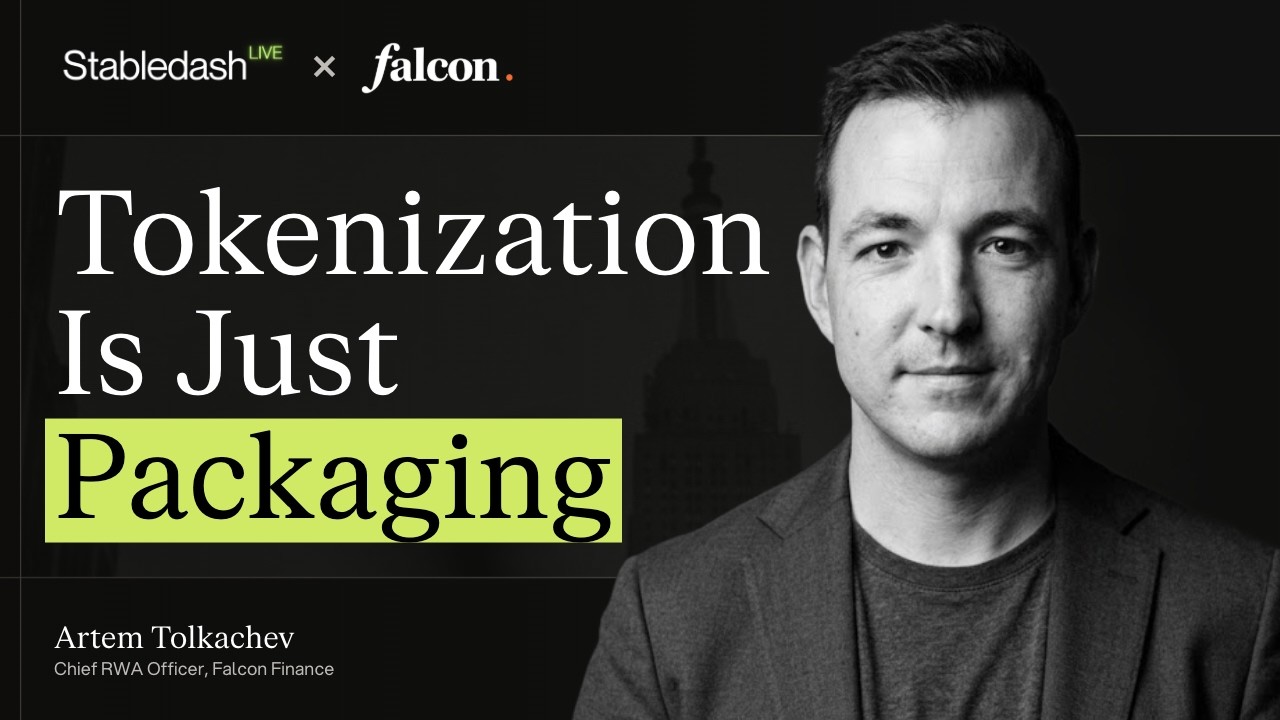
$1.34B in USDf and a GENIUS-Ready Institutional Rail with Artem Tolkachev of Falcon Finance
Artem Tolkachev
Drew Rogers interviews Artem Tolkachev, Chief RWA and R&D Officer at Falcon Finance, a collateralization infrastructure platform for tokenized assets. Tolkachev, a lawyer in crypto since 2013, discusses Falcon's two stablecoins: USDF (a synthetic dollar backed by crypto and RWA collateral earning yield from market-neutral strategies) and FUSD (a regulated stablecoin issued by Anchorage Digital Bank). The conversation covers how Falcon serves institutional crypto holders like trading desks and market makers with minimum 10k-50k mint requirements, the recent 480% rise in tokenized RWAs versus a 33% drop in Bitcoin market cap, and the industry shift toward specialized stablecoins serving particular use cases rather than one universal stablecoin.
Transcript
23 turns, about 3300 words. Straight from the recording, so it reads like speech.

Drew Rogers
host0:00
Ns.co. Artem, thanks for joining. How's it going today? Hey, guys. Thanks for having me. It's alright. It's alright. Artem, what could be better today? What what what's one thing that you wish was better? Feel like that's, like, seven out of 10. Interesting question. So, no, I think I'm nearly eight out of 10 right now. To feel me better, maybe
Artem Tolkachev
guest0:20
I I I shouldn't look at the crypto chart that much. What chart are you looking at right now? Now I close it because too too much discussion.
Drew Rogers
host0:29
It's an interesting week to be yeah. Bitcoin, I know. May mainly, I've been just watching Bitcoin. Bitcoin's been having an interesting week. Looks like we're back over 60,000. We Andre, this would be a great moment if we had the crypto price charts. I know we we actually, Artem, we don't talk about, like, price action a lot on the show.
We're typically just talking about what we'll talk about today, the business, what you're doing at Falcon, but we actually are about to ship, like, real time data within the studio so we could actually just pull in a chart in this moment. So little teaser of what we're trying to think through, but oh my gosh. Wait. Wait. Pull it back up. That's amazing,

Zach Fowler
host1:04
Andre. Real time. I didn't know this was Hey. Above you know, I just had a friend ask me. He's like, where was Bitcoin at last night? Was like, oh, I think around 58,000. I unchecked it. So, hey, there we go. We're back above 60. And Ryan and This is sweet. This is sweet. And this is real time price, Andre? Sort of. Yeah. Hell yeah. So the first real time price ever shown on Stable Ash live. Are we at a nine out of 10 yet? Does this does this are we at a nine yet? Makes me feel like a nine out of 10. Yeah.
Well Nine out of 10. Later. It's funny. I I'm I'm I will not dive into it right away. You guys had a tweet the other day about the great decoupling. But before we kinda get into that, this decoupling of stablecoins and and price action, let's kinda just lay the ground level, Artem. Who who are you? What does it mean to be the chief r d b RWA officer of Falcon Finance? And we'll kinda go into the get more into the weeds. Yeah. Sure. So I'm a lawyer by background, and I've been in crypto since 2013.
Artem Tolkachev
guest1:58
Back in the days, I published one of the first legal papers on Bitcoin in my region. It was September 2013. And I never left, so I saw the whole story, Antigox exchanges, Cryptocards, ICO. Yeah. Along the way, my law firm was acquired by Deloitte, and I bought I I was building a blockchain practice there, advising banks and regulators and businesses on digital assets and also supported a bunch of ICOs during during those time. When I show area ended, my takeaway was kinda simple.
Raising capital with tokens is really interesting concept. It's kinda powerful, but users, investors needs to have something more tangible than shitcoins. Right? And I decided to build a platform for issuance and secondary trading of tokenized securities. So it was 2018, and I was doing dealing with tokenized securities back back in the days. Later, we turned it into yield bearing stablecoin backed by corporate bonds. It was 2021.
And, yeah, the project closed in 2022 partially for geopolitical reasons, but it taught me the lesson. So putting an asset on chain means literally nothing by itself. So it was possible in 2018. It's even more possible now. But the if if asset is not working on chain, it's if it's just there, yeah, it doesn't doesn't mean anything. So an asset goes on chain to do something, to unlock liquidity, to work as collateral, to plug in into other things. So that's that's the idea behind Falcon.
Falcon universal cauterization layer. Basically, the idea is we would like to work with any type of collateral, which is liquid, which is which can be accepted as collateral and provide the liquidity and yield on top of this collateral. So, yeah, now, as a chief of double AA officer, it's I invented this role by myself. It sounds kinda cool. Right?
Drew Rogers
host4:05
Yeah. It's really cool. An awesome title. I I think you I think you chose well. So my my major role is to build this l d part
Artem Tolkachev
guest4:14
of of the stack. So we are working with all more or less tokenized treasuries, with CLOs, corporate credit, with tokenized gold, tokenized stocks. So adding those collateral, evaluating those collateral properly, and building the next step
Drew Rogers
host4:31
in this stack, probably a cauterization engine. It's it's all part of my daily routine. So I was just pulling up the some of the parts of the website here. It seems like there are these really simple three steps in the process, access, stake, and restake. Maybe we just kinda walk through as we're describing the business, the typical flow or the typical process that you imagine people going through as they get started with Falcon. Maybe this is, like, a helpful one, two, three of that. Yeah.
So you deposit collateral,
Artem Tolkachev
guest5:00
stablecoin, Bitcoin, Ethereum, tokenized assets. You mean to USDF, and you can stake it into as USDF, which earns yields from diversified set of market neutral strategies. Funding rate, arbitrage is more in both directions, cross exchange arbitrage, staking option strategies, not just a basis trade. So that's that was the whole point when we launched it. So diversified diversified set of strategies that that allow users to earn the yield.
So, basically, on a normal lending market, you borrow against your asset and you pay interest on Falcon, and you unlock liquidity from your assets and that liquidity earns. So it's a bit different concept. Yeah. That's why we are over 1,000,000,000 in circulation and one of top 10 stablecoins
Drew Rogers
host5:49
on Ethereum right now. Yeah. If you look at that one yeah. I'm looking at 1,340,000,000 total value here. If you were to if this was like a pie chart and you were to kind of high level summarize the breakdown of where that capital is coming from, like, what kind of companies or traders or investors high level make up that group? Like, who's really, right now, in the early days attracted to participating in this in this system? Our
Artem Tolkachev
guest6:15
core client base are institutional crypto holders. So we have a minimum amount to to mint USDF. So it's 10 k for classic mint and 50 k sometimes less, some sometimes more for innovative mint. So we have different types of mints, but it kinda show you the the category of users who are working with us mostly. Majority of of the collateral is Bitcoin, I believe, at the moment. Yeah. And the the core client base is it's institutional crypto holders, like trading desks, market makers,
Zach Fowler
host6:47
whales, and so on. Yeah. Artem, I'm I'm interested. We were actually talking about Igor from Wintermute the other the other day, and we were kinda asking him, like, hey. What do you think is kind of missing or not getting talked about enough in the, you know, Internet capital markets conversation? And I was surprised that he said, I think there's actually not enough conversation of wrap happening around synthetic dollars.
You know, you've recently launched FUSD regulated by Anchorage Digital Bank, Then now you also have USDF, which is, you know, your overcollateralized crypto native synthetic dollar. What what place do those do those assets hold in your mind? Why do we need both? And what would you say to somebody that is maybe, you know,
Artem Tolkachev
guest7:31
scared of the synthetic dollar? You're absolutely right. We have two different assets, and they're, like, kinda super different from the legal point of view. So USDF is a synthetic dollar, so it plays its own role. FUSD, it's a regulated genius ready asset issued by Anchorage. So, like, two completely different setups with different reserves, attestation, legal regime, and stuff. So for particular clients, we provide particular solutions.
So if the clients are interested in DeFi liquidity, in in DeFi sort of yield, they're choosing synthetic door. If they need something more regulated and they would like to deposit these assets into centralized exchange and to use it as collateral so they can work with FUSD. So FUSD, in my point of view, the whole Genius Region was a really big step for for the industry because it allows you to issue highly regulated assets which can earn some yield and which can be actually used in various venues.
So we decided to partner with Anchorage because one of the leaders in the space is, I believe, they're, like, a leader in the space. And yeah. So kinda super straightforward model, segregated trust, Deloitte audits and reserves, supervision, and so on. So, yeah, it's it's a kinda no brainer if you understand why you're doing this.
Because I believe right now, we're the whole stablecoin sort of industry are moving from let's have one stablecoin for all for, like, particular areas that particular stablecoins and products are dealing with particular client needs. So FUSD serves the client base that I described before. So it's we're not focusing on retail users. We are focusing on our core client base, like trading desks, market makers, and and other large holders who is depositing the collateral to Texas every day.
And with FUSDs, they can they can improve the p and l for their strategies simply
Drew Rogers
host9:40
having some economic result of of these reserves. As we go into yeah. Go ahead, Drew. Take it. So these two like, you you mentioned these two assets are extremely different in terms of the use case, the the client base. Very high level. If you were to look at the differences between the two and who the who you are really seeing the use cases for just so we're understanding. Are you saying these are different organizations or actually maybe the same organization that's just using these things in different ways?
Like, who who what are you seeing right now? I think it's
Artem Tolkachev
guest10:09
it can be the same organization, but I I believe in it's the the major difference is the use case. So if you're a trading company, you're dealing with crypto assets, and you're trading on taxes, for example, you would like to have some assets that will earn you additional yield and will be accepted as collateral to the taxes basically that will allow you to boost your PNL. So you can use FUSD.
If you have a volatile assets, doesn't matter, crypto assets or RWA assets, and you would like to receive some liquidity or some yield on top, you can use USDF.
Zach Fowler
host10:45
So it it depends on the client profile, but sort of client category overall is the same. And so you mentioned this started primarily with Bitcoin, primarily with Ethereum, primarily with these digital assets. Bitcoin price is going down. RWAs are coming on chain. I think actually, I'll pull it up here really quick here when we were talking about talking about this decoupling. Let me screen share really quick, Drew. Here it is. Drew, I think you saw the screen share. You got it ready. I can pull it up. There you go.
Yeah. So you saw this quiet decoupling. Right? Bitcoin's been choppy. Tokenized RWAs continue to to go straight up here. Sorry about this. Trying to zoom in so we can see this better. So over the same eighteen months, Bitcoin market cap fell 33%. Distributed tokenized RWAs rose up 480%. How does this impact the way that you may use a synthetic dollar? How is this this space evolving? I think that's where we're seeing a lot of the conversations start to happen around Robinhood chain.
It's like, again, like you said, tokens come on chain. Great. What are we doing with them? What what are people doing with these RWAs from your vantage point when they actually start to come on chain? Yeah. I said that before. So tokenization,
Artem Tolkachev
guest11:57
it's basically it's packaging. It's not a product. So what is a product is this authorization and liquidity. So if RWA is just coming on chain and sits on chain and nobody can use them actually or, like, five wallets can touch them, and they're not doing anything rather than sits and earn some yield, it it doesn't make much sense. It makes some sense, but not that much.
In terms of this particular chart, I believe for all this movement of trade fight to on chain shows us that the rails we we we have rails, but we need to adapt to the infrastructure for the new type of products that come into to the to the and to allow assets that is being tokenized to be used in crypto, not just to sit on, like, five, ten wallets. So for us, it just supports our thesis that we are building collateralization infrastructure. It doesn't matter what type of risk you're working with.
If we can price your asset and if we can create some risk reward model on top of this asset, we can accept it as collateral. We can provide you liquidity for this asset. So I believe we're quite early with TradeFy coming to DeFi or to, like, on chain overall, and we'll see much more volumes, especially due to upcoming regulation, the Clarity Act and stuff. So, yeah, I think still quite early. Our thesis is confirmed by this chart.
And for us, it means, again, if if you have tokenized real world assets and you would like to have liquidity on top, if you would like to have additional yield on top, you can use our infrastructure or a lot of players, right, in building DeFi based infrastructure right now for real world assets, allowing to do some leverage, looping, and stuff. So it's
Drew Rogers
host13:50
yeah. I think it's it's just obvious. Artem, how do you think about just thinking, you know, you you probably have a good mental framework of the other companies who are in this space and where you sit next to them or how you fit within them. The this collateralization part of the stack seems so foundational in terms of how companies get started. It it I'm wondering how you see Falcon and how you could maybe mentally frame those around you in this kind of, like, tokenization stack.
Are there are there other companies or, like, typical core pieces of this puzzle that need to come together that could help people kind of mentally map where Falcon fits versus others? We have our our,
Artem Tolkachev
guest14:32
like, client base. Our client base understands who we are, and we are quite comfortable with that. A lot of players on the market are using a part of the stacks that we are using because it's kinda obvious if if you can work with tokenized US treasuries, and it allow you to receive a decent yield comparing to, like, other type of strategies. So why why not to use it? So we have different stablecoins. You'll burn stablecoins who's utilizing some of of our strategies and a lot of real world assets.
And I believe it's gonna be more and more companies like this. So but, again, my point is quite clear. We we understand who is our target audience. We don't want to cover, like, every user. We don't want to cover, like, all retail in the world or all institutions, clients in the world. So we have a a pretty straightforward pitch for these marketplaces that we're working with. And, yeah, I think it's kinda obvious that we we understand their needs, we're trying to to help them.
For the rest of the market, I think RWA is the hottest topic in the moment. A lot of things happening. A lot of new infrastructure is being built. I believe all the protocols that allow dealing with RWAs, looping RWAs, exiting RWAs will grow quite fast this year and next year. A lot of stable stablecoins
Drew Rogers
host15:59
will come to market, use stablecoins with particular audience as well. So, yeah, I think it's kinda great times to be to be on the market. What particular audiences do you think are wanting more products, like more stablecoins or more you know, you you mentioned earlier, like, having specific assets created for specific audiences, and that's, like, something you think is gonna happen more and more.
What type of audiences do you think need there there are probably like, we were talking about OpenUSD at the top of the show and these different approaches to creating and issuing stablecoins. Are you seeing opportunities that aren't being met with particular audiences that you feel like, you know, people need to go solve for those things specifically? I'm curious what you what you see. I think this always the yeah. Yeah. It's a great example,
Artem Tolkachev
guest16:45
which confirms that as is that stablecoin without reserve economic sharing is just they can exist, but as a new wave, we'll be definitely focusing on improving the p and l for the holders. Yeah. And it's I believe for, like, a lot of TradeFi players who come to market, and we saw a lot of attempts to build, like, a particular blockchain for institutional needs or a particular stablecoin for institutional needs. Some of those initiatives survive, some of those not.
But I believe if you understand what exact problem you're solving and for what kind of audience, everything's gonna be okay for you and for your product. So this OpenUSD, I think it's a great initiative, but maybe it's just too many players inside. So it I believe it's gonna be a lot of negotiations and discussions and governance issues. So I've been involved in, you know, in multiple projects with a lot of stakeholders. So it's usually a bit messy to decide on, like, major issues.
But, yeah, OpenUSD is a great example answering your questions about audiences, I believe. A lot of trade fi bring a lot of volume on chain, and I believe they're all gonna use separate instrument for dealing with with these volumes. So not not everybody will use USDT or USDC, so I believe it's gonna be a lot of fragmentation for stablecoins because it is they're gonna serve particular audiences with particular needs. Cool. Artem,
Drew Rogers
host18:25
anything we as we as we close here, anything that we missed or things that you want to make sure that the audience we have, mainly who is a stablecoin and kind of tokenization native audience, would that you wanna leave them with or make sure they know about what you're building as we close? First first of all, it it's too fast. It's twenty
Artem Tolkachev
guest18:43
five minutes past. Wow. I was speaking Time flies. I think I covered most of the topics. So I believe the major the major point that I would like to share was our approach as Falcon, what are we building, that we're building the full stack infrastructure for dealing with multiple types of collateral, crypto collateral, collateral, volatile collateral, yield bearing collateral. And, yeah, we're kinda would be glad to to discuss every possibility to work to cooperate.
So we are kinda building a lot of cool things right now with various market players, and, yeah, would like to Awesome. Love would love to continue doing this. Awesome. Thanks for coming on, man. Thanks, Arv. Thanks for having