Episode
Every Company (And Person) Needs Accounts Built for AI Agents
Sinclair Toffa, founder and CEO of Mural, expects every company, and every person, to run AI agents that spend money. He argues the banks and fintechs built for humans are not ready.
Sinclair Toffa, Founder and CEO, Mural
Stableminded · Episode 63 ·
In this episode
- Connecting an agent to Plaid is the wrong setup
- How Palantir's move to the cloud shaped its fintech thesis
- No one cares about stablecoins
- People will run three to 10 agents as a personal finance team
- Every startup has to decide what it wants to own
“Every business and every individual is going to become a fintech.”
Sinclair Toffa expects AI agents to spend money for companies and for people, and he thinks most of the systems they would spend through were never designed for them. The founder and CEO of Mural describes his company as “the compliant system of record for businesses to launch financial products.”
Every company, and every person, becomes a fintech
Toffa's thesis comes from Palantir, where he was a forward-deployed engineer during the move from on-prem data storage to the cloud. The companies that migrated became data companies and built applications on top, and the rest fell behind. “And now every company is a data company,” he said.
He sees the same split forming around money.
Becoming a fintech, in his definition, means bringing embedded financial software into a business so it can launch financial products, such as a wallet or cross-border payments, and own the end-user experience. Companies that do it now get a head start on distribution and business model over those that wait.
Agents need their own accounts
Agents speed the shift to fintech up.
Toffa calls them a change in user experience on the scale of mobile: rather than one app for a ride, one for food and another for paying someone in Argentina, a single chat does it all.
Businesses will have to accept payments from agents, which brings KYA, know your agent: who made a payment, on behalf of whom, and what happens when it fails. He says the banks and fintechs that powered mobile are not equipped, “because a lot of those systems were built for humans.”
The risk today, he said, is that “people are connecting their agents to their Plaid, which is probably the worst thing you could do.” Plaid is a one-to-many link into all of a person's bank accounts, which works well for humans. Connected that way, the agent gets full read and write access, and nobody is sure who is responsible when it messes up.
His alternative is a dedicated account. A person or company funds it, and the agent spends from it by bank transfer, PIX in Brazil, SPEI in Mexico, SEPA in Europe or a push-to-card payment. Mural builds these on blockchain-native rails, with programmatic wallets and policies on each wallet, so “those agents can then spend money from those dedicated accounts.”
“No one cares about stablecoins, really.”
End users rarely see the stablecoin layer underneath. They care about moving money quickly between apps and holding dollars.
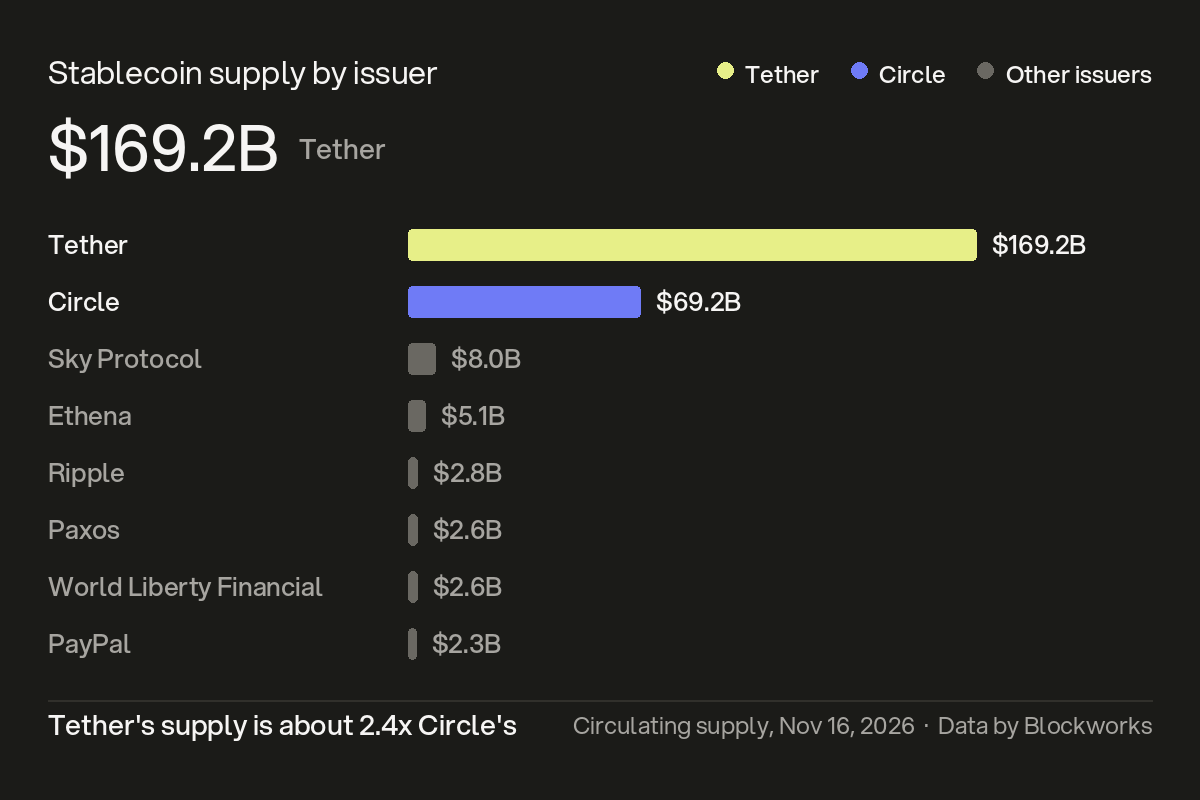
That layer is concentrated. Tether, which led Mural's $15 million Series A, and Circle together issue about $238 billion of circulating supply, according to Blockworks data for Nov 16.
Your agents become your finance team
Toffa expects people to run “three to five to 10 agents each that are carrying out these payments on behalf of them.” He compares it to a company: “Very similar to how a business has a finance team carrying out transactions.” An instruction might be to find someone in Argentina to build a website, spin up a $500 budget and pay them, or to book a hotel in Brazil over WhatsApp.
In his model, each budget is money set aside in an account the agent spends from, and each payment still has to show which agent made it and for whom.
The bookkeeping is familiar to him: he has tracked every expense he has made since he was around 14 or 15, first in a sheet and then in an app.
The ontology, and what each company wants to own
At Palantir, Toffa's job was to build the ontology: the core business objects that shape a company and the relationships between them, such as a customer, a chef and a transaction in a restaurant. Mural's API follows the same idea. It draws no line between a crypto rail and a fiat rail, so one account holds stablecoin and fiat balances alike.
He sorts companies by what he calls fintech centrality. Primary fintechs earn most of their revenue from financial services, secondary fintechs such as Deel earn a portion of it, and tertiary fintechs move money without keeping it. He expects AI-native businesses in that last group to grow faster than a lot of existing primary fintechs.
For teams weighing build versus buy, he suggests architecting the stack on a whiteboard first, because stitching providers together keeps adding complexity. Mural commits to getting customers to a first production payment in two weeks.
His question for every startup comes back to the objects: “What do you want to own?”