Stableminded · · 57 min
USDC, Coinbase, Goldman Sachs & Building a Non-Custodial Exchange
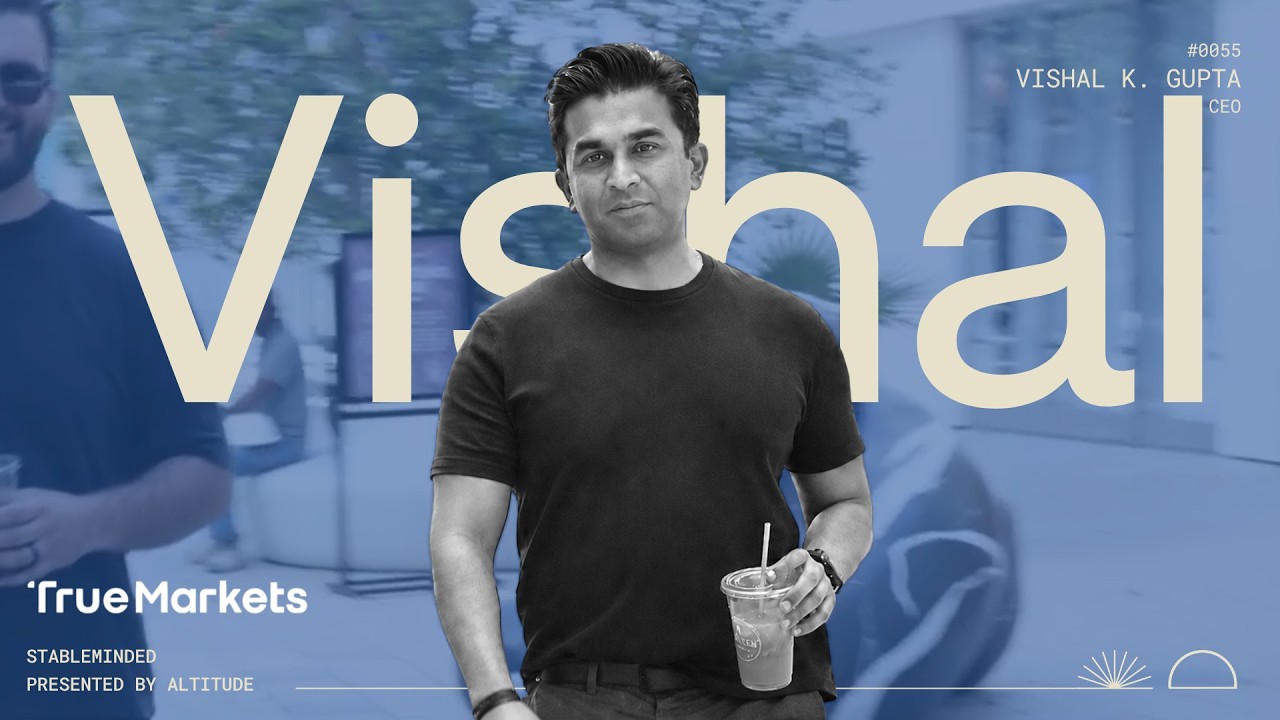
Vishal Gupta
True Markets
Vishal Gupta, founder of TrueMarkets, discusses his evolution from Goldman Sachs electronic trading to building crypto markets infrastructure. Drawing on his experience scaling USDC at Circle and running exchanges at Coinbase, he explains why stablecoins are foundational to DeFi and markets, the importance of separating custody from execution, and his vision for building non-custodial exchanges that operate like traditional market infrastructure—efficient, multi-asset, and stablecoin-agnostic.

True Markets
truemarkets.coTokenized markets, built for everyone.
Key takeaways
- USDC became the front door for DeFi; it transformed the ecosystem from being primarily ETH-denominated to having stable settlement infrastructure.
- Exchanges should not hold custody of assets; execution and custody should be separate, with assets settling to qualified custodians or self-custody wallets.
- Stablecoins have a 'superpower' beyond being dollars—they allow capital pooling across business units and enable faster, cheaper settlement across ecosystems.
- Number of wallets and distribution metrics matter more than total supply; 10 wallets holding 90% of a stablecoin signals centralization risk.
- Tokenization makes sense only when utility clearly exceeds risk; stablecoins pass this test, but many RWAs do not yet.
- FTX's innovation was using dollar-denominated stablecoins as collateral for perpetual futures, a model others adopted.
- TrueMarkets trades 150+ assets with 13 people at 100 basis points, demonstrating that modern markets infrastructure requires far fewer staff than legacy exchanges.
Transcript
25 turns, about 13700 words. Straight from the recording, so it reads like speech.
Vishal Gupta
guest0:00
I think there's, like, a superpower to stablecoins. A lot of people are like, it's just a dollar. My general thesis is that exchanges probably shouldn't be holding assets. I tell people, DeFi didn't work well until USDC showed up. Like, we became the front door for DeFi. The most beautiful things that we're building at at TrueMarkets is we can speak in ingenious compliance stablecoin. You can come and leave with whatever stablecoin you want. It's not an accident that I'm building a markets based business.
I was writing market ecosystem docs at Coinbase. This is my time to bring that ecosystem vision to the forefront. I wanna see markets and liquidity as a service the same way you see AWS. And I think everything does become markets over time. It's my fifth crypto exchange. We're just early, and I love building in a bear market, and then that's what we're doing.

Drew Rogers
host0:46
Hey. It's Drew. Quick thank you to Altitude for making this episode possible. Altitude is rebuilding business banking for teams on the frontier. They offer the full stack for the modern CFO and founder, a beautifully designed platform for payouts, bill pay, corporate cards, enterprise controls, and so much more. Move money with speed, yield, and total control all from your stablecoin balance. Operate at altitude. If your business is on the frontier, your finances should be too. You can learn more at altitude.xyz.
Vishal, thanks for hanging out this morning. Excited for this conversation. Okay. Just thinking about where we wanna begin and thinking about the listener base that we have and the the people that follow this show. I think a lot of the obviously, stablecoins are very core to this, but your role and your point of view in stablecoins within markets, but also how markets have evolved over time. Why don't we start with I just love for that to be the thread of our conversation, is how markets have evolved.
Give us your your intro and Yeah. Totally. Go back to the beginning. Happy to give a little bit of background. You know, background, computer engineer,
Vishal Gupta
guest1:50
graduate graduating the .com bus. So I I did a small extent in Silicon Valley as a hardware engineer at Cisco Systems back in the day. I was kinda, like, forming my opinions around technology and, you know, building in general. Just kinda seeing that, like, vigor, but also, like, the volatility of that market was very interesting to see as a young man. As I graduated into the .com bus, you know, as a computer engineer, everybody's telling me that all the computer engineering jobs are around being outsourced.
And I'm like, okay. Great. This is is this great for my career. It's actually it feels a lot like AI right now and how new grads feel with, like, a big seismic change. And this happens to be, like, obviously on the downturn, but, like, the AI upturn is also really confusing, I think, for new grads. But I graduated, found my way through the startup space, ended up actually taking, like, my first full time job at at Goldman Sachs at the time on what was then the, like, the newly formed electronic trading desk.
This is back in 2002 for I know that you probably have listeners that are younger than that now. But Electronic trading is what it was called? It was it was it was called well, it was the old Spearleeds and Kellogg, which was a company that was bought out by Goldman Sachs. And that was there was, like, the very first inklings of algorithmic trading and things like that that were offering execution services for, like, hedge funds and brokers and every these are, like, very simple algorithms at that point.
So equities, options, futures, FX. And I was, like, literally just like a grunt on the desk day one, you know, straight out of college. I kinda worked my way up, ended up running their options business over time. I was there for about ten years. I met my cofounder there seventeen years ago. So I pulled him right out of college. He was, like, the the right flavor of, like, autism that you want for, like, a cofounder, like, cofounding CTO. And, you know, we just kind of been building since.
So this is our fifth gig together. You know, I'll go through some of the background, but, like, you know, we did a lot of amazing things at Goldman. Had our you know, we were part of the teams that were building some of the first ATSs and really kind of, like, invigorated the the options business was a very small business for them, and we were able to, like, innovate in that space, build algorithms that people wanted.
You know, I was a young guy effectively running, like, a small desk that, you know, was routing at some point about 10% of the options volume through our technology. So that was really interesting. Learned a lot there, kind of pivoted out of, like, banking or, like, being at a bank and and worked for of all market makers. Me and my co founder went to a firm and and helped kind of build a similar business to what we had at Goldman at a smaller firm.
And we were able to I think our first big client was, like, we were able to steal Fidelity from Goldman Sachs. And that was like Wow. That was, like, pretty big. And it was, like, just two guys in 7 World Trade Center in, like, a a room much smaller than this just kinda, like, working together. And, you know, we're in her early thirties at that point. Or I was in my early thirties. He's probably still in his twenties. And two guys, like, you know, just making business happen.
And I So just to let's let's pause on the one, this this the moment of Goldman Sachs for you. There's this ten year period was such a Yeah. I'd imagine a very formative time for you in terms of learning about how those markets function. Yeah. And also
Drew Rogers
host4:46
the the prelude to maybe some of those inefficiencies or opportunities that TrueMarkets is now solving. But I wanna I wanna take this time also for me is, like, I think a lot of people will hear Goldman. They'll hear these terms, options. They'll you know, we're familiar with these types of terms, but I I'd love for you to break down. If you were to, like, imagine you had, like, a whiteboard in your head of those kind of core parts of, you know, you have options and you have all these pieces.
Like, what actually makes up that a trading desk and and how these things work? Like, break that down so I mean, we were we were building what we'll call execution services. So these are, like, effectively
Vishal Gupta
guest5:20
trading software algorithms. So, like, what we had, like, support desks, we had sales desks, but largely, this is all electronic. So we were sitting on a trading floor, but, you know, you're taking phone calls. But for the most part, you're servicing, like, large scale hedge funds that are trading, like, size.
And so in terms of the different product classes, equities was, like, the big volume maker, but options end up being, like, there's a lot of revenue back there, and there's, like, things like payment forward flow. And it's actually a very, like, advanced market structure options. I think there's, like, 15 or so options, exchanges, and they all have slightly different market structure. So it's very different than crypto. Crypto is a very simple market structure. It's, like, maker taker only, right, for the most part.
And what I learned there is that there's, like, this natural evolution of markets that we still haven't seen at some you know, effectively, like, a very immature market, which is crypto. Like, the amount of things that we know and we can apply to markets, we still haven't really applied to to spot markets or perpetual futures or anything. Even, like, prediction markets are very simple market structures that we love to, like, invigorate. So, yeah, I mean, there's there's complexities here that we could talk about.
Yeah. So you but you joined at a time where a lot of these trades were happening maybe more manually with phone calls and, like, OTC orders and I things like was just at the very like, I joined at the very cusp of, like, electron trading going, like okay. So kind of harkening back to my my previous role, like, working in Cisco Systems as a hardware engineer, like, there was this idea of we're gonna build the Internet and then everybody will come. Right?
And then there was a moment of, like, dark fiber where, like, they lay a bunch of fiber down and nobody was, like, streaming video. Nobody was doing these things back in 01/00/2002, and that's where the dot com bust kinda, like, happened. So when it ended up happening and it wasn't like it it it looks like I I, like, willingly, like, kinda, like, found the right niche for myself. And I I did love markets. I was, you know, always attuned to markets.
But the banks, brokers, hedge funds all found that there was all this, like, latent fiber around, so they were able to take these markets electronic. So I kinda joined at a time where things were going electronic. I wasn't taking, like, paper trades or anything like that. These weren't a these are listed trade like, I started in the equity space and then, okay. Now we'll figure out internalization, reg ATS. All these other things started happening.
This is 2007, you know, going from o two to o seven, just a little bit of evolution. Then And we saw that their options world, like, there was, like, a lot to do and it was still pretty pretty early. I mean, it it's it's pretty small scale still and we saw the ability to grow that market. So, yeah, the evolutions markets, the electronic markets, I wasn't there day one. I was there, like, day two. Yep. Yeah.
What what are the similarities that you see between maybe what traditional electronic markets were at that time? And maybe did the traditional options business, like, how similar effectively are these things to bringing these things on chain? Or do are they operating in a very similar way? Are there new things that are possible?
You know, there's you know, the thing that I'm excited about for, like, true markets is that we are a team that have seen both the traditional markets, some very, like, you know, these are the New York Stock chains and NASDAQs of the world. They've been around one hundred plus years. And you see, like, the new stuff that's literally being launched real time where it's, like, on chain markets. You've got prediction markets. Go to all these other things. So it's, like, the the mixture of the old and new.
And nobody's really kind of splitting the gap and saying, hey. We know a bunch of, like, stuff from the old, and we know where the new stuff's going, and we can see, like, an opportunity to kinda, like, do do both well. Right? Like, what's stopping us from taking equities twenty four seven, really? It's not really tokenization. It's infrastructure. It's DTCC. It's, like, it's a legislation. It's a bunch of other stuff. Right?
I think crypto in general and we are a crypto based business, but we're markets focused, not crypto focused is what I would say. Yeah. I think there's a lot of opportunities. You see this in, like, prediction markets. Like, of them are on chain, half of are not. Right? It's really just more of a focus around, you know, things like, you look at a market like Hyperliquid, like, parts of it are on chain, parts of it are not.
I love that, you know, we'll we'll talk more about your markets, but, like, we love the hybridization of some of these markets. We see, like, reasons for certain things to be on chain. We see certain reasons for things to be off chain. But evolution of markets is what gets us excited. Are there are there things specifically that you feel like should or should not be on chain that are or people maybe things that people are trying to put on chain that don't deserve to be or don't need to be?
You know, if you look at the evolution of DEXs, right, like and I've been in the market long enough. And, again, like, I think it's probably helpful for the for the podcast to know that, like, after Goldman, I went through, like, traditional finance. I I kinda, like I I was done with TradFi after, like, 2015, pivoted towards fintech and crypto. Was an early guy at Circle, so was head of business development, but more importantly, head of USDC. So I was in charge of launch and growth of U S D USDC.
So, really, I I tell people, DeFi didn't work well until USDC showed up. Like, we became the front door for DeFi. Right? You know, you could everything was eth denominated before that. Tether hadn't really taken on, like, a a real, like, hold on the DeFi markets yet. So we had saw we had seen, like, the opportunity in the DeFi markets to kinda be the front door. You know, the Aves and the Compounds of the world were really kinda eth denominated before USDC showed up.
So that gave us, like, an opportunity to, like, innovate in the DeFi markets. Then looking at DEXs, right, like, you know, the the first, like, DEXs and, you know, I'll throw out, like, you know, we I was trying to make markets on, like, radar relay, and I'm like, alright. You can't do that well and effectively because whenever you place an order or cancel an order, you're paying gas fees. And as a market maker, you're never going want to do that. It's just too heavy, and it doesn't really work well.
So then you see AMMs come up, and AMMs make a lot of sense, but they're not, like, order book driven. They're obviously a little bit, like, different, and there's a place for them as well. But I think what you see with, like, Hyperliquid is that they build their own chains highly focused on the idea that this is built for, like this is literally, like, to building markets. Right? And the idea of placing an order and canceling order and not paying a gas fee makes a lot of sense for it being on chain.
So it's less about whether it should be on chain or off chain. It's just how effectively can you allow a market to happen. And markets cannot are more than just order books. They're more than just RFQs. There's, like, a bunch of different ways to do these things. And, like, what are what should and shouldn't be on chain is a is a is a good question. My general thesis is that exchanges probably shouldn't be holding assets, so we wanna be non custodial, which is where our true markets is.
We want the ability to settle to, like, a qualified custodian as a QC, like, for things like Bitcoin and let let them sit in bankruptcy remote accounts. Right? So these assets are sitting in your name. So if either the QC or we blow up, you're gonna be fine. Assets are sitting there for you. Or they're sitting in technical wallets, so we use turnkey behind the scenes. So I think that, like, for us, settlement is very, like, very much at home on chain.
Whether or not the order books have to be on chain, whether or not orders and executions and things like that have to be on chain can be debated. I just think that at least the idea of self custody or noncustodial exchange, like, resonates with me. Again, I don't think we're I don't think we're crypto obsessed. We're we're markets obsessed, we're just trying to get we're trying to make to build the best mousetrap. Yeah.
While we're so we can go back to because we we can we'll be talking for a We can go back to the circle, and and Yeah. I wanna spend some time on that. But since we're kind of now talking about how true markets is built Sure. Let's just define this. So you the qualified custodian like, just let's break this down a little bit. So Yeah. The qualified custodian is where assets get parked, but you actually believe that the exchange layer shouldn't hold assets. I think that's a Yeah.
Let me let me define TrueMarkets for the for the audience a little bit. How is this structured? Yeah. So TrueMarkets and and and, again, like sorry. A little bit more on the background. So after Circle, I left to join Coinbase as head of exchange. You know, I had helped run Poloniex a little bit at Circle as well, building liquidity programs and things like this. So that was my first, like, real crypto exchange. And then I was running Coinbase spot exchange.
And at at that time, like, the exchange was running about 20 assets, and, you know, the exchange infrastructure was a little bit brittle. So we took one of my my cofounder was one of my first hires, Patrick, and we were able to take the exchange from 20 assets to 235, launched two derivative exchanges, really kind of like, bolster the exchange business over there. And, you know, we we learned a lot. So, like, you know, I I ended up running three exchanges at Coinbase.
It was, like, the the spot exchange and the two derivative exchanges. And now true markets is just, like, the natural evolution of where we think that market should go. The one feedback we would hear over and over again from, like, people are like, yeah. I get you. FTX happened. A bunch of things are happening. I don't feel comfortable with my exchange holding the assets. And there's I think Coinbase is a trustworthy team, and they're in they're the best of the best of the best out there.
But I think, technically speaking, you want your execution and custody to be separate. And one of the things that I think crypto grew organically, you were a broker, you're a custodian, you're an exchange all in one clump. And in, like, traditional finance, it's like the custodian is here, the exchange is over here, and the broker is here. Right? And they're very separate, and there's, like, systems of checks and balances. And I think that, again, we're an API for markets. Our focus is, like, to be markets.
And, you know, in in many ways, like, we don't want the markets to be on the back end. We want it be in the front. That's we're we're markets. The custodianship, whoever the broker is, like, that's that's up to you know, we'd love to, like, white label our our services and give it to every fintech out there and let them trade Bitcoin and the 150 other assets we have. Eventually, we'll do other markets, like securities derivatives, prediction markets, everything else. We just wanna be the API for that stuff.
So I I think there's there's a real opportunity to do it that way, and no one's really thinking about markets that way. Yeah. So man. Okay. So when was the first time you heard about Circle? Like, when when did that first hit your radar and and Yeah. To bring us into the USDC story? Sure. Sure. So I was in a a a fintech firm by the name of MoneyLion, exited all ex Goldman guys, building an online lender. And I was, like, very much crypto obsessed. I I have a good friend of mine.
We're sitting around my kitchen table, and I'm like, you know, I I like fintech, but I just I don't feel that, like, thing. Right? And Moneyline, you said? Moneyline. Yeah. Moneyline was was very influential, very, like Oh. In that, like, twenty fifteen ish. There's a Moneyline mafia that's an incredible we have I think half our team are Moneyline guys. So, like, they're they're they're quite quite great. Yeah. In that in that very influential kind of neobank Yeah. Gritty. Fintech. Yeah. Yep.
And they're they're great. Big fan of the team out there. And I would say no. I mean, with with that in mind, I mean, we we built, man. We just built with that team. But was was MoneyLion you weren't you weren't using stablecoins within that? So I I became crypto obsessed. I was doing it personally. I was, like, playing around with some things, and I wanted to build out a crypto prime broker back in, like, 1617.
And at the time, Bitcoin was trading, you know, way low, and nobody saw an op like, nobody saw a reason to have smart routing for, like, for crypto. And I I'm not entirely sure that was the best idea either, but, like, prime brokerage was, like, not an idea at that point. And I was trying to raise capital around that. Couldn't raise the capital I wanted. Nobody wanted to talk about crypto back then. And I ended up talking to a couple teams. I talked to the Coinbase team.
I think I talked to the Coinbase team twice before I even took like, the third time I finally joined Coinbase, but I was talking to there I think there was only, like, three firms you could look at in crypto that had, like, the pieces. And I looked at Circle. They had the best OTC trade desk that, you know, in in crypto at the time. They had just bought Poloniac, so they had an exchange. They were still trying to figure out what to do with that.
And when I was brought under the umbrella of, like, what was going on behind the scenes, like, there was this white paper for this new stablecoin called USDC. The idea was, hey. There's a consortium model center. There's gonna be multiple issuers. There's gonna be, you know, it's gonna be $24.07 ish issuance, and it's gonna be fee free from, you know, Mint and Burn. And there's all these other ideas that were happening. And, like, some them came true, some of them were not, but, like, it sounded really interesting.
And I was joining as head of business development, and I started asking questions about, like, okay. Who's the market maker that we're gonna be working with to get it out in the markets? Who are Like, which markets are we talking to? Again, I'm a markets focused person, so I was asking all the right questions, I think. And at some point, I think Jeremy was just like, all right, you're gonna answer these questions by just owning it. And they gave me a little bit of runway to, like, figure it out.
So from zero to 500,000,000 in the market cap, I was at Circle kinda leading the the charge in the market. So I'm getting USDC out in the market. I spent a lot of my time in Asia, a lot of time in The US just trying to get USDC up and up and into the market. And then, you know, obviously, Coinbase joins a couple months after we launch it, and everything kinda set off. It it was the easiest thing to sell. It's a great product. Yeah. What was the approach? So you come in. You have this awesome role.
You're building the first, like, major regulated stablecoin.
Drew Rogers
host17:18
What was the strategy? Who did you go to? How did you grow it? Yeah. So there's a lot of
Vishal Gupta
guest17:23
things here. There was a couple waves of stablecoins. There was obviously Tether before us, and then there's this wave of stablecoins which include TrueUSD, GUSD, PaxosDollar. And then the last to launch was USDC. And, you know, there was, like there was a couple, like, funny things happening in the market at the time. Like, people would mint a bunch of a stablecoin, and then they would go to burn it. And the Disher would be like, ho ho. Wait. Can't burn all of it. Can't burn all at the same time.
And they would kinda, like, put a little bit of speed bumps here and there. And I effectively said, listen. Like, I'll never stop you from minting or burning something. And even if I did, you could just go to Coinbase. Right? And there's another effectively another issuer. So it created a little bit more of an easy way out. And, again, this is 1819 where, you know, minting and burning wasn't as easy as it is now.
We were the first to, like, integrate with Silvergate Sense, so we had, like, twenty four seven mint burn. I think we were just the first to a couple of things, and we, like, looked a little bit different than Tether in in The United we were, like, what I'll consider, like, one of the first, like, real good US domiciled, US denominated stablecoin. And that, like, gave us a leg up, and all you needed is a slight leg up. And it wasn't like it was never was it super obvious that we were winning.
We were just like, okay. We're just climbing out of okay. It's $50,000,000 market cap. Okay. Cool. Sweet. We got there and, like, kinda, like, work with The Trade Desk, work with Poloniacs. Like, okay. How do we get this thing to, like, the next level? Okay. 200. We sat at 200 for a long time. 200,000,000 market cap was, like, supremely long to the point where we didn't know if we could get out of that hole. Who was driving the volume at that time?
Like, what kind of capital So we're talking to so it's OTC trade desks for trade settlement on the OTC trade side, lending. It wasn't really the exchanges at that point because nobody really integrated it. Still, people aren't integrating stablecoins correctly, we could talk about that more. But, like, the first use cases were trade trading settlement, lending settlement, OTC focus. So a lot of the mint burns were coming from large scale OTC market makers and traders that you would know.
Like, you know, a lot of time I spent in Asia just, like, shaking hands of, like, the big mint and burners of USDC. Okay. So you get this thing off the ground. It has momentum. Sure. You said bring us into the relationship with Coinbase, how you met that team. You said you were in touch with them before. But So that was almost entirely Jeremy, I would say. Like, then Jeremy and the exec team, like, you know, obviously, I think at that point, USDC went from, like, being, like, a small project to, hey.
Like, we've got some big things to do here, and they were able to capture as the first, like, issuer, like, the issuer, and I use quotes because there's only really one issuer. They were able to capture kind of the the attention of the Coinbase team. Yeah. And so at that point, very much an exact conversation with their exact team. But, you know, I'm working with my counterpart at at Coinbase, I'm obviously very close to all my counterparts at Coinbase at that point. So it's it's their business development teams.
It's like, you know, it's the guys like Jim McJoe, Cyril, like, a bunch of these other guys, Namel. Like, all these guys are working hand in hand just trying to get that thing up into the right. And then, again, then we're like, it's okay. Partnership's happening. Now what do we do? And it still wasn't like a success. Like, never I don't think we were ever like, hey, this thing's super successful now. It wasn't like that. It was like, what are the metrics that we have to pay attention to?
And there were a lot of ghost metrics, right? There were lot of metrics where like, Okay, should we be paying attention to liquidity on order books? Should we be paying attention to number of wallets? Like, what should we be paying attention to? And I think no one had successfully, like, launched, like, a stablecoin outside of Tether, and it just looked very different. A lot of people just focus on total supply. Yeah. And that's definitely that one metric. Matter in your in your view?
I think number of wallets is actually a supremely interesting one. So whenever you wanna look at one of these stablecoins, you're like, well, how many wallets are holding how much? Like, so if it's like there's 10 wallets holding 90% of the stablecoin, like, that that doesn't sound like a win to me. Now if you have a bunch of wallets holding a couple $100, that's like retail. That's like a bunch of other things. Like, that's getting out there in the ecosystem.
So, you know, average dollars in wallet and number of wallets is a very interesting one. I think the centralized exchanges, like, largely just, like, don't understand how to land like, leverage the stablecoins. Like, they're just, like maybe you could unwrap with them, but the order books are largely, you know, driven by you know, they're, like, US dollar, and they're, like, doing something behind the scenes.
So, I mean, we can talk about that too, but I I think one of the key things that FTX did well actually, the first wedge that FTX had was using stablecoins for collateral for perpetual futures. So I remember I don't know if Arthur would remember this, but I we were at Circle, one of our offices, and I remember saying to him, you know, your per product is amazing, BitMEX, but what about using, like, a stablecoin for collateral?
And he's like for many reasons, he didn't wanna touch, like, a US dollar denominated stablecoin. And I'm like, if you don't, someone will. Right? And so FTX's
Drew Rogers
host21:57
first, like, wedge was using dollar denominated stablecoins for collateral for for perps. And, like, FTX's futures trading exchange, right, that they were perps only at that time. They only really took on stablecoins and and paid out in stablecoins. So the wedge that FTX had was effectively stablecoins as collateral, and the first stablecoin that they integrated was USDC. So that was the work that we had done. Yeah. You've seen so many things behind the scenes.
What do you think that the you know, we we can go into what exchanges or other players are doing correctly or incorrectly with things like stablecoins. I think you you understand you understand the role that these things play within markets. What do you think right now is under maybe missed or undervalued or things that people might think of stablecoins that? I I think there's, like, a superpower
Vishal Gupta
guest22:42
to stablecoins that people like, a lot of people are like, it's just a dollar. Why do I need a stablecoin? Like, why does that matter? And, like, you know, I had a conversation with Sony about, I don't know, probably a year ago, and and, you know, they were looking at stablecoins. And I think they they had asked me a question, like, why do we need a stablecoin? And I'm like, well, okay. You've got you're Sony. You've got four or five businesses.
Each one of these businesses has a CFO, has, like, a has, like, a pile of money that they have to manage. That money is being invested in short duration bonds and long duration bonds, and they're always gonna kind of, like, plan for the worst case scenario. Right? So the percentage of short duration versus long duration is always gonna be bigger than it probably should be if you if you had pooled the money together. Right?
And so imagine a world where all those CFOs are pooling that money together, and they're bringing it in as a stablecoin. And then their their percentage of short duration versus long duration bonds changes where you can have more interest because you're willing to take on a little bit more risk because the stablecoin allows you to pool those monies together. Right. Now, imagine taking that stablecoin and then expanding it to your PlayStation network and your externally to, like, retail customers.
And all of a sudden, like, you're pulling a lot more dollars together. You can be a lot more effective. And also, like, the transmission of these things become, like, zero and things all of the the ease of use and the utility of a stablecoin is much higher than the risk associated with with minting and burning. So all of a sudden, it's, like, it's very interesting. And that's I think that's one of those superhero powers that people don't understand.
And now on the counter side, the people always ask me, like, real world assets, tokenizing assets, tokenizing everything. Let's tokenize the world. And I always, like, pause for a second and I say, it's always a measure of utility versus risk. Right? So tokenizing a dollar makes a lot of sense. There's a lot of utility. Like, if I give you one USDC or one paper dollar, you're probably gonna take the USDC because you're gonna say, hey. I can use this for collateral. You can air draw me interest.
I was like, once you're, like I can do a 100 things with thing. Right? Now the risk associated are now was a dollar is there a dollar back there? Do I trust the issuer? What's the time for a mint? What's the time for a burn? Like, those are the risks associated. So if you look at that and you say utility versus risk, there's, like, a good deal of utility and, like, minimal risk. Now if you start to, like, tokenize, like, let's say, a REGNMS security, there'll be a question of, like, what's the additional utility?
Like, why am I doing this? Can I use it for collateral? You're still in the REGT margin world. You're still kinda, like, inviting the SEC in. Like so, like, utility is, like, kinda minimal, like, what the tokenization. And, I I used to help run the securities business at Coinbase. Right? So the utility is relatively small. The risks associated are relatively high. It's like, oh, do I trust the broker? Is it, like am I getting my voting rights? Is it, you know, there's, like, a ton of things there.
I'm not saying that this equation won't change, but right now, the utilities are much higher than the risks associated. So, like, that's why, like, tokenizing a dollar makes a lot of sense. And then on the other side, like, tokenizing everything may not. Yeah. What what parts of tokenization
Drew Rogers
host25:26
in our in our RWAs do you think are you know, because there there's a spectrum here. Which one like, you think about what Superstate is doing and some of companies like that. What what parts of the market do you think are actually doing meaningful
Vishal Gupta
guest25:39
like, will get meaningful traction versus maybe others? I mean, I think it's projection of, like, where, like, things like regulation and risks will will lie. So, again, like, you it's gonna be always a question of, like, well, what's the additional utility? So, like, it's gonna be a question of, like, do I need this thing to be tokenized? Like, is it adding utility? And if the answer is no, then you probably shouldn't do it. Yeah.
And if the and if the answer is, like, there is utility, but the risks associated are too high, then you gotta ask, well, what's gonna lower the risk? Maybe it's regulation. Maybe it's rule setting. Maybe it's a bunch of other things. So it's always that, like, utility versus risk. And the market will tell you what's working or not. Stablecoins, dollars are working. Right? Everything else is meandering a little bit. Right? Like, until they find that utility versus risk metric that makes sense for the market.
If you're in the market, and I'm talking about, like, market maker or systematic traders, they're, like, not gonna just willingly mint like, tokenize something and add risk Sure. That is gonna be worth less. Sure. Right? So they won't do that. So you spent a ton of time in the context of exchanges and the relationship that exchanges have to things like USDC or stablecoins more broadly. What role have you seen stablecoins play within the context of an exchange?
You mentioned the CX use case of, like, what was really innovative about that. Like, what do people need to know there? Yeah. So I would say this. Like, current state, most of the centralized exchanges kinda, like, just, like, take them in or they can, like you can trade one for the one for another. Yeah. But there's not, like I mean, there's many reasons, but there's not you know, they're not, like, just, like okay. So It's bringing me into our last night, the chat we had around USDG a little bit.
Like, how how exchanges and leaders at exchanges need to be thinking about stablecoins? So so let's let's talk about, like, the first thing I wanted to do at Coinbase when I joined. So, again, I was running USDC at Circle. My next job is head of exchange at at Coinbase. And I, at the at you know, my prior job is trying to, like, hey. At the exchange, you need to do these things. Like, you can't have separate order books for USDC and USD. You need to combine these things.
You need to allow USD and USDC to be one thing. And that took about two years, but we ended up combining them. So, like, that was, like, the first thing we had to do. Like, USD and USDC needs to feel like the same thing, and they need to be the same thing. When did that join when did that happen, the joining of this? I joined Coinbase in 2020, and I think it happened, like, 2022. So, like Okay. That's, like, v one. Right? Like, so now we speak USD and we speak USDC, and it's one and the same. We're an issuer.
It it kinda is the same thing. Now the question is and some of the most beautiful things that we're building at at TrueMarkets is we can speak in Ingenious compliant stablecoin. We can settle to Ingenious combined compliant stablecoin. We have our like, our our execution engine is built in a way that, like, we can settle to PYUSD. You can bring PYUSD. You can bring USDC in. You can come and leave with whatever stablecoin you want. And I think that that's that's the natural evolution. No one's done it like that.
Right? So, again, it's super hard, but, like, we know how to do it well. So if, like, a bank broker or anybody else or fintech says, hey. I'm gonna launch my own stablecoin. I wanna use your rails to, like, buy and sell Bitcoin and some other, like, volatile assets in CeFi and DeFi, and I wanna settle to my own stablecoin, we can do that at your markets. That's, like, the natural evolution. I don't think anybody's doing that. So, again, like, we have a very different view on markets.
We're just trying to be infrastructure. We're trying to power the next wave. We want, like, the fintechs and banks and brokers to say, I don't need to buy my own exchange. I can just, like, leverage an API and settle to my own, like, stablecoin. So those are things. That's the natural evolution. It's just supremely hard. So our goal is to be stablecoin agnostic, chain agnostic, and eventually, like, custodian agnostic as well. Yep.
Do you think exchanges will start seeing that stablecoin itself as like, right now, you know, Coinbase was in a really unique position when you were there because of the relationship to USDC.
Drew Rogers
host29:11
A lot of these exchanges are now in the position where they're like, well, we wanna participate in the economics around that thing. Yeah. How have you seen, like, maybe the model and maybe we define I think it's important we define what the relationship Sure. I think so many people don't appreciate the relationship Coinbase had to to Circle and USDC
Vishal Gupta
guest29:27
and now how other exchanges are trying to position themselves in that way. Yeah. So I'll say this. Like, first, the Coinbase and Circle relationship, effectively, like, they share the interest revenues and, you know, effectively, it's $50.50 in whatever is left over from their pool of interest. And they do pay out some I mean, there's some deals that they make, obviously, with some exchanges and other players out there to hold USDC.
I don't think they're ever giving away more than, you know, a 100% of the the interest. They're giving them a portion of the interest. But given that Coinbase and Circle are effectively, like, partners in this, they have an incentive to settle their trades in something like USDC. So something like we launched a perpetual futures exchange. There's a big question like, oh, can we make enough money for this to be worthwhile?
And I'm like, in the interest alone on the stablecoins that are used as collateral, obviously, USDC, that will pay all the bills. They'll keep the lights all, like, on. So, like, don't even worry about the transaction revenue. Just looking at only the stablecoin interest revenue will be fine. And so that's, like, a very unique position to be in where you not only own the exchange, but you also own interest revenues around the stablecoin that you're using for collateral. Now not every exchange has that ability.
Right? And we're talking about exchanges, but it could be any app. It could be anything. Like, what am I, like, settling dollars to? And, you know, there's two schools of minds here. It's like, I'm gonna create, like, a walled garden stablecoin. I'm gonna create MetaMask USD or whatever it is that's gonna, like, be hyper focused on my own ecosystem, and it's gonna work really well. And I'm gonna get a 100% of the interest, and it's gonna be sitting in my walled garden, and that's gonna work beautifully.
And then there's, like, the idea of a network based stablecoin. USDG is a version of it. I think there there's gonna be more and more versions of these things that make more sense, but those are the two different ideas. Now, if I'm if I'm if I'm cracking in my launch launching my own stablecoin, I don't know. I have some ideas there, but, you know, we're we're building. So, you know, I'm not gonna show too much of of what we're smiling right now? Yeah. I've I've ideas. Like, listen. I I ran to ACC.
I I you know, I'm building a ChewMarkets is my my my cofounder and I is, like, dream. We're building all the things we wanna build. We're we'll capitalize. We're just small. We're a small team. Yeah. Can't get too much off it too early. I you know, I like building. You guys will see things that we're you know, we just started trading Bitcoin recently. So you're trading Bitcoin for a 100 basis points, which is, a third of what, you know, the top exchanges are in The United States.
They're sitting in bankruptcy remote accounts. If you're gonna buy Bitcoin on in size, like, TrueMarkets is the best way in The United States to do it. We're just small. Nobody knows us, and that's fine. Like, I love coming in from behind because we're we're a small scale team. We're 13 people. We're trading Bitcoin and a 150 other assets. That's a that's a great place to be. You're seeing a bunch of layoffs. You're seeing a bunch of things happen, like inefficiencies
Drew Rogers
host31:59
in the markets. You need 5,000 people to run a crypto exchange. Well, we're trading a 150 assets with 13 people in The United States. So, you know, there's a way to do it. It's awesome. Alright. I wanna go back to the network the network versus the Sure. Kind of the walled garden. Do you think that either of those like, I just wanna pick those apart. Sure. Like, maybe even, like, thinking about MoneyLion and, like, that use case over there versus the exchange use case.
Vishal Gupta
guest32:22
Do you see, like, one being more maybe effective or successful, or it just matters on the use case? So let's, like because you have on the spectrum, you have, like, like, a MetaMask dollar or something that's, like, sitting way over here in, like, kind of a walled garden, which is, like, great, and that's that's good for them. And I'm sure that works for them. And then you have, like, a player like Sony that has, like, an ecosystem for sure.
Like, they definitely have, like, dollars coming in in and out of their ecosystem. And it is a wall garden, but it's a huge wall garden. And it's not just, like, one thing. It's not one application. It's, like, many things. And there's many reasons for them to have their own stablecoin and do it well and sit in their own world. And, like, if Disney did the same thing, like, what would happen? You know, like, that that seems also very interesting.
Drew Rogers
host32:58
So the last conversation we had was with Nas from Bastion. Sure. And Sony Bank, I believe, put capital into Bastion in their last round. Yeah. I think that's really where they're now focused. It's like those use cases of, like, super complex ecosystems
Vishal Gupta
guest33:12
where they can kind of bring all this tech to a Sony. Exactly. So I think, like, in the spectrum, like, if you're a global ecosystem where you have many touch points with many you know, there's different FX rates. There's different things happening. There's dollars behind the scenes. Like, what if you create a stable point for that ecosystem? That's really interesting. And then you've got players that are like, well, I can't build a Sony, but I am like a I'm a small scale exchange. I'm a trading desk.
I'm an OTC like, how do I get involved in a network? And the reality is I think that that's still an unsolved problem. Like, USDC was meant to be a consortium. It never really was. Say more on that with with Center. Yeah. I mean, it just I think after Circle and Coinbase kinda found their footing with USDC, there wasn't a lot of impetus to, like, grow that network. Right? So they effectively parked Center or, like, or made made it go defunct, and, you know, they renegotiated split. So it is not multi issuer.
It's always been kind of circle behind the scenes, and and Coinbase takes inventory and they can manage it effectively. I mean, one of the key reasons why that works, though, is that Coinbase does a really good job with ACH and debit risk and all the other things that need to have. So they're effectively the retail dollar rail for USDC. Was USDC's original vision to be multi issuer? Yeah. So sitting around the consortium the center consortium.
And then, like, you know, the Facebook dollar, you know, DM was coming up, and that was, like, really scary for us. At one point, we're like, oh, no. And, like, you know, we were small like, Circle was a very small, like, group at that point. Like, there was, I think there was, like, 300 people and, like, 280 of them or 90 of them were focused on, like, Poloniacs. So, you know, it wasn't like there was a huge amount of us, like, working on USDC. And, you know, you got a behemoth like Facebook saying, hey.
We're gonna effectively create a consortium model that is gonna blow your consortium model out of the water, and we've only got Coinbase. So it didn't make you know, it was scary, like, as a startup. What would that have if that went through, what would that have meant, do you think? What were you scared of? It's funny. I I think I think Zuck is probably, like, kicking himself a little bit for pulling the plug on that one, and I think he's, like, rethinking his ideas there.
But, like, I think that would have been scary for USTC. And while we parked the consortium model, we still had the strength of, you know, format because it is Circle or Coinbase, and you're never really worried that you're just gonna be holding the dollar. So I think that worked for the market. Again, I don't think it's I don't think anybody's tried the consortium model well enough yet. I think Paxos is obviously trying with USDG,
Drew Rogers
host35:23
but I think there's gonna be there's opportunities there, I think. Sure. Sure. How have you thought about just the the way that you are building monetization? Like, there are all these things that we we now live in these, like, modern markets where economics are flowing in different places. Mhmm. And you called out just, some of these layoffs, and feels like we're going through a pretty interesting transition where, like, modern markets are finally arriving. Yeah.
Where do you see we've talked about stablecoin economics and, like, the PERP use case. Where do you see most of the economics going and maybe some of these new channels
Vishal Gupta
guest35:55
that you're thinking about? Yeah. I I think that, like, exchanges don't have to be huge moneymakers all the time. They're meant to be you know, there's meant to be a little bit of friction in the execution, but it's not meant to be you know, you don't have to take the rent down 300 basis points to buy Bitcoin. Right? Like, that that shouldn't always be the case on an execution venue. The broker can take whatever he wants, but, like, you know and that that's a different question. But Why is it typically so expensive?
It sounds like you guys have really prided yourselves right now in being, like, you said the best in The US trade good point. Like, again, we're small. Are most of is most of it just expenses and costs from Yeah. I mean, we're a small team. We're able to do things, like, pretty effectively. We're not holding so we obviously, like, are not holding the assets or held at a qualified custodian that does this really well. We pay them for the customer. Our rates can be really low.
We're just our ideal is to be cheaper, faster, safer. Right? And, you know, I think exchanges so it's it's, again, traditional finance. You have you have a custodian. You have a broker. You have an exchange. Right? And our goal is to power all the brokers out there and give them proper crypto rails, whether you're a big big name bank or a new fintech or you wanna be the next Robinhood competitor and you don't wanna buy your own crypto exchange. We wanna be markets and liquidity as a service.
And that will start with crypto, and there's so many other interesting markets we'd love to get into, and we're just trying to kind of climb our way in into that market. Yeah. Markets and liquidity as a service. Who right now do you who are you trying to start with in that? Like Yeah. Where are you embedding this type money? So our first layer is really kind of, like, systematic traders.
And, like, in this market where things are getting obviously more and more automated and, like, crypto is largely, like, systematic trading, we have a liquidity program. We're actually launching now. We're giving away a million dollars of equity for systematic traders to show up and provide and take liquidity. And it's a really interesting pro program. Can you define systematic trading? Like, what does that mean? Pretty much anybody that's coming in via APIs, I would consider systematic.
And that that comes in via fix, rest, even our CLI, and providing and taking liquidity, liquidity offering. You know? Again, these are like this could be anybody from, like, a large scale market maker that, you know, names that you know to, you know, two guys in a garage or one guy in a garage that's just trying to figure out how to systematically trade, maybe building robots. And it's every, you know, every month, it's getting easier and easier to build something. Right?
So, like, systematic trading will be really important. So, like, if anybody asked me TLDR on, like, what TrueMarkets is, it's it's it really is API for markets. And we wanna be the back end for those systematic traders. We wanna give them, again, best, cheapest, safest way to get there. So that's what we're doing. What is what is if I'm a builder, if I'm wanting to go compete with Robinhood and go build modern markets Sure.
Go serve a specific audience to do so, what do I have at my fingertips to go build with with something like what you've built? So we have product called TrueMarkets Gateway. It's an API. You can build your front ends, and you can say, okay. I wanna offer a 150 assets plus Bitcoin. And we give you all the tools. It's an API, and you can get right there. It's actually a lot easier than, like, trading equity. Right? Like, equity, you have to come like, there's a bunch of things you have to do.
Obviously, like, this one's a little bit easier. So if you wanna start there, you can start there with us. And, eventually, we'll be doing securities, derivatives, everything else. So we just you come in with a pipe, and we just offer you, like, the best execution, give you best pricing, and we just we it's all fair. Right? Like These are all digital assets like crypto Currently, you yeah. It's it's spot markets. Yeah. Currently. So it's a 150 spot markets. Yeah.
How do you see the other asset classes fitting into that with things like tokenized equities and stuff like that? Are you focused on that right now? Or It's a good question. So I our rails will be used for any of these tokenized RWAs to any degree. So we we currently speak Solana based HyperEVM, and we'll be chain agnostic, and wherever the the volume is will go. And so, like, yeah, if there's an if there's a real world asset that needs to settle in a tokenized manner, we'll do it.
But we're also, like, not hyper crypto obsessed. Like, if you look at prediction markets, like, I think, you know, you see CallSheet and and Poly and, like, you know, call chain is obviously off chain and Poly is obviously on chain. And, you know, I think they in the eyes of a consumer, they look very similar. And, like, so we're not so obsessed with the underpinnings. We have crypto underpinnings, but we also we also do on chain we do off chain matching.
We do, like, things that you know, we can do things on or off chain. Yeah. Yeah. Yeah. Very interesting. We have our own matching engines. We have our own settlement engines. Yeah. If you weren't building true markets at this layer and you were forced to and maybe maybe you could consider this even it's not of this or that. But if you were to give the business to Patrick for a year and go build something on top of it Yeah. What would you go build? Well, it's funny. I it would stay in the market.
I'm gonna say, we're building as we go. Like, I I we had a hackathon recently, and the only of the hackathon, we split the team into a team b team, was you can't work on something we're currently building. And the two things that came out of that are gonna go to production in the next six months. Like, you know, these are, like, coming from the founders, this is what we wanna try. Let's see how far we can go.
Again, using our core infra, using our core, like, technology, staying in the world of you know, our our company is called TrueMarkets. Like, there's no accident. We're a markets based business. What I saw at places like Coinbase is that the markets was, like, sitting in the back end and some database in the back that people don't think about much. Like, TrueMarkets is markets first. And to be a markets first business, like, allows us to kinda speak the truth of what what we're doing. And speak about the name.
What did the name Yeah. Yeah. TrueMarkets came to me in in many different ways, and we had, like, a bunch of code names in my mind, I think, before we really named it. But years ago, you know, I really was like, well, if if I leave Coinbase, what do I wanna do in my life? Like, know, and that's gonna be you know, I run the largest crypto exchange in The US, and I've always been in markets, like, since o two. Right? So, like, TrueMarkets was always my thinking. Wanna build it.
Markets and liquidity as a service is what I would call up my mind. And, you know, I the the name TrueMarkets came in many different ways, but I remember one specific way that I was like, okay. That really locked in for me. And I think we already named the company, but, like, I was at Network State in, like, Singapore at one point, and I heard, like, Naval speak. And he said something along the lines of a group of people that think the same and come to consensus is a mob.
And a group of people that think differently and come to consensus is a market. And there's some, like, idea of truth within markets. And this is really before, like, prediction markets had really taken off. And I do think that there is, like, the idea that, like, if you're gonna buy and sell, like, they buy a, like, a two by four and you go to Home Depot and it's, like, the true market value, you're not paying $20 for it. You're paying, like, you know, a buck. Right? Like, it's there's a real market value.
And there's this idea in markets, like, you know, there's a bid, there's an offer, there's a quote, there's, like, all these other things. But then you walk in a room and be like, well, what's a what's a true market? You know? That's, like, more of along the lines of, like, what's the truth? What's it gonna print at? Like and that resonated with me. You we know, actually had to go through a pretty litigious, like, trademark battle because someone tried to park our name. And I'm like, no, man.
We've we've owned those trademark for a long time, baby. Like, we've been we've been thinking about this for a long time. It's not an accident that I'm building a market space. I was writing market ecosystem docs at at Coinbase that, you know, hopefully execs were reading, but, like, this is my time to bring that ecosystem vision
Drew Rogers
host42:42
to the forefront. Yeah. What do you consider to be a true market? I think we're in a really interesting point of history where there are more different
Vishal Gupta
guest42:50
from my vantage point, it seems like we're entering all these different types of markets that now can exist. Yeah. You've mentioned Polymarket, Calci, like Yeah. With prediction markets. It seems like anything can be a market. Yeah. How do you think about the state of markets right now and what is true, how you're thinking about the pie growing? It seems like Yeah. Everything is becoming a market. Yeah.
Again, like, I think these are it's what we see is that there's this bifurcation of, like, old school markets, the New York Stock Exchange, NASDAQ's of the world that have been around for a hundred plus years, and they haven't, like, fully why are we not at twenty four seven equities yet? It's not because we technically can't do it, obviously. It's because of, like, I'll say, like, little bit of complacency. Right?
Like, we're just kind of been sitting in that world for a long time, and it's like, whether it's, like, regulation or technology, we're just not doing it for many reasons. And I've been in this market for so long, we still can't do twenty four seven, like, Tesla trading. Like, that's crazy. And why aren't options markets twenty four seven? But, like, there's lot of things you can learn from those markets. Like, why do the options market in equities? Like, why do they work? Like, they're quote driven market.
They're like, you get a good bid offer everywhere, and market makers are incentivized to provide, you know, a a good bid offer. There's 15 plus exchanges or whatever it is to, like, offer fungible, like, options quotes and people. Like, there's a reason why those markets work really well. You know, they've figured out loss trading. They figured out, like, you know, self trading rules. They figured out, like, circuit breakers. They've done a a good amount of work to figure out some of those things.
And then you get the new school that's, like, obviously, like, kinda, like, in the fuck around and find out mode where it's, let's just launch these things. Let's do some cool shit shit. And, like, these teams are super innovative. They're trying to figure it out, but they're also, like I I think they're missing some of the the key pieces that they could have gotten from, like, traditional markets. And, like, that's what happens when you're a startup.
Like, we're not I won't pretend like we built all the things we wanna build yet. So I think that there's a real opportunity to kinda, like, split the gap and, like, build with tradition in mind, but, like, with new age technology and, like, matching engines. I mean, like, our matching engine at Coinbase and and the one that's still being used for the spot market is effectively the same tech that we started in 2014.
Drew Rogers
host44:43
But it's it's 50 or a 100 x better because we've been replacing it and, you know, replacing parts over time. Yeah. But I I think that, like, sometimes when you do a refresh or a brand new from, you know, ground up, first principles, your technology's gonna be better. Like, know, I've got one and a half guys on on the matching engine. I don't know how many I had at at Coinbase. You know? Yeah.
I think about the reality of programmatic programmatic trading trading or or systemic systemic trading with something like TrueMarkets not being available. And, you know, you go back to this side of the spectrum where someone has some sort of personal conviction. They make a phone call. Someone on the other end is picking up that phone call, and then they're making that trade on behalf of someone manually. Like, we have some people still do that, but we've we've evolved so much from that type of trading experience.
Right. I now start wondering I'd love your thoughts on this. Like, with the rise of research agents'
Vishal Gupta
guest45:29
inputs rising in terms of how you can build insights, how you can have agentic trading start happening Yeah. Having that as, like, the top top of the funnel and then pairing something like an agent with true markets under the hood. Like, how are you seeing those worlds come together? Totally. Like, an agent doesn't care about your brand marketing or anything else. What they care about is, like, what are your fees? What is my access to liquidity? What are my access to, like, assets?
What am I like, they care that that's what agents will start to look for. Right? So, you know, it doesn't care how your app looks. It doesn't care about it worries about the APIs. So your API for market. So if TrueMarkets is the best place to buy Bitcoin in The US, like, you will get all of the flow. The agents will figure it out. Yeah. Right? And, again, like, we're gonna charge a little bit less. It's gonna be a little bit safer.
It's sitting at a QC, sitting in bankruptcy remote accounts, and then trust in your name. Like, these are things that you just like, so we're building for that next version. Right? Like, I don't think we'll have the best app, but we'll have the best APIs. Right? That's a good example of that. We build on our own APIs all day. Like, if you ever go to our website, go to our download our app, every two weeks, you'll see a new version that's, like, drastically different because we're just constantly, like, iterating.
Yeah. And, again, we're sitting in this agentic world where, like, with 13 of us, I think 10 of us are engineers. And, like, the only you we have a couple, you know, operations, design, a couple other people, but, like, everybody's building. Like, it's the best time to be building as an entrepreneur. I'm, you know, I've been blessed with a great career, but I've also always been a builder, you know, and I wanna be building and I wanna be building in markets.
And the idea that you can have a bunch of you know, 90% of my team used to work for me at one point or another. And just teams that you know really well, and we're in office, and we're grinding, and we're hacking away. And, like, you know, the fact that we can just, like, come up an idea, spin up v one very quickly is amazing. Now, I don't think all of it goes to AI. Like, we okay. Could you build a matching engine with AI? You could.
It's just not gonna be as effective as someone kinda building it from the ground up. But, like, no one's building it from the ground up anymore. You're building pieces with AI. And all of a sudden, now, I've got one and a half guys built you know, my CTO is a a coding CTO. Him plus half of him and and and another guy are building a matching engine or built have built a matching engine. It's it's trading right now. Again, like, it would take dozens of people in the prior world.
And so they are using AI to build, like, some of the pieces, and they're building Lego blocks together. So this is, like, the most amazing time to be building. So the news from Coinbase yesterday, this will come out in a couple weeks, but what would you say to the person who's maybe unexpectedly hit by that news, who's very I think, probably many, many talented builders right now. What's your Sure. What's your message to them? Yeah.
I mean, I've been part of a bunch of rifts, like, you know, having to drive them in circle and Coinbase and up and downturn, you know, turns. And, honestly, like, crypto is the most volatile, like, market out there. So, like, you're gonna have good days and bad days. And, like, obviously, like, I think that the execs at places like Coinbase and Circle are, like, know what they're doing. They're gonna cut to the bone and try to find where the core of the team is, and that's what their job is.
Now for everybody that's out there, it's a great time to, like I think they give great packages, great time to be learning, great time to be building. You know, this is a good time for you to, you know, grab a friend or two and start building. And I do think that, like I do think as an entrepreneur, it's great to build with someone else too. Like, you have up up days and down days. So it's like, I don't think you should be building by yourself if if possible.
But, like, grab some friends, come you know, like, ideate and build. I mean, I What do you look for when you build something meaningful with someone? You've known Patrick for, you said, seventeen years. Yeah. So the founder makeup, the founder kind of like Venn diagram. So I think it was like Marc Andreessen said something or actually, Ben Horace said something around that two good founders probably make up, like, five or six jobs. Right?
And they can still it's a Venn diagram where they, like, can speak the same language. But, like, I am, at times, a designer. I'm, at times, a, you know, an engineer. I'm, at times, a product person. I'm, at times, a salesperson. I'm, at times, a podcast person. I'm doing all these things. Now Patrick is consistently a builder, but he also understands regulation really well. He understands, like, techno I mean, he's the best technologist I know by far.
He understands, like, leverage and risk and, like, he can be a risk officer to some degree. So, like, you need someone you need to be able to look at the two of you and be able to say, can you do five or six jobs really well? And, like and then you'll start seeing where the pain points are and they'll start hiring for the pain points. And so when I would look when I talk to young entrepreneurs and I say, the worst thing to do is to partner with someone that looks exactly like you.
You know, you you don't want someone that's gonna say because you're gonna fight as well. You're literally, like, the same person, just duplicative. Find the counterbalance to you. And that's gonna help you cover those five or six jobs and and be really effective. Yeah. What are the what are the specific things that you think you personally bring to the table that's kind of your throughout your career has been your, like, defining force? Yeah. I mean, I'm, first of all, energy.
Think I that, like, you can't be like a slow you can't you have to bring the energy. I'm, you know, I'm 46 years old and, you know, so energy? You've always been that way? Yeah. I think that there's, like, an enthusiasm, and you have to keep a little bit of a chip on your shoulder. If you're an entrepreneur, you have something to prove, and I definitely have something to prove. But, no, I mean, you need that energy. You need that consistency. You need that focus. I mean, I think no.
I I jokingly, like, when I left Coinbase, I'm like, alright. I I went to Chatuchiki at the time. There was, like, a early version of it. And I was like, what are the things, like, a VC founder should be doing? Like, what are the and the three there's really things. It's like, set the vision. Right? Raise capital for the vision. So be able to tell that story and be able to raise the capital for if you can. Right? And then and then build a team around that vision. You know?
And that and that's, like, been consistently in those things. But, like, again, I'm in pixels. Like, I I have patents on trading UIs from back in the day. Like, I love, like, being a designer. Like, I minored in design. I was a computer engineer, but I minored in design. So I love that. I was a sales guy at Goldman at one point, but not because I wanna be a sales guy. It's because nobody else could trade nobody else could speak that, you know, was running a derivatives test.
Volatility was, like, an interesting product that nobody really fully could sell. So I'm like, alright. You know? I'm in. I'll do it. Yeah. So you have to put on the sales hat. And, honestly, as an engineer nearby background, but to pull on the sales, you know, thread is is hard. And but I I like it. And you have to be able to cover those things. I am supremely a product person. Like, I am a trader. I like to trade.
I like to, like I know when, you know, the trading UI sucks or when it's great, and I can tell you which ones are great and which ones because I trade, like, you know, in the morning, I'm selling premium on options. You know? Like, I I do that. Where should people learn about this stuff? Like, if if there's, a beginner I feel like there's a huge education gap between people who actually, like, you understand this. Yeah.
What is the best way for someone who someone who's either personally or professionally for their firm wanting to go take more of a sophisticated approach with Like, what's the best way to get started? Yeah. I mean, I think what you're doing is really interesting. Like, obviously, people are you're getting, you know people can then follow us on, like, Twitter or something like that and we'll write some thought pieces around the markets. And, like, I I think trading in general, you gotta trade.
Like, you gotta, like To start. Yeah. And I I think you have to be careful. Like, I think that, you know, my TLDR on trading would be, like, first, like, if you wanna if you have cash, like, put it in something like the S and P 500. Keep it simple. Once you have an opinion on something and you wanna put, like, your money to your opinion, then you start taking out the S and 500 and you buy something else. Okay. Is Tesla undervalued? Is is Apple undervalued or overvalued?
And just you're taking small trades, you're starting to okay. Now I'm gonna go along something I believe in. Okay. Well, now how do I use an option to either go longer or sell premium on it? Like, these are questions it's like you have to go step by step, and you can't, like, expect to be an excellent options trader day one. You just have to, like, step into this.
And, like, I'm guessing, you know, a lot of people, like, listening are, like, 20, 30 years old, and, like, they first save, then invest, then start to learn the next phases. And you you have to keep learning. I know a lot of really smart people. They're like, oh, I don't really touch my money. It's not something I do myself. And I'm like, it's probably one of the most important things in your life. It's like not paying attention to your health. It's like, well, if you're not paying attention, no one is, You know?
So I would say it's something people should just keep read, watch a couple podcasts, follow people that are in the know. You can DM people. I mean, I I get great DMs sometimes. It's wild, isn't it? Everyone's accessible. Yeah. You can just DM me and ask me a question about options. I might answer or it's stablecoins or I don't trade crypto markets for the reason I run crypto exchanges, and I don't think that exchange operators should be trading crypto specifically.
Drew Rogers
host53:17
You know, I I knew what asset we were gonna list next in Coinbase, so I never really traded it. Yeah. Yeah. So as we kind of wrap this, so true markets, looking at your career, where you've been, where you've gone, it seems like such a beautiful you're kind of talking earlier. Like, it it seems like a culmination of all these pieces that you've picked up along the way. What does a successful true markets look like? Like, I it seems like this has the potential to be just a career defining
Vishal Gupta
guest53:43
just Sure. Something you do for the rest of your career. Like Absolutely. What does that look like? What does a successful true markets look like? Yeah. I I think our goal is really to be the back end for a lot of, like, the markets that people trade. I'm not super obsessed with being, like, a retail focused business because I think it's supremely hard to launch retail businesses, but I wanna be the back end. I wanna see markets and liquidity as a service the same way you see AWS. That should be our AWS moments.
Every prediction market, every Uber, eBay are markets, and what I wanna do is be infrastructure for that. I want to be markets and maybe get you access to liquidity. I want to be able to build those for you as quickly as possible. And I think everything does become markets over time. And I don't think it's just going be one or two venues. I think these are multi venue markets, and that's what they're meant to be. I'd like to be infra behind the scenes.
But I'd also I'm gonna, you know, I'm gonna find out in the retail space as well. I wanna you know, I think there's lot of innovation left in, like, places like prediction markets and equity markets and options markets. And there's, like, a lot of things you can and cannot do when you work at a big company. You know? It's not your vision. It's the founder's vision. And you have to fit your vision within their vision. And I think this is this one's for us. Right? This one's for Patrick and myself.
And this is again, we see traditional markets being really old school and not really budging and, like, they've they're like, oh, you know, they're a little fuddy duddy. And they, like, they do know things, but they're not they're not innovating fast enough. And then you see that on the other side where, like, these brand new markets are just going really fast and breaking things, which is cool too. But imagine a world where you can kinda do both.
It'd it'd be interesting if you guys I mean, just given the tools you have, almost like, you did this internal hackathon. Yeah. It would be really cool to see almost opening that up to, like, other people that come build. Like, have you thought about that? Yeah. So we have open APIs, and they can code up. If you go to truemarkets.co, you'll see our APIs. We'll be having trading competitions and other things that, like, hackathons that we're gonna be doing so people can build on top of our systems.
And that's gonna be a great way to, like, go to market for retail API traders, which I think have been largely underserved. Like, if you think about retail API traders, they used to go to, like, Coinbase Pro, and that's largely been dedicated to Coinbase Advanced Trading, and their APIs are different. And then you've you know, they used to go to FTX. They used to go to Binance US. And the reality is, like, it's too expensive to trade as a systematic trader in The United States as a retail trader.
You're trading cost 40 basis points or something to provide liquidity on some of these exchanges. We're gonna do it at a fraction of that, a tenth of that. So if you wanna cut your teeth on, like, systematic trading, come do it with us. You're gonna you're gonna we're gonna charge you less. Yeah. Would this be virtual or in person, do you imagine? Probably virtual. We might do some in persons. We've done in persons in New York. We did one with NYU. That was great. We got four interns out of that.
So, like, that was fantastic. Yeah. So NYU NYU Columbia Cornell, like, big big names are coming in big on our internship program. Be fun. It'd be fun if if you hosted one of those. We could Yeah. We we got a beautiful office in NoHo that's ready for a hackathon. So Cool. What's your final message to markets? What what do you wanna tell the markets about what you're building, and what's the invitation? Yeah. I think the the the battle cry here is that markets will innovate.
There's a lot to learn from the old markets. There's a lot like, then the new markets can learn from the old markets and vice versa. We're gonna be the team that's just gonna drive markets forward. We wanna be that team. That's a that's our that's our focus. This is not an accident. Like, we've been in markets since o two. I've been you know, this is my fifth crypto exchange. This is we're just early, and I love building in a bear market, and that's what we're doing.
If you wanna trade with us, API driven traders, like, we're giving away a million dollars of equity for systematic traders. It's on our website, truemarkets.co, tm.co. There's gonna be a bunch of trading competitions we're gonna be launching for API traders. So we're really trying cater to API traders. Awesome. Vishal, thanks for the time. This was fun. Thank you. Cool, man.