Stableminded · · 43 min
He Built a DeFi Savings App, Grew It to 10,000 Users, and Aave Acquired His Company
Mario Cabrera
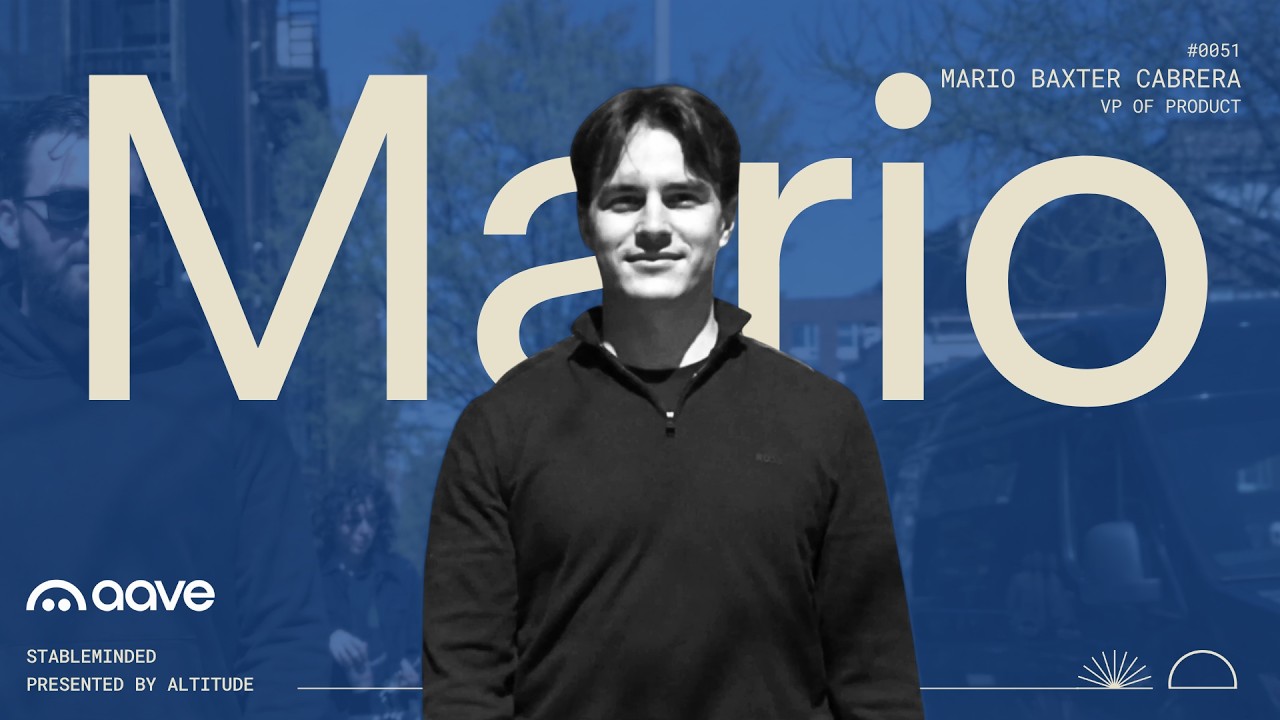
Drew Rogers interviews Mario Cabrera, VP of Product at Aave, about his path from machine learning engineer at Meta to founding the stablecoin savings startup Stable, which was acquired by Aave Labs in 2024. Cabrera discusses the "fintech test" concept (making blockchain-powered apps indistinguishable from traditional fintech), noting that roughly 40 million people use DeFi versus 4 billion who use fintech products, framing mass adoption as a 100x opportunity. He details Aave's product suite—Aave app (consumer savings), Aave Pro, Push (regulated banking connections), and Horizon (real-world asset markets)—along with features like stable rates, multichain vaults, biometric recovery, and balance protection insured up to $1 million per customer. The conversation also covers Aave's history from ETHLend through v2/v3 pooled liquidity to the v4 hub-and-spoke model, plus reflections on founder mentality, equity-driven ownership, and Aave's emphasis on security.
Transcript
41 turns, about 7800 words. Straight from the recording, so it reads like speech.
Mario Cabrera
guest0:01
The total market for DeFi today is not that much larger than it was at the peak of the last bull cycle. And to really reach mass adoption, you're going to have to radically change what the experience looks like. There's 4,000,000,000 people around the world that use fintech products today. There's only our best estimates say there's about 40,000,000 people that use DeFi today. The best way we have of conceptualizing this is what we call the fintech test. And it goes goes very similarly.
You place a user in front of a fintech application, and you ask that user, is this application powered by blockchains or is it not? And if the user isn't able to tell you with any degree of certainty, then it passes the fintech test. So being able to bring DeFi to everybody everybody is is a a 100 x opportunity, and that's what Aave app is doing, and so that's what we're building at Aave.

Drew Rogers
host0:54
Hey. It's Drew. Quick thank you to Altitude for making this episode possible. Altitude is rebuilding business banking for teams on the frontier. They offer the full stack for the modern CFO and founder, a beautifully designed platform for payouts, bill pay, corporate cards, enterprise controls, and so much more. Move money with speed, yield, and total control all from your stablecoin balance. Operate at Altitude. If your business is on the frontier, your finances should be too.
You can learn more at Altitude dot x y z. I'm so excited for this because you are you're in a really exciting moment of your career, of your of your professional journey. I'm excited to dive into, in this conversation, the evolution of you as an entrepreneur and the work that you were doing at Stable and how that's evolved into this new role at Aave. So much that we'll cover here.
Aave seems to me to be, like, one of the most interesting companies in the world of lending and and, like, DeFi growing up and maturing into something that a lot of businesses around the world can actually start getting access to and and building on top of, and we'll get in all that fun stuff. Why don't we start with what your new role is at Ave, and then we can go back into the more of the entrepreneurial journey before that. Sure.
So I joined Ave about seven to eight months ago now, and I joined as director of product. So specifically working on Ollie app, which is our flagship consumer savings application. And we re released a wait list for that late last year during,
Mario Cabrera
guest2:20
DevConnect in Argentina. And since then, we've had a ton of sign ups for the iOS app. We have the Android app that's coming out soon. And then recently, I became VP of product at Aave, so overseeing all products, including Aave app, Aave Pro, Push, which is the regulated side of our business that allows us to connect natively to banks and do bank deposits, withdrawals, KYC, etcetera, as well as a ton of new products that are coming down the pipeline very soon. So exciting.
Drew Rogers
host2:53
We're gonna remember each of those because they all seem to be playing unique roles in the suite of stuff that you guys do. The journey of you entering the business is really interesting. It it's one of the main reasons I was really excited to sit down with you because when we first met, you were building Stable, and it felt to me to be one of the most well designed user experiences around Stablecoins, like extremely simple. And you were you were leading and running that business when we met.
What what was that for those who either either wanna know the story of how Stable in this journey kind of how how did this all unfold? Like, what what's the story of Stable? Or if we wanna even go back farther, maybe that's a better place to start. So I before starting my entrepreneurship journey,
Mario Cabrera
guest3:37
I was a machine learning engineer at Meta, really interested in artificial intelligence, then obviously got really interested in in crypto, and tried to put those two worlds together. So I was briefly for about three or four months exploring how you could bring AI inference and serve decentralized applications. After really investigating, that didn't seem to have as many legs as I thought it did. And so I discovered stablecoins, and I saw that they were growing all over the world, mostly in emerging markets.
And I questioned why are they not growing in the West? Why are they not growing in The US in the same way that they're growing, at least on a consumer basis, across the rest of the world?
And it it really came down to there was not the same need for stablecoins in The US as there was in, say, like, Turkey or Argentina, where you have very high debasement currencies that lose a lot of value against, obviously, the the dollar, but other assets as well, as well as these countries were really in need of better sell settlement financial settlement rails. And in The US, we have great financial settlement rails. I mean, you could Venmo somebody, and it's free, and it happens instantly, and it works great.
And you don't need to hedge against debasement versus the dollar because everybody already holds the dollar. And so the one sort of opening that we saw was when it came to yield. So this was back when interest rates were lower than the DeFi rates. And so the DeFi rates at the time were around six, seven, 8%, whereas the TradFi rates were in the three to 4% range.
And we really thought if we can give the same user experience that somebody has when using a major financial, fintech product today, but just have it be powered by stablecoins and blockchains, Would that make sense? Would that be powerful? And we found quite a bit of success in that. We had a lot of users be really excited about that, and eventually,
Drew Rogers
host5:35
we partnered with Aave and and were acquired last year by by Aave Labs, And now, Stable is sort of reinventing itself as the Aave app. Yeah. Okay. So bring us into the build of Stable. So you guys were working what what were those users getting excited about? Obviously, like, great yield makes everyone excited. What was it about Aave, or what was that relationship like at that time that drew you in to wanna work with them in the first place? So we did an accelerator called
Mario Cabrera
guest6:06
AllianceDow.
Drew Rogers
host6:07
Yeah. You probably It's very Solana. That's a very Solana focused one or is that not true? They Iran runs that. Is that the name? They also love
Mario Cabrera
guest6:16
a ton of other ecosystems. We were building exclusively on top of Abe. So we were the first way you could earn with USCC on Aave across multiple different chains. And so this was a a pretty neat solution. And the guys at Alliance were like, well, have you spoken to Aave? And we said, no. We've no contact at Aave. But we'd love to speak to them. Could you intro us? And so they introduced us to to Aave, and and we started speaking.
The relationship started with a co marketing campaign that we did early on, and and that did well. It was good for for Stable. It got us a lot of users, a lot of traction, a lot of views on on social media. And as time went on, we developed the relationship further. And as we really looked at what it was gonna take to onboard the world to stablecoins and to DeFi, we really realized that it was gonna take
Drew Rogers
host7:14
a ton of resources that we're not gonna get by building Stable alone. And so it made the most sense to partner with somebody like Aave, the largest, longest standing lending protocol out there, take advantage of all of the resource that resources that we could have at our disposal there, and really achieve the most ambitious version of stable possible. So why do you think you were the first to do this?
It's it seems unique to me that, like, you would be the only platform or the first platform at that time to integrate and work with Aave across those chains in that way. Was it tech was there, like, extreme technical hurdles to doing that well? Were people are people just not thinking of Aave in this way? Like, what what was it that made it so unique for you guys to to go to go build it in this way? And is that still the case? Are there now people who are kind of doing the same thing?
Or So what made Stable unique was
Mario Cabrera
guest8:06
the focus on building for a net new user that had never made an on chain transaction in their life. And so the idea was if we could mimic the experience that somebody has when using one of the top fintech applications in The US today and give them higher yield, then that seems like a no brainer.
The the emphasis was always on, let's onboard a net new user, somebody who isn't a crypto native, somebody who's never made an unchanged transaction in their life, and make the experience really mirror what the experience that they're used to from a UX point of view, from a safety point of view, from a value proposition point of view. And, yes, that that's what really made Stable unique.
And there was a lot of really interesting technical stuff that we had to do behind the scene to really make it safe, really make it noncustodial, really make it recoverable.
Drew Rogers
host8:56
So based on the what was the total time from, like, founding to acquisition? If you're able to, like I'm always interested to hear the story of, like, how these acquisitions happen. Like, what was what was the first time how long how long was it from founding to acquisition? And then I'd love to peel back more of, like, the story of how the acquisition happened. Like, what was that like? How did that all go down? Yes. Stable was started,
Mario Cabrera
guest9:23
in early twenty twenty four. And, originally, we were we were just really excited about Stablecoins. And we were exploring a ton of different ideas from remittances to consumer savings. And, eventually, we we landed on consumer savings as, the way that we thought would would be the the the the easiest and and best way to acquire use it, users and and and build a a big business. We did AllianceDAO in early twenty twenty five, and that's when we met Aave.
We then grew stable to, almost 10,000 users, around, 4,500 in average balances. And from speaking to users, we got a sense of what the delta was between what we could deliver at with Stable's resources and what it was gonna take to really onboard the world. And so that is a lot of the work that we've been doing at Aave now that includes a brand new vault system. It includes a a brand new state of the art, like, recovery system that we're building in partnership with Coincover.
It has biometric recovery, a brand new sort of first of its kind balance protection feature where your balances are insured up to, a million dollars per customer. And so all of these thing that really are required for DeFi powered application to really mirror the experience of using a a traditional fintech application were only possible with these expanded resources.
And so all of these things, the vault, meaning you need custom smart contracts, you need multiple audits, this is hundreds of thousands of of dollars to set up the insurance program. That's, you know, hundreds of thousands, millions of dollars. The same with all of the engineering resources to make this a really good design. So we have an internal design system called Aave Glass. It is beautiful to use. You can see it today in in Aave app.
So all of these reasons were why we decided to partner with Aave to build Aave app and then other applications as well. There was a sense of realizing what was possible,
Drew Rogers
host11:27
what was what still needed to be built, and the idea of doing that in partnership with Abe was something that was, like, extremely exciting for you. To go do that with them versus not just as partners, but actually internally as an embedded team, That became a really obvious and attractive option for you, it sounds like. Yeah.
Mario Cabrera
guest11:45
For the past two to three years, I've been really starting with account abstraction, making it easier for everyday people to use crypto has been a real goal and mission of mine to bring the power of blockchains and stablecoins and noncustodial wallets and software to everybody, to the entire world, to people who have never made an unchanged transaction in their life, to people who cannot explain to you how a blockchain system works. I mean, nobody understands how the financial system works under the hood.
Very few people could tell you, and yet everybody uses it. And we wanna do the exact same thing but with blockchains. And the way that best way we have of conceptualizing this is what we call the fintech test. And it's very similar to a relevant topic in artificial intelligence today called the the Turing test. So the Turing test is you place a user in front of a mess messaging application, and you ask that user, are you messaging with a human being or are you messaging with an AI?
If the user can't tell you with any degree of confidence if they're messaging with another human being or an AI, then it passes the Turing test. And we believe that our industry has a very similar test, and we call it the Fintech test. And it goes very similarly. You place a user in front of a Fintech application, and you ask that user, is this app application powered by blockchains or is it not? And if the user isn't able to tell you with any degree of certainty, then it passes the fintech test.
And in many ways, this is what our industry's been working towards since its very inception. It's let's bring the benefits of our new open, transparent, global, permissionless, composable financial system to everybody around the world. And what we're doing with this brand new vault, with the insurance program, with the design language we have, with everything we're building with Aave app, This is really the first time that DeFi and stablecoins are gonna pass the fintech test.
And so I think we're gonna see a real explosion in sort of everyday consumer usage of DeFi and stablecoins with Aave app and the other products that we're building. So exciting. Okay. So give us a little bit of the history for those who are just now getting to know Aave for the first time. So we've gone into the history of stable,
Drew Rogers
host13:57
some of your background. Before we get into, like, all of those things that are next with Aave, give us a little bit of the history of the lending protocol itself, like, the history that it's been through, what have people historically been using Abe for. And it seems like right now we're entering as of we were even talking before this, like, it seems like Abe is entering this kind of new chapter of growth and maturity and going into new places and new institutions.
And but before we go into those things, where has Abe been? What is some of that history that is important to cover for those who might be just getting to know it for the first time? Yeah. So Aave started as,
Mario Cabrera
guest14:33
Ethland, and it was really a pioneer of, peer to peer, lending and borrowing. So back in the day, you could take a loan against your Ethereum as collateral. And over the years, it evolved to Aave v two, v three, and now Aave v four, and it's grown to be the largest, longest standing, most lendee lending protocol out there in in all of DeFi with tens and tens of billions dollars in deposits. And there's a ton of different reasons to use Aave.
There's a ton of different users who decide to deposit and and use their deposits as collateral. These are folks who perhaps want to take out leverage on an Ethereum position. These are folks who potentially have made a lot of money in crypto, and they would like to spend some of those gains without incurring a taxable event. And all of that creates yield for the underlying suppliers. So those would be users of Stable, users of Aave app. They would be able to deposit Stablecoins
Drew Rogers
host15:33
and, in exchange, earn pretty sweet yields that have, historically been significantly higher than what you could have gone in traditional savings accounts. So there's break let's break down a little bit of the kind of the lending and and borrowing side of this. Like, you have a really interesting supply and demand marketplace that you need to facilitate here and both, from my understanding, need to exist in a strength like, place of health and strength.
What are some of these balances that Aave has struck historically? Or, you know, we're we're on Vee. You have different versions of this. Like, help us understand maybe some of those economics and how how this all works, and then also the improvements that continue to be made over time or some of these things that have gotten better over time in those ways. Yeah. So the initial version of Aave or back when it was called ETHLAND was
Mario Cabrera
guest16:25
very much isolated markets. So there was no shared or pooled liquidity, which meant that you really couldn't access the network effects of many, many borrowers and many, many lenders coming together in this network. With v two and v three, Aave introduced a pooled model, which really allowed these network effects to flourish.
And it meant that no matter where the demand for borrowing a certain asset came from, it meant that it could be pooled with demand for, all of the other assets, and therefore create a much deeper liquid lending and borrowing market. That that has its its limits as well because you you perhaps don't want to have all assets in a pool. You you're basically, doing curry curation at the pool level, and you would like to have some more flexibility.
And so that's really what four allows us to have with the hub and spoke model where you can have hubs that centralize all of the liquidity, and you can have spokes that dictate what the collateral is gonna be for a specific loan. And so, therefore, you you can have the best of both worlds. You can have the network effects of pooled liquidity, and you can also have isolated collateral markets. You can build really anything.
You can think of spokes as being this, like, Turing complete, like, maximally expressive lending primitive where you could have qualified custodians with off chain collateral, take loans on Aave. You could have LP tokens from Uniswap be used as collateral and take a loan against those tokens.
Drew Rogers
host18:06
It's really this, like, really the the north star end model for what on chain lending should look like. Yeah. So I wanna get into the app side of this, and I know that's something that you really are personally involved with. As we think about the individual or the business at the end of this who is maybe making that decision of, like, I know I need to be earning money on my money. Where do I go to do that?
What does that look like today in the current experience of Aave or the app versus what you were kind of inferring was coming next or how you're thinking about the future? You're growing the team a lot on the BD side. Like, what is that experience today versus, you know, in one, two, five years from now? The experience that you're really going into in more of this, like, embedded version that we were discussing. Like, give us the the current moment versus where you guys might be heading into the future. Yeah. So the
Mario Cabrera
guest18:59
the total market for DeFi today is not that much larger than it was at the peak of the last bull cycle. And that is because there's really a negligible amount of net new users. And that is because the experience has remained the same. It is this narrow set of very highly technical, very early adopters that are really passionate and excited about the world of non custodial software and permissionless markets. People listening to this conversation probably. A lot of the people listening to this conversation. Yeah.
And there's really only so many people that fit in that bucket. And to really reach mass adoption, you're going to have to, like, radically change what the experience looks like for using these products. And that's what Aave app is doing. That is what Aave Pro will do and eventually in subsequent versions as well. And
Drew Rogers
host19:53
What is the pro is the more, like, enterprise institutional version? Or So Aave Pro is the interface,
Mario Cabrera
guest20:00
that wraps, Aave v four, which is our new improved version of the underlying lending protocol. And it has a a brand new interface, that, you know, just looks a lot cleaner, looks a lot sleeker, and will have a lot more functionality built built into it that is only enabled by the v four and all of the the things that that that's gonna bring.
But really, the the TAM for this, for Aave app and and and and interfaces that are able to pass this fintech test that we call that that we spoke about earlier is, like, the world. 8,000,000,000 people. That is you know, there's there's there's 4,000,000,000 people around the world that use fintech products today. There's only about our best estimates say there's about 40,000,000 people that use DeFi today. So being able to bring DeFi to everybody is a 100 x opportunity.
Drew Rogers
host20:54
And so that's what that's what we're building at Olli. So so today, we're currently in this state where, like, those who might be using this dashboard, this application, people who are in the industry, working in the industry, maybe they're crypto native and wealthy because of that. They've been involved very early in some of these protocols. They know how they work.
They are convicted about this stuff, and they're willing to go through those user experience hurdles that typically get in the way that prevent most people from from getting there. So that's what's currently happening. What are some of these are what are some of the things in your guys' minds that get you excited of, like, hey. There's gonna be a guy in in Saint Louis who's running a mid market commercial business.
He's gonna be getting a small business loan through his payment search dashboard, and that is gonna be powered by this like, give us a few of these examples that are just kind of simple and how the how you're gonna go from the current x to 99 more. Like, what are some of those kind of tail end ones where they start to feel really familiar where Aave can kind of implant and embed into those situations? Yeah. So I can speak, best about Aave app. That's what I've been spending most of my time on.
But it's I think it's it's less clear the benefit immediately by,
Mario Cabrera
guest22:11
you know, just looking at it, you and I, because we're residents in The United States, and we have great access to financial products. But being able to bring the benefits of Aave and safe high yields to everybody around the world, allowing them to spend in their local currencies, allowing them to hold US dollars, earn a high yield on US dollars in a way that is safe.
That's not just at the protocol level with Aave, but at the recovery level with being able to always recover your account no matter if you lose your password, if you lose your phone. I mean, building around noncustodial software is really tough, and there should be no place, there should be no sort of, like, hole in that experience, in that journey, where a user cannot look under their account. And so that's one of the things we've burnt we we worked really hard on.
And being able to demonstrate that to users is one of the things that is gonna allow them to feel really comfortable using something like Ova app. The balance protection feature, also massive. One of the biggest questions when somebody is thinking about using a brand new financial product is is this thing safe? Right? I've never heard of this before. What is this? How can I how can I know that it's safe?
And so with balance protection, we're literally putting our our money where our mouth is, and we're saying we're backing this with everything we've got. This is this is built to endure. This is built for you to save for your mortgage or built for saving for your kid's education. Yeah. So we're we're building Ave app starting with the savings application, then we'll be adding in other features like a card. You'll be able to earn up until the point at which you spend.
So that that'll be pretty pretty excited about Aave card for the future. Stablecoin There's involved in this as well. I understand correctly. Right? Is that gonna be attached to this card strategy too? Or how does that work? So Aave app will work with all major stablecoins. So that's that's one of the really cool features about this brand new vault is no matter what major stablecoin you have, you deposit that into the Aave app vault and you will get vault shares shares in return.
So you could deposit USDC, USDT, GO, etcetera. Any major stablecoin, you will receive Vault shares in return. When you go to spend with your card, all that will happen from, like, a flow of funds perspective, as in the debit card situation, your funds will be debited from your account. They'll be converted you'll convert your shares into stable coins. They'll be those will be settled with the merchant, and payment will be successful. You'll you'll buy your partners or service.
And in the event of a credit card, you will settle with the merchant instantly. You will be able to take a loan out using Aave from your Aave app vault balance and you'll be able to pay that back in, you know, in this settlement period of time three weeks from now. You'll And be able to continue earning up until the point at which you need to pay that
Drew Rogers
host25:07
statement back, which is a pretty neat feature. Yeah. Super interesting. We were meeting with the Moto team, Shimon, who's building that business and they're thinking through something really similar. I think something like that gets me really excited in terms of like practical practical adoption. Like in that settlement delay, earning earning in that window of time to offset spending, things like that are really, really interesting.
What are when you think about this, even when you're speaking about the design challenges that you you faced building stable, the fintech test, like, I can just tell that you are someone who really, really deeply cares about the user experience and and the way that design plays into that user experience. Where do you find right now as you're building the app or building just in in today's market, given the constraints that we still have building financial products on chain?
What are some of these key areas that are very top of mind for you around designing products that don't feel on chain native? Like, how are you currently thinking about some of these challenges? What are some solutions that you're finding are working? You know, you you obviously did that really successfully at Stable on the more, like, retail product side with the retail app. How are you now bringing that sort of design forwardness into, yeah, the scale challenges that Aave has? Yeah. So Aave app is a
Mario Cabrera
guest26:25
much more ambitious version of what we were building at Stable. Like, much, much, much more ambitious. And that came from speaking to the users at Stable and figuring out specifically speaking to the folks who were net new users and asking them, you know, you signed up. You did that deposit. Why was that? Or, you deposited and then you withdrew. Why was that? And really understanding what worked and what didn't work. And a few things that didn't work were, for example, variable rates.
Variable rates are extremely confusing to everyday people, and they simply don't fit the mental model of a traditional savings application they have. If they're using any major savings applications today, they're earning maybe 3%, 3.5%. It's a nice round number. And It doesn't seem as risky. It doesn't It is what it is. It is what it is. It allows you to predict how much it's gonna grow six, twelve, twenty four months from now. And in DeFi, you have these rates where it'll be eight percent one day.
It'll be, like, 4% the next day, 3%, 5%. And one, it just doesn't fit the mental model. And two, it it doesn't allow them to really project. One common question we had as well was if the rates are this variable, like, could they ever be negative? And we got that we got that a lot. And so what we're doing with Aave app to fix this is we're giving users stable rates. And so at the vault level, you'll be able to program per user what their rate is.
And so this is important from the stable rate perspective that mirrors what TradFi applications are giving their users, but it also helps from a, user incentives point of view because you're able to reward users for referring friends, for setting up automated deposits, for performing any in app actions that would constitute a a reward in the form of APY. So one of the things that we had to fix was these variable rates.
Another thing we had to fix was the ability to be multichain, and we also fixed this with the brand new Aave app Vault. And the reason multichain is important from a UX perspective is you want user fees, user gas fees to be completely abstracted away from the user. So you want the application to sponsor those. The issue is the chains where gas is efficient, the pools of liquidity are not that deep. And so you want to somehow get the best of both worlds.
You want to be able to deploy and accept user deposits and withdrawals on gas efficient chains and not have that cost the company a ton of money. But then you also don't wanna become a victim of your own success in the event that you do attract billions and billions of dollars in deposits, and you end up moving the market where you deployed that vault.
And so the, the gold standard for what these vaults should look like for consumer savings is you're able to accept deposits in a gas efficient chain, and you're able to route those deposits anywhere where Aave is deployed. So it could be Ethereum main net, billions and billions and billions of dollars of stablecoin liquidity there. We're able to go to any other chain that launches recently and take advantage of any incentive programs that they may have to help maximize the user's APY.
So a lot of these benefits come from the Vault layer, and that's one of the things that we've been investing a lot of time and a lot of resources at over the past five to six months. Other features are super important for onboarding everyday users. We've touched on them such as the balance protection feature, the the recovery feature, making it feel like, you know, you're you're you're not recovering a noncustodial wallet, but you're just recovering a regular account at any other fintech that you ever had.
So these these are some of the problem we've been tackling. I was talking to another founder founder who's passing the fintech test in the consumer, like, stablecoin space. The conviction he had was, like, we actually need to educate
Drew Rogers
host30:26
our users more on where this shield is coming from and the kind of origins of where how how it's all working. And originally, knowing him, he was building the app where a lot of that stuff was, like, behind the scenes. It was super simple, super clean. And one of the realizations was, we actually want to expose and go a bit deeper into, like, educating our users on some of those nuances of, like, this protocol versus that and the nuances of these vaults and how they're curated or managed or whatever.
Where do you fall within the, like, showing how the sausage is made a little to users, and how are you thinking about that without making it overly complex or overly intimidating?
Mario Cabrera
guest31:07
Any thoughts on that from, a design standpoint? Yeah. My my read on that is that the experience is probably not mirroring close enough the experience that users have when using a traditional savings account. If a user feels a need to learn more and they feel like they're not getting enough, there's something missing at the product level. And it's more information for the user is not gonna help. It's if anything, for the average user, it's gonna confuse them more.
And so the solution is really gonna be to identify what the points of friction are, what doesn't make sense, what does not mirror what, average, TradFi savings accounts offer and try and just attack those from first principles as opposed to overly explaining what's happening. I think that that's that's the right approach. And
Drew Rogers
host31:58
So so it sounds like if users are asking that or or feeling that way, there's maybe, like, an up stream there there may be something broken upstream or or something that needs to be fixed from, a trust or user standpoint, it sounds like. Exactly. Yeah. How are you guys approaching that internally right now? Like, how are you thinking about education going from one to 99? Like, what are some of these growth levers that you guys are thinking through? I know you're hiring more people on that side of things. Yeah.
Bring us bring us in a little bit to the growth side of this and what people can expect or what institutions can expect in the next, like, twelve months from the team? So from the,
Mario Cabrera
guest32:37
institutional side, we, last year, launched, Ave Horizon, which is our real world asset market. It's built on on top of v three, or it's really a clone of the v three markets on Ethereum mainnet today. And it allows folks to post real world assets as collateral and borrow stablecoins. And so this has a number of different use cases today. It allows people to loop their real world assets. It allows folks to access liquidity on real world assets that would otherwise have illiquidity off chain.
And so it's really a glimpse at what the future of real world assets and lending markets looks like. With AAVE v four, it is really tailor built towards, you know, the capabilities of real world assets on lending markets. And so with AAVE v four, we also have the hub and hub and spoke model. So that will allow for a lot more long tail assets of real world assets to also be listed and not impact the overall risk profile of, say, like, the safer, more prime hubs.
And then on the you mentioned growth on the growth side for consumers, for example, where we have, a very, I think, unique social media strategy when it comes to the DeFi space. Most crypto companies do not have, I would say, a social media profile that is, you know, that that, attractive to everyday. What does it mean for people who don't know who don't follow Aava yet? What do you mean by that?
We have just a really good amount of content that is really understandable and engaging and just really well produced content. We have our main channel, which is we have this, smart money series. It takes you through the history of of money starting with ancient civilizations, and then and then with, like, the gold standard and fiat and and then crypto. And it's just really well produced, really short snippets, really well made for reels or shorts or TikTok.
And, then we have these other podcast series that we're launching. It's it's really tailored not just to crypto people, but really for the same audience that all the app is targeting, which is everyday people, people who are just interested in money. This is just money. This is just yield. This is just, you know, lending and borrowing. It's no different than what you're doing with major fintech product today. It's the same thing. It's just the the back end is different.
Back end is powered by blockchains, and that allows you to have all of these benefits of composability, a global access, twenty four seven,
Drew Rogers
host35:16
access. And the team has been doing a really good job on the social media front. It's been so as we round here, round the corner, eight months into the role, what has been something unexpected that that has happened since being in seat that you didn't really see coming, but you're really grateful for it? Like, something that you didn't really know you were getting into, but you now look back and you're like, yeah. I'm really I'm really grateful that we're going through this or we're seeing this or building this.
It can be it can be a big decision to sell sell a company or, like, be acquired or also a lot of people don't talk talk about the idea of, it's exciting to sell a company, but it's also, like, it comes with a ton of letting go of a lot. And there's a lot of decision that probably went into you deciding that that was a good idea and and putting yourself in the position of like, no, I'm not a founder anymore. I still I still have ownership.
I still have the ability to drive this forward, but there there comes a lot of open handedness as you enter into a role like this for eight months. So what has what has that been like, maybe compared to what you expected for for better or worse? Or how's it been going? Yeah. I would say that being a founder is is, it's it's almost like a mentality,
Mario Cabrera
guest36:23
and it's an energy you bring. And it's a a drive and a sense of a direction and speed. And we have been the entire Stable team has been mirroring that inside of Aave, and I think that that's been that's been really awesome. You mentioned, like, what's one thing that's was a little unexpected. At Stable, we were fully focused on speed. You have to be as a startup. Aave is also super, super, super focused on speed, but they have an extreme focus on security as well.
You do not become the largest and most successful lending protocol out there by not taking securities seriously. The amount of audits that go into everything we do, not just smart contracts, but back end and front end and infrastructure, everything. Everything is battled down and has continuous audits going all the time. And I've never seen anything like it. That's been really surprising on the upside, just the the the emphasis on security.
Why do you why do you think more internal employees don't have that sort of founder
Drew Rogers
host37:24
mode direction? It sounds like you you guys, the team who's been coming into the fold with Abe, you guys have been able to keep that sense of speed ownership direction. Why why isn't that as common for internal employees or internal leaders? Like, what is unique about that, and why why don't you see that as much? When you start a company and you have a burn rate It's all on you. You
Mario Cabrera
guest37:47
have a death day, and you have to build something or die. So that pressure motivates you and really makes you you have no choice but to just go 100%. And if you're if you've never been in that position, it's tough to understand why the heat is is important. And it's really the the pressure of, you know, if I don't make it, I'm not going to build something that people love, then this thing is gonna die, and I'm gonna have to start all over again.
And if you haven't gone through that experience, I think it's it's tough for for people to just naturally follow the same principles
Drew Rogers
host38:28
that you would have to follow as a founder. That feeling felt most intensely during the stable journey? When when was that, like, sense, like, in your entrepreneurial journey pre Abe, like, when was that feeling of pressure?
Mario Cabrera
guest38:42
When when was that felt most? I think we were we were doing we were doing a really big rewrite at Stable of the entire code base. And we were migrating basically from Swift to be based on React Native. And it was a really tough decision because on the one hand, you had existing users and you had people who relied on your platform and were begging for more and more features and expanded functionality.
And you had to basically make a decision of I'm going to take the short term pain of not shipping new features, not going as fast on the iteration front, but solving for this longer term benefit of having cross platform system of being able to support both users on iOS and Android. It makes recruiting a lot easier. There's very few iOS engineers that are really good at blockchain, whereas that's less of the case in React Native.
This is mostly a legacy reason because crypto applications were mostly web based until recently. And so a lot of the talent is based amongst the React engineers.
Drew Rogers
host39:49
What was so hard about that? Just the the delay of shipping products? Or were users starting to leave or what was the impact of that? Well, you're it's a competitive space and you're only as good as your last product. And you have to make this tough decision where you may sacrifice a little bit of short term growth for more sustainable long term growth. And when you have a burn, then that is that can be stressful.
I've really loved the idea of, like because when when we're building our team right now and we're looking for people to bring into our business, it's it's hard to put your finger on it, but you kind of want that everyone needs to have that feeling of ownership over something. A direct relationship to, like, that feeling of burn or that feeling of, like, if this goes well, then I'm personally doing great, or if this doesn't go well, like, I'm personally at risk.
Having that at an individual employee basis is something that I'm thinking about right now as a leader. It's like, how can I give all of our team that? Is that something that you've found in the AAVE fold? Is something that you're continuing to realize is actually a a way that you guys are measured? And it's cool how you can kind of bring the same literally bringing stable into this new thing. You're building that. You're leading that. Your success is measured by that. Is that where that comes from?
Do you think that's that's why that continues to be felt? There's a pride in, like, hey. We wanna see what we've originally built continue to be successful. That's definitely the case for me. I think that just in in general, I think being extremely generous
Mario Cabrera
guest41:22
with equity and sharing the upside with the rest of the folks in the business is extremely important. You want them to feel the same fire that you feel. You want them to understand the problem that they're solving the same way that you understand it. You want them to share the same financial upside or similar financial upside as you will have if the business is successful.
Drew Rogers
host41:45
And so really unifying everybody towards the same mission with equity is super, super, super powerful. Last question. Twelve months from now, you are still leading product. V four is cooking. It's doing great. What what would you say is, like, when you think about what success means to you personally a year from now, what does that look like, and how are you trying to measure that with the team? We need to get net new users, whether that is consumers with our app, whether that is institutions
Mario Cabrera
guest42:12
with everything we're doing on the BD side and everything we're doing with cuss you can do with custom spokes. DeFi needs an a net new source of capital, and we're exploring all of the different areas there. We're on the frontier of acquiring new capital. And twelve months from now, I think Aave app is gonna be a huge success. I think we're gonna onboard hundreds of thousands of net new consumers.
And with, all of the BD work we're doing and all the institutional work we're doing with v four, we're get we're gonna have billion billions of dollars in net new capital that otherwise wouldn't find a home anywhere else in DeFi. On the frontier. Perfect place to end. Mario, thank you for the time. Really appreciate your time today. This was fun. Thank you. Happy to be here.