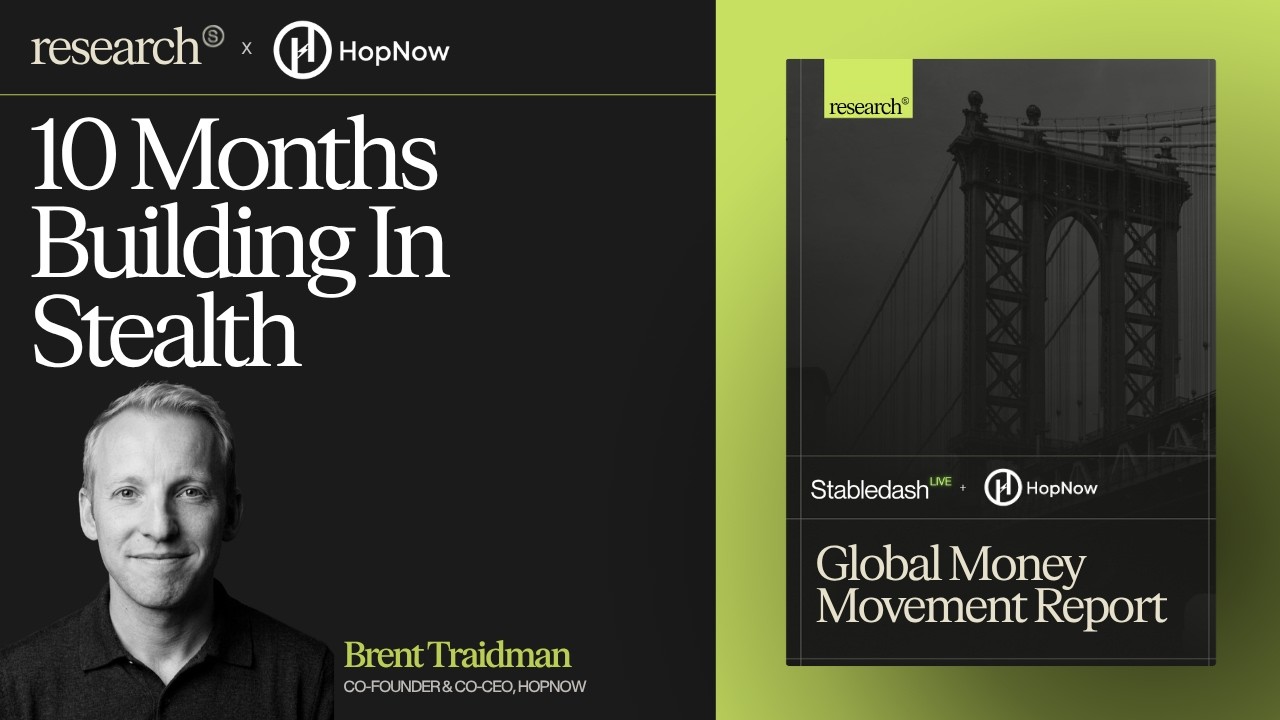
Brent Traidman discusses HopNow, a B2B global financial infrastructure startup emerging from stealth after roughly ten months of building, in what he describes as one of its first public appearances. He details his background—co-founding Bitcoin wallet company Bread Wallet (BRD), which sold to Coinbase in 2021, plus roles at Anchorage Digital and Vista Equity Partners—and describes HopNow's platform combining FX, stablecoins, liquidity, virtual/bank accounts, and compliance to help businesses move money across borders. He explains the company targets fintechs, PSPs, remittance companies, neobanks, and import/export firms across Latin America, Africa, and Southeast Asia, emphasizing process-driven, disciplined focus on specific corridors and fast onboarding (within a day or two). Traidman notes the team plans to attend a stablecoin conference in Mexico City and cites the founding team's experience (Coinbase, Anchorage, Stripe, Uber, Goldman Sachs) as his primary reason for joining.
Transcript
23 turns, about 4700 words. Straight from the recording, so it reads like speech.
S0
0:00
We're pumped to to showcase Hop Now, tell the story, profile you guys a little bit. I think I was saying this, is this the first kind of time someone has publicly talked about Hop Now, or has John or anyone else gone on any pods before? Do you know? This this might be the first time
Brent Traidman
guest0:15
on something live, for sure. Okay. We've been pretty quiet. We were in stealth for a while. So our team was busy building for the past, I'd say, ten months, and now we are we're gonna be a little more out there. And for instance, we're gonna go to,

Zach Fowler
host0:31
you know, get all the founders together this weekend, go to a stablecoin conference. Kind of getting out there is is Yeah. Is really what we're doing right now. Yep. Love it. So help us lay the ground level. And we haven't you know, we've also talked to some early stage founders. You you sit in this really interesting position where you're definitely not new to this space in any way, shape, or form. You know, you've put your time in Anchorage and Coinbase.
Brent Traidman
guest0:51
But maybe help us understand, you know, where you were at, what your position was at both those firms. But then especially, like, what does the time building in Stealth look and and feel like? Yeah. This is a different founding team for sure. We are what's unique, this is not my first startup. My last startup was a company called Bread Wallet, b r d, where my brother and I had a company. Actually the first Bitcoin wallet back in 2014, 2015. That's kinda how we got started. That's my my background with start ups.
Prior to that, I was a venture partner at a VC doing investments. I was also on the other side of the table, really, and but very entrepreneurial. So I kind of got my first foray. You know, I I heard everything going on in San Francisco while I was living there, and it's, you know, got into crypto very early. We ended up selling that company to Coinbase in 2021 during the the last big run up, right before the winter there. So for me, this isn't my first start up.
The team who has a great pedigree makes us very unique, for sure. While we built in stealth, we knew what success looked like. Our team has worked at Coinbase, Anchorage Digital, Stripe, Uber, know what a real company should be, and we're not first time founders, you know, and, you know Yep. Junior founders. So we've been around the block for a while, and what was interesting this time around is that when, you know, ten, fifteen years ago, when you're doing a crypto startup, was tough to fundraise. Now Yeah.
A little bit the opposite, I'd say.
This is a white hot market, and we're general fintech at this point, so stablecoins, as we'll talk about, is is part of that mechanism, but as you build kind of itself, you use those things you've learned over the years, right, and my team, what they built at Stripe, and Goldman Sachs, and Uber, just like how to do it the right way, and create the right foundation takes time, before you go out into the market and have people testing your product, you want to make sure it's right, and it works well. Mhmm.
So that's what's kept us busy for a little bit. Brent, I wanna we wanna dive into, like, specifically Hop Now in the current moment, but, like, as you've shared, this is not your first rodeo in the kind of startup startup
S0
2:59
moment and building, like, an early founding team. It I'd love your thoughts on this current moment versus what you've seen as you've built startups in the past. It seems like we're in this very unique moment in time where, like yeah. How do you how do you compare and contrast what it feels like being in the kind of founding foxhole of HopNow versus what you and Adam were doing at Red Wallet? Like, what's how does that feel if
Brent Traidman
guest3:24
how would you compare the market now to what that was like back then? Gosh. I mean, the it's completely changed. I mean, if you would have told me ten years ago that things like stablecoins would be discussed on a daily basis on CNBC, and companies would be using them as a operational tool, I wouldn't have really thought that would be possible so quickly, and that even, you know, there's legislation, there's laws around the risk and compliance.
That is exactly what we had planned ten years ago, and I'm just like, you know, thankful everybody did that in the industry. Now it's bleeding into general fintech to a point where it's like wildfire. So the total addressable market is ridiculously large now, where if you're just in a crypto spot or just in a nuanced fintech spot, it's very finite.
What we're focusing on at HopNow is, you know, a global business, a global financial infrastructure system, moving money across borders is much larger than just one thing, like one asset in crypto. So for us, I think making that having that larger addressable market makes it much more compelling. Number one, you could find thousands and thousands of target clients and partners, and it's endless.
I mean, the geos, the spaces that we're focusing on, it could be overwhelming at times when it's like, do we focus on today? Do we focus on Africa, Southeast Asia? We want to solve all these problems, but we have to do it very process driven, and do it in a way where we're helping those companies build, and then we go on to the next one. And we look at companies like, you know, Stripe, and how they kind of did this many years ago with the digital economy.
They worked with startups and medium sized businesses, made it easier for those businesses to just interact with the digital economy. That is what we experienced as part of our team, and I experienced at Coinbase and Anchorage, how do you build trust and compliance, and make everybody, you know, work with these types of products in the main financial mainstream? That's kind of the bridge that we're helping out with Mhmm. In that regard.
So I'd say the addressable market is much larger than it was for something like stablecoins, and I think we're looking at it more of, like, internal tooling. It's more table stakes at this point, like, should be using stablecoins, and that is what's different today is that more companies are just completely open to exploring this, where five years ago when I was at Coinbase, there were a lot of window shoppers, and they, you know, Fortune one hundreds would call us. They'd bring on 20 people to a call.
But why are we talking why are we talking to this beverage company? Oh, because they move billions of dollars a day from this country to this country, and they're doing very early exploration. Is there a better way to do this? Because it takes thirty days to get the money across the border, we're losing 5%, there's a better way. And now, five years later,
Zach Fowler
host6:03
they're actually doing some action. So that's what's why timing is good right now. Brent, so the seems Go ahead, Zach. I was gonna say, so when you think about the verticals you serve, and I can even I remember experiencing this in my my last startup where I was just like, yeah. You're right. This TAM is so big, but I feel like if I start speaking to everybody, I'm speaking to no one. How do you balance that?
The TAM is so big, but, hey, we have to find, like, these two or three core verticals to to go out, win, build up some really strong case studies. What's that experience been like, and kinda where are you starting to see maybe some signs of product market fit? Sure. Yeah. Let me just I'll take a step back and talk about just, you know, why we created HopNow, because I think that's part of what I will explain to answer that question.
We created HopNow with one belief, in that every business should be able to access this global financial infrastructure
Brent Traidman
guest6:55
without having the friction of building the same network, the same banking relationships, the same local access in every country, solving those complexities from scratch. And I I saw it multiple times, and so did my cofounders, where every startup, whether they were coming out of Y Combinator or popping up in some part of the world, they had to do this from scratch every time.
And for us, the opportunity was, alright, how do we build this comprehensive platform that does FX, which is, you know, currency trading, table points, liquidity, you gotta have deep liquidity, bank accounts or virtual accounts, compliance, and connectivity around all those things in a very thoughtful way, where speed is critical, execution and is critical, and customer service is critical. That is one platform. Nothing existed. Right? And that's why we built HopNow. So that's the first thing.
The second piece, to answer your question, is you're right. And I experienced this when I was at a private equity company about ten years ago. I worked for Vista Equity Partners. I was an operator. So like a head of sales, VP of sales at these different portfolio companies. At the end of the day, Zach, it's process driven sales, that doesn't change.
And if you have the right process where you nail one geo, you nail one vertical, don't leave that vertical if you're still doing well before you get distracted, and go to another vertical or another geo. When I was at Coinbase, we experienced this publicly, where we went into many too many geos at once, and we failed in some of these geos, and we had to retract. Wasted all that time, wasted all that money, and we didn't nail one country before we moved on.
And I think we take that that learning, but I also learned that, as I mentioned at the private equity company that really taught me process driven growth and sales, is that, yes, you can get distracted. You get an inbound from some country you've never talked to, or or, you know, somebody in this currency that you don't support today, and you wanna solve their problems because it's it's right at your front door. Yeah. But it takes strength to say, hey, you know what? We're not there yet.
We're gonna talk to you when we're ready, and we're ready to serve you, but right now, this is what we do. So right now, you know, there's certain geos and certain corridors that have billions of dollars of flow every day, and if we nail those corridors and nail those verticals, then we that gives us the right to move on to another one.
Zach Fowler
host9:01
Oh, the the right to move on. That's that's strong. I'd steal that. I also think, like you said, from an entrepreneurial, like, philosophy standpoint, there there is, like, a huge power being to stay being able to just sit stayed say no even if you may there may be some short term gain and and low hanging fruit. But, Drew, it looked like you were about to to say something. Yeah. Yeah. 100%.
S0
9:24
I wanted to dive into the specific pain or the specific issues that maybe, Brent, you personally saw that that HopNow is is solving that I think you, just knowing your background a little bit, you had a lot of you had many opportunities, I think, to go and devote your time and your energy and your focus to a ton of different early companies and early problems. I'm wondering what about the kind of the fragmentation banking issue, local market access stuff.
Like, what what about that with HopNow was uniquely attractive to you personally? Or maybe speak a little bit about to the the the true, like, pain that you see in the market that Hop Now is covering. Yeah. First, when we when we worked at companies like Anchorage and Coinbase,
Brent Traidman
guest10:07
we ran into a lot of the same problems where those companies happen to be primarily US focused, would say, and then there's geos in Latin America, Africa, Southeast Asia that didn't have access, is how I would explain it. So when we set out for HopNow, we we said, okay. All of these companies keep coming to us, but we don't have a way to fix their problem.
Their problem is they need something like virtual accounts, or they need a bank account and they can't get one, or they need access to USD and they can't get it, or they're having a really hard time getting it because they come from a country that doesn't have access. So I I think about the same thing, you know, that some of these digital asset companies are saying. It's like, you wanna wanna expand access to everybody.
We're doing that on the b to b side, where we're connecting our experiences with that common idea of expanding access. That's what we're solving for. I'd say one of the pain points I hear often on calls in, you know, every day is, yes, I want another bank account, or I want another liquidity provider, or I need more because I don't have enough. Or I'm having trouble onboarding somewhere, and help me.
And maybe they're an early stage startup or medium sized business, but this is still a complex web of kind of point solutions that they've kind of pieced together, and they need more of a comprehensive solution. And that's what we're building at Hotmail. Where do you where do you see next steps happening? Like, you guys are you're getting louder.
S0
11:32
You're I I think I was gonna ask if I could show the website. I think the website's getting updated. You're kind of you're you're getting louder. We have some exciting stuff we'll we'll talk more about later on the research series that we're doing. But, yeah, where where are you guys focused right now from a go to market? Who are you wanting to talk to? Who who what kind of companies are you really trying to reach right now? How are you thinking about the the short term future here? Yeah.
We we focus on maybe three different areas of the world right now,
Brent Traidman
guest11:59
those areas which are emerging markets that need access. When you think about a company, it's funny. When you go to, like, I used to go to Y Combinator when I was a venture partner at a at a VC in San Jose. And I would sit on the other side, and all these companies would pitch. And at that time, it was, like, you know, Coinbase and these guys, right, and Airbnb. But now it's remittance companies or fintech providers that serve Africa and LatAm, and the list goes on and on.
You could see all these companies coming out of YC. They're solving problems in their own country where import export has problems getting bank accounts, sending money over borders. They just wanna they just wanna get in the global economy at the end of the day.
So these verticals we're focusing right now are, I'd say, in three main geos, LatAm, Africa, Southeast Asia, that are very advanced when it comes to using things like Sablecoins, and very advanced at sending money across borders, because it's part of their economy, and that's what they do.
So these the verticals are fintechs, PSPs, remittance companies, which could have a b to c app, or a b to b app, where they're sending, they've you got merchants, or they've got consumers sending money back home via Pakistan to Dubai, and back and forth, or UAE, different corridors. And those are great types of clients, because we work with their treasury teams, and we do portfolio management with them, settlement, and optimize their current treasury operations, so those are great for us.
We help them with virtual accounts, we help them with FX experience, and just help them have access. The most of the time, there has to be a cross border component. If they say, hey, I'm a US company, I'm only working in The US, we're going to go outside of The US at some point, that's when they need our help. But most of the companies we're working with right now, as I mentioned, fintechs, I mean, some are neo banks, payroll companies, employment of record companies. We're looking at importexport freight.
That's a huge addressable market with a lot of pain right now, where stablecoins and and quick money movement is solving those problems. There's a massive addressable market. So those are those are the verticals we mostly focus on, but I'd say the the discipline to stay in those verticals is what we're we're trying to do because we get some that are outside of those, and we have to figure out if it's a right fit or not for both of us. Yeah. It's hard. The dis the rails
S0
14:12
that's something we see a lot is, like, the stack and the rails are very similar in terms of maybe the pairs of currencies or the infrastructure behind the scenes that is able to be utilized. But what what we have actually seen or what I've seen personally is, like, companies that try to okay. I like the way you're talking about it because companies who try to do so much or try to appeal to so many use cases can actually really dilute or confuse the end buyer of, like, what they do best.
We've started to see companies be become really opinionated about, like I think specifically some some of the ones that come to mind are, like, companies that are really trying to resonate with, like, the trade finance use case, for example, or even specific geographies, like, going after specific institutions Yeah. In those places just to really try to build resonance and depth. I think that's, like, for me personally, where I I have a lot of passion around startups who are trying to because it's it's a hard thing.
Like, you're trying to build. You're trying to get volume up. You're trying to close deals. You're trying to not limit also limit yourselves to what's possible, but being really opinionated on those few use cases, I think early on is really key. And it seems like the thread for you guys that's that's kind of threading through all of it is that kind of local market banking fragmentation access where moving money in and out of USD into these, like, local fiat currencies is a is gonna be a core competency.
Would you would you say that's kind of the the thread?
Brent Traidman
guest15:42
Yeah. I would. I would say we're getting much better at getting into those strategic conversations. We get really strategic with our partners, and they onboard, and we kinda get to know their business, and we try to optimize with them. I think when you know, sometimes it could be very confusing in this space. I mean, I've looked at, I can't tell you how many websites you guys probably do, where it's like, hey, what exactly do they do? You explained it to me. We've never said that. Global money movement. Right.
Money faster. In one sentence, what do you do? Right. Yeah. That's it's difficult for some of these companies. I usually kind of start off with, are you in the flow of funds, are you not? Right? Are you touching money, or are you are you purely software? You know, are are you licensed? Are you not licensed? Are you getting licenses? What's the vision of kind of where what are you building? Usually, And the companies we talk to, they don't want a provider like a point solution, where they're in and they're out.
They want somebody they can partner with for the long term. So they get into, what are you building in the future? What are where do you see this market going? Do you have the expertise to get me there? Because I could go talk to 20 different companies. I want people that are gonna be like advisers for me. Yeah. Strategic advisers that have done this for
S0
16:48
Like, how do you when you ask that question, I feel like that's such a key one in the discovery process of like, are you touching funds, or are you not touching funds? Like, when you ask that, what like, bring us a little bit into why you're asking that question, and how that might change how you proceed with
Brent Traidman
guest17:04
prospect. Clarity It gives on exactly what they're selling, because it's hard to glean that on a website, Number one, you know, it's a general fintech. Okay, well, but then they have an OTC, or they do this, or they, you know, use another fintech provider under the hood to solve something, but then do they is it their own technology, or is it somebody else's? Do they have a bank underlying?
The the reality is you still have to have, like, you know, bank partners, and you have this is the the the recipe for building these is it's not just one thing. You have to have the partner distribution channel, and partnerships, and strategic partners, and alliances, at every different country down to, like, you know, the local pay ins and payouts, and all of those nuances.
That's why it's so hard to build, and it takes a lot of time, where the good news is our team has done that before at other companies, and they know how to build. The second thing is you could, to your point, get really distracted if you have very minimal functionality in certain countries, or you get disqualified when they're like, oh, you don't touch money. Well, we're not even there yet to build our own thing. We really need help, because we need you to actually send us the funds, or do the actual FX for us.
So that's where the early discovery is critical, and the more those clients and partners can kinda just throw it out on the table, it's better for everybody to see, like, alright, here's where we can help you, and we start in one area, and then we build over time. So Yeah. Like, what's the lowest what's the lowest hanging fruit where we can just provide value day one with you, and then we build on top of that after we get more strategic. Where where do you see that, like, lowest hanging fruit?
Like, right now, if someone's listening to this, they're builder. Know. Yeah. Like, what what does that typically look like, or what do you want that to look like? What are some of those, like, really simple,
S0
18:46
let's get off of zero. Here's what first base looks like. What does that look like with HopNow?
Brent Traidman
guest18:51
Yeah. I'd say maybe two different things. Number one, how easy is it to onboard with HopNow? Number one, I have you know, you've probably experienced this in your life. I know you have, right, where these companies Hopefully easier than opening a Coinbase institutional account in 2020. Pick on anybody. Too. Yeah. I asked. You know, whenever we open a bank account, we say, describe to me the process for opening an account. Right? What is the expectation? And we can onboard folks within a day or two, which is great.
We've got we're using behind the scenes tooling now, technology that wasn't around a couple years ago that our team knows how to use, and then we can delightfully onboard a client very quickly. That's number one. Is it gonna be hard to work with us? Is number one. And the answer is no, because we can onboard quickly. Once you get on, you could do really there's two easy kind of layups in just getting folks value. Number one is, do you need virtual accounts? Do you need access to fiat?
USD, euro, pounds, Singapore Dollars, whatever it is. We have the rails, and we can once you're onboarded to us, we can onboard you to one of our strategic partners. That's great. That's huge value, and I'd say that that checks a lot of boxes. The other is, great. What do you do with that bank account? You need to move money in and out. So the other thing is you're already set up with us. You're onboarded. You could do trading.
You could you could, you know, wire us in USD, and we can give you a stablecoin or vice versa, or just do euro to AUD, whatever you need. Those are the low hanging fruit. It's just provide value day one and execute execute within within twenty twenty four, four, forty eight hours on one of those things is huge. So that's it's like it opens their eyes to be like, wow. You guys are fast, and you can provide value day one.
We're not gonna solve all their problems day one, but we're gonna start with what we think we can help with right away. Yeah. Yeah. As we close here, I know you guys we're gonna see you guys
S0
20:32
just in a few days in Mexico City. I'm excited for that. Are you guys any like, a lot of folks who are in our network are likely gonna be showing up in Mexico City. Any opportunities to see the Hop Now team or, like, events you guys are going to, anything like that people can be aware of? Yep. Our founders will be down there. We're gonna be together, which is great. It's kinda like we for the past couple of Same here. It's fun. We've our team has never gotten together. We're kind of building this as a off-site
Brent Traidman
guest21:01
as well, so we're pumped. Yeah. We've got founders in New York, in San Francisco, and it's like we're all converging here. So we'll be in Mexico City. We're gonna be in the event on Monday with some of our partners and, you know, going from to a couple booths. So, yeah, reaching out to us on something like LinkedIn or hopnow.io
S0
21:19
is a great way to get in touch with us. Reach out to me directly. We'd love to meet as many folks as we can down in Mexico City. Yeah. Cool. Last question from my side, Zach. I don't know if you have any any last one. No. No. I I will not open up any can of worms, so you could take the last one. Yeah. What what would be what's the what's the main reason that you are so bullish on hop now?
Like, what what would be the when you were thinking about choosing to go all in with with this team, what was that core core reason for you? Simple answer is the team. By far, the team.
Brent Traidman
guest21:49
And my experience, twenty plus years investing in startups, being at VCs, it's like three things are the most important, the team, the team, and the team, and that's it. It's like, is this the team that's going to build what they say they're going to build and execute? And the good news is I've seen this team, I've worked with them closely, and all of us have worked together, which is huge at other companies that we know what success looks like, and that's the most important thing for sure.
So assessing a company by their team, can they execute? Can they follow-up? Can they do what they say they're going to do? That's the most important thing. And I'm I'm that's why I joined is I really I enjoyed working with this team. We have fun, and we work really hard together. Love it. Well, Brent, we'll see you soon. Anything answered. Yeah. Team, the team, the team. I love that. Thanks for having me.


