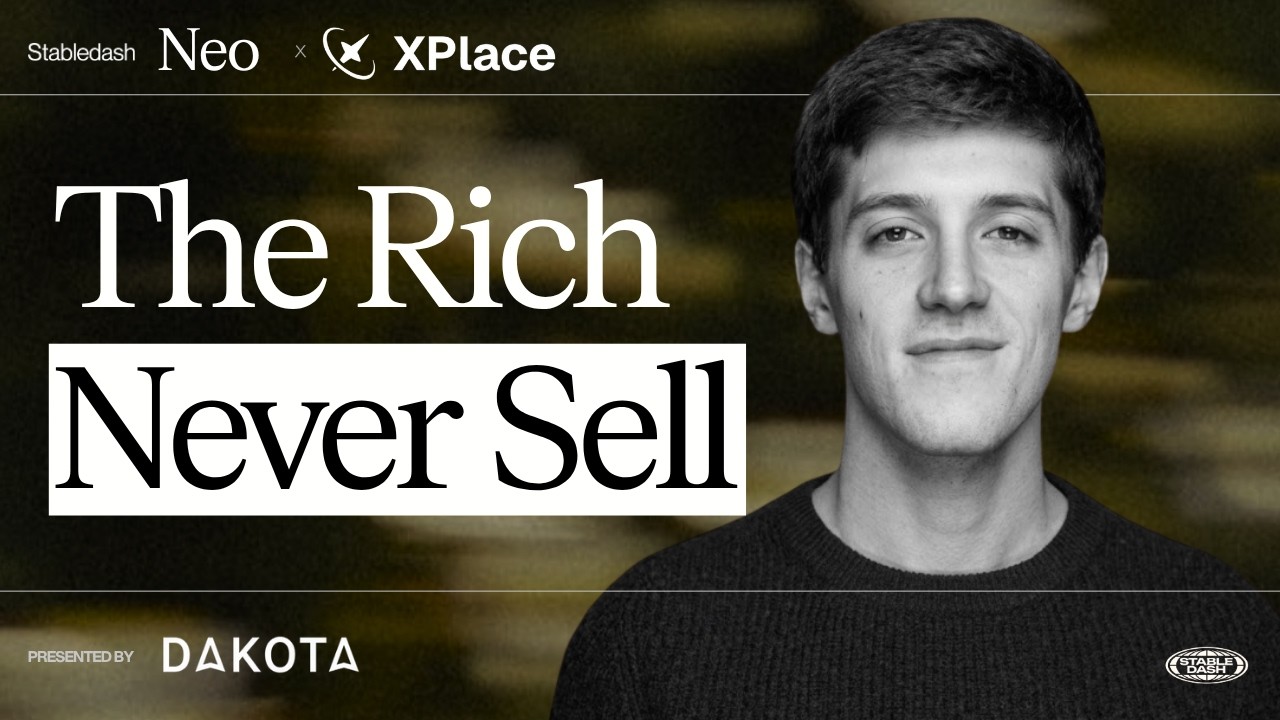
The host (S1) and Zach (S3) interview Artem Ponomarev, founder of x.place, a crypto lending platform enabling users to borrow against on-chain assets without liquidating holdings. Artem discusses x.place's credit card tiers, positioning the product as a solution for wealth-building that mirrors how ultra-high-net-worth individuals leverage assets rather than sell them. He compares x.place to other crypto card projects, arguing that most are simply prepaid cards with crypto as an on-ramp, not true crypto products. The conversation covers the product's two modes (cash and borrow), target users with $25k–$10M in on-chain assets, tokenized equities as future collateral, and how payroll routing directly on-chain will unlock mass adoption.
Key takeaways
- x.place lets users borrow stablecoins against crypto collateral and spend via card without selling assets, avoiding capital gains taxes and liquidation losses.
- Crypto cards that instantly convert deposits to fiat are prepaid cards with crypto on-ramps, not crypto-native products.
- Current gap exists for on-chain borrowers with $25k–$10M in assets; those under $25k lack access, those over $10M use JPMorgan; x.place bridges this middle segment.
- Borrow mode is stickier than cash mode as users experience the product's core value of capital efficiency and avoid selling appreciated holdings.
- Tokenized equities coming on-chain (SPY, QQQ, others via Camino) will expand collateral options and unlock mass-market adoption beyond crypto holders.
- Mass adoption requires payroll to route directly on-chain into stablecoins so users receive income where yields and opportunities are greatest.
- Platinum tier offers 0% borrow fees, 10% cashback on airlines, unlimited lounges; gold tier at $10k–$25k monthly spend offers 2% cashback and metal card.
Transcript
33 turns, about 4600 words. Straight from the recording, so it reads like speech.
S0
0:00
Value transfer is nothing new. Hunt, gather, trade, expand. An exchange that's older than instant. Where the strongest prevail and the fastest survive. The function remains as its form continues to accelerate forward.
S1
0:47
Artem, everyone's doing live.
Artem Ponomarev
guest0:49
Nice to see you. Going home so happy to meet Great to meet you. I think you officially get the crown of coolest domain
S3
0:55
x.place. Like, I love it. It's super unique. Yeah. Hopefully, Elon Musk is not coming for us anytime soon. I was gonna say not to confuse with x money. Did you have the name of the company ideated before
Artem Ponomarev
guest1:07
there was all the all the conversations going around around x money, or did that kinda happen at the same time? Actually, it was bought, like, maybe two and a half years ago. So it was even, I think, like, a little bit just maybe before, although just after the the x acquisition. It was very interesting because it never was any time connected or anything, like, connected to x, but it's, like, the concept that was always in my mind. I think maybe Elon Musk and I share something together
S1
1:33
for the ex alliter. I feel like it's one of those issues where if it becomes a problem, it's a good problem. You know what I mean? It's kinda like you must be on you must be on to something. Art of it is not It's like, okay. We must be we must be doing something right. Tell us a bit about what you're building. I've been I think personally, it's always fun. I've been following you on x, or at least like coming across a lot of these posts that that you've been coming out with the last few weeks.
The what I've appreciated about it is your often contrarian views around some of these things that people think of with neobanks or how they're getting built or where the economics live, things like this. I really enjoyed at least getting a tease of, like, how you think about this stuff. So excited to kick off. Why don't we start with with you and a little bit about the intro to x place, and then we can dig dig into more about how you're thinking about what you're building.
For context, this is a part of a broader segment that Zach and I have been hosting. We've been meeting with neobank founders for over a month now. How many are we on, Zach? Have we interviewed?
S3
2:38
It's been like I mean, almost been We've been doing at least two two a week, and so probably we're we're pushing think probably 20.
S1
2:48
Oh, 20, oh my gosh. So Yeah. Anyway So we've been kind of nerding out on these topics, so it's great to have you on. I was Appreciate it. Too. The the guest beforehand was like, hey. We we didn't go down the metallic
S3
3:00
card route with the with the black and white brand branding. We chose orange. I was like, this is like a perfect contrast back to back. Because, again, on the surface, similar products, spend your cryptos, spend your stablecoins, get cash back, two two very different approaches. So maybe give us a quick walk through. Like you said, you bought this two and a half years ago. What was the inspiration for X Place and kinda give us the the TLDR of the products and product, and we'll we'll take it from there. Yeah.
Absolutely. Thank you so much. Great questions.
Artem Ponomarev
guest3:31
So I would just maybe start a little bit from my background. So as originally started at VC, fintech, and and crypto basically in London. After that, I moved to doing credit basically back in the in Latin America and Central America and Mexico to build a company there, microfinance.
And then around that time, as I said, I was thinking about how to make credit basically universal, make it completely global, and solve some problems not on the subprime lending and microfinance segment, but basically solving a problem much bigger than that.
And so, like, if you talk about x place, x place is a probable private banking layer that if you think about around, like, Elon Musk that we brought to the topic earlier before, that all of their wealthy people are not spending or selling their assets to actually cover their costs. They actually borrow against their assets to spend in their real life or to actually to get some liquidity, to make some big purchases or just spend out in the world. Right?
And so what actually is is an on chain credit card that lets you spend without selling your assets. So instead of being a crypto card that you deposit crypto there, it's a prepaid card and that lets you just sell your assets when you spend. We actually help you to not liquidate your portfolio,
S3
4:49
but at the same time, get liquidity out of it. From a from a user behavior perspective, do you think that this is something common, that this is what most people think of? Or has there been an education phase of like, hey. This is actually an option, and you've kind of always had it, you know, with if with Camino and if you're in the d DeFi realm.
But would you say that this experience of posting your assets as collateral and then you're not just taking out a $10,000 loan to, you know, do what you want or go buy a car. You're actually it's kind of a variable rate. Well, I don't know if it is variable rate. I'll I'll actually let you note on go, you know, go into that. But that's also it's a variable amount that you're actually borrowing.
Artem Ponomarev
guest5:32
What's your experience been like educating users and bringing this type of product into and giving them this type of product? Question. Thank you very much. So I would say instead of educating the users who might not need that product, we actually started working with the high net worth individuals who have 25 k plus in their on chain assets portfolio. And so what it means for them is that if you have $100,000 worth of Bitcoin, so if you're selling that, let's say, Netherlands, you're up to 37% capital gains tax.
Right? But depending on the jurisdiction, they have different tax breaks, and they have different things, like, related for example, if you're not willing to lose enough sight of the coin that you're holding or any asset that you're holding that you're a believer in it, or at the same time, you just don't want to sell those assets just by paying off ramp fees or just by paying, like, trading fees on it. Right?
So it's just depending on the users who are, like, from 25 k to 10,000,000 k in the portfolio, there is no any access to get a loan against your assets. Right? But if you, let's say, have 10,000,000 plus worth of assets, you can go to JPMorgan or you can go to any other, like, big private bank, and you can potentially get a loan on good on good terms and good trades. Right? But if you are, for example, a person who is below that net worth, right, you still want to get access to that opportunity.
And this is actually what we're bridge bridging to the real life. But in terms of the education of the users, I think it's, like, very straightforward if you just show the benefits of it. And once you try it, you don't want to come back to actually selling your crypto to spend.
S3
7:03
I see you have yeah. So go ahead, Drew. Two two kind of core
S1
7:08
anchoring ideas here. So one is how do wealthy people build wealth, and how does that look different from maybe how a lot of people who don't have wealth think about building wealth. You have identified a very, very somewhat what feel could feel obvious, but actually isn't that obvious to people of, like, the the wealthiest people actually don't sell. They don't sell their assets. They're able to live off of them and commercialize their lives around them without selling them.
Maybe speak a little bit about that core conviction and why that is so maybe powerful to people, but also why that hasn't been something we've seen a lot of, like, mainstream user apps deployed to the masses. Like, what what are those common problems that builders face that may be the ultra high net worth or
Artem Ponomarev
guest8:03
those in that position? Like, they have advantages to accessing that type of capability. These are great questions. So I would start with the first one. So the first one is where is conviction is coming from? So the conviction comes from right now, we are living in an economy that everyone sees is assets rich but cash poor. Right? So a lot of people are making decisions by end of day each month whether I invest in Apple stock, whether I buy an asset, or actually just pay my rent. Right?
So we believe that's it's fundamentally wrong. You shouldn't be choosing between compounding and consuming at any time of your life. Right? You can actually do both at the same time. Right? And our belief is that you can actually stay invested, actually invest in appreciating assets, and at the same time, like, just fund your lifestyle, right, without, like, making a compromise in any of that.
And the second bit is why is it right now is possible to do that, and why right now we believe that this is something, like, provides a big opportunity for that. Right? So before that, if you had, like, any crypto or, like, asset related, etcetera, etcetera, you didn't have a lending infrastructure for that. Right? So the lending infrastructure came from talking to the private deals or OTC desks. And it was it was kinda very, very difficult to do so. Right?
And right now, if you're going to the DeFi, like, DeFi lending, it's also kinda complex for the retail audience as well because they have variable rates. Right? They have they have health factors. They have liquidations, all of that, and it just sounds very complicated and very scary, right, to the traditional user. And and the second bit is how we can actually go mass market with that, is that we can have crypto as a starting point, and it's a big economy, right, the non chain assets.
But the next bit is that tokenization is coming as a tailwind. Right? And so the on chain provides the best data feed possible for any asset and to actually make it global depending on the jurisdiction and product terms. But at the same time, it just provides a great landing global infrastructure, which is permissionless and which gives you the better rates that maybe even a private bank can provide you in Switzerland. Right? So it's just like all of these things are coming on.
And and a great point about that is that we are not bidding or doing, like, any sort of business development with asset providers or anyone else to bring assets on chain. Everything is else done by a tokenization tailwind, which is coming.
S3
10:35
Yeah. It's interesting to think about, like, these through the lenses of how does this change with, you know, tokenization and all these stocks coming on chain, you know, very similar but different user profile now that has these assets. Then also, how does this change with fixed rate lending? You know, we've seen the launch of Morpho Midnight. I have to imagine Camino and Jupiter are gonna come out with similar products. You know? And then if we even go a step further, we've seen micropayments with AI.
What about, you know, these these microloans, these small, short, fixed rate loans, you know, like you said, for these individual purposes? How do you kind of see the xPlace app evolving as some of these products start to evolve and and come together? Will it look drastically different? Will it maybe just look different under the hood?
And, you know, you know, when you look at on the from the outside in, it looks like it's the same thing, but fundamentally, like, this is a very different user experience and the economics. That's that's a great question. And I think
Artem Ponomarev
guest11:33
you just need to follow the money. Right? You just need to follow where the actual money is flowing to and how fundamentally people are building their wealth. Right? Like, the majority of the population of the tier one economies are receiving their pay paycheck into their bank account. Right? And it's it's very hard to go on chain from your bank account, for example, in the country where I live, in UK, for example. But there's a good progress going on there.
So I'm thinking, like, if you are to utilize, like, an on chain economy, you need to receive, like, a paycheck in an on chain economy, right, in a in a stablecoins, etcetera, etcetera. But for for for, like, on chain economy to actually grow big, your paycheck your off chain paycheck should land directly into the non chain, like, account. Right? Yeah.
And so basically, if you're saying about, like, how this will evolve in in in the short to long term, I believe is that the paycheck of of of the users and of the people will actually root to the opportunities that provide you better yield, provide you better features, etcetera, etcetera.
And as of right now, the great partners on your podcast, like, for example, the the Kota, right, for example, or anyone else who is providing, like, the banking rails for that, I think they're doing the god's job of actually making the paycheck of the users on an off chain economy a land since non chain economy economy that is providing better opportunities than
S3
12:55
trade fight right now for the retail. I love what you said about routing because I think there is a big shift here when we think about how we manage our finances going from I get my paycheck in a bank account, I move it to my Fidelity account, and then either a financial adviser touches the money, or and I have to do the research and figure out what I'm trading. I think what you're getting at is the future would look like funds go into your wallet.
You already have maybe an agent or predefined set of rules for how that money is gonna be allocated. And then now within the same days or hours or minutes of receiving those funds, if you want to post it as collateral and spend it, that is really what the transition looks like from, like you said what did you say? You said consuming to compounding. And it's, like, it's crazy to think that we're actually not that far away from it. It's more just kind of putting those those pieces together.
And I think the one area where I would say is, how are you deciding what you wanna invest in? Who's determining that? Is this AI? Is it some financial adviser? Is it is it Coinbase's financial adviser?
Artem Ponomarev
guest14:00
But I love what you said about the, like you said, the the routing and the the spend there. It's a it's a great point that you're you're talking about how how do I decide where the assets are actually going to be allocated. Right? And if you are looking at TradFi, the ETF scheme. Right? And the retail didn't need to even have an option, like, didn't even have to think where should I allocate my assets to. And it's great that we're seeing ETFs coming on chain and can be used as a collateral, for example. Right?
Like, at Camino right now, you can use SPY, SP SP five hundred, or for example, QQQ, Invesco all stays collateral, which is like, you couldn't even think about that a couple of years ago. Alright. So making this super practical,
S1
14:38
you know, let's put put yourself in the position of middle middle class, upper middle class, lower upper class. Like, the the group of folks who are, like, they're employed. They have, you know, capital to spend. They're not, like, ultra high net worth, but they're probably in the in the mix of folks who, at least from what I'm getting, are your target users. What is the, you know, typical user behavior you hope to see?
Like and and maybe correct me or or confirm that kind of gut feeling of who you're going after, and then what what are you actually hoping they do? Are they are they using this as their main financial accounts? Are they, you know, bringing in more speculative
Artem Ponomarev
guest15:23
types of things in here? Is this a spending account? Is this where they like, what what are you seeing, and what what are your gut reactions around user behavior? That's a great question, to be honest with you, because our whole goal is to make actually your capital more efficient. Right? And if you think about, like, what's the audience that actually requires it? And I think it's actually everyone who invests in some sort of something.
Like, for example, if you invest in stocks, invest in crypto, and you invest in ETFs, or any other basket investment baskets, basically. And at the same time, you are using a credit card. Right? So for example, you are using an Amex card or you're using any other product, but you also need to manage your paycheck from another bank account, and also you need to actually buy some assets to actually grow your portfolio. And, like, we are changing that from the first principles. Right?
And it's very hard to change the behavior that was introduced hundreds of years ago. Right? And it's, like, completely, like, like, changes the fundamentals, basically. And for us, like, what we'd love to see and, like, we are seeing right now is that people actually trying xPlays to make their capital more efficient. Right?
And instead of selling their assets that they think they'll appreciate, or for example, they're making some sort of adjustments so that in the long term thinking of that, they're just trying to lend their paycheck into x place, invest in assets, and actually spend without liquidation of their portfolio. And it's just a great process, and it's great to see this moment. Right? So we, for example, see the users who are making their first, like, borrow purchase,
S3
16:55
because we have, like, two modes, cash and borrow mode. They're just trying to get more of that. They're just trying to get more purchases and just putting some feedback notes to our concierge saying, like, it's insane that it worked. No. I was gonna ask just, like, which side is stickier right now? Like, we we don't see this in all the neobanks, right, that there's the the cash and borrow mode. Do you see that it's pretty evenly split between your users? Are you skewing one more than the other right now?
That's an awesome question. And would say
Artem Ponomarev
guest17:22
the process in education. Right? And so you are using cash mode as an acquisition tool in some sorts as well. Right? Because people are used to stablecoin backed cards. They're trying the product with a cash mode. And once they're good with it, once they're really trying to do something new, then we go with a borrow mode. Can you define what you mean by cash mode and borrow mode and the differences? Yeah. Absolutely.
The cash mode is basically once you deposit your stablecoins, let's say, USDC, it just funds them one to one. But again, it's not like selling your stablecoin. It just settles with a provider like Cardichur basically on stablecoin rails as well. Right? But if you're using the borrow mode, instead of selling your collateral, instead of selling your, let's say, BTC, it borrows against that. It borrows to USDC, and actually, your transaction settles at the same time. So you don't need to manually borrow.
But if you're if you want, so you can borrow as well manually, and it will land to your cash account. But, like, for majority of the users, they're just on autopilot, don't want to manually borrow at the moment to purchase it, just using the borrow mode. Gotcha. And Right. If you're some user
S3
18:26
looks into the product. Yeah. Go ahead, Zach. Feel free to take this. Now dive into this. What what I'm specifically interested on this bottom right image where we're talking about the the model cards. Kinda give this the the cash back breakdowns right now. I know it's pretty small. Are you you're asking about the platinum card cash backs? Yeah. Platinum card. What what is the cash back tiers? Like, what is what what is the ecosystem?
What are people's options when they want if they wanted to go sign up for xPlace, use these different cards? What do they get? You know, what is their cashback? What where should they start?
Artem Ponomarev
guest18:58
That's a great question. So I would start with a basic tier. Basic tier, it's similar to the cash tier dynamic as well as it's a card that actually you keep starting with. So this has lower limits, but it has 0.5 cash back on on on the spend. It gets you the virtual cards, Apple Pay, and Google Pay ID. Then we're going to the silhouettes here that gets you one lounge per year, gets you one fast track per year, gets you lower borrow rates, and at the same time, it gives you the physical plastic card on top of that.
So then we go to the gold tier. The gold tier is basically if you are spending something like from 10 k to 25 k per month, which is very typical, let's say, for the Amex gold card, but it's, like, on the higher upper end of that. Steyn gives you higher cashback. It gets you 2% cashback. On a borrow mode purchases, gets you the metal card, gets you the AI cashback Blah blah blah. I suggest you the yeah. Absolutely.
And and gets you also then the Rise cashback, right, which is Lite four, really, which is a chauffeur service down here in Europe and UK. Also, the rental card for Sixt and for the Uber as well. And the last bit, the last tier, is the platinum tier. So the platinum tier is you gets you the platinum card, gets you 0% effects added, and gets you some other perks like unlimited free lounges per year. So you can use a QR code in the app and go to any lounge from 1,400 plus lounges.
Dance, you get also five fast tracks, get 10% cashback on AI, 10% cashback on airlines down down to the product terms and and caps,
S1
20:37
and 2% cashback on cashmode and 4% cashback on borrow mode. Artem, time is limited, so I just I gotta pop this up and ask you this because going back a little bit to some some of the things I appreciate, it's just like your perspective on the space. So this was one that stuck out to me. Please stop calling cards that sell your crypto crypto cards. Where how should we be thinking about this? This got this got a lot of buzz in our, like, little fun echo chamber, like, crypto infrastructure on X.
Like, what what is the thesis behind this take, and what are people missing? Yep. I didn't actually thought it'll bring some numbers.
Artem Ponomarev
guest21:13
So just what my take I was thinking about. So I'm just thinking about, like, if you are to have a prepaid card, right, that gets you, let's say, 100 options and one of the option is depositing crypto, and then when you deposit, it instantly sells your crypto. I don't think it's the crypto card. In my opinion, it's just a prepaid card with the crypto as an on ramp option. And why is that so why is that so, you know, provocative? I don't really know. That's why I don't know why my tweet blew up, to be honest with you.
Yeah. I think that when you start looking at what's happening under the hood, you start realizing
S3
21:43
the difference of, like, maybe what how things are presented versus what's really happening. Yeah. I mean, you think about it at the end the day, crypto card, I think, carries this connotation that it's like pro crypto. It's pushing the space forward. And, you know, the day is something that is inherently selling your asset a good thing for the space. I mean, again, I don't think I'm not saying never sell, never take profits. You know, Pay for your kid's marriage. Put your kid through college.
Go buy your wife you know, take your wife on vacation. But at the end of the day, you ask, like, what what does an on chain what should an on chain native, crypto native experience look like? It's probably not just selling your assets. Do do we need to
S1
22:22
maybe last question practically. So, like, let's just say I have assets that are held within retirement. Do do retirement lee like, IRA assets qualify for any of this, or are those kind of, like, in in any sort of four zero one k retirement related wrapper? Do you get the benefits of holding assets in those vehicles, or are we just talking about, like, spot custody
Artem Ponomarev
guest22:44
types of types of assets for x placement? Yes. I think that's a great question. And right now, we are just scratching the surface. So we are soon to go live with an with the tokenized talks as a collateral. And I think
S1
22:58
I will get back to you once we are close to that timeline going to the 04/2001 k's and and other And that means that I need to go to this app, acquire tokenized stocks from this app versus, like, I have stocks that might be tokenized or held elsewhere and connecting it. Are both of those things gonna be available, or will I have to, like, go to x place to acquire and hold those stocks? So you can actually deposit, let's say, like, an x stock, which is like a tokenized stock
Artem Ponomarev
guest23:25
by a network, like, via salon of, let's say, network. And then once they let land the next place, they already become a collateral. And so straight away, you can go and get liquidity out of it. But also you can acquire an asset as and and other providers. Yeah. Man. Man. So bullish on tokenized equities. More on that later.
S1
23:45
Artem, I know we're just scratching the surface on this. We gotta move on and go to our next guest, but it's been really, really fun getting to know you a little bit. As more features get shipped and as more of the product starts to come to life, we would love to expose more of it and just continue to learn from you. We're very, very passionate about equities coming on chain and what that will enable for the future of money. And so your learnings here are very valuable to us and to our audience.
So thanks for coming on. Thank you for having me, and thank you for your audience for watching. Thank you. Have a good day, Azul. Thanks, Art. You too. See you.


