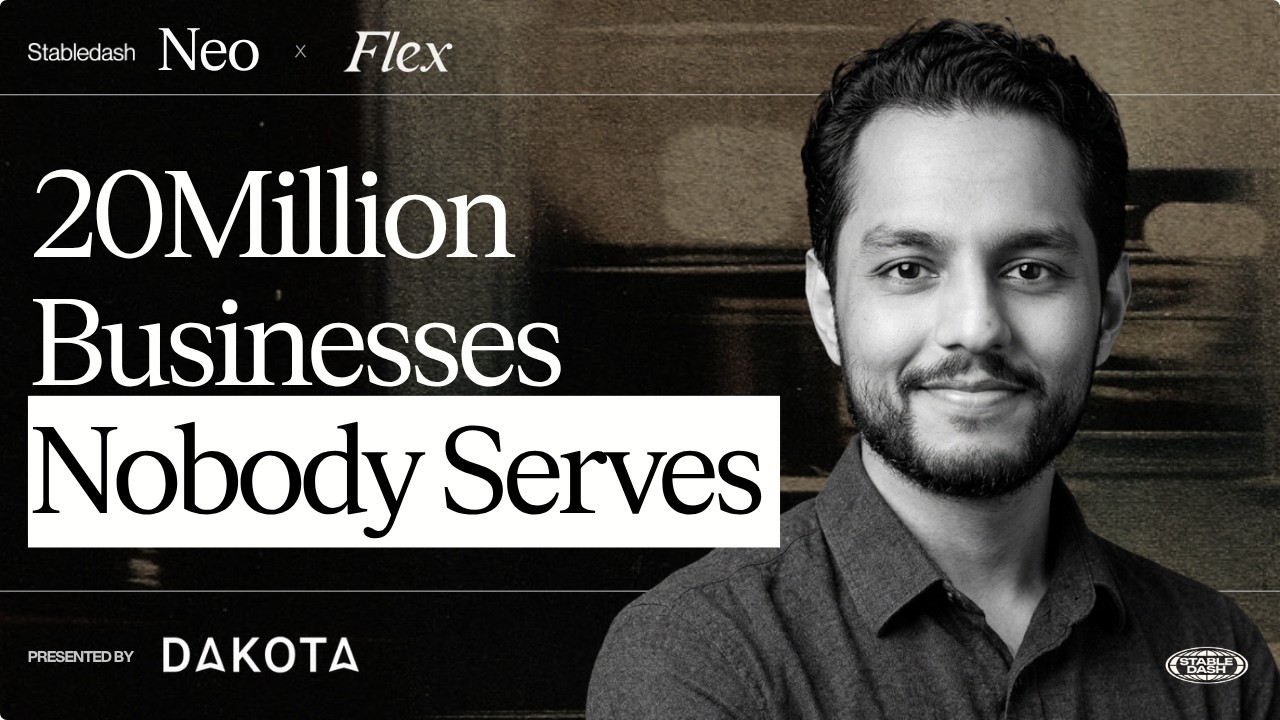
Neo · · 27 min
Inside Flex: Stablecoin Rails, Net 60 Cards, and a Compliance-First Approach to Crypto Banking
Shadman Ahmed
Shadman Ahmed, head of Flex Global and Crypto, discusses Flex, an AI-native fintech platform designed as a financial home for middle-market businesses globally. Flex differentiates itself through a corporate credit card with 60 days of float, lending managed off-balance-sheet, and stablecoins integrated as infrastructure rather than standalone products. Ahmed shares his background moving from traditional banking (JP Morgan, Citi) to fintech (Brex, Mercury where he launched crypto banking post-SVB), and explains Flex's strategy to serve underbanked businesses worldwide through stable coin rails, multi-entity platforms, and planned AI features like Beacon (weekly business analytics) and CLI access. He emphasizes that Flex's competitive advantage lies in prioritizing compliance, risk management, and fundamental banking operations over chasing trends, and believes the global fintech market is large enough to support multiple successful players rather than being winner-take-all.
Transcript
14 turns, about 5000 words. Straight from the recording, so it reads like speech.
S0
0:00
Value transfer is nothing new. Hunt, gather, trade, expand. An exchange that's older than instant. Where the strongest prevail and the fastest spies. The function remains as its form continues to accelerate forward.
Shadman Ahmed
guest0:46
Intro us to Flex. This is the first time we've covered the business AI native private finance platform for business owners. Excited to dive into this. Yeah. Tell us a bit about your your journey with us. Sure. Thanks for having me. So I'm Chadman. I'm the head of Flex Global and Crypto. So Flex is a financial home for middle market businesses here in The US. We serve primarily industries that are not well covered by any other fintech.
You figure a lot of fintechs either focus on true SMBs or, you know, they go after the enterprise companies and try to sell, you know, a thousand seats of their expense management product or whatever the case is. We have been focusing on that middle market that drives probably 40% of the revenue in The US. And we do that primarily through a corporate credit card that has sixty days of float.
So you figure if you're a contractor and you're buying materials and your customers are paying you net 30, you can now float your purchases for up to sixty days. And that's been a really, really powerful product for a lot of industries. You know, we're now getting into e commerce and different industries like that. I joined, you know, a little bit of background. I spent first nine years of my career in banking.
So between JP and Citi and the private banks, I was at Brex for a little under two years, and then I spent, you know, three and a half years at Mercury. I had started the a couple days after SVB collapsed. And at Mercury, I led and launched the crypto business. As you can imagine, after SVB collapsed, not many people wanted to touch crypto, especially banks. So it was a lot of work to get our partner banks comfortable. And I saw cryptos and underserved industry. I was sort of an asymmetric bet. Right?
You figure after what happened with FTX and sort of a bear cycle, a lot of people wrote crypto off, but it was a way to you know, you figure when the cycle came back, crypto would do well again. People would raise money again. And if you were able to position yourself as a reliable company, they would choose you again. And then I joined Flex recently to lead our global product.
And what that is is, you know, and and a little bit of context, I think a lot of fintechs and companies build for The US consumer, and they've got kind of rose colored glasses on where The US consumer already has access to pretty much everything you can imagine. And so when you offer something like stablecoins or a tokenized equity, it's not that much of an improvement from what you're already getting with your bank infrastructure. You know, if you're trading on Robinhood, it already feels like you settle instantly.
So a tokenized stock doesn't provide that much more improvement for the day to day of a US consumer or a US business. Our vision, you know, between Zaid and myself and our team at Flex is that because of stablecoins and where we are as an industry, you can take stablecoins not as a product, but as a rail and use it to really give access to, I'd say, almost US level of banking infrastructure for millions of underbanked businesses worldwide.
And if you look at the kind of business landscape, there's probably half a billion businesses, in the world where there are forty, fifty million in The US. I think north of 20,000,000 businesses worldwide make over $1,000,000 a year. And all of these businesses are they're either with their local community banks or if they've got multi jurisdiction process and cross border payments, they're using something like Santander or HSBC.
Those are great products, but I think there's a huge opportunity for a company to offer a really good user experience with great service and a stable coin, you know, forward banking. And, obviously, if you've spent any time on crypto Twitter, you'll see half a dozen neo banks pop up every week. Yeah. I think what makes Flex different is banking is kind of our DNA. A lot of our team are ex bankers, and we understand credit. We understand banking.
And there's a lot that goes into, even if you're using stable coins, there's a lot that goes into offering a banking product. You've got multiple levels of approvals. You've got cross border treasury. You've got FX hedging. All these things that you have to take into consideration. And so we're really excited on, you know, about the products we're gonna be launching. Sorry. I have to for it for, like, twenty minutes. No. It's good, Zach. Go go for it.
S3
5:12
Well, I was just gonna say you talk about your team knowing banking in and out even when you were just giving your intro. It's like, okay. You started in TradFi, Brex, Mercury, like, this the the old banking and the new banking, it seems like you personally have been living and breathing this for quite a few years, and then you're really breaking that to this neo banking,
Shadman Ahmed
guest5:33
more stablecoin native sphere as well and seeing all the benefits that can happen, like you said, around the world as well. Yeah. No. Exactly. Can you define a little bit of the differences between maybe some of the stuff that you saw at Brex or Mercury? I know some of them are probably becoming more stable coin native lately, but how Flex is architected and the behind the scenes a little bit compared to some of those folks? Yeah. Absolute are can you guys hear me right We we had a quick refresh, but we're good now.
Alright. Yeah. Mercury and Brexford are obviously phenomenal businesses, and they do exceptionally well in the cohorts that they're serving. The, you know, Mercury, for example, has become kind of the JP Morgan for startups. Like, if you're a startup, you're it it's almost like you're obviously going to Mercury. And and Brex has done a phenomenal job of being the corporate credit card provider.
The the the issue is when you add stable coins to these stable coins kind of feel like additive and they kind of feel like a standalone product. We're we're thinking of it a little differently, right? Like stable coins for us are not a product. Stable coins should be as easy to use as any other banking rail that you've ever used, whether that's ACH or wire.
And the, you know, the way we think about it and the way, you know, myself and our product team thinks about it is if we were to give our customer who's a business in, let's say Mexico City or Canada, we're giving them the option of, you know, using a US bank account or using an account that's got stable coins under the hood, they shouldn't be able to tell a difference nor should they care. You know, I think for most people, they don't wanna and especially true for businesses.
They don't wanna go through the complexities of understanding, you know, a new product feature or understanding what stablecoins are, what gas fees are, what bridging is, what chain I have to use. You can go down the rabbit hole. I think, you know, we're we're trying to delineate from this is just a product for crypto native folks to this is a payment rail that any business can use. It definitely doesn't feel like that.
Like, when you when you look at the the product and how it how it looks and performs even from a brand standpoint, from a website standpoint, I mean, this does not feel like some sort of crypto native thing, which is awesome. I love it. It's I love also the one of the strongest brands that I've that I've seen and just the way that things are looking and feeling and the green is just so beautiful and premium and, yeah, it's awesome. Yeah. Thank you. We you know, it it's funny.
We're launching a consumer product as well, and and that's come from the feedback from our customers of, like, hey. You guys have kind of this Amex feel. Why don't you just launch a personal product that I can use? So appreciate the kind words. Yeah. So you guys have on the product side I'm looking at the site. So maybe let's go let's go back a little bit to the kind of high level of the business.
You have the private credit business, payments, and you you see this with a lot of, like, traditional banks where they will be in all of these different businesses. Where are you really seeing like, get maybe go back and give us a high level of those different categories and where you're really seeing traction right now. Yeah. Of course. I think the number one product that we see the most traction in would be the corporate credit cards because they've got the float built in. You know, if you use the The net 60 card?
Yeah. Exactly. Exactly. And what what is so unique about that? This net 60 how does that compare to what's typical? So if you if you compare it with a Prexser ramp, right, and you spend let's say you're a business, you spend $10,000 on June 1, that $10,000 balance is due at the end of the month. So even if you spent another 15,000 on June 28, on June 30, it really acts like a charge card. You have to pay the entire $25,000 balance on June 30.
What we're doing is we're functioning sort of between a regular credit card where you can, it's a revolving card where you can hold a balance for months on end and a charge card. So up to sixty days of float. So if you spend something on June 5, you have sixty days after that to pay it off with no interest. Which feels, you know, a little like a line of credit, a little like a credit card. What I guess what I like about it, what stands out to me is just thinking about how running a business actually works.
S3
9:54
Like, think about how this plays out real. You spell you spend your 10,000 on June 1. Right? And then say that was some expense gonna be reimbursed by your client. And then you you, you know, send your little invoice with your payment link and all this. It's like, oh, yeah. Yeah. We'll handle that in our next payable cycle. And, like Which is thirty days. Businesses, small, mid sized businesses, even large ones all over the world are saying like, hey.
Just pinging you on this, making sure it didn't slip through the cracks. It's like people get paid eventually, almost always, but it's not always right on time. Yeah. No. Exactly. And I think what's also unique about a product is it's very modular. So you can sign up for a next, you know, net 60 card. But if your payback period is fifteen days and you're getting paid often,
Shadman Ahmed
guest10:40
you can then kinda switch that sixty day payment period to fifteen days and then start earning cash back. So we can provide up to, you know, 1.75% cash back if you, depending on your payment terms. Very cool. So you can incentivize your users to pay quickly to settle their balances quickly. Exactly. So it helps us, on the underwriting side, it helps us manage risk and then it also helps our customers.
So if you're in, for example, if you're in e commerce and you sell out in ten days and you're just buying a bunch of inventory and paying it off within a couple of days, you know, maybe a higher cashback is perfect for you. Or but if you're a contractor and you're spending a million dollars, but your clients, you know, pay you back forty days from now, maybe the next sixty or forty five day card is right for you. Is that what the is showing? Sorry. What was that? Yeah. Yeah. Exactly. That's what scale is showing.
Cool. I I think we might be in the our business might be in the market for this because It does. There's definitely I mean, the simple business model we have, right, is like we're a media company, so, like, all the logos on the screen, they will pay us to support the show, and they'll give us money mostly in the, like, front of the month. And then we have a team. We have vendors. We have contractors. We have a ton of stuff.
But the the the interesting thing is I think a lot of companies like ours find themselves in this position where they actually are sitting on a lot of capital that is, like, floating in between the time of being received and the time of being paid out, which if you're able to earn on those balances over time, especially as the the business grows and the numbers get bigger, like, that's a pretty significant source of revenue just from the yield of those earnings or the interest of those earnings.
So the idea of being able to extend because, like, we have a completely separate business credit card we use for, like, other things, but, like, to be able to connect these two worlds together is really interesting even for us. However you I guess my main question then is, like, something we're always asking is, like, the kind of the plumbing behind the scenes here of, like, what's actually being maybe built versus bought here.
What what are some of the tech what's some of the tech that that Flex is really owning and building to make some of this stuff possible versus maybe partner key partners or key infrastructure companies that you guys work with behind the scenes to to power some of this? Great question. You know, just to kinda give you the entire rundown, Flex, of course, is not a chartered bank. So all of our banking products are done by column who's our sponsor bank.
And then we've got lead bank as another partner bank of ours for all of our credit cards. However, the main business, which is the lending and the sixty day cards, that's actually done completely in house. So we lend off balance sheet. You know, we raised separate debt facilities for this. And the reason that's really useful and helpful for us is because we kinda get to control our own destiny when it comes to, you know, what kind of credit limits are we providing and who are we underwriting.
So it gets us to be able to underwrite a lot easier, serve a lot more industries, and really be there for our customers. You know, in times where a traditional bank underwriting model might not fit them. As for our other products, you know,
S3
13:54
any ins you know, anything in particular that you guys are curious about? Like, who we work with? Or Something I was kind of curious is just as we talk about that float and sort of the yield side of the business. I was seeing that 1.75% cashback, but you can distinguish for me here. If you're you were talking about stable coins and kind of, like, that being part of your stack. Is there a built in ability to earn yield based on a certain amount of balance you have in a flex account? So as part of our global
Shadman Ahmed
guest14:24
our global launch and our global product suite, there will be. We'll have coming soon coming soon. Yeah. Yeah. Okay. So we'll, we'll have a couple of options for yield, you know, generally, and it's interesting, you know, was speaking to, I was speaking to a customer about this. And, you know, if if you're The US, like you obviously chase yield, but if you're a business, let's say in Argentina or you're a business in, you know, India or Mexico City, oftentimes the mindset is completely different.
Those kinds of customers are not really chasing yield. They're chasing capital preservation, which is to them the US dollar. Right? And so when you think about yield programs, yes, we can go down the DeFi rabbit hole and offer 14%. But for our customer base, which is mid market businesses, they're generally very content with just things like treasuries, money market funds, where you can earn risk free rate of return.
And so when I think about a yield product, we also have to think about it from that perspective of do we just offer tokenized money market funds and treasuries? Yeah. And do you find based on that
S3
15:33
capital preservation that the need and the uptick and sort of the demand for this is higher in non US countries, or is it kinda balanced? It just depends. For, like, token holders? Joining flex for joining flex or sort of Oh, yeah. Yeah. Appetite for this. Yeah. I mean, we launched a wait list for Flex Global,
Shadman Ahmed
guest15:51
and, you know, it it's it's a lengthy wait list now. Knock on wood. We've got, you know, kinda companies of all industries interested, whether you're an electronic reseller or you're an e commerce business overseas or you're a contractor overseas. And a lot of these businesses have really interesting profiles of, you know, I've got an entity in this country. I've got an entity in that country. I've got operations here.
And, you know, we have a product called multi entity where you can link all of your entities no matter which country into one platform, and you can toggle between all of them at any time. Where does the the really AI native nature of this start to come to life? It looks like in the future, you guys are starting to turn on you're calling it the agentic ERP. How do you how is this going to evolve into more of a kind of agent native financial stack? Yeah. Good question.
I think it's kinda becoming apparent that a lot of fintechs are using AI just to make their customers' life easier. And so, you know, we launched an early version of this called Beacon, which was for business owners only. And what Beacon does is it's kinda like Spotify wrapped on a weekly, you know, a weekly cadence. Oh, I like it. I like that. Where it'll, you know, it'll reach out just to the owner to give you a full kind of comprehensive view of your business and how it did over the last week.
And because, as a banking platform, you get so much data in and out. We can see how much is going out for payroll, how much is going out for expenses. If you've got our cards, we can see the granular transaction data. And so Beacon kinda synthesizes all of that and tells you, here was your P and L for the last week. Here's where you might be struggling. Here are vendors where the cost might be a little higher than usual and you might be able to negotiate payroll has spiked. Did you bring on a contractor, etcetera?
So we're gonna use that as a foundation. And, you know, once customers have their personal accounts as well, it's gonna be all right. We're now able to track the dollar from the time your business makes it to the time you spend it personally. And you're gonna be able to get insights to all of that. Going from there is, you know, our AI tools for accountants.
So, you know, your accounting team or CFO can easily just implement rules and, you know, categorizations and our models will continue kinda learning and, you know, understanding what kind of transactions you're doing and categorize them as needed. And then, of course, and can't forget, a CLI that everybody's excited for is gonna be rolling out as well. What does that mean? Just a command line interface. So if you're using Claw directly, you can be able to access, you know, all of your Flex Data.
Now granted More from, like, a data, like, a data reporting and and gathering, like, accounting related stuff and things like that. Yeah. Yeah. Yeah. Exactly. Granted, AI use, think, still is, you know, fairly an edge case compared to, like, just operations for global companies. And by no means are we pivoting to becoming a bank for, like, AI agents. We are thinking of AI same way we're thinking of stablecoins is we don't need to rebrand. We don't need to offer this as a standalone product.
Let's just figure out how we can use it behind the scenes to improve,
S3
19:15
you know, our customers' experience. Yeah. It's interesting thinking about this, Chadman, because banking is obviously one of the most fundamental things for any business. Right? It's like, oh, you started a business. Like, what do you have to do first? Probably get a bank account. Yeah. It's it's foundational. It's sort of old in that sense. And so it's really fun. Like, you mentioned, oh, there's a new neobank on the timeline every other day. Sure.
But it's fun because there's so much disruption and room for improvement of a typical business banking experience all these ways. But then, like, you're kind of pointing out, it's almost very vulnerable to sort of shiny object. There's foundational things. Yeah. Like, having the Spotify wrapped or having, like, the sixty day that sound like these kind of acute problems, where it's like, a lot of people be asking for those. And then there's kind of the, hey, maybe we should get ready for the agentic wave.
If you guys think about sort of being on the leading edge versus making sure you get the more foundational stuff first. Like, you're laying this out on a product roadmap, or is there ever sort of, like, disagreement in the team of what we should prioritize?
Shadman Ahmed
guest20:24
What's that looking for, like, as you watch these features? Yeah. I mean, I think it's, you know, that's the symptom for every tech company where there's gonna be a kind of disagreements of what kind of product you launch or, you know, do you launch an AI product first? I think the way we think about it is we are focusing most of our time and effort on getting the basics really right for these businesses because this is true, especially for banking.
If you mess up kind of the foundational pieces, you gotta live and die by your reputation. Right? Like, you're if you're serving a customer who's got operations in three different countries and they need to send kind of a mission critical payment, If you are messing up the payment, they're not really gonna trust you for anything else. Right? It doesn't matter how AI native you are. That's not gonna be what they're going for.
And this is, you know, this is why people stick to, you know, local banks and and these banks that have been around for hundreds of years where, you know, even if the user experience isn't great, you have a certain sense of, you know, it it it's almost like you have you've got, like, this little bit of a guarantee of if I send a payment through Chase, it's usually going through them, asterisk, unless I'm a crypto company, and then I'll get debunked. You know, that's how I'm thinking of things.
Are there any maybe my last question, just given your background and some of the stuff that you learned, saw, the I guess, trying to think of a creative way to put this, like, to make you sound like a superhero. But, like, the time that you've spent in your career working at you said Brex and Mercury. What what are some of these I mean, as someone who's worked in fintech myself most of my career, I've constantly seen these companies who are doing this, like, banking as a service that look really great.
They have awesome brands. Their websites are slick. And for whatever reason, they blow up or they they step on a landmine and something goes wrong. I'm sure you've seen that as well. I'm I'm sure you've kind of seen being in the industry and space some of this. Like, what what are some of these things that give you confidence in Flex? You've mentioned some of the partnerships on the, like, lead bank and and column that you're working with.
But, like, what what are what are some of these things that give you confidence that Flex is gonna be here ten, twenty, thirty years from now? That's a great question. And this might seem ironic because I'm in crypto, but I think the answer is risk and compliance. I think, you know, crypto native folks generally, for some reason think compliance is an evil word or KYC is a bad thing.
And I get, you know, that's not what the origin was of crypto was for, But I think what most fintechs get wrong and also most banks when serving, you know, really niche industries is compliance. Right? And especially if you're a fintech and you've got a banking as a service model, you kind of live and die by your partner bank. Right? Like if your partner bank says, I don't wanna support you anymore, it doesn't matter how many products you have. You're dead in the water. Right?
Now you now you have to look for another partner bank, or you've gotta migrate all of your customers into a completely different bank. And I think what separates Flex is we have a really strong compliance team and we lead with compliance. So and this was similar, you know, to my to my take on Mercury as well. Like when we started winning over crypto companies, it wasn't that, hey. We're just gonna take any crypto company. It was we're gonna be very intentional, and we're gonna ask the right questions.
And we're gonna form the right kind of, you know, compliance model and policy that lets our partner banks and our partners have faith in us and trust us that we're not just going to the wild, wild west and onboarding a bunch of vaporware. That's really, you know, kinda sketch. And we're doing the same thing at Flex. Right? Like, again, I mentioned a lot of our team comes from banking. Banking is by far the most conservative industry you'll ever be in.
And so we try to take a quick bal you know, a delicate balance of we have to understand our customers. We have to ask the right questions, and we have to have a bulletproof compliance team and policy that lets us drive the business forward while at the same time lets our our partner banks feel really secure in partnering with us. It's awesome. As we wrap here, any other I know we we had to give Eric the boot, unfortunately. We weren't able to figure out his his audio.
But any final thoughts from you in terms of, yeah, things on the horizon or key things that that are getting built that get you excited about the future in terms of flex? Yeah. I think what gets me excited really is the products that we're making to make just the day to day easier for a lot of businesses overseas. I think, you know, a lot of people are, you know, they think it's a really competitive space, but I challenge that of it's an incredible market and incredible opportunity size.
And I think there are pockets where every kind of neobank or every fintech can do really well. It's not, I don't think it's gonna be a winner take all market. And I don't think it, you know, I don't think flex doing really well should make anybody feel like they can't compete. I think, you know, if you've seen how many just chartered banks there are and how many have billions of dollars in the balance sheet and are continuing to thrive and do well, this is gonna be an incredible market.
And there's so many needs in the global landscape that it's it's just gonna be a blast to try to tackle them all. It's awesome. Yeah. Well, Shavon, thanks for thanks for joining us. Yeah. Of course. We will be granted for thirty minutes. No. It's good. It's good. We're we're excited to cover more more folks in in this stack and and really trying to highlight what makes what is getting built with different neobanks and different platforms specifically unique. So thanks for taking the time.
I'm really, really interested to dive into more of that net 60 card and more of the stuff behind the scenes there. So Anytime. Appreciate it. I love it too. And and your last note is one big happy family of neobanks. I'm like There you go. Wanna get a big family dinner together. It's a big pie. Big pie we can share. Yeah. And the neo folks together. I I mean, I think Eric Eric posts about this often of, you know, how easy it is to create a neobank.
And, you know, yes, it's easy, but there's there's a lot of work that goes into it of, you know, if you're actually trying to serve the needs of these customers. It's the hard part. Yeah. Exactly.
S3
26:55
Amazing.
Shadman Ahmed
guest26:56
You for coming on. And Oh, thanks for having me, you soon. It was a pleasure. Bye.


